
Buyers judge a light fixture by three things. Brightness, price, and how it looks in the catalogue photo. None of those explain why one floodlight...
Buyers judge a light fixture by three things. Brightness, price, and how it looks in the catalogue photo.
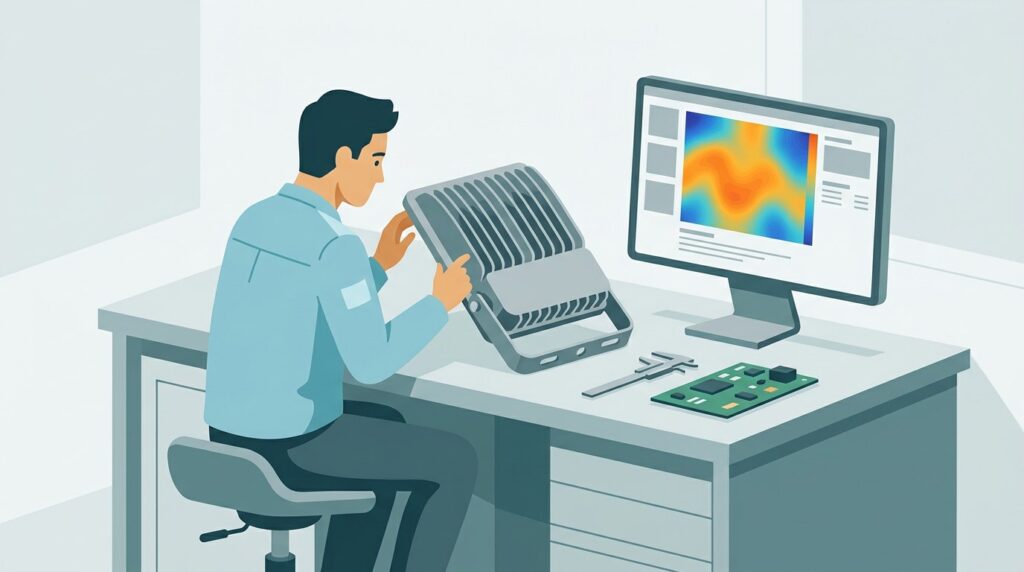
None of those explain why one floodlight dies in a year while another lasts a decade. That gap is settled long before the photo shoot. It is settled at a desk, by an engineer arguing with a heat model. A Wosen engineer works at exactly that point. It is where a drawing turns into hardware that must survive rain, heat, and voltage swings.
This guide explains what that work involves. It covers heat design, driver choice, sealing, tooling, and testing. It also covers what buyers should ask before they place an order.
Who Wosen Is and Where Its Engineers Sit
Context first, since the name alone tells you little about what a Wosen engineer does. Wosen is a Chinese LED lighting maker based in Guzhen, Zhongshan, in Guangdong province.
The business dates to 1992, though not as a lighting firm. It began as Pengjie Metal Factory, a metal shop. Die casting in aluminium followed around 2002. LED work started about a decade later, in 2012.
That history matters more than it looks. The firm learned to cast aluminium before it learned to make lights. Consequently, its engineers came to LED work already fluent in the metal that keeps LEDs alive.
Today the firm reports a plant of around 30,000 square metres and a staff in the low hundreds. Public listings range from roughly 300 to 500 people, so treat any one figure as rough. The range spans street lights, floodlights, high bay and stadium lights, panel and recessed lights, plus solar units.
Thermal Design: The Wosen Engineer Priority
Ask what kills an LED, and most people guess the diode burns out. That is rarely what happens.
LEDs fade instead. Heat at the junction wears down the phosphor and the package, so the light dims slowly over thousands of hours. A badly cooled unit can lose a painful share of its output long before anyone calls it broken.
So a Wosen engineer spends real time on heat paths. The chain runs from the LED junction to the solder joint, then into the circuit board and out to the housing. Every step adds resistance. The weakest step sets the result.
Housing design carries most of the load. Fin shape, surface area, angle, and airflow all change how fast heat escapes. Notably, a light fixed flat to a ceiling cools very differently from the same light on a pole.
Material choice matters just as much. Wosen says it uses ADC12 aluminium alloy. That grade casts well and moves heat reasonably, so a designer can cast tricky fin shapes rather than machine each one.
Choosing the LED Package and the Driver
Two parts decide most of a fixture’s character. Ask any Wosen engineer and the answer is the diode and the driver.
On the diode side, Wosen says it uses lamp beads from known suppliers. The list includes Cree, Osram, Philips, and Nichia. Those brands publish binning data, so an engineer can predict colour match and light loss rather than guess.
Binning needs a plain word. LEDs leave the line with small shifts in colour and output, so makers sort them into bins. Tight binning means twenty lights on one street look alike. Loose binning gives a patchy row, and clients spot that at once.
The driver is the quieter risk. It turns mains power into the steady current LEDs need, and it usually fails before the diodes do. The capacitors inside it hate heat, so a hot housing cuts driver life directly.
Therefore, where the driver sits is a real design call. Some fixtures wall it off in its own bay, away from the LED board. Others mount it well away from the light. Each choice trades cost, size, and repair access against life span.
Surge protection rounds out the electrical side. Street and stadium sites face surges from nearby lightning. So ask for a stated surge protection level before you order.
Sealing, IP Ratings, and Outdoor Survival
Outdoor fixtures fail in dull ways. Water gets in, or the fixture breathes itself to death. So a Wosen engineer treats sealing as a core task, not a finishing touch.
IP ratings describe that guard with two digits. The first covers dust and solids. The second covers water. An IP65 fixture shrugs off dust and low-pressure jets, while IP66 takes stronger jets. Higher water digits cover soaking, which street lighting rarely needs.
Hitting a rating is fiddly work. Gaskets must squash evenly, so the casting has to be flat and the screw pattern has to make sense. Cable glands need the right cable width too. A gland that does not match leaks quietly for months.
Here is the detail buyers rarely hear. A sealed fixture warms up, the air inside swells, then it cools and shrinks. That cycle pulls damp through any flawed seal, night after night. Good designs fit a breather membrane, which lets air pass but blocks water.
Rust adds one more layer. Coastal and factory sites eat at aluminium. So the surface treatment and paint quality decide how the housing looks after three winters.
Optics and Photometric Performance
Raw lumens sell fixtures. Useful light gets specified, so a Wosen engineer works in beam shapes rather than headline numbers.
A street light does not want an even glow. It wants a boxy patch that covers the road, spares the gardens next door, and laps neatly onto the next pole. Lens and reflector design make that shape.
Consequently, photometric files matter to any serious buyer. Such a file maps how light leaves the fixture in every direction. Designers load it straight into planning software. A maker that hands them over is one whose numbers you can check.
Glare control belongs in the same talk. Stadium and flood projects now face rules on light spill and sky glow. A Wosen engineer on that kind of job must weigh coverage against the neighbours.
Colour temperature and colour rendering finish the picture. Warmer light suits homes and quiet streets. Cooler light suits works yards. High colour rendering matters wherever people must judge colours by eye.
Die Casting, Tooling, and the OEM Workflow
This is where the firm’s metalworking roots show. Custom fixtures need custom moulds, moulds cost real money, and a Wosen engineer guards that spend.
Wosen says it backs customers from mould work through to full production. Its OEM service covers looks, materials, and packaging. In practice, that means a design talk before any metal gets cut.
The steps run in a familiar order. First comes the brief, covering wattage, optics, setting, and target market. Next comes design review, where the team flags anything that will cast badly or trap heat.
Then comes tooling. A die-casting mould costs a lot, and changes after cutting run slow and dear. For that reason, the review stage pays for itself by catching faults while they are still drawings.
Samples follow, then testing, then a pilot run. Only after that does full production start. Rushing those steps is how brands end up with a warehouse of lights that fail in the field.
Wosen also reports more than five new products each year, across a range of over 100 designs. It credits an R&D team with around fifteen years of average experience. Those are company figures, not audited ones, so weigh them as such.
How a Wosen Engineer Handles Certification
Certification is not just paperwork. It is proof that a fixture does what its label claims.
Wosen lists CE and RoHS for Europe, SAA for Australia, and ISO 9001 for quality systems. Some supplier pages add ETL, which covers North American safety. Scope varies by product, so always check which model carries which mark.
Know what each mark covers. CE deals with safety and radio interference in Europe. RoHS limits harmful substances. SAA covers Australian electrical safety. ISO 9001 certifies the management system rather than any single light.
That last point trips people up often. An ISO 9001 certificate says the plant follows written processes. On its own, it does not prove that one floodlight passed one test.
Ask for the reports instead. Photometric data, heat test results, water and dust testing, and surge records tell you far more than a logo on a brochure.
What to Ask a Wosen Engineer Before Ordering
Buyers get better results when they ask a Wosen engineer better questions. A Wosen engineer, like any competent engineering contact, can answer these directly.
Start with the LED and driver model numbers, not just the brand names. Then ask for the photometric file and the test report behind it. Next, ask what air temperature the stated life assumes. A rating at 25 °C means little in a 45 °C plant.
Ask about surge protection and whether the driver can be swapped. A driver you can change on site turns a failure into a ten-minute job rather than a full fixture swap.
Pin down warranty terms as well. Wosen says it aims to answer overseas enquiries within twelve hours, and to cover shipping and customs on warranty goods. Get any such promise into the contract rather than trusting a web page.
Finally, ask what happens when something goes wrong at scale. The answer reveals more about a supplier than any specification sheet.
Where a Wosen Engineer Adds Real Value
Not every project needs custom work. Standard fixtures exist for good reasons, and they cost less.
Custom work earns its money in three cases. The first is brand identity, where a distributor wants a housing nobody else sells. Next comes a harsh site, with high heat, salt air, shaking, or heavy dust.
Third come the rules. A market with odd voltage, mounting, or beam demands can rule out every stock option. In that case, a design partner is the only route to a legal product.
Volume decides what is possible. Tooling costs spread across units, so a custom housing pays off at scale and rarely pays off for fifty pieces. An honest team will say so early.
FAQs
What does a Wosen engineer do day to day?
The work covers heat design, LED and driver choice, housing and lens design, tooling review, and testing. Engineers also guide OEM customers through samples and pre-production checks. Much of the job is catching faults before a mould gets cut.
Why does thermal design matter so much in LED lighting?
Heat wears LEDs down slowly rather than killing them outright. A hot fixture dims over time, and its driver fails sooner. Good heat paths therefore guard both brightness and service life.
What certifications does Wosen hold?
The firm lists CE, RoHS, SAA, and ISO 9001. Some supplier pages add ETL. Scope differs by product line, so always check which certificate covers the exact model you plan to buy.
Can Wosen build a fully custom fixture?
The firm says it offers OEM services across looks, materials, and packaging. Support runs from mould work through to full production. Custom tooling suits higher volumes, since mould costs spread across units. Raise quantity early, because it drives everything.
How do I verify a manufacturer’s performance claims?
Ask for photometric files, heat test data, water and dust reports, and driver specs. Outside test reports beat marketing figures every time. A supplier that shares papers freely is usually the safer bet.
Conclusion
Lighting looks simple from outside and rarely is. A fixture must move heat, block water, shape a beam, ride out surges, and still hit a price the market accepts.
Those goals pull against each other all the time. Bigger heat sinks cost more metal. Tighter seals trap heat. Better optics add parts. Design work is the art of finding a balance rather than winning one argument.
So judge a supplier by its engineering answers, not its brochure. Ask for test data, ask what the lifetime rating assumes, and ask who fixes a field failure.
A good Wosen engineer should welcome those questions rather than dodge them. The firm dates to 1992 and cast aluminium long before it made LEDs, so the background is there. Check the details for your own project anyway. Good suppliers expect exactly that.