
A weak or flat car battery can create an inconvenient situation, especially when a vehicle has been parked for a long time or the battery...
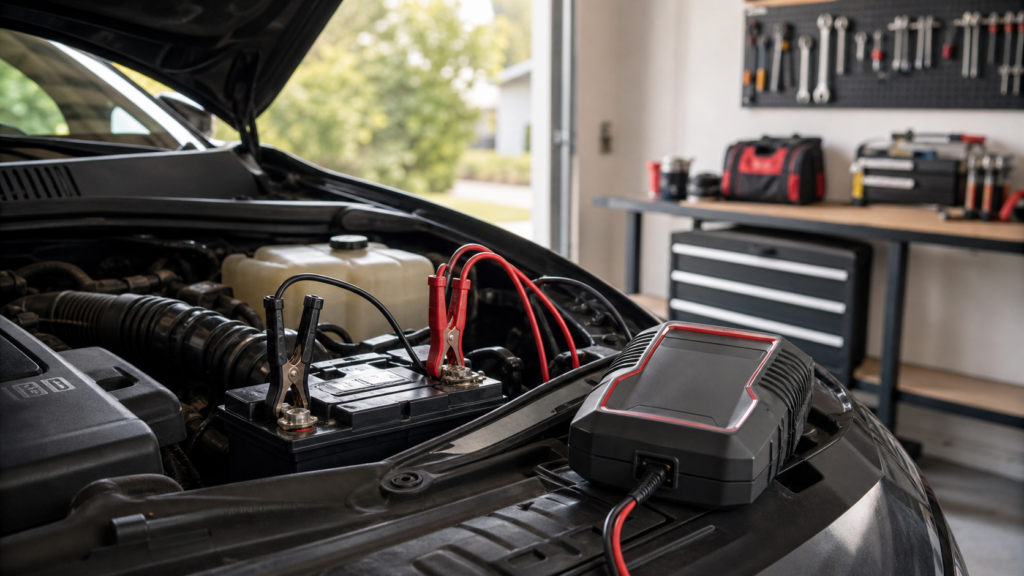
A weak or flat car battery can create an inconvenient situation, especially when a vehicle has been parked for a long time or the battery has gradually lost charge. A smart car battery charger offers a practical way to recharge and maintain many automotive batteries while automatically adjusting the charging process based on battery condition. Unlike basic chargers that may deliver a fixed charging output, smart chargers typically use electronic monitoring to manage charging stages, reduce the risk of overcharging, and help maintain a battery more effectively over time.
Modern vehicles depend heavily on electrical systems.
Even when a car is not being driven, small amounts of power may continue to support alarms, computers, keyless entry systems, clocks, and other electronics.
If the vehicle remains parked for days or weeks, the battery can slowly discharge.
A suitable charger can help restore battery power and reduce the chance of finding a vehicle that will not start when needed.
What Is a Smart Car Battery Charger?
A smart car battery charger is an electronic device designed to recharge a vehicle battery while monitoring its condition during the process.
Instead of continuously supplying the same amount of current, it can adjust charging according to the battery’s state of charge.
Many models use several charging stages.
These stages may include:
- Battery detection
- Initial charging
- Bulk charging
- Absorption charging
- Maintenance charging
- Float mode
- Pulse maintenance
- Battery condition monitoring
The exact process varies by charger.
The main advantage is automation.
Once properly connected and configured, the charger can usually control much of the charging process without constant manual adjustment.
How Does a Smart Car Battery Charger Work?
A smart charger monitors electrical information such as battery voltage and charging response.
It then selects an appropriate charging level.
When the battery is significantly discharged, the charger may initially provide more current.
As the battery becomes fuller, the charger gradually reduces output.
Once charging is complete, many smart chargers switch to a maintenance mode rather than continuing to push full charging current into the battery.
This helps reduce the risk of overcharging.
Multi-Stage Charging
Multi-stage charging is one of the most important features found in many smart chargers.
A simplified charging cycle may look like this:
Stage 1: Battery Check
The charger checks whether a battery is connected and may assess its voltage.
Stage 2: Bulk Charging
The charger delivers a higher level of current to restore most of the battery’s capacity.
Stage 3: Absorption
Charging current reduces as the battery approaches full charge.
Stage 4: Maintenance
The charger maintains the battery at a suitable level without continuously applying maximum current.
This controlled approach makes smart chargers useful for both recovery and long-term battery maintenance.
Why Car Batteries Lose Charge
Car batteries naturally lose some charge over time.
However, several conditions can increase the rate of discharge.
Common causes include:
- Leaving lights on
- Frequent short trips
- Long periods without driving
- Cold or extreme temperatures
- Aging batteries
- Electrical accessories
- Alarm systems
- Dash cameras
- Vehicle computers
- Battery deterioration
Short journeys can be particularly challenging.
Starting the engine requires a significant amount of power.
If the vehicle is only driven briefly, the alternator may not have enough time to replace all the energy used during startup.
Repeated short trips can therefore leave the battery progressively weaker.
Benefits of Using a Smart Car Battery Charger
A smart charger can provide several practical advantages.
Automatic Charging Control
One of the main benefits is automatic adjustment.
Users do not need to manually reduce the charging rate as the battery becomes full.
The charger handles this process electronically.
Reduced Risk of Overcharging
Traditional chargers may require more attention during charging.
Leaving some basic chargers connected for too long can potentially stress the battery.
A smart charger is designed to reduce or stop full charging when the battery reaches an appropriate state.
Battery Maintenance
Many smart chargers can remain connected in a maintenance mode for extended periods when the manufacturer’s instructions allow it.
This can be useful for vehicles that are not driven regularly.
Easier Operation
Many chargers are designed for straightforward use.
Users generally connect the clamps, select the correct battery mode if required, and allow the charger to manage the process.
Support for Different Battery Types
Some smart chargers support more than one battery chemistry.
Depending on the charger, compatible battery types may include:
- Flooded lead-acid
- AGM
- Gel
- Calcium
- Lithium
Compatibility varies considerably, so users should always verify both the charger specification and battery type.
Smart Charger vs. Traditional Battery Charger
Traditional battery chargers can still be useful.
However, they often require more attention.
A basic charger may supply a relatively constant current.
A smart charger uses electronic control to change charging output depending on battery condition.
Traditional Charger
A traditional unit may:
- Use basic charging control
- Require manual monitoring
- Offer fewer charging stages
- Provide limited battery diagnostics
Smart Charger
A smart unit may:
- Monitor battery voltage
- Adjust charging automatically
- Use several charging stages
- Enter maintenance mode
- Include safety protections
- Provide battery status indicators
For occasional users, the additional automation can make charging easier.
What Battery Types Can Smart Chargers Support?
Battery compatibility is one of the first things to check before purchasing a charger.
Flooded Lead-Acid Batteries
These are common traditional automotive batteries.
Many smart chargers support them.
AGM Batteries
Absorbent Glass Mat batteries are used in many modern vehicles, including some vehicles with stop-start systems.
They may require a specific charging profile.
Gel Batteries
Gel batteries use a gelled electrolyte and can be sensitive to incorrect charging voltage.
A compatible charger should be used.
Calcium Batteries
Some automotive batteries use calcium technology.
They may require different charging characteristics compared with conventional batteries.
Lithium Batteries
Lithium batteries require a charger specifically designed for the relevant lithium chemistry.
Never assume that a charger designed for lead-acid batteries can safely charge a lithium battery.
Choosing the Correct Charger Voltage
Voltage compatibility is essential.
Most passenger cars use 12-volt batteries.
Some motorcycles use 6-volt or 12-volt batteries.
Larger commercial vehicles may use 24-volt electrical systems.
A charger must match the battery system.
Using an incorrect voltage setting can damage the battery or electrical components.
Before connecting a charger, check:
- Battery label
- Vehicle manual
- Charger specification
- Voltage setting
Understanding Charger Amperage
Amperage affects how quickly a battery can charge.
A higher-current charger may recharge a larger battery faster.
However, faster is not always better.
The appropriate charging current depends on battery size, condition, chemistry, and manufacturer recommendations.
Small batteries may require lower current.
Large automotive batteries may accept higher charging rates.
Many smart chargers automatically manage current within a specified operating range.
What Is Battery Capacity?
Battery capacity is commonly measured in amp-hours, often written as Ah.
A higher Ah rating generally indicates that a battery can store more electrical energy.
For example, a small motorcycle battery may have significantly lower capacity than a large vehicle battery.
When selecting a smart car battery charger, check the recommended battery capacity range.
A charger that is too small may take a very long time to recharge a large battery.
A charger that is too powerful may not be suitable for smaller batteries unless it offers a lower-current mode.
Important Smart Charger Features
Not every charger includes the same features.
Several functions can improve convenience and safety.
Reverse Polarity Protection
Reverse polarity protection can help prevent damage if the positive and negative clamps are accidentally connected incorrectly.
Spark Protection
Some chargers are designed to reduce the chance of sparking during connection.
Short-Circuit Protection
This feature can stop or limit operation if the charger detects a short circuit.
Overtemperature Protection
A charger may reduce output or stop operating if it becomes excessively hot.
Battery Detection
Some models check whether the battery is connected correctly before charging begins.
Maintenance Mode
Maintenance mode can keep a charged battery at a suitable level when the vehicle is stored.
Battery Status Display
An indicator or digital display may show information such as charging progress, battery voltage, mode, or fault conditions.
What Is Battery Maintenance Mode?
Maintenance mode is particularly useful for vehicles that are not driven often.
Once the battery reaches full charge, the charger switches to a low-level monitoring state.
Instead of continuously charging at full power, it watches battery voltage and provides small amounts of charge when required.
This can help compensate for natural self-discharge and small electrical loads.
Vehicles that may benefit include:
- Classic cars
- Weekend vehicles
- Seasonal vehicles
- Motorcycles
- Recreational vehicles
- Second cars
- Stored vehicles
Always follow the manufacturer’s guidance regarding long-term connection.
Can a Smart Charger Repair a Dead Battery?
Some chargers include recovery, repair, reconditioning, or desulfation modes.
These functions may sometimes help batteries affected by certain charging or sulfation conditions.
However, they cannot repair every failed battery.
A battery may be beyond recovery if it has:
- Severe internal damage
- Failed cells
- Physical swelling
- Cracks
- Significant leakage
- Extensive age-related deterioration
A charger should not be treated as a guaranteed battery repair device.
If a battery repeatedly loses charge, further testing may be necessary.
How to Use a Smart Car Battery Charger
Always follow the instructions provided with the charger and vehicle.
A typical process may include the following steps.
Step 1: Park Safely
Park the vehicle in a suitable, ventilated location.
Turn the engine off.
Remove the key if required.
Step 2: Identify Battery Terminals
Locate the positive and negative terminals.
The positive terminal is generally marked with a plus symbol.
The negative terminal is marked with a minus symbol.
Step 3: Inspect the Battery
Do not charge a battery that appears badly damaged, cracked, swollen, frozen, or leaking.
Step 4: Connect the Charger
Follow the manufacturer’s specified connection order.
Make sure clamps are secure and correctly positioned.
Step 5: Select the Correct Mode
Choose the appropriate voltage, battery chemistry, or charging mode if the charger requires manual selection.
Step 6: Start Charging
Allow the charger to monitor and recharge the battery.
Step 7: Disconnect Safely
Once charging is complete, follow the recommended shutdown and disconnection procedure.
Correct connection and disconnection practices are important for electrical safety.
Safety Tips When Charging a Car Battery
Battery charging involves electricity and chemical energy.
Always take basic safety precautions.
Work in a Ventilated Area
Some battery types can release gases during charging.
Good ventilation reduces the chance of gas accumulation.
Keep Sparks and Flames Away
Never smoke near a charging battery.
Keep flames and ignition sources away from the battery.
Use the Correct Charger
Match the charger to the battery voltage and chemistry.
Inspect Cables
Do not use damaged charger cables, plugs, or clamps.
Avoid Charging Damaged Batteries
A swollen, cracked, frozen, or leaking battery should not be charged.
Read Instructions
Charging procedures can vary between battery and charger manufacturers.
Always follow the correct instructions for the equipment being used.
Can You Leave a Smart Charger Connected Overnight?
Many smart chargers are designed to enter maintenance mode once charging is complete.
This may make them suitable for longer charging sessions.
However, users should not assume every charger can be left connected indefinitely.
Check the manufacturer’s instructions.
Use the charger in an appropriate location and ensure the device is operating normally.
Smart Chargers for Cars Stored Long-Term
Vehicle storage is one of the most common reasons people use battery maintainers and smart chargers.
A battery can gradually discharge even when the car is not being used.
Over time, repeated deep discharge can shorten battery life.
A maintenance-capable smart charger can help keep the battery at a suitable charge level during storage.
This is particularly useful when storing:
- Classic cars
- Sports cars
- Convertibles
- Seasonal vehicles
- Collector vehicles
- Second cars
Signs Your Battery May Need Charging
Several symptoms may suggest that battery charge is low.
These include:
- Slow engine cranking
- Dim interior lights
- Electrical systems behaving inconsistently
- Clicking when attempting to start
- Vehicle sitting unused for weeks
- Battery warning from monitoring equipment
These symptoms can also indicate other electrical problems.
Charging the battery may not solve issues caused by a failed battery, faulty alternator, wiring fault, or excessive electrical drain.
Charger vs. Jump Starter
A battery charger and a jump starter perform different jobs.
Battery Charger
A charger restores battery energy over time.
It may take several hours depending on battery condition and charger output.
Jump Starter
A jump starter provides a short burst of high current to help start the engine.
It does not necessarily fully recharge the battery.
After jump-starting a vehicle, the battery may still need proper charging or testing.
How Long Does It Take to Charge a Car Battery?
Charging time depends on several factors.
These include:
- Battery capacity
- Remaining charge
- Charger output
- Battery condition
- Battery chemistry
- Charging stage
A deeply discharged battery may require many hours.
A battery that is only slightly low may need much less time.
Smart chargers often reduce charging current near the end of the cycle, so the final part of charging may take longer than expected.
Common Mistakes to Avoid
Using a charger correctly can reduce safety risks and improve charging performance.
Choosing the Wrong Battery Mode
Selecting an incorrect battery chemistry may result in unsuitable charging voltage.
Connecting Clamps Incorrectly
Always confirm positive and negative terminals before connecting.
Charging a Damaged Battery
Do not attempt to charge a battery showing serious physical damage.
Ignoring Ventilation
Avoid charging batteries in poorly ventilated enclosed areas.
Assuming Every Battery Can Be Recovered
Some batteries have reached the end of their service life and need replacement.
Buying Only Based on Maximum Amperage
Charging current is only one specification.
Compatibility, battery capacity range, safety features, charging modes, and intended use are equally important.
How to Choose the Best Smart Car Battery Charger
Start by identifying your battery.
Check its:
- Voltage
- Chemistry
- Capacity
- Vehicle application
Then consider how you plan to use the charger.
If you mainly need to maintain a weekend vehicle, a lower-current charger with a strong maintenance mode may be sufficient.
If you frequently recharge larger batteries, a higher-current charger may be more practical.
Look for clear controls, suitable safety protections, reliable clamps, durable cables, and charging modes that match your battery.
Smart Charger Features for Modern Vehicles
Modern cars contain more electronics than older vehicles.
Some have stop-start systems, advanced driver assistance equipment, infotainment systems, security devices, and multiple control modules.
These systems can place additional demands on the battery.
AGM and other specialized batteries are increasingly common in vehicles with advanced electrical systems.
For this reason, correct charging mode selection is increasingly important.
A charger designed only for traditional lead-acid batteries may not be ideal for every modern vehicle.
How to Maintain a Car Battery Between Charges
A charger works best when combined with sensible battery maintenance.
Helpful habits include:
- Drive the vehicle regularly
- Avoid repeated very short trips when practical
- Turn unnecessary accessories off
- Keep battery terminals clean
- Check for loose connections
- Monitor battery age
- Test weak batteries
- Investigate repeated discharge problems
If a battery repeatedly becomes flat, do not simply recharge it indefinitely.
There may be a problem with the battery itself or the vehicle’s charging system.
When Should You Replace the Battery Instead?
Charging can restore energy, but it cannot reverse every form of battery deterioration.
Replacement may be necessary when:
- The battery repeatedly fails to hold charge
- Testing indicates internal failure
- The battery is physically damaged
- Starting performance remains poor after proper charging
- The battery has reached the end of its useful service life
If unsure, battery testing can help determine whether charging or replacement is the more suitable option.
Why Smart Charging Is Useful for Battery Care
Battery life can be affected by both overcharging and repeated deep discharge.
A well-matched smart charger helps manage charging more carefully.
By monitoring battery condition and adjusting output, it can provide a more controlled process than many simple fixed-output chargers.
This does not mean a smart charger can prevent all battery problems.
Battery lifespan still depends on temperature, usage, vehicle condition, battery quality, and maintenance.
However, correct charging can help support better battery care.
Conclusion
A smart car battery charger can be a useful tool for drivers who want a safer, more convenient way to recharge and maintain automotive batteries. Its automatic charging stages, maintenance modes, battery monitoring, and built-in safety functions can make it easier to manage batteries used in everyday cars, motorcycles, seasonal vehicles, and long-term storage situations. The most important step is choosing a charger that matches the battery’s voltage, chemistry, capacity, and intended use. Users should also follow correct connection procedures, maintain good ventilation, inspect batteries before charging, and avoid attempting to recover batteries that are physically damaged or have clearly failed. With the right charger and sensible battery maintenance, drivers can reduce unnecessary flat-battery problems and keep their vehicles more reliably ready for use.
Frequently Asked Questions
What is a smart car battery charger?
A smart car battery charger is an electronically controlled charger that monitors battery condition and automatically adjusts charging current and voltage through different charging stages.
Is a smart car battery charger better than a basic charger?
A smart charger can be easier to use because it automatically controls charging and may include maintenance modes and safety features. The best option depends on the battery and intended use.
Can I leave a smart car battery charger connected for a long time?
Some models are specifically designed for long-term maintenance. Always check the charger’s instructions before leaving it connected for extended periods.
Can a smart charger charge an AGM battery?
Many smart chargers include an AGM charging mode, but not every model does. Check both the battery type and charger specifications before charging.
Can a smart car battery charger revive a completely dead battery?
Some chargers offer recovery modes, but severely damaged or failed batteries may not be recoverable. A battery that repeatedly fails to hold charge may need testing or replacement.
How long does a smart charger take to charge a car battery?
Charging time depends on battery capacity, remaining charge, condition, chemistry, and charger output. A heavily discharged battery can take several hours or longer.
Can I use one smart charger for different vehicles?
Yes, if the charger’s supported voltage, battery chemistry, and capacity range match the batteries in those vehicles.
What should I look for when buying a smart car battery charger?
Check battery compatibility, voltage, charging current, supported capacity, maintenance mode, reverse polarity protection, short-circuit protection, temperature protection, cable quality, and ease of use.