
Drop fiber optic cable is the last stretch of the network, the span that leaves the distribution point, crosses a street or a pole line,...
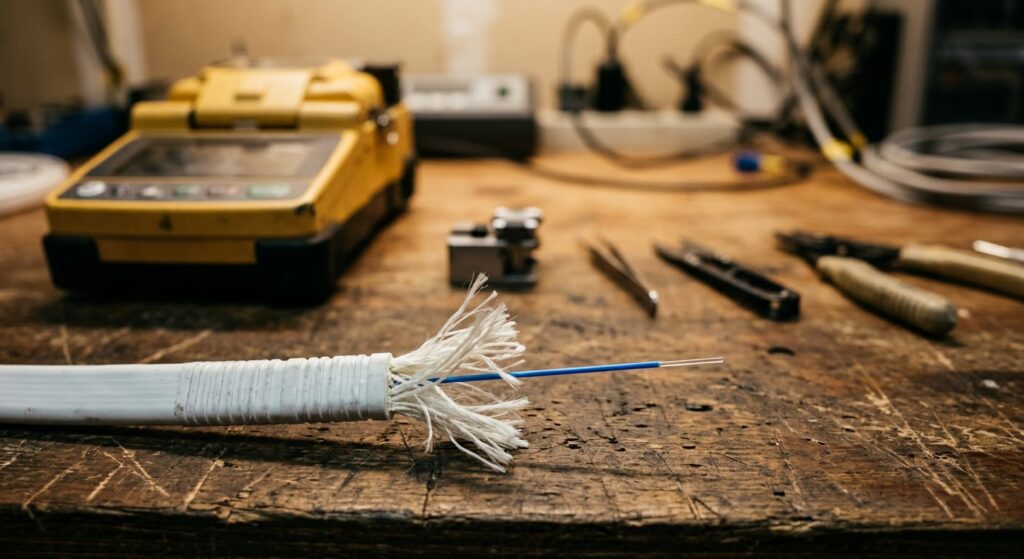
Drop fiber optic cable is the last stretch of the network, the span that leaves the distribution point, crosses a street or a pole line, and finally enters the subscriber’s home, and it is also the stretch where the subscriber’s entire opinion of the network is formed, because no customer notices a clean splice two kilometers back but everyone notices the Wi-Fi that drops every time it rains. The last mile is mechanically the roughest environment in the whole system: cables get stapled to baseboards, crushed behind furniture, bent around door frames, strung between poles in the wind, and occasionally chewed by rodents, all while carrying light through glass roughly the diameter of a human hair. That combination, tiny signal and brutal handling, is exactly why drop cable is its own product category with its own engineering, standards, and type range, and why choosing the right construction for each route matters more on this span than anywhere else in the plant. This guide explains what drop fiber optic cable actually is, how the fiber inside it works, and the nine essential types every FTTH planner, installer, and network operator should recognize, followed by a specification table, practical installation notes, and the questions buyers ask most often.
Key Takeaways
- A drop fiber optic cable is the final link between the service provider’s distribution network and the subscriber’s premises, built for easy handling and tight routing.
- Bend-insensitive G.657 fiber is the defining ingredient: it tolerates 10 mm and even 7.5 mm bends that would strangle standard fiber.
- Construction is matched to route: flat butterfly for indoor walls, round for ducts, figure-8 with messenger for aerial spans, armored for harsh outdoor runs.
- Strength members (FRP or steel), jacket material (LSZH indoors, PE outdoors), and tensile rating decide how the cable survives installation and service.
- Testing the match between cable type and actual route, before ordering by the kilometer, is the difference between a clean rollout and a truck-roll-heavy one.
What Is a Drop Fiber Optic Cable?
A drop fiber optic cable is the final cable link in a fiber-to-the-home network, running from the distribution point or splice closure to the individual subscriber’s premises, whether that terminal is a house, an apartment, or a business. It typically carries one to four fibers, just enough for the subscriber’s service plus a spare, and it is engineered around the realities of the last few hundred meters: small cross-sections that fit along walls and through conduits, strength members that survive pulling and stapling, jackets suited to indoor, outdoor, or mixed routing, and bend-insensitive fiber that keeps the signal alive through corners that would defeat standard cable. Drop cable is deliberately easy to strip, terminate, and splice in the field, because installation happens at thousands of individual homes rather than in a controlled facility, and every design choice, from the cross-section to the easy-peel groove, exists to make the ten-thousandth installation as clean as the first.
Anatomy of a Drop Cable
A typical drop cable concentrates five functions into a few millimeters of cross-section. At the center sit the fibers themselves, usually one to four single-mode fibers in tight-buffered or mini loose-tube construction, sometimes with an easy-peel groove that lets a technician strip the jacket cleanly without tools gouging the glass. Flanking the fiber run the strength members, FRP (fiberglass-reinforced plastic) or steel wires, which carry the pulling and stapling loads so the fiber never does; steel offers higher tensile strength, while FRP is fully dielectric and immune to electrical interference. Around everything sits the jacket: LSZH (low smoke zero halogen) or flame-retardant PVC indoors where fire safety rules, UV-stabilized polyethylene outdoors where weather rules, and optional steel armor where rodents and rocks rule. Get these five elements right for the route, and the cable quietly does its job for decades.
Why G.657 Fiber Changed Everything
The fiber inside modern drop cable is usually ITU-T G.657 bend-insensitive single-mode fiber, and it is the single most important specification on the datasheet. Standard G.652.D fiber punishes bending, with a minimum bend radius around 30 mm, roughly a ping-pong ball, below which light escapes the core and loss spikes; G.657.A1 tolerates 10 mm bends with no more than about 0.1 dB of loss per turn, and G.657.A2 pushes the design allowance down to 7.5 mm through a trench-assisted refractive index profile that traps light in the core even at sharp angles. Both grades remain fully compatible with G.652.D, so they splice and interoperate with the rest of the network without penalty, which is precisely why the industry adopted them wholesale for in-building work. For planners, the practical translation is simple: G.657.A1 suits standard FTTH drops and long straight runs, A2 earns its premium in tight corners, crowded enclosures, and dense apartment routing, and both make indoor installations possible that were impractical a generation ago.
9 Essential Drop Cable Types
1. Butterfly Flat Drop Cable
The butterfly flat drop cable, with its characteristic figure-8 cross-section of fiber lobe atop strength-member lobe, is the workhorse of indoor FTTH. Its flat profile lies against walls and baseboards, takes staples cleanly, and tucks around door frames, typically measuring around 2.0 by 3.0 mm, small enough to disappear along a skirting board. Fiber counts run one to four, with FRP or steel strength members, and LSZH jackets indoors; it terminates easily in the field, which is why installers reach for it by default in houses and apartments. If a rollout involves routing cable visibly inside subscriber homes, this is the type the route is asking for.
2. Round Duct Drop Cable
Round drop cable swaps the flat profile for a cylindrical one, typically 3.0 to 6.0 mm, and trades wall-friendliness for pulling strength and crush resistance. It is the natural choice for duct and conduit runs, underground entry paths, and any route where the cable slides rather than gets stapled, and its round jacket distributes crush load evenly when the conduit gets crowded. Installers use it for the span from the distribution point to the building entry, then transition to flat cable indoors. When the route is a pipe rather than a wall, round is the answer.
3. Figure-8 Aerial Self-Supporting Drop
For pole-to-house spans, the figure-8 self-supporting drop cable carries an integrated steel messenger, a tension member molded into the cable’s silhouette, so a single cable both hangs and carries. The messenger takes the tensile load of the span, wind, ice, and its own weight, so the fiber lope rides along with essentially no strain, and spans of tens of meters are routine with correct tensioning. Self-supporting construction eliminates the separate lashing wire and hardware of conventional aerial practice, cutting installation time dramatically on dense residential streets. Wherever the route leaves the ground, this is the type that keeps both the cable and the schedule intact.
4. Single-Armored Outdoor Drop
Armored drop cable adds a steel tape or corrugated armor layer between inner and outer jackets, turning the cable into something a rodent has to work very hard to defeat. It is specified for direct-buried entry paths, harsh outdoor routes, and any run through terrain where rocks, digging, or chewing wildlife are part of the environment. The armor raises crush resistance sharply and adds a meaningful moisture barrier, at the cost of extra diameter and stiffness. Rural drops, coastal routes, and anywhere the cable crosses ground that moves deserve the armor.
5. All-Dielectric Flat Drop
All-dielectric drop cable removes metal from the construction entirely: FRP strength members, no armor, no metallic elements anywhere, which makes the cable immune to electromagnetic interference and safe along power routes and through lightning-prone terrain. It is the specified choice where electrical isolation matters, near high-voltage infrastructure, on joint-use poles, or inside facilities where bonded metal is a compliance headache. Modern FRP members deliver respectable tensile performance, so the dielectric advantage no longer costs meaningful strength. Wherever steel would create an electrical problem, all-dielectric solves it by subtraction.
6. Toneable Flat Drop
Toneable drop cable includes an integrated locate wire, a thin metallic conductor that lets crews find the buried path with a tone locator months or years after installation. It solves the oldest problem in buried plant, which is knowing where the cable actually runs once the grass grows back, and it makes future excavation, by the operator or by a third-party contractor, dramatically less likely to slice the network in half. Construction resembles standard flat drop with the tone wire added, so installation practice barely changes. For buried drops and any underground route likely to be disturbed, toneable construction is cheap insurance.
7. Double-Sheath Drop Cable
Double-sheath drop cable wraps the standard construction in two separate jacket layers, trading a little diameter for substantially higher mechanical and moisture protection. The configuration suits demanding mixed routes, outdoor-to-indoor transitions, share trenches, and environments where a single jacket would age prematurely, and variants pair different outer materials for specific threats, UV, abrasion, or rodent pressure. It occupies the sensible middle ground between standard flat drop and full armor, and many rollouts that “feel harsh” but lack a specific rodent problem are exactly its territory. When a route is not quite standard but not quite hostile, double sheath is the considered answer.
8. LSZH Indoor Drop Cable
LSZH-jacketed drop cable is defined by its sheath chemistry rather than its geometry: low smoke zero halogen compounds that emit little smoke and no toxic halogen gas when exposed to fire. That property makes LSZH the required or strongly preferred jacket in enclosed public and residential spaces, apartments, hotels, offices, tunnels, and any plenum-adjacent route where evacuation smoke is the real hazard. It is available across flat, round, and tight-buffered constructions, including 3.0 mm single-fiber drops with tensile ratings matched to indoor spans. Indoor air is a safety parameter like any other, and LSZH is how drop cable respects it.
9. FTTR and Onward Indoor Cabling
The drop no longer ends at the front door in modern builds: fiber-to-the-room deployments carry bend-insensitive micro cable onward to routers, desks, and access points in every room that needs bandwidth. FTTR cable resembles miniature indoor drop, tight-buffered G.657 fiber in slim jackets, often 0.8 to 3.0 mm, built for invisible routing along skirtings, through wall penetrations, and behind furniture with bends that would have been unthinkable in legacy indoor plant. A manufacturer like OMC Cable structures its range exactly along this arc, from the butterfly flat and self-supporting aerial families in its Drop Fiber Optic Cable range through armored, all-dielectric, toneable, double-sheath, round, and FTTR categories, with fiber counts from single fiber up to twelve and tensile ratings from light indoor 80 N spans to 1000 N heavy-duty constructions. Treating the room-level run as part of the drop system, rather than an afterthought, is what makes whole-home gigabit actually behave like gigabit.
Drop Cable Specifications at a Glance
| Type | Cross-Section | Typical Route | Strength Member | Signature Feature |
|---|---|---|---|---|
| Butterfly flat | Figure-8, ~2.0×3.0 mm | Indoor walls, baseboards | FRP or steel | Staples flat, easy strip |
| Round duct | Round, 3.0-6.0 mm | Ducts, conduits, entry paths | FRP or steel | Crush and pull resistance |
| Figure-8 aerial | Figure-8 with messenger | Pole-to-home spans | Steel messenger | Self-supporting, no lashing |
| Single-armored | Flat or round + armor | Buried entry, rodent zones | Steel | Crush and rodent resistance |
| All-dielectric | Flat, no metal | Power routes, joint poles | FRP | EMI-immune, lightning-safe |
| Toneable | Flat + locate wire | Buried drops | FRP or steel | Findable after burial |
| Double sheath | Two jacket layers | Harsh mixed routes | FRP or steel | Layered protection |
| LSZH indoor | Flat or round | Enclosed occupied spaces | FRP or steel | Low-smoke fire-safe jacket |
| FTTR micro | 0.8-3.0 mm round | Room-to-room onward runs | FRP | Bend-tolerant, near-invisible |
The table reads as a decision tool: find the route first, then the row, then the datasheet, and the reverse order is how over-specified cable ends up in gentle routes and underspecified cable ends up in bad ones.
Installation Notes That Protect the Signal
The best cable still needs disciplined handling, and a few habits carry most of the value:
- Respect the bend radius everywhere, not just at corners: G.657.A1 allows 10 mm bends by standard, but good practice keeps installed radii around 20 mm, leaving margin for a lifetime of nudges and building movement.
- Load the strength member, never the fiber: staples, clamps, and service loops must grip jacket and strength member only, and staple guns should never deform the fiber lobe.
- Match tension to the rating: light indoor drops around 80 to 200 N, self-supporting aerial and heavy constructions 800 to 1000 N, and never exceed the datasheet figure during a pull.
- Leave service loops at both ends and at every structural transition, because terminations get redone and buildings settle.
- Work clean at the strip: use the easy-peel groove or proper tools, score rather than crush, and inspect every cleave before splicing.
These are small disciplines individually, and they are the entire difference between an install that tests clean on day one and one that generates intermittent loss complaints for years.
Frequently Asked Questions
What is a drop fiber optic cable?
It is the final cable of an FTTH network, running from the distribution point to the subscriber’s premises, typically carrying one to four bend-insensitive fibers in a slim construction built for easy indoor, duct, or aerial installation.
G.657.A1 or G.657.A2 fiber: which should I specify?
A1 handles standard FTTH drops with a 10 mm minimum bend radius; specify A2, rated to 7.5 mm, when the route forces tighter bends in enclosures, apartments, or dense routing, and note A2’s 7.5 mm figure is a design allowance, so request loss measurements at your actual radius for critical links.
Can drop cable be buried directly?
Single-armored and toneable constructions are designed for direct burial and underground entry paths; light indoor flat drop is not, and unarmored cable in buried ground will eventually meet a rodent or a shovel it cannot survive.
What does LSZH mean on a drop cable datasheet?
Low smoke zero halogen: the jacket emits minimal smoke and no toxic halogen gas in a fire, which is why LSZH is preferred or required in enclosed residential, commercial, and public spaces.
How much tensile strength does drop cable need?
It depends on the span: indoor flat drops are typically rated around 80 to 200 N, while self-supporting aerial and heavy outdoor constructions run 800 to 1000 N, and the pull tension during installation must stay within the rated figure.
What is the difference between flat and round drop cable?
Flat butterfly cable staples along indoor walls and terminates easily; round cable offers better crush and pulling performance for ducts and conduits, so most rollouts use round for the external span and flat for the run inside the home.
Conclusion
Drop fiber optic cable is where network engineering meets carpentry, weather, and the reality of ten thousand individual homes, and the nine types above exist because no single construction can survive every route between the distribution point and the set-top box. The selection logic is straightforward once the system is understood: match the fiber grade to the bends the route will force, the strength members to the loads the install will apply, the jacket to the fire and weather environment the cable will live in, and the extras, armor, locate wire, double sheaths, to the specific hazards the path actually contains. Operators who treat the drop as a system rather than a commodity see it in their metrics, in fewer truck rolls, cleaner OTDR traces, and customers who never think about the network at all, which is the highest compliment infrastructure can earn. Choose by route, install by datasheet, and the last mile will quietly be the best mile.