
County clerks, municipal courts, state agencies, and federal offices across the country still guard millions of vital paper deeds, historical microfilm reels, oversized zoning maps,...
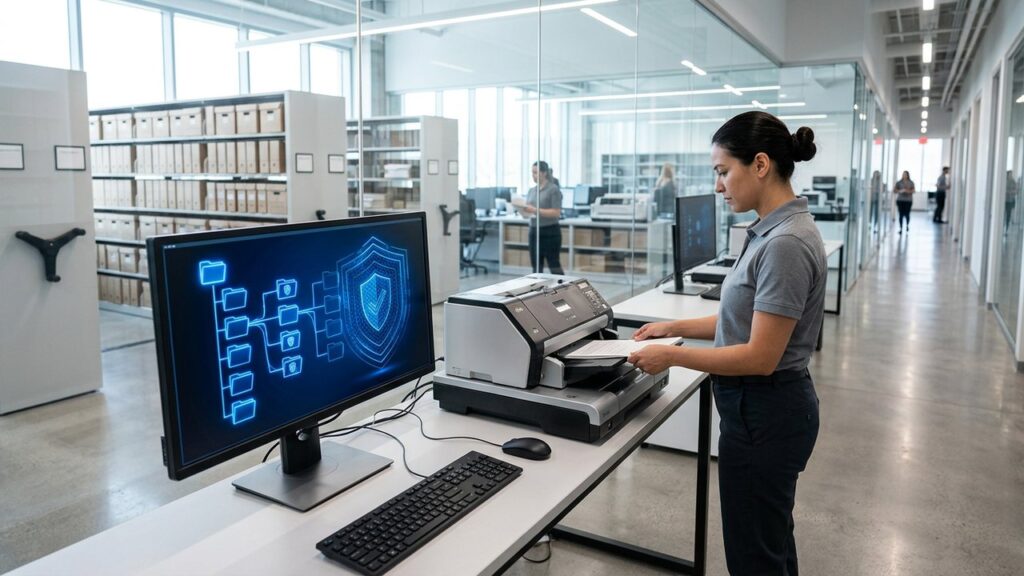
County clerks, municipal courts, state agencies, and federal offices across the country still guard millions of vital paper deeds, historical microfilm reels, oversized zoning maps, and citizen case files inside crowded vaults and costly off-site warehouses. Partnering with specialized document scanning services for government transforms aging paper archives into secure, searchable digital records so public servants fulfill FOIA requests in minutes, slash physical storage bills, and safeguard priceless civic history against fire or flood.
Grounded in DataBank IMX public-sector practice, modern document scanning services for government pair SOC 2 Type II, ISO 27001, and ISO 27017 security with vetted staff, on-site mobile capture, +/-10% accurate volume scoping, hybrid AI-plus-human indexing, cooperative purchasing, and direct OnBase, Laserfiche, or SharePoint ingestion so agencies digitize records cleanly.
Why Agencies Prioritize High-Volume Document Scanning Services for Government
Every filing cabinet sitting inside a courthouse basement or leased off-site archive extracts three silent taxpayer costs simultaneously: recurring square-footage real estate expense, hours of manual staff hunting whenever citizens file public-records inquiries, and catastrophic disaster exposure whenever burst pipes, fires, or mold strike unbacked paper collections.
Dedicated document scanning services for government solve all three pressures systematically. By converting standard office dossiers, bound historical ledgers, wide-format engineering blueprints, parcel maps, and deteriorating microfilm into cleanly indexed electronic files, agencies accelerate constituent service speed, enable secure remote casework, enforce retention schedules automatically, and reclaim valuable municipal real estate.
Unique Public-Sector Formats That Require Specialist Equipment
Standard office multifunction copiers jam instantly when confronted with fragile hundred-year-old civic archives. Professional document scanning services for government centers run specialized scanners engineered specifically for varied public holdings:
- High-Volume Case Files and Permits: Fast duplex sheet-fed production scanners equipped with ultrasonic double-feed detection and staple-removal prep.
- Oversized Maps, Plats, and Engineering Blueprints: Wide-format calibrated rollers preserving fine architectural line work and legible marginalia.
- Bound Historical Deed Books and Ledgers: Overhead cradle book scanners capturing crisp flat spreads without cracking delicate spines.
- Microfilm, Microfiche, and Aperture Cards: Specialized optical film scanners rescuing fading analog rolls before vinegar syndrome destroys readability.
8 Vital Compliance and Execution Checks for Government Digitization
Public records carry strict statutory custody laws, citizen PII protection mandates, and public audit scrutiny. Evaluate every candidate provider of document scanning services for government against these eight non-negotiable operational gates.
| Compliance Gate | Required Public-Sector Standard | Why Agency Leaders Enforce It |
|---|---|---|
| 1. Security Certifications | SOC 2 Type II, ISO 27001 & ISO 27017 | Independently audits data & cloud security controls |
| 2. Personnel & Chain of Custody | Background-vetted staff & barcoded box tracking | Zero unaccounted records from pickup to return |
| 3. On-Site vs Off-Site Option | Secure mobile on-site teams when legally required | Vital or restricted records never leave agency walls |
| 4. Volume Scoping Accuracy | Structured estimation within +/-10% variance | Prevents mid-fiscal-year municipal budget overruns |
| 5. Dual Indexing QA | AI auto-classification plus human verification | Guarantees rapid FOIA retrieval & clean metadata |
Check 1: Verify Active SOC 2 Type II, ISO 27001, and ISO 27017 Audits
Never accept vague marketing assurances about “secure facilities.” Request current third-party attestation reports covering SOC 2 Type II operational controls, ISO 27001 information security management, and ISO 27017 cloud security safeguards, alongside any agency-specific mandates such as CJIS, HIPAA, or state privacy statutes governing your department’s records.
Check 2: Audit Background-Vetted Personnel and End-to-End Chain of Custody
Every banker’s box holding citizen birth certificates, tax records, or legal dockets must remain traceable at every single minute. Leading document scanning services for government enforce strict employee background screening, badge-controlled climate-monitored conversion centers, GPS-tracked transport vehicles, and barcoded box-level manifest logging from pickup through final verified disposition or return.
Check 3: Decide Between Off-Site Production Centers and On-Site Scanning
While dedicated regional conversion facilities maximize speed and lower unit cost for large backfile projects, certain statutory records, such as active judicial evidence, sealed vital registers, or classified agency archives, cannot legally cross facility boundaries. Selecting a partner capable of deploying vetted on-site document scanning services for government teams directly into your courthouse or agency floor removes legal friction completely.
Check 4: Scope Box Counts Precisely Before Requesting Fiscal Funding
Guessing “maybe two thousand boxes” leads straight to awkward mid-project change orders during tight municipal budget cycles. Use structured scoping frameworks like document scanning services for government such as DataBank IMX’s Paper Volume Estimator (which forecasts true image volumes within roughly +/-10% based on box type, paper density, and double-sided ratio) so grant proposals and city council appropriations stay airtight from day one.
Check 5: Pair AI Auto-Classification With Human Quality Assurance
Scanning millions of pages into giant unnamed PDF blobs solves nothing if clerks still waste twenty minutes hunting for one citizen’s permit. Modern document scanning services for government combine automated AI optical character recognition (OCR), intelligent document classification, and human quality-assurance checkpoints verifying skewed pages, faint stamps, and exact search index fields (such as Case Number, Parcel ID, and Date).
Check 6: Confirm Native Integration Into OnBase, Laserfiche, or SharePoint
Digital records deliver maximum agency efficiency only when loaded cleanly straight into your existing Enterprise Content Management (ECM) system. Verify upfront that your vendor exports exact folder structures, XML metadata schemas, and automated batch imports compatible with OnBase, Laserfiche, Microsoft SharePoint, or your department’s chosen records repository without requiring manual IT re-keying.
Check 7: Leverage Pre-Competed State and Cooperative Purchasing Contracts
Drafting a brand-new municipal RFP from scratch can stall critical modernization projects for six to nine months. Ask shortlisted providers of document scanning services for government which approved state term schedules or cooperative purchasing vehicles (such as statewide IT or national public-procurement contracts) they hold so your agency procures vetted services rapidly while honoring full statutory competition rules.
Check 8: Quantify Storage Savings and FOIA Labor Payback Cleanly
Securing approval from county commissioners or finance boards goes far smoother when backed by concrete multi-year payback math. Combine off-site warehouse lease elimination, reclaimed downtown office square footage, and reclaimed clerk search hours against one-time document scanning services for government investment inside the Nemin Break-Even Calculator to present a crisp, fiscally responsible modernization business case.
Off-Site Production Centers vs On-Site Government Scanning
Weighing both operational delivery models side by side helps department heads align legal sensitivity cleanly with budget constraints.
| Operational Dimension | Secure Off-Site Conversion Facility | Dedicated On-Site Agency Scanning |
|---|---|---|
| Legal Custody Fit | Ideal for standard archives & active backfiles | Mandatory for records barred from leaving premises |
| Throughput Velocity | Highest daily volume via industrial scan fleets | Steady paced throughput inside agency room space |
| Cost Per Image | Most economical per-page unit pricing | Higher due to mobile gear & on-site staffing |
| Active Record Retrieval | Rapid Scan-on-Demand digital pull within hours | Immediate physical proximity for local clerks |
Six-Step Public-Sector Digitization Rollout Roadmap
Breaking huge multi-decade archives into disciplined phases builds fast visible wins and trains agency staff comfortably:
- Retention Purge First: Apply statutory state records-retention schedules lawfully before document scanning services for government so taxpayers never pay to digitize expired documents eligible for certified destruction.
- Volume and Format Inventory: Separate standard files, bound books, wide maps, and microfilm, quantifying exact page counts accurately.
- Taxonomy and Index Mapping: Define exact search fields and ECM folder structures collaboratively with clerks and FOIA officers before document scanning services for government box one.
- 10-Box Pilot Batch Verification: Digitize a representative sample first, import it live into OnBase, Laserfiche, or SharePoint, and inspect image clarity and OCR accuracy thoroughly.
- Full Backfile Conversion Plus Day-Forward Intake: Execute bulk archive scanning while pairing clean day-forward mailroom document scanning services for government so new paper never rebuilds the backlog.
- Certified Return or Disposition: Complete signed post-QA audit sign-off before returning archival originals or executing authorized secure shredding.
Four Avoidable Mistakes That Derail Municipal Scanning Projects
- Scanning expired clutter without completing lawful records-retention purging beforehand, inflating document scanning services for government invoices needlessly.
- Over-indexing twenty obscure metadata fields per document when four clean search keys plus full-text OCR retrieve files just as fast at half the cost.
- Forgetting “day-forward” intake workflows, allowing incoming mail and paper forms to quietly refill emptied vaults twelve months later.
- Skipping physical post-scan QA spot checks before authorizing destruction of original physical source boxes.
Transforming Public Trust Through Faster, Resilient Civic Records
Modernizing paper vaults through specialized document scanning services for government goes far beyond tidying basement shelves. When a homeowner pulls a 1978 building permit in thirty seconds, a journalist receives a complete transparent FOIA response well ahead of statutory deadlines, and historic civic ledgers survive hurricanes completely intact inside encrypted cloud backups, digital transformation fulfills its core promise to taxpayers.
How Different Public Agencies Tailor Document Scanning Services for Government
Municipalities, county courts, state licensing boards, and federal divisions manage vastly different statutory archives under distinct legal retention mandates. Experienced document scanning services for government adapt preparation, scanning hardware, optical recognition rules, and indexing taxonomy precisely to each public department’s daily workflow rather than forcing rigid generic templates onto every office.
County recorder and land-title offices rely on document scanning services for government to preserve century-old bound deed books and wide plat maps without cracking fragile bindings. Courts, district attorneys, and police records units depend on document scanning services for government to digitize active dockets under airtight chain-of-custody tracking, while municipal planning, HR, and public-works bureaus digitize permits, engineering drawings, and citizen records for instant cross-department access.
Comparing In-House Clerk Scanning vs Specialist Document Scanning Services for Government
Well-meaning agencies occasionally buy two desktop scanners and assign summer interns or existing administrative clerks to tackle twenty years of basement boxes internally. Calculating true staff labor hours, equipment downtime, missed index errors, and multi-year backlog delays quickly proves why high-volume document scanning services for government deliver superior accuracy at far lower total taxpayer cost.
Five Operational Advantages of Dedicated Document Scanning Services for Government
- Industrial Throughput Speed: Specialized production fleets inside document scanning services for government process hundreds of thousands of pages monthly without pulling clerks off citizen counters.
- Fragile and Wide-Format Mastery: Non-destructive overhead book cradles, calibrated map rollers, and microfilm scanners inside document scanning services for government handle delicate civic artifacts safely.
- Certified Security and Audit Trails: Active SOC 2 Type II, ISO 27001, and ISO 27017 frameworks inside document scanning services for government satisfy strict municipal IT audits cleanly.
- Hybrid AI Plus Human Indexing QA: Combining automated OCR classification with trained quality inspectors gives document scanning services for government pinpoint FOIA retrieval reliability.
- Clean Day-Forward Continuity: Pairing bulk backfile conversion with structured mailroom intake keeps agencies utilizing document scanning services for government permanently paper-light.
Crafting a Strong Procurement Scope for Document Scanning Services for Government
Clear project scoping eliminates costly change orders and speeds approval across city councils, IT security committees, and state procurement officers. Include five concrete specification points whenever evaluating bids for document scanning services for government.
- Verified Retention Purge Boundaries: Confirm expired files have been lawfully separated so document scanning services for government process strictly retained active and archival holdings.
- Exact Format and DPI Standards: Specify archival resolution targets (typically 300 DPI minimum, higher for intricate maps or microfilm) alongside searchable PDF/A or TIFF deliverables required from document scanning services for government.
- Chain-of-Custody and On-Site Clauses: State explicitly which restricted record series demand secure mobile on-site teams versus off-site conversion centers operated by document scanning services for government.
- ECM Ingestion and Metadata Mapping: Document exact XML index fields and target folders for OnBase, Laserfiche, or SharePoint imports before document scanning services for government scan box one.
- Pilot Acceptance and Cooperative Contract Terms: Require a paid or included sample box pilot sign-off and verify eligible cooperative purchasing contracts held by document scanning services for government.
Building Disaster-Resilient Digital Civic Infrastructure
Flooded courthouse basements, fire-damaged municipal annexes, and fading analog microfilm threaten irreplaceable community history every single year. Investing thoughtfully in certified document scanning services for government secures encrypted cloud resilience, speeds public transparency, reclaims expensive physical storage leases, and equips public servants to serve citizens smoothly for decades to come.
Managing Citizen Privacy, Redaction, and FOIA Speed With Document Scanning Services for Government
Public transparency laws and citizen privacy statutes pull municipal clerks in opposite directions daily. Agencies must release requested public records promptly under strict FOIA or state open-records clocks while simultaneously redacting Social Security numbers, juvenile identities, protected medical notes, and sealed witness addresses with 100% accuracy. Modern document scanning services for government resolve that tension cleanly through automated OCR discovery paired with human-verified redaction workflows.
Once paper archives are digitized cleanly by certified document scanning services for government and ingested into OnBase, Laserfiche, or SharePoint with structured search metadata, clerks locate exact multi-decade records in under sixty seconds rather than trekking down to basement storage vaults for half an afternoon. Automated redaction rules flag sensitive PII patterns instantly for legal review, slashing FOIA turnaround backlogs while safeguarding citizen privacy rigorously.
Evaluating Vendor Readiness Before Awarding Public Digitization Contracts
Procurement committees and municipal IT directors reduce implementation risk dramatically by verifying six concrete readiness indicators across finalist proposals for document scanning services for government.
- Independent Security Attestation Copies: Inspect current SOC 2 Type II, ISO 27001, and ISO 27017 audit letters submitted by document scanning services for government.
- Facility Tour or Virtual Security Audit: Confirm badge access, camera surveillance, environmental fire suppression, and box tracking inside document scanning services for government centers.
- Reference Calls With Peer Public Agencies: Speak directly with county clerks, court administrators, or state records officers who completed projects with those document scanning services for government.
- Live Sample Box Output Inspection: Review exact OCR accuracy, image deskewing, color fidelity on maps, and ECM import XML produced during pilot testing by document scanning services for government.
- Transparent Per-Image and Prep Pricing: Verify staple removal, fragile paper handling, wide-format surcharges, and indexing rates cleanly upfront with document scanning services for government.
- Certified Post-Scan Return or Destruction Protocol: Confirm documented audit sign-off gates before document scanning services for government return original boxes or execute lawful certified shredding.
Sustaining Digital Records Governance Beyond Backfile Completion
True civic modernization pairs historical backfile elimination with clean day-forward capture and automated retention policies inside your ECM. Working alongside proven document scanning services for government protects priceless historical archives permanently, cuts warehouse lease waste, and empowers public servants with instant, compliant digital access every working day.
FAQ’s
What security certifications should document scanning services for government maintain?
Public agencies should require independently audited security frameworks including SOC 2 Type II, ISO 27001, and ISO 27017, paired with background-vetted staff, barcoded chain-of-custody tracking, and compliance alignment with specific department mandates such as CJIS or HIPAA where applicable.
Can government records be scanned without leaving our courthouse or agency building?
Yes. Experienced document scanning services for government partners offer secure on-site scanning options where background-vetted technicians deploy production scanning hardware directly inside your facility so legally restricted or irreplaceable vital records never leave government premises.
What physical document types can specialized government scanners digitize?
Beyond standard letter and legal case files, document scanning services for government specialists process oversized architectural blueprints, county parcel maps, fragile bound deed books, microfilm reels, microfiche jackets, and aperture cards using specialized non-destructive hardware.
How do agencies avoid surprise budget overruns on large paper backfiles?
Conduct a lawful retention purge first to eliminate expired records, then use structured scoping tools like a Paper Volume Estimator (accurate within roughly +/-10%) alongside a small representative pilot batch to lock precise image counts and indexing scope before full production.
Will newly digitized records integrate into OnBase, Laserfiche, or SharePoint?
Yes. Leading document scanning services for government configure OCR text layers, verified search index metadata, and batch import packages tailored natively for OnBase, Laserfiche, Microsoft SharePoint, and other municipal ECM repositories.
How can agencies procure document scanning services for government faster without a year-long RFP?
Check whether qualified document scanning services for government hold pre-competed state term schedules or cooperative public purchasing contracts approved for your jurisdiction, allowing fully compliant procurement on dramatically shortened timelines.
Conclusion
Preserving public history while meeting strict FOIA deadlines and tight municipal budgets requires disciplined, security-first modernization. Choosing vetted document scanning services for government backed by SOC 2 Type II and ISO certifications, strict chain-of-custody tracking, accurate volume scoping, hybrid AI-plus-human indexing QA, and clean ECM integration turns vulnerable paper vaults into resilient civic assets.
Purge expired holdings lawfully first, verify quality through a small pilot batch inside your live repository, pair backfile conversion with day-forward intake, and deliver faster, safer service to every constituent you serve.