
Day trading is a speed game, and the window between a breakout and a fade can be a matter of minutes. That makes choosing the...
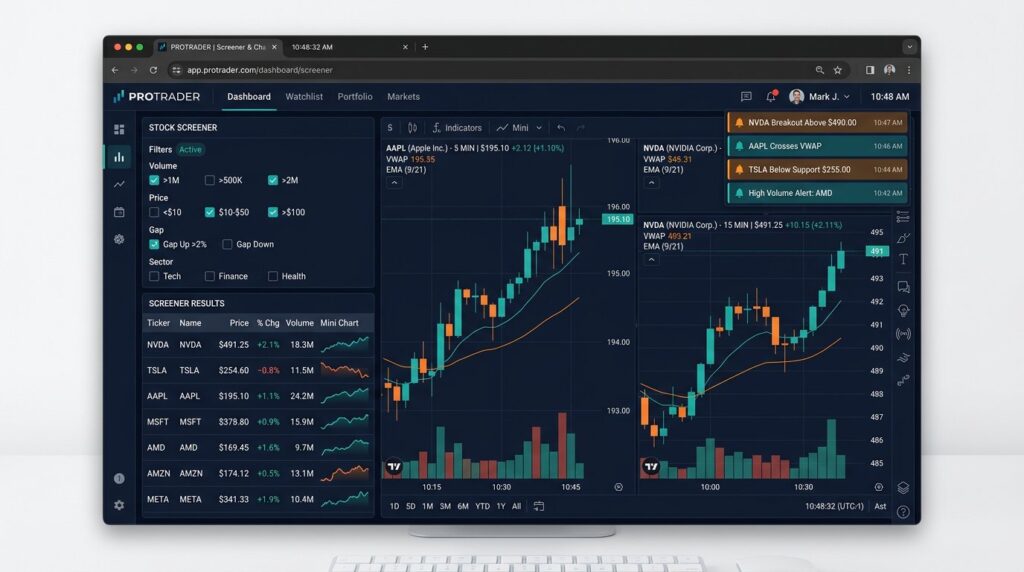
Day trading is a speed game, and the window between a breakout and a fade can be a matter of minutes. That makes choosing the right stock screeners for day trading one of the most consequential decisions an active trader makes. A quality screener does far more than list stocks; it compresses thousands of tickers into a short watchlist of real-time opportunities before the market has already moved on. This guide explains what genuinely matters for intraday traders and compares the seven strongest free and paid stock screeners for day trading worth your attention in 2026.
If you only have a minute, here is the short version. The best tool for a day trader is one that delivers true real-time data, surfaces premarket movers and unusual volume, and can push alerts to you when a setup triggers. Trade Ideas is the strongest dedicated intraday scanner, TradingView is the best free and most versatile platform, and Finviz is the fastest free way to slice the market. The right pick depends on your strategy and your data plan.
Why Day Traders Need a Screener Built for Speed
Swing traders can afford a slow screener because they hold positions for days or weeks. Day traders can not. Every minute you spend digging through a cluttered results list is a minute the move may have exhausted itself. The entire purpose of a day trading screener is to compress your decision time without sacrificing context.
The Difference Between a Scanner and a Screener
These two words are often used interchangeably, but the distinction matters for intraday traders. A screener applies a set of static criteria to a snapshot of the market and returns a list of stocks that match right now. A scanner runs continuously, watching the tape in real time and alerting you the instant a condition is met.
Day traders benefit most from tools that combine both. You screen, for example, for stocks above $5 with a float under 20 million shares, and you scan for the moment relative volume surges above a threshold. The best platforms let you build the filter and then watch it live.
What Real-Time Data Means for Your P&L
The most important technical requirement for day trading is un-delayed data. A delayed quote of 15 minutes is effectively useless when you are trying to enter a move that may last only a few bars. Most free tiers provide delayed or exchange-gated quotes, so treat real-time capability as the first filter in your evaluation, not a nice to have.
Indicators that matter to intraday traders include premarket gap percentage, relative volume, average true range, VWAP, and short interest. If a platform cannot deliver these on a live feed, it is not a serious candidate for day trading.
Matching the Tool to Your Intraday Style
Not all day trading styles place the same demands on a screener, which is why the best tool is rarely the same for two traders.
- Momentum and gap traders need premarket scanners with low-float and relative-volume filters to find the leaders before the open.
- Scalpers benefit from Level 2 data and near-instant scanning that keeps up with rapid price action.
- News and catalyst traders thrive on a screener that surfaces headlines and earnings alongside the scan.
- Systematic traders want automation and backtesting so they can validate a set of rules before risking capital.
Identifying which of these describes you will narrow the field faster than comparing every feature on a pricing page.
7 Critical Filters a Day Trading Screener Must Have
The volume of filters a screener offers is meaningless if they are the wrong ones. These are the categories that actually drive intraday decisions.
Momentum and Volatility Filters
- Premarket gap and direction: A gap up or down on high premarket volume frequently sets up the day’s strongest momentum plays.
- Relative volume and unusual volume: Relative volume above two to three times the average signals crowd interest and institutional participation.
- Price and float: Low-float stocks under $20 with high relative volume are the classic recipe for fast, volatile intraday runs.
Context and Risk Filters
- Short interest and squeeze potential: Days-to-cover and short float percentage help you identify names with squeeze fuel.
- VWAP and moving averages: Intraday traders use VWAP and the opening range as reference levels for entries and exits.
- News and catalysts: Earnings, FDA decisions, guidance, and contract wins often ignite the moves a screener surfaces.
- Sector and market cap: Narrowing by sector and size helps you trade with the broader theme of the day.
What to Avoid in a Day Trading Screener
A screener can waste your time even when it looks capable. Watch for these warning signs.
- Delayed data sold as real-time. If the tool uses 15-minute quotes, it cannot serve an intraday strategy.
- A shallow filter list. Many filters that only cover valuations and long-term ratios are of limited use to a trader closing positions by the close.
- No custom alerts. Without the ability to trigger on a specific condition, you are forced to watch the screen all day.
- A cluttered interface. A screener that buries the data you need behind menus costs you time when it matters most.
- Unsupported claims of guaranteed returns. No screener can promise profits; treat that kind of language as a red flag regardless of the price.
The 7 Best Stock Screeners for Day Trading in 2026
The tools below span free, mid-range, and premium price points. Each has been selected for the way it supports intraday speed rather than long-term investing.
1. Trade Ideas
Trade Ideas is widely regarded as the gold standard for active day traders. Its strength is its real-time scanning engine and the AI assistant known as Holly, which evaluates thousands of setups against historical data and streams ranked ideas throughout the session. It is extremely customizable and includes a point and click backtesting system that requires no coding.
The Gap Scanner is especially useful for traders who build their day around premarket movers. Alerts and a live trading room add real value, and you can set up a scan once and let it run for the entire session.
- Why it works for day trading: Continuous real-time scanning, AI-ranked ideas, and automation.
- Pricing in 2026: Standard and Premium plans are subscription based, with a notable discount for annual billing. Pricing is high relative to free tools.
- Watch out for: There is no mobile app, so you need a desktop or browser setup. The cost and learning curve are real.
2. TradingView
TradingView is the most versatile platform on this list and an excellent choice for the day trader who also wants superb charting. The screener supports hundreds of technical and fundamental filters across global markets, and the platform integrates paper trading and direct order entry with many brokers.
What sets TradingView apart is the balance of power and accessibility. The free tier is genuinely usable, and paid plans are affordable. A curated column layout lets you strip away everything except the data you care about.
- Why it works for day trading: Fast screening, excellent charting, alerts, and a strong mobile app.
- Pricing in 2026: Free tier with ads; Pro, Pro+, and Premium plans are low-cost monthly subscriptions.
- Watch out for: Some real-time data requires a paid plan or exchange add-on, and Level 2 data is not available.
3. Finviz
Finviz is the fastest free way to get a visual read on the market. The interface is clean and quick, letting you set up a screen in seconds and sort results by criteria such as gap, price, volume, and short float. Its heat maps and screener visualization are excellent for spotting the day’s leaders at a glance.
For an intraday trader on a budget, Finviz works well as a discovery tool. You can filter by sector, market cap, price, average volume, and short float to build a shortlist, then move to your trading platform for execution and real-time context.
- Why it works for day trading: Fast, simple, and free; strong float and short-interest filters.
- Pricing in 2026: Free tier with delayed data; Finviz Elite is a paid monthly subscription with a money-back guarantee.
- Watch out for: The free version shows delayed data and ads, and there is no mobile app. Front-end filters are less extensive than premium rivals.
4. TC2000
TC2000 pairs its award-winning EasyScan screener with a powerful charting platform. The scanning engine handles both technical and fundamental criteria, which is handy when you want to confirm an intraday setup against underlying fundamentals. The interface is clean and the layouts are highly customizable.
Because TC2000 also offers charting and a trading simulator in the same environment, you can move from a screen to a chart to a paper trade without switching applications. If you open a brokerage account, the integration between EasyScan and order placement is seamless, which makes it one of the more efficient stock screeners for day trading on a single platform.
- Why it works for day trading: Technical and fundamental screening in one platform with strong charting.
- Pricing in 2026: EasyScan is included in the Gold and Platinum plans, which are monthly subscriptions with annual and semiannual discounts.
- Watch out for: EasyScan is not available on the entry-level plan, coverage is limited to US and Canadian exchanges, and backtesting is not built in.
5. TrendSpider
TrendSpider is ideal for the day trader who wants automation without writing code. Its standout feature is automated trendline drawing and multi-timeframe analysis, which lets you scan for structures like breakouts and retests across several timeframes at once. It includes point and click backtesting so you can validate a strategy before risking capital.
The platform delivers real-time data on supported plans and pushes alerts to your mobile device. That combination of automation, alerts, and backtesting makes it a strong choice for a systematic intraday approach.
- Why it works for day trading: Automated technical scanning, multi-timeframe insight, and mobile alerts.
- Pricing in 2026: Tiered monthly subscriptions, with lower rates on annual billing and a free trial.
- Watch out for: The advanced scanning and backtesting features make it a better fit for technical traders than for pure news scalpers.
6. Scanz
Scanz is built for speed and is beloved by traders who scan fast-moving, low-float names. It provides real-time scanning with Level 2 data and news integration, which gives you a view of order flow and catalysts in the same window as your scans. This is valuable when the market is moving and you need conviction quickly.
The platform is fully web based and responsive, with premarket and intraday scanners that help you identify the leaders before the open. News and volume features combine to give a fast, professional-grade edge.
- Why it works for day trading: True real-time data, Level 2 visibility, and integrated news.
- Pricing in 2026: Paid subscription with a flexible pricing structure, intended primarily for active intraday traders.
- Watch out for: There is no dedicated mobile app, so it is best used on a desktop during market hours.
7. Benzinga Pro
Benzinga Pro is the strongest choice for the news-driven day trader. It pairs a real-time screener with instant news headlines, an earnings calendar, and AI-powered sentiment, so you can catch a catalyst while it is still fresh. Filters for earnings, rumors, and unusual options activity add a layer that purely technical screeners do not offer.
For traders who build their day around headlines and catalysts, the ability to see a news item and immediately run a screen on the affected stock is a major time saver.
- Why it works for day trading: Real-time news, AI sentiment, and a live screener in one workflow.
- Pricing in 2026: Subscription based, with tiered plans and a limited free tier.
- Watch out for: The full experience is geared toward traders willing to pay for premium news speed; the free tier is limited.
Stock Screeners for Day Trading Compared
| Screener | Best For | Real-Time Data | Key Intraday Filters | Mobile App | Price in 2026 |
|---|---|---|---|---|---|
| Trade Ideas | AI-powered intraday scans | Yes | Gap, RVOL, unusual volume, Holly AI | No | Premium subscription |
| TradingView | Charting and global screening | Exchange dependent | 200+ technical and fundamental filters | Yes | Free to low cost |
| Finviz | Fast free market read | Elite only (free is delayed) | Gap, price, float, short interest | No | Free to Elite |
| TC2000 | Technical plus fundamental scanning | Yes | EasyScan technical and fundamental | Yes | Gold and Platinum plans |
| TrendSpider | Automated technical scanning | Yes | Patterns, multi-timeframe, indicators | Yes | Tiered subscription |
| Scanz | Real-time Level 2 fast movers | Yes | Level 2, news, premarket | No | Paid subscription |
| Benzinga Pro | News and catalyst trading | Yes | News, earnings, sentiment | Yes | Subscription |
How to Build Your Day Trading Screener Workflow
Choosing a platform is only the first step. The value comes from a repeatable workflow that turns a scan into a trade plan.
Set Up Before the Open
- Define your setup before the open. Decide precisely which conditions you are hunting for, such as a premarket gap above five percent on a low float with relative volume over three.
- Create a shortlist before the bell. Use premarket data to identify the candidates you care about, so you are not deciding in the heat of the open.
Execute and Track Through the Session
- Confirm with price action. A screener tells you where to look. The final confirmation belongs to the chart, the Level 2 tape, and your risk plan.
- Set alerts and stop watching the screen. Let the scanner do the watching; alerts draw your attention only when a condition triggers.
- Track your results. Logging each scan, trade, and outcome is how you learn which filters actually produce the setups you want. This is where a trading journal becomes indispensable, and TraderVue is built for exactly that.
Free vs Paid Screeners and What Your Budget Buys
The gap between a free and a premium screener is often less about the number of filters and more about the speed and depth of the data behind them.
- Free tiers typically deliver delayed quotes, limited filter depth, and a narrower universe. They are excellent for learning and for daytime discovery.
- Mid-range subscriptions usually unlock real-time or exchange-gated data, mobile alerts, and a wider set of technical filters.
- Premium tools add continuous scanning, Level 2 order flow, AI-ranked ideas, backtesting, and live trading rooms.
A common and sensible strategy is to combine a free discovery tool such as Finviz with a paid scanner for the actual session. This keeps your subscription cost down while still giving you live, real-time capability during market hours.
Mistakes to Avoid When Choosing
Even a well-reviewed platform can underperform in your hands if the selection process is rushed.
- Choosing by price alone. The cheapest option is rarely the most expensive failure, but the most expensive option is not automatically the best fit.
- Ignoring your own strategy. A screener is only valuable if it matches how you actually trade.
- Skipping the trial. Free trials and money-back guarantees exist so you can test the tool against a live market before committing.
- Not checking broker compatibility. If you want to move directly from a scan to an order, confirm your platform connects to your broker.
How to Choose the Right Platform for Your Trading Budget
There is no single best answer, so approach the decision as a short evaluation rather than a search for perfection.
- If you want automated, AI-ranked intraday scans and can invest in a premium monthly subscription, Trade Ideas is the strongest candidate.
- If you want flexibility, excellent charting, and an affordable path to real-time data, TradingView is the most balanced choice.
- If you want a fast free starting point for discovery before you commit to a paid tool, Finviz is where most traders begin.
- If you want to combine technical and fundamental screening with strong charting, TC2000 and TrendSpider both deliver.
- If you trade news and catalysts, Benzinga Pro is built around the headline-driven style.
Frequently Asked Questions
What are stock screeners for day trading?
Stock screeners for day trading are tools that filter the entire market down to a shortlist of stocks matching the real-time criteria an intraday trader cares about, such as premarket gap, relative volume, price, and float.
Do day traders need real-time data in a screener?
Yes. Delayed quotes make it nearly impossible to time an entry on a move that lasts only a few minutes, so real-time or exchange-gated live data is an essential requirement for day trading.
Is there a free stock screener for day trading?
Yes, but with a caveat. Finviz and TradingView offer free tiers, yet both typically provide delayed or exchange-gated data, meaning reliable real-time screening usually requires a paid plan.
What filters should a day trading screener use?
The core filters are premarket gap percentage, relative volume, price, float, short interest, and VWAP, with news and catalyst filters for event-driven trades.
Can a stock screener predict winning stocks?
No. A screener is a discovery tool, not a prediction engine. It identifies candidates that meet your criteria, but the final decision requires confirming price action and managing risk.
What is the difference between a scanner and a screener?
A screener applies static criteria to a snapshot and returns a list, while a scanner monitors the market continuously and alerts you the moment a live condition is met. Day traders benefit from using both.
Conclusion
The best stock screeners for day trading are the ones that fit your strategy, your data requirements, and your budget. For most active intraday traders, that means prioritizing a tool with genuine real-time data, strong premarket and relative-volume filters, and reliable alerts that let you step away from the screen without missing a setup. Trade Ideas leads for serious automated scanning, TradingView offers the best balance of power and price, and Finviz remains the fastest free starting point. Whatever you choose, pair it with a clear premarket routine and a disciplined trading journal, because a screener only refines the candidates, and the decisions that follow still belong to you.