
Great classroom teaching does not always have to follow the same format. Carefully selected primary workshops for schools can give pupils opportunities to explore curriculum topics through...
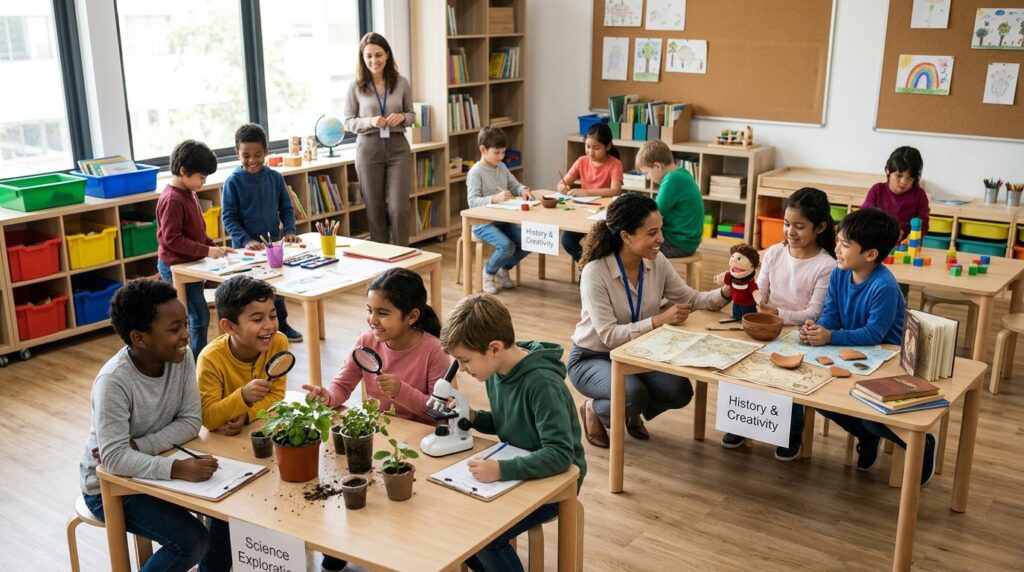
Great classroom teaching does not always have to follow the same format. Carefully selected primary workshops for schools can give pupils opportunities to explore curriculum topics through practical experiments, storytelling, performance, problem solving, creative activities, historical interpretation, movement, and collaborative learning. When workshops have clear educational objectives and are appropriate for children’s ages and needs, they can complement everyday teaching by approaching familiar subjects from a different perspective. The strongest sessions are not simply entertaining events but planned learning experiences that connect activities with what pupils are learning before, during, and after the visit.
Primary schools can use workshops in many curriculum areas, including science, history, literacy, mathematics, art, music, drama, computing, physical education, and personal development.
A workshop provider should not replace the teacher’s professional role. Instead, external specialists can contribute subject knowledge, unusual resources, practical activities, or performance skills that help schools enrich existing plans.
Choosing well requires attention to curriculum relevance, safeguarding, accessibility, provider experience, practical arrangements, costs, and how learning will be extended once the session finishes.
What Are Primary Workshops for Schools?
Primary workshops are structured learning sessions created for primary age pupils and usually delivered by an external specialist, organization, artist, educator, performer, or practitioner.
Some take place in classrooms, halls, libraries, playgrounds, or school grounds. Others can be delivered virtually.
Sessions range from short activities for a single class to full day programs involving multiple year groups.
The format depends on the subject and learning objectives.
A science workshop may involve demonstrations and pupil experiments, while a history session might use artifacts, costumes, storytelling, or role play. Creative workshops could involve writing, visual arts, dance, music, or theatre.
Why Primary Workshops for Schools Can Support Classroom Learning
A change in learning format can provide new ways for pupils to engage with a topic.
Practical experiences may make an abstract idea more concrete. Role play can provide context for historical or literary study. Collaborative challenges can encourage children to explain their thinking and work with others.
However, workshops should not be assumed to improve learning merely because they are interactive.
Educational value depends on quality, relevance, accessibility, delivery, and integration with broader teaching.
Schools should therefore ask providers what pupils are expected to learn rather than evaluating workshops only by how exciting the promotional description sounds.
How Primary Workshops for Schools Fit the Curriculum
The best curriculum connection is specific.
Instead of saying that a workshop “supports science,” a provider should be able to identify which concepts, skills, or areas it addresses and for which age groups.
In England, schools may compare content with relevant areas of the national curriculum. Schools elsewhere should use their applicable curriculum framework.
Teachers can then decide whether the session introduces a topic, deepens existing learning, provides revision, or offers a practical application.
9 Benefits of Primary Workshops for Schools
Workshops can support different educational goals depending on how they are designed. The following benefits are possibilities rather than guaranteed outcomes.
1. Primary Workshops for Schools Can Make Learning Interactive
Hands on activities give pupils opportunities to participate rather than only listen.
Children might measure, build, observe, solve, create, perform, classify, discuss, or investigate depending on the subject.
Participation should have a clear purpose.
An activity that creates excitement but does not connect with the learning objective can consume valuable school time without adding much educational value.
Good facilitators explain what pupils are doing, why they are doing it, and how it relates to the topic.
2. Primary Workshops for Schools Can Provide Specialist Expertise
External practitioners can bring skills or resources that are not regularly available within a school.
A professional musician may introduce unfamiliar instruments. A historian can bring high quality replicas or specialist knowledge. A science educator might provide equipment designed for classroom demonstrations.
Specialism should still be communicated at an age appropriate level.
Expert knowledge has limited value if the presenter cannot translate it into language and activities primary pupils can understand.
3. Primary Workshops for Schools Can Encourage Collaboration
Many workshops use pairs or small groups.
Collaborative activities can give pupils opportunities to share ideas, divide tasks, listen, negotiate, and explain reasoning.
The design of group work matters.
Simply placing children in teams does not guarantee productive collaboration. Clear roles, achievable tasks, suitable timing, and thoughtful facilitation can make participation more equitable.
Teachers may help providers understand existing classroom dynamics before the session.
4. Primary Workshops for Schools Can Support Different Learning Approaches
Pupils vary in their interests, confidence, prior knowledge, communication, and support needs.
Workshops that combine visual, verbal, practical, and collaborative elements can offer multiple ways to participate.
Providers should avoid simplistic claims that every child has one fixed “learning style.”
Educational research does not support tailoring teaching to rigid visual, auditory, or kinaesthetic learning style categories as a route to improved learning.
Varied teaching can still be valuable because it presents concepts in different useful forms.
5. Primary Workshops for Schools Can Build Topic Vocabulary
Specialist sessions can introduce and reinforce subject specific language.
A workshop about rocks might use vocabulary associated with properties and formation. A history session might introduce terms relevant to a particular period.
Facilitators should explain terminology clearly and revisit important words throughout the session.
Teachers can strengthen this learning by introducing key vocabulary beforehand and using it again afterward.
Vocabulary becomes more useful when pupils encounter it repeatedly in meaningful contexts.
6. Primary Workshops for Schools Can Create Memorable Context
A distinctive learning experience can give pupils a shared reference point for later classroom work.
Teachers might refer back to an experiment, performance, artifact, challenge, or story during subsequent lessons.
Memory does not automatically equal understanding, however.
A pupil remembering an exciting demonstration is not necessarily the same as understanding the concept behind it.
Follow up activities can help children explain what happened and connect the experience to curriculum knowledge.
7. Primary Workshops for Schools Can Encourage Creativity
Creative workshops can give pupils structured opportunities to generate ideas, experiment, make decisions, and produce original work.
This can occur in art, writing, drama, music, design, computing, and even STEM subjects.
Creativity benefits from constraints as well as freedom.
A strong workshop may provide a clear problem, materials, techniques, or theme while leaving enough room for pupils to make meaningful choices.
The objective should not be for every child to produce an identical final product.
8. Primary Workshops for Schools Can Enrich Theme Days and School Events
Workshops can support science weeks, book events, arts programs, cultural celebrations, history days, transition activities, and other special occasions.
They can give an event a clear educational structure.
Schools should nevertheless avoid choosing activities solely because they match a theme name.
A workshop offered during a themed week should still have age appropriate outcomes and fit the school’s wider learning goals.
9. Primary Workshops for Schools Can Support Teacher Follow Up
A strong provider may offer preparatory resources, vocabulary lists, reading suggestions, lesson ideas, worksheets, or extension activities.
These materials help the workshop become part of a sequence rather than an isolated event.
Schools should review resources before use.
Teachers can adapt them according to pupils’ needs and existing curriculum plans.
Useful follow up should deepen the learning rather than simply repeat what children already did.
Primary Workshops for Schools in Science
Science lends itself particularly well to practical workshop formats.
Children can observe phenomena, make predictions, collect information, classify materials, or investigate simple questions.
Activities should match pupils’ age and the school’s safety procedures.
Choosing Science Primary Workshops for Schools
Ask what scientific concepts the session addresses.
Terms such as “spectacular experiments” may sound appealing, but learning objectives should remain clear.
Find out whether pupils conduct activities themselves or primarily watch demonstrations.
Both approaches can have educational value.
Provider risk assessments, equipment requirements, substances used, supervision expectations, and classroom setup should be discussed in advance.
Safety in Science Primary Workshops for Schools
Providers should identify foreseeable risks and appropriate controls.
Schools should review relevant documentation according to their own health and safety procedures.
Activities involving heat, chemicals, electricity, projectiles, biological materials, or other hazards require especially careful planning.
Age appropriate protective equipment should be used where the risk assessment requires it.
Excitement should never depend on bypassing sensible safety controls.
Primary Workshops for Schools in History
History workshops can use storytelling, artifacts, replicas, costumes, role play, maps, images, and source analysis to explore the past.
They can help pupils encounter historical evidence in a more tangible way.
Historical accuracy remains important.
Historical Primary Workshops for Schools
Ask providers which period and curriculum objectives the workshop covers.
A session about ancient civilizations, the Romans, Anglo Saxons, Vikings, Tudors, Victorians, or twentieth century history should distinguish evidence from legend where appropriate.
Historical reenactment can be engaging while still acknowledging uncertainty.
Providers should avoid presenting contested interpretations as unquestionable fact when the evidence is more complex.
Handling Sensitive Topics in Primary Workshops for Schools
History can involve warfare, persecution, colonialism, enslavement, discrimination, death, and other difficult subjects.
These topics need age appropriate handling without unnecessary graphic detail.
Schools should ask beforehand what material will be covered.
Teachers can advise providers about relevant pupil circumstances and help determine whether adaptation is needed.
Sensitive history should be taught accurately and thoughtfully rather than sensationalized for entertainment.
Primary Workshops for Schools in Literacy
Literacy workshops can focus on storytelling, poetry, creative writing, spoken language, drama, author style sessions, or particular genres.
They can offer fresh prompts for reading and writing.
The best sessions involve pupils actively using language.
Literacy Primary Workshops for Schools and Storytelling
Oral storytelling can introduce structure, character, setting, vocabulary, and performance.
Pupils may retell sections, predict what happens next, create characters, or develop alternative endings.
Follow up writing can build on the shared experience.
This connection gives children a concrete starting point rather than presenting an isolated writing prompt.
Poetry Primary Workshops for Schools
Poetry workshops can explore rhythm, imagery, vocabulary, performance, and different poetic forms.
Avoid reducing poetry entirely to rhyme.
Age appropriate sessions can show pupils that poems use language in many ways.
Performance opportunities can be valuable, but children who are uncomfortable presenting alone should not necessarily be forced into an unnecessarily stressful public role.
Primary Workshops for Schools in Mathematics
Mathematics workshops can make use of games, puzzles, investigations, patterns, measurement, logic, and collaborative problem solving.
A successful maths workshop should do more than disguise routine questions with colorful props.
It should encourage mathematical thinking.
Problem Solving Primary Workshops for Schools
Open problems can allow pupils to try different strategies.
Facilitators can ask children to explain how they reached an answer rather than simply confirming whether it is correct.
This creates opportunities to discuss reasoning and misconceptions.
Difficulty should be calibrated carefully.
A challenge that is too easy can become superficial, while a task far beyond pupils’ current knowledge can produce frustration rather than productive struggle.
Primary Workshops for Schools in Art and Creativity
Visual arts workshops can expose pupils to techniques, materials, artists, and creative processes not routinely available in lessons.
Sessions might involve drawing, painting, printing, sculpture, textiles, collage, or digital art.
Materials need to be suitable for the relevant age group.
Creative Primary Workshops for Schools and Inclusion
Activities should allow meaningful participation from pupils with different motor, sensory, communication, or learning needs.
Adapted tools, additional time, alternative materials, or changes in instructions may be appropriate.
Discuss accessibility before the visit rather than improvising solutions after a pupil discovers they cannot participate.
Providers should be willing to work with teachers on reasonable adaptations.
Primary Workshops for Schools in Music and Performance
Music workshops can involve singing, rhythm, instruments, composition, listening, and performance.
Drama workshops may explore characters, stories, historical scenarios, communication, or confidence.
Noise levels and space requirements should be established beforehand.
Performance Primary Workshops for Schools
Participation should remain supportive and age appropriate.
Not every child enjoys being placed individually in front of a large audience.
Skilled facilitators can provide different participation routes, including group speaking, ensemble music, small group work, movement, or technical roles where appropriate.
The objective is meaningful learning, not identifying the most confident performer in the room.
Primary Workshops for Schools and Computing
Computing workshops may cover programming, computational thinking, robotics, digital creativity, online safety, or problem solving.
Check whether the school needs to provide devices and whether the software works with existing systems.
Data privacy can also matter.
Digital Primary Workshops for Schools
External providers should not collect children’s personal information unnecessarily.
If accounts, photographs, recordings, or online platforms are involved, schools need to follow applicable safeguarding and data protection procedures.
In the UK, this can include considerations under UK GDPR and the Data Protection Act 2018.
Schools should use their own policies and data protection guidance when evaluating technology based sessions.
AI Primary Workshops for Schools
As artificial intelligence becomes a classroom topic, workshops may introduce concepts such as pattern recognition, generative systems, limitations, bias, privacy, and responsible use.
Content should be appropriate to children’s ages.
Providers should not encourage pupils to enter personal or sensitive information into public AI tools without proper school authorization and safeguards.
Critical thinking is as important as demonstrating what technology can generate.
Safeguarding in Primary Workshops for Schools
Safeguarding is essential whenever external adults work with children.
Schools should follow their existing safeguarding policies and current statutory guidance relevant to their jurisdiction.
In England, Keeping Children Safe in Education is an important reference for schools.
Vetting Providers of Primary Workshops for Schools
Schools should establish what checks and supervision arrangements are appropriate for the activity.
DBS checking requirements depend on the role, frequency, nature of contact, and applicable eligibility rules. A DBS certificate should not be described as a complete safeguarding guarantee.
Providers should understand professional boundaries and school procedures.
Visitors normally need appropriate sign in, identification, supervision, and conduct arrangements according to school policy.
Photography During Primary Workshops for Schools
Providers should never assume they can photograph pupils for marketing.
Schools need to manage photography and video according to safeguarding, privacy, and consent requirements.
Agree expectations before the session.
If images are not necessary, avoiding collection altogether can simplify privacy management.
Where photographs are authorized, their purpose, storage, access, publication, and retention should be understood.
Accessibility in Primary Workshops for Schools
A workshop is not genuinely inclusive if some pupils are unable to participate in its core activities.
Providers should ask about access requirements early.
Schools can explain adaptations already used successfully with individual pupils.
Adapting Primary Workshops for Schools
Possible adjustments can involve instructions, visual supports, sensory environment, physical access, group size, communication methods, seating, breaks, or equipment.
The correct adaptation depends on the child rather than a diagnostic label alone.
Do not assume what a pupil can or cannot do.
Teachers, support staff, families where appropriate, and the pupil can provide valuable insight.
How to Choose Providers of Primary Workshops for Schools
Begin with educational purpose.
Identify what pupils should know, understand, or be able to do after the experience. Then look for providers whose sessions genuinely support those aims.
Price matters, but it should not be the only selection criterion.
Verify Primary Workshops for Schools Providers
Review the provider’s experience with the relevant age range.
Ask for safeguarding information, risk assessments where appropriate, public liability insurance, references or testimonials, accessibility information, and clear booking terms.
Verify claims that materially influence your decision.
A long list of schools supposedly served is less useful than clear evidence about what the provider delivers and how sessions are structured.
Questions to Ask About Primary Workshops for Schools
Before booking, schools can ask:
• What curriculum objectives does the workshop address?
• Which year groups is it designed for?
• How many pupils can participate effectively?
• What space and equipment are required?
• What safeguarding arrangements apply?
• Is a risk assessment available where relevant?
• How will additional needs be accommodated?
• Are photographs or pupil data collected?
• What is included in the total price?
• What happens if either party needs to cancel?
Written answers can make planning easier for teachers and administrators.
Budgeting for Primary Workshops for Schools
Workshop pricing varies according to provider, location, session length, number of pupils, equipment, staffing, travel, and specialist resources.
Schools should request a complete quotation.
Check whether VAT, travel, materials, accommodation, or additional sessions create extra charges.
Making Primary Workshops for Schools Cost Effective
Consider educational value per session rather than price alone.
A full day workshop serving several classes may provide value where logistics allow, while a specialist smaller group session may justify a higher cost per pupil for a particular learning objective.
Schools can also investigate local cultural organizations, museums, universities, charities, libraries, or community initiatives.
Funding opportunities vary over time and should be verified directly.
Planning Primary Workshops for Schools Successfully
Good logistics allow teachers and facilitators to focus on learning.
Confirm date, times, room, pupil numbers, age groups, breaks, equipment, parking or access, setup time, lunch arrangements, and school contacts.
Share essential policies beforehand.
Preparing Pupils for Primary Workshops for Schools
A brief introduction can give pupils enough context to participate immediately.
Teach essential vocabulary or discuss what they already know.
Avoid explaining every activity in advance.
A degree of discovery can remain part of the experience.
Teachers should also communicate expected behavior and participation norms using the school’s usual approach.
Following Up Primary Workshops for Schools
Revisit the learning soon afterward.
Ask pupils to explain important concepts, create something using their new knowledge, answer retrieval questions, or connect the workshop with subsequent lessons.
Feedback can also help schools evaluate providers.
Rather than asking only whether children enjoyed the day, investigate what they learned and which activities supported that learning.
Frequently Asked Questions
What are primary workshops for schools?
Primary workshops for schools are structured sessions that use specialist expertise or interactive activities to complement classroom teaching across curriculum and enrichment subjects.
Which subjects can primary workshops for schools cover?
They can cover science, history, literacy, maths, art, music, drama, computing, physical activity and other curriculum or enrichment areas.
How do primary workshops for schools support learning?
Well designed workshops can provide practical experiences, specialist resources, discussion, collaboration and memorable contexts that teachers can connect with classroom learning.
Are primary workshops for schools suitable for all year groups?
Many providers adapt sessions by age, but schools should verify that content, language, duration, activities and resources are appropriate for the specific year group.
What safeguarding checks do primary workshops for schools need?
Requirements depend on the provider’s role and jurisdiction. Schools should follow their safeguarding policies and current statutory guidance for visitors and external providers.
How should schools choose primary workshops for schools?
Compare curriculum relevance, age suitability, provider experience, safeguarding, accessibility, safety documentation, total cost, logistics and opportunities for follow up learning.
Conclusion
Primary workshops for schools can enrich classroom learning by giving children opportunities to investigate, create, perform, collaborate, and encounter specialist knowledge in fresh ways. Their educational value depends on much more than entertainment, making curriculum relevance, safeguarding, accessibility, safety, and age appropriate delivery essential considerations. Schools should define learning objectives first and then select providers capable of supporting them with clear evidence and practical planning. When workshops connect meaningfully with teaching before and after the event, they can become a valuable part of a broader learning sequence.