
Turning a product concept into a physical part requires designers to make decisions about geometry, materials, tolerances, surface quality, volume, cost, and manufacturability. CNC milling services are...
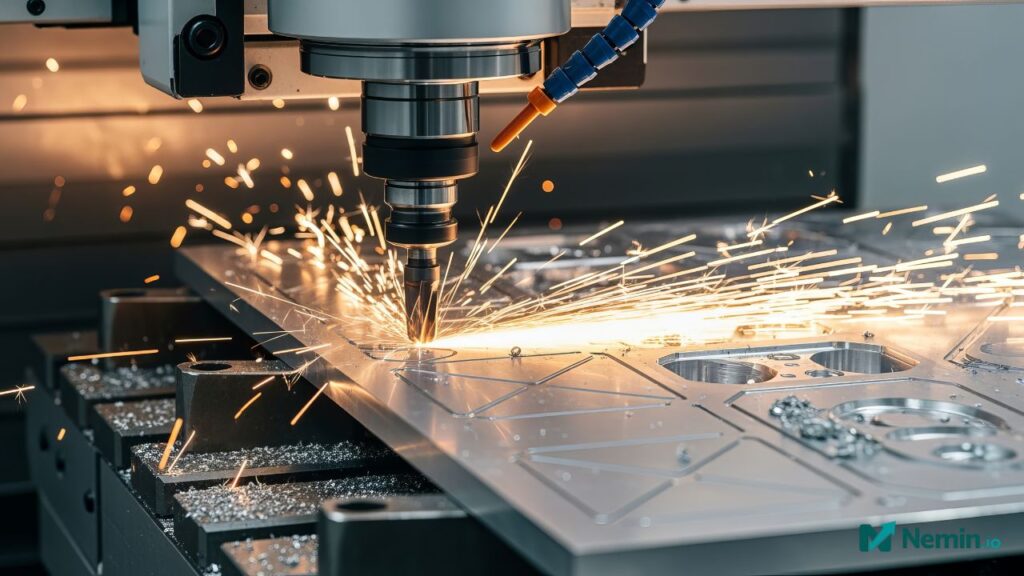
Turning a product concept into a physical part requires designers to make decisions about geometry, materials, tolerances, surface quality, volume, cost, and manufacturability. CNC milling services are widely used for this transition because computer-controlled machine tools can remove material from solid workpieces to produce accurate features in metals, engineering plastics, and other machinable materials. The process can support early prototypes, functional testing, fixtures, tooling, replacement parts, and repeat production.
CNC milling is only one option within modern manufacturing. Turning, injection moulding, additive manufacturing, sheet-metal fabrication, casting, forging, extrusion, and other processes can be more appropriate depending on part geometry and production volume. Effective product design therefore does not begin by forcing every component onto a milling machine. It begins by understanding what the part needs to do and then choosing CNC milling services when their combination of accuracy, material capability, flexibility, and production economics fits those requirements.
What Are CNC Milling Services?
CNC milling services use computer numerical control machine tools to remove material from a workpiece with rotating cutting tools. The machine follows programmed toolpaths generated from part geometry and manufacturing instructions.
The workpiece can be cut through operations such as facing, pocketing, profiling, drilling, boring, slotting, and contour machining.
Modern CNC milling services range from relatively straightforward three-axis machining to multi-axis systems capable of reaching complex features from several orientations.
Capabilities vary by supplier, machine, tooling, software, material, and component size.
How CNC Milling Services Work
A typical workflow begins with an engineering model or manufacturing drawing.
The manufacturer reviews the geometry for machinability, selects suitable stock, determines workholding, creates machining operations, programs toolpaths using computer-aided manufacturing software where appropriate, and sets up the machine.
Cutting tools then remove material progressively until the required geometry is produced.
Parts may undergo additional deburring, finishing, heat treatment, coating, or inspection depending on requirements.
CNC Milling Services Versus Manual Milling
Manual milling relies heavily on an operator directly controlling machine movements.
CNC equipment automates controlled machine-axis movement through programmed instructions.
This supports repeatability and allows more complex toolpaths.
Skilled machinists remain essential. They determine setups, tools, cutting parameters, workholding, inspection strategies, and how to respond when actual machining conditions differ from digital expectations.
Why CNC Milling Services Matter in Product Design
Machining lets designers create functional components directly from engineering materials without first investing in expensive production moulds.
This can make CNC milling services particularly useful during development, when geometry may still change.
Once a design stabilises and demand grows substantially, another manufacturing method may become more economical.
CNC Milling Services in Modern Manufacturing
Product development rarely depends on one process.
A smartphone, industrial pump, appliance, medical instrument, vehicle, or piece of production equipment can combine machined, moulded, stamped, cast, extruded, printed, welded, and coated components.
CNC milling services fill an important role where parts require subtractive machining.
Prototyping With CNC Milling Services
Machined prototypes can use the same or similar material families planned for production.
This makes them valuable for mechanical testing.
A designer can evaluate fit, stiffness, strength, thermal behaviour, fastener interfaces, sealing surfaces, and real assembly constraints more realistically than with some visual-only prototypes.
CNC Milling Services for Production Parts
Machining can also produce finished components directly.
It is common in aerospace, automotive, robotics, electronics, scientific instruments, industrial machinery, energy, defence, tooling, and many other sectors.
Production suitability depends on cycle time and economics.
A part requiring extensive machining may be appropriate at hundreds of units but uneconomical at hundreds of thousands.
1. CNC Milling Services Provide High Dimensional Control
Precision is one of the primary reasons designers specify machining.
However, terms such as high precision are meaningless without actual tolerances.
Tolerances Depend on the Part
Achievable tolerance depends on:
- Machine capability
- Part dimensions
- Geometry
- Material
- Tooling
- Setup strategy
- Temperature
- Workholding
- Measurement methods
- Surface finish
- Production volume
A CNC milling services supplier should review critical dimensions rather than promise one universal tolerance for every feature.
Apply Tight Tolerances Selectively
Unnecessarily tight tolerances increase manufacturing and inspection costs.
Designers should identify dimensions that truly affect function.
A cosmetic external surface may not require the same control as a bearing bore, locating feature, or sealing interface.
Good engineering drawings communicate these priorities clearly.
2. CNC Milling Services Handle Complex Geometry
Rotating cutting tools can generate pockets, holes, slots, contours, bosses, chamfers, threads, and three-dimensional surfaces.
Multi-axis machines expand access to complex features.
Three-Axis CNC Milling Services
Three-axis machines typically control movement along X, Y, and Z directions.
They can manufacture an enormous range of prismatic parts efficiently.
Features on multiple sides may require the part to be repositioned between operations.
Four-Axis CNC Milling Services
A fourth rotational axis can allow the workpiece to rotate during or between machining operations.
This can reduce manual repositioning for suitable geometry.
Five-Axis CNC Milling Services
Five-axis machines provide additional rotational movement that lets tools approach surfaces from more directions.
They can reduce setups and machine complex components.
Five-axis machining is not automatically necessary for every complicated-looking part. The supplier should choose the manufacturing approach that delivers the required result economically.
3. CNC Milling Services Support Many Materials
One advantage of machining is access to established engineering materials.
Different materials require different tooling and cutting strategies.
Aluminum CNC Milling Services
Aluminum alloys are widely machined because they combine relatively low density with useful mechanical properties and generally good machinability for many grades.
They appear in electronics, robotics, aerospace, fixtures, housings, and consumer products.
The exact alloy should be selected based on product requirements rather than simply specifying aluminum.
Steel CNC Milling Services
Carbon, alloy, tool, and stainless steels can provide high strength, wear resistance, corrosion resistance, or other properties depending on grade and treatment.
Some steels are significantly more difficult to machine than others.
Material condition and hardness can affect cutting time and tool wear.
Plastic CNC Milling Services
Engineering plastics can be machined for insulators, guides, prototypes, fixtures, housings, and various functional components.
Polymer machining requires attention to heat, deformation, workholding, moisture behaviour, and material-specific dimensional stability.
Other Materials
CNC milling services can process many additional materials, including copper alloys, titanium alloys, nickel alloys, composites, and specialist materials when the supplier has appropriate expertise.
Material capability should always be confirmed before ordering.
4. CNC Milling Services Enable Rapid Design Iteration
Tooling-intensive manufacturing processes can make design changes expensive after production tooling has been created.
Machining often provides greater flexibility during development.
Change the Digital Model
When a prototype reveals a design problem, an engineer can update the CAD model and drawing.
The manufacturer can then review the revised component and create updated machining instructions.
Physical tooling may still be required for workholding, but iteration can be more flexible than changing a complex injection mould.
Prototype Before Committing to Tooling
CNC milling services can help teams validate critical geometry before investing in mass-production tooling.
This can identify problems involving assembly, fasteners, clearances, ergonomics, interfaces, and functional performance.
Prototype testing should resemble intended service conditions where practical.
5. CNC Milling Services Offer Strong Repeatability
Once a process has been developed successfully, CNC machining can reproduce programmed movements consistently.
Repeatability still depends on material, tooling, fixtures, machine condition, setup, and process control.
Tool Wear Changes Results
Cutting tools wear during use.
As wear progresses, dimensions and surface finish can change.
Production CNC milling services should use appropriate tool-life management and inspection to keep critical features within specification.
Workholding Matters
A part can be machined accurately only if it is located and held appropriately.
Excessive clamping can distort thin components.
Insufficient clamping can allow movement.
Fixture design is therefore an important part of manufacturing engineering.
6. CNC Milling Services Can Deliver Excellent Surface Quality
Machined surfaces can achieve high-quality finishes when tools, feeds, speeds, rigidity, and finishing passes are appropriate.
Surface requirements should be defined according to function.
Functional Surface Finish
Sealing faces, sliding components, bearing areas, and optical or fluid interfaces can require particular surface characteristics.
An Ra value or another relevant parameter may be specified where justified.
Do not assign an extremely fine finish to the entire part when only one surface needs it.
Cosmetic CNC Milling Services
Visible machined parts often retain subtle tool patterns or receive post-processing such as polishing, bead blasting, anodising, plating, painting, or powder coating.
The desired appearance should be agreed before production.
Cosmetic standards are easier to control when defects and acceptable surface variation are documented.
7. CNC Milling Services Work Well for Low and Medium Volumes
Machining has relatively low dedicated tooling requirements for many parts compared with moulding, die casting, or stamping.
That can make it economically attractive at modest production quantities.
Unit Cost Versus Tooling Cost
A machined part may have a higher unit cost than a moulded part at high volumes.
Injection moulding, however, requires tooling investment.
The break-even point depends on geometry, material, tooling complexity, machining time, mould cycle, finishing, scrap, and anticipated volume.
Bridge Production
CNC milling services can sometimes provide bridge production while higher-volume tooling is being developed.
This allows early products to reach testing or customers sooner.
The machined version must still meet functional requirements and any material differences need evaluation.
8. CNC Milling Services Support Design for Manufacturability
Design for manufacturability, or DFM, aims to achieve the required function using geometry that can be manufactured reliably and economically.
Early supplier input can prevent expensive design decisions.
Avoid Unnecessarily Deep Pockets
Deep narrow pockets can require long tools that are less rigid and more susceptible to vibration or deflection.
Where function permits, improving tool access can reduce machining difficulty.
Internal Corners Need Tool Radius
A rotating milling cutter cannot naturally create a perfectly sharp internal corner.
Internal corners generally require a radius.
Designing suitable radii can allow larger, more rigid tools and faster machining.
Avoid Excessive Setups
Features requiring machining from many orientations can increase setup time.
Multi-axis CNC milling services may reduce repositioning, but simplifying geometry can still save cost.
CNC Milling Services Benefit From Standard Tool Access
Designers do not need to know every cutter in a machine shop.
They should understand that unusual tiny features, extreme depths, and inaccessible surfaces can require specialised tooling.
Discuss critical geometry with the manufacturer early.
9. CNC Milling Services Integrate With Quality Control
Manufactured components need verification against drawing or model requirements.
Inspection strategy should be proportional to product risk and tolerance.
Basic Inspection
Calipers, micrometers, gauges, height instruments, and other tools can verify appropriate dimensions.
Critical geometry may require more advanced equipment.
Coordinate Measuring Machines
A coordinate measuring machine, or CMM, can inspect complex dimensional relationships.
Capabilities and uncertainty depend on equipment, programming, environment, fixturing, and measurement strategy.
A CMM report is not automatically required for every CNC milling services order.
First Article Inspection
New parts or processes can receive more extensive inspection before full production.
Industries may have specific first-article requirements.
The customer should communicate these expectations at quotation stage because inspection adds cost and lead time.
CNC Milling Services Compared With CNC Turning
CNC turning rotates the workpiece while a cutting tool removes material.
It is especially suited to rotationally symmetric parts such as shafts, bushings, pins, and certain fittings.
CNC milling primarily rotates the cutting tool.
Mill-Turn Manufacturing
Modern mill-turn machines combine capabilities from both processes.
Complex rotational components with milled flats, holes, slots, or off-axis features can sometimes be completed in fewer setups.
The best process depends on part geometry.
CNC Milling Services Versus 3D Printing
Additive manufacturing builds parts layer by layer, whereas milling removes material from stock.
Each process has distinct advantages.
| Factor | CNC Milling Services | 3D Printing |
|---|---|---|
| Material form | Solid stock | Layer-built material |
| Tooling | Cutting tools and fixtures | Usually limited dedicated tooling |
| Internal geometry | Limited by tool access | Can enable complex internal features |
| Surface finish | Often strong directly from machining | May require post-processing |
| Material properties | Established wrought stock available | Process-dependent |
| Prototype speed | Strong for functional parts | Strong for rapid complex prototypes |
| Waste | Creates chips and removed material | Builds nearer to final geometry |
| Scaling | Strong for selected low-medium volumes | Depends heavily on process and part |
Neither method universally replaces the other.
CNC Milling Services Versus Injection Moulding
Injection moulding is highly efficient for large quantities of suitable polymer parts after tooling is completed.
CNC machining offers greater flexibility before that investment.
When CNC Milling Services Make More Sense
Machining can be attractive for prototypes, low volumes, engineering plastics, parts requiring tight machining features, or designs likely to change.
When Moulding Becomes Attractive
High-volume plastic products can justify mould tooling when the design is sufficiently stable.
Mouldability introduces its own design rules involving draft, wall thickness, gates, shrinkage, and tooling access.
CNC Milling Services Versus Casting
Casting creates parts by forming material within moulds.
Machining is often used afterward to establish precise surfaces and interfaces.
Near-Net-Shape Manufacturing
Casting can reduce the amount of material CNC milling services need to remove for high-volume or large components.
A cast pump housing, for example, may still require machining of flange faces, bores, threads, and sealing surfaces.
Combining processes can provide better economics than insisting on one method.
CNC Milling Services Versus Sheet Metal Fabrication
Sheet metal processes cut, bend, punch, stamp, and join relatively thin material.
For enclosures and brackets, sheet fabrication may use less material and cost less than machining the shape from a solid block.
Choose Based on Geometry
A simple bent bracket generally does not need to be milled from billet.
A compact component with thick sections, pockets, precision interfaces, and complex mounting features may suit machining better.
Modern product design succeeds by matching method to geometry.
CNC Milling Services Cost Drivers
Designers can reduce cost more effectively when they understand what creates machine time and complexity.
Material Cost
Stock price depends on alloy, dimensions, certification, availability, and market conditions.
Removing large amounts of expensive material can create both raw-material and machining costs.
Machine Time
Complex toolpaths, deep pockets, tight tolerances, hard materials, and fine finishes can increase cycle time.
Higher-end multi-axis equipment can have higher hourly costs but may reduce total setups.
Setup Cost
Programming, fixtures, tool selection, machine preparation, and inspection occur before or around production.
These costs are spread across quantity.
This is why unit prices can fall as CNC milling services order volumes increase.
Post-Processing
Heat treatment, anodising, plating, passivation, painting, grinding, polishing, and other secondary operations add cost and schedule.
Include them when comparing quotations.
CNC Milling Services and Material Waste
Subtractive manufacturing creates chips.
For some components, a large portion of the original stock is removed.
Improve Material Utilisation
Near-net stock sizes can reduce waste where they remain economical and available.
At larger volumes, castings, forgings, or extrusions can reduce machining material removal.
Recycle Machining Chips
Metal chips can often enter recycling streams when appropriately segregated and managed.
Coolant contamination and mixed alloys can affect scrap value.
Manufacturers should follow relevant environmental and waste requirements.
Choosing CNC Milling Services for Critical Parts
Safety-critical, regulated, aerospace, medical, automotive, or other high-consequence components can require additional controls.
Material Traceability
Customers may require certificates linking material batches with particular production lots.
Traceability requirements should be specified before ordering.
Process Validation
Some products require controlled manufacturing procedures, documented inspection, qualified special processes, or regulatory quality systems.
A general machine shop may not satisfy every sector’s requirements.
Supplier qualification should match risk.
Choosing a CNC Milling Services Provider
The right supplier is not simply the shop advertising the highest machine precision.
A strong provider has equipment, engineering capability, quality systems, capacity, and material experience suited to the actual part.
Ask About Machine Capability
Provide representative drawings under an appropriate confidentiality arrangement.
Ask how the supplier intends to manufacture the component.
Machine travel, spindle, axis count, workholding, tool availability, and inspection capacity can all matter.
Evaluate Quality Systems
Quality expectations vary by industry.
Review relevant certification, calibration, nonconformance control, traceability, inspection, and document processes.
Verify certifications through appropriate sources where material to supplier selection.
Check Capacity
A shop can be technically capable but unable to meet the required schedule.
Discuss batch quantity, frequency, lead time, forecast demand, and capacity before committing production work.
CNC Milling Services Quotation Best Practices
A complete request for quotation gives suppliers enough information to price consistently.
Include:
- 3D model where appropriate
- Controlled engineering drawing
- Material specification
- Quantity
- Tolerances
- Surface finish
- Threads
- Coating or treatment
- Inspection requirements
- Certification requirements
- Delivery destination
- Required date
- Annual volume where relevant
Incomplete RFQs lead suppliers to make assumptions.
Those assumptions make quotations harder to compare.
CNC Milling Services Best Practices for Designers
Product designers can improve cost and manufacturability without compromising function.
- Specify only necessary tolerances.
- Use realistic internal corner radii.
- Avoid excessively deep narrow features.
- Provide adequate tool access.
- Reduce unnecessary setups.
- Use standard hole and thread sizes where practical.
- Choose materials based on function and machinability.
- Identify critical surfaces clearly.
- Communicate cosmetic requirements.
- Consider stock dimensions.
- Review high-cost features with machinists early.
- Include inspection requirements in the RFQ.
- Control drawing and model revisions.
- Prototype critical geometry before scaling.
- Compare machining with alternative processes at higher volumes.
These CNC milling services practices reduce ambiguity and unnecessary manufacturing effort.
Common CNC Milling Services Design Mistakes
A part can be mathematically valid in CAD and unnecessarily difficult to manufacture.
Common mistakes include impossibly sharp internal corners, very deep tiny holes, excessive tolerance requirements, inaccessible surfaces, thin walls prone to distortion, unnecessary five-axis geometry, incomplete drawings, conflicting CAD and drawing data, and cosmetic requirements that are not objectively defined.
Another mistake is choosing material purely from a property chart.
Availability, stock size, condition, heat treatment, machining behaviour, and finishing also matter.
CNC Milling Services for Prototype Development
Prototypes should answer questions.
A visual prototype may only need overall shape, while a functional prototype needs more realistic material and dimensional performance.
Define Prototype Intent
Before ordering CNC milling services, decide what the prototype will validate.
Possible objectives include:
- Mechanical fit
- Assembly
- Strength
- Thermal response
- Sealing
- Ergonomics
- Appearance
- Fastener access
- Motion
- Manufacturing feasibility
Do not pay production-level inspection costs when a rough form study is all the project needs.
CNC Milling Services for Scaling Production
As demand grows, manufacturing strategy should be reviewed.
A process appropriate for 100 units may no longer be optimal at 100,000.
Optimize Cycle Time
At larger quantities, custom fixtures, tool optimization, pallet systems, automation, and multi-part setups can reduce handling.
The investment becomes more justifiable when spread across higher volume.
Consider Alternative Manufacturing
High-volume components may benefit from cast, forged, extruded, moulded, or stamped near-net shapes followed by CNC milling services on critical features.
Hybrid process planning can reduce cost without abandoning machining precision where it matters.
The Exciting Future of CNC Milling Services
Machining continues to evolve through more capable multi-axis equipment, automation, connected production systems, in-process measurement, advanced tooling, simulation, and data-driven process control.
Robotic loading can increase unattended production for suitable parts.
Tool-monitoring systems can help detect wear or breakage.
Digital manufacturing platforms can shorten quotation and procurement workflows.
Artificial intelligence can assist with manufacturability analysis and process planning, although experienced manufacturing engineers remain essential for difficult components.
CNC Milling Services and Digital Twins
Simulation can model toolpaths, detect collisions, and estimate machine behaviour before physical cutting.
More advanced digital manufacturing systems may increasingly connect design, machining, inspection, and production data.
The goal is not technology for its own sake.
It is more predictable production.
Why CNC Milling Services Will Remain Important
New manufacturing methods continue to emerge, but subtractive machining retains major advantages.
Industrial products still need accurate holes, sealing surfaces, bearing locations, interfaces, fixtures, molds, dies, and components made from established engineering materials.
CNC milling services are therefore likely to remain a central manufacturing method while increasingly working alongside additive, formative, and automated production technologies.
FAQ’s
What are CNC milling services?
CNC milling services use computer-controlled machines and rotating cutting tools to remove material from solid stock and produce precise components based on engineering models and drawings.
What materials can CNC milling services machine?
Common materials include aluminum, steel, stainless steel, engineering plastics, copper alloys, titanium, and other machinable materials, depending on supplier equipment and expertise.
Are CNC milling services suitable for prototypes?
Yes. CNC milling services can produce functional prototypes from engineering materials, making them useful for fit, mechanical testing, assembly, thermal evaluation, and design verification.
How accurate are CNC milling services?
Accuracy depends on machine capability, geometry, material, setup, tooling, temperature, measurement, and required tolerance. Critical tolerances should be specified and reviewed with the manufacturer.
Are CNC milling services expensive?
Cost depends on material, quantity, programming, setup, machine time, complexity, tolerances, finishes, inspection, and secondary processing. Simple designs and higher quantities can reduce unit cost.
When should CNC milling services be used instead of 3D printing?
CNC milling services can be preferable when established stock material properties, tight machined features, specific surface finishes, or suitable low-to-medium production economics are important.
Conclusion
CNC milling services occupy an important position in modern product development because they combine design flexibility with established engineering materials, controlled dimensions, complex geometry, and repeatable production. They can move a design from CAD into a functional prototype without requiring major production tooling, then continue supporting bridge production or finished manufacturing where quantities and component economics make machining appropriate.
The greatest value from CNC milling services comes from designing with the process rather than merely sending any CAD model to a machine shop. Appropriate tolerances, accessible geometry, sensible corner radii, suitable materials, clearly defined finishes, controlled drawings, and early manufacturing input can reduce cost while improving quality. When designers also compare CNC milling with turning, additive manufacturing, moulding, casting, and sheet fabrication, they can select the process that best fits each component and build modern products around manufacturing methods that are both technically sound and commercially practical.