
Healthcare organizations often discover that generic software does not perfectly match the way their clinicians document care, coordinate teams, exchange information, schedule services, or manage...
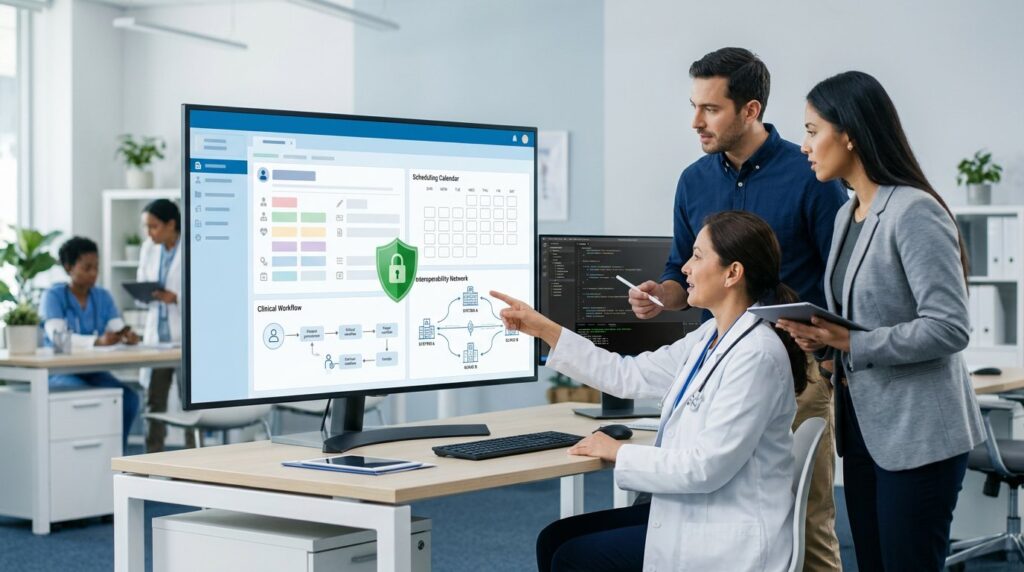
Healthcare organizations often discover that generic software does not perfectly match the way their clinicians document care, coordinate teams, exchange information, schedule services, or manage specialized workflows. Custom EHR development offers another approach by designing electronic health record capabilities around defined clinical and operational requirements. However, building healthcare software is substantially more complex than creating an ordinary business application. Patient safety, privacy, cybersecurity, interoperability, regulatory requirements, accessibility, data integrity, clinical usability, implementation, and long term maintenance must be addressed throughout the software lifecycle.
Customization can range from developing extensions and integrations for an established EHR to creating a more comprehensive proprietary platform. These options involve very different levels of cost, risk, regulatory responsibility, and maintenance.
Before commissioning a new system, organizations should establish whether genuine custom development is necessary. Configuration, standards based integration, workflow redesign, or targeted modules may solve the underlying problem with less complexity.
When custom software is justified, success begins with clinical needs rather than technology choices.
What Is Custom EHR Development?
Custom electronic health record development is the process of designing and engineering software that creates, stores, presents, exchanges, or manages electronic health information according to an organization’s specific requirements.
An EHR can include far more than clinical notes.
Depending on scope, features can involve patient registration, encounter documentation, medication information, orders, results, appointments, messaging, billing interfaces, clinical decision support, patient portals, reporting, and interoperability with external systems.
A custom solution does not necessarily need to replace every existing application.
Organizations can develop specialized modules that integrate with established systems through supported standards and APIs.
Why Organizations Consider Custom EHR Development
The primary reason should be a clearly documented unmet need.
Specialty practices may have workflows poorly represented in general purpose software. Healthcare networks may need to integrate several systems. New care models may require specialized patient engagement or coordination capabilities.
Organizations may also seek greater control over workflows, interfaces, integrations, or analytics.
Control creates responsibility, however.
A proprietary system requires ongoing security updates, regulatory monitoring, infrastructure management, interoperability maintenance, user support, and product development.
The complete lifecycle should be considered before development begins.
When Custom EHR Development May Not Be Necessary
Building from scratch is not automatically more efficient than purchasing established software.
First examine whether existing products can meet requirements through configuration, templates, integrations, APIs, or approved extensions.
Evaluate total ownership cost.
A seemingly expensive commercial license can still cost less than years of software engineering, security, testing, hosting, compliance, implementation, and support.
Custom development is most defensible when the differentiated requirements are important enough to justify those responsibilities.
9 Essential Custom EHR Development Steps
Healthcare software should be developed through a structured, multidisciplinary process. These nine areas are central to responsible planning.
1. Begin Custom EHR Development With Clinical Workflow Research
Do not start by drawing dashboards.
Observe how clinicians, nurses, administrative teams, pharmacists, laboratory staff, and other relevant users actually complete their work.
Document current workflows and pain points.
Identify where information originates, who needs it, which decisions depend on it, and where delays or duplication occur.
Include different roles because optimizing one user’s interface can unintentionally create additional work for another team.
The product requirements should emerge from real clinical and operational needs rather than assumptions made by developers.
2. Define Custom EHR Development Requirements Precisely
Separate essential requirements from desirable features.
Functional requirements describe what the system must do. Nonfunctional requirements cover areas such as performance, availability, security, scalability, accessibility, and recoverability.
Clinical requirements need additional precision.
Ambiguous behavior around allergies, medications, orders, results, patient identity, or decision support can create safety implications.
Requirements should be traceable through design, development, testing, and acceptance.
3. Design Custom EHR Development for Interoperability
Healthcare organizations rarely operate in isolation.
An EHR may need to exchange information with laboratories, pharmacies, imaging systems, hospitals, payers, public health systems, patient applications, or other clinical platforms.
Standards based interoperability reduces unnecessary proprietary coupling.
HL7 FHIR is increasingly important for modern healthcare data exchange, while HL7 v2, DICOM, X12, CDA and other standards remain relevant in particular contexts and markets.
Use the standards appropriate to the actual integration.
4. Build Security Into Custom EHR Development
Healthcare information is highly sensitive.
Security should be designed into architecture and engineering rather than added shortly before launch.
Controls can include strong authentication, appropriate authorization, encryption, audit logging, secure session management, vulnerability management, secrets protection, backup, disaster recovery, and monitoring.
Access should generally reflect job responsibilities and least privilege principles.
Threat modeling can help teams identify likely abuse cases before implementation.
5. Align Custom EHR Development With Applicable Compliance
There is no single worldwide EHR compliance framework.
In the United States, HIPAA and HITECH may be relevant depending on the organization and data relationship. Other requirements can include 42 CFR Part 2, state privacy laws, information blocking rules, ONC certification criteria, FDA regulation in certain software contexts, and contractual obligations.
The EU and UK have their own privacy and healthcare frameworks.
Compliance needs to be determined for the specific organization, product, users, data, and jurisdictions.
Qualified legal and compliance professionals should participate early.
6. Prioritize Usability in Custom EHR Development
Clinical software needs to support demanding work environments.
Poorly designed interfaces can create unnecessary clicks, make important information difficult to find, encourage workarounds, and contribute to documentation burden.
Usability testing should involve representative users.
Avoid designing exclusively around executives or a small group of enthusiastic clinicians.
Test routine tasks as well as unusual but important scenarios.
Accessibility should also be incorporated according to applicable requirements and good design practice.
7. Test Custom EHR Development for Clinical Safety
Ordinary software testing is necessary but insufficient.
Unit, integration, performance, security, and usability testing should be accompanied by scenarios focused on clinically significant workflows.
Test patient identification, orders, results, medication information, allergies, alerts, date and time handling, data exchange, and failure states where relevant.
Consider what happens when external systems are unavailable.
Safe behavior during failure can be just as important as functionality when everything works normally.
8. Implement Custom EHR Development Gradually
A technically functional system can still fail during implementation if users are unprepared.
Pilot deployment provides an opportunity to test workflows in a controlled environment.
Training should be role specific.
Clinicians need different information from reception staff or system administrators.
Create escalation channels for problems during launch and distinguish urgent patient safety issues from ordinary usability requests.
9. Treat Custom EHR Development as an Ongoing Product
EHR work does not stop after deployment.
Clinical requirements change, interoperability standards evolve, vulnerabilities emerge, regulations are updated, browsers and operating systems change, and user needs develop.
Establish ownership for long term maintenance.
Monitor system performance, security, error patterns, user feedback, integration failures, and safety concerns.
Software lifecycle costs should form part of the business case from the beginning.
Custom EHR Development Architecture
Architecture determines how effectively the system can evolve, scale, integrate, and recover from failures.
There is no universal best architecture.
Choices should reflect organization size, expected workload, team capabilities, availability requirements, integration landscape, regulatory obligations, and infrastructure strategy.
Cloud Custom EHR Development
Cloud infrastructure can provide scalable computing, managed services, geographic redundancy, and mature security capabilities when configured appropriately.
Using a major cloud provider does not automatically make an application compliant.
The healthcare organization and software team remain responsible for configuration, access, application security, data governance, and contractual requirements relevant to their roles.
Where HIPAA applies, organizations should determine whether appropriate business associate agreements are required.
On Premises Custom EHR Development
On premises deployment can provide organizations with direct infrastructure control but also creates significant operational responsibilities.
Teams need to manage servers, physical security, networking, backups, patching, monitoring, redundancy, and disaster recovery.
Hybrid architectures are also possible.
The decision should be based on requirements rather than an assumption that cloud is always safer or on premises is always more private.
Custom EHR Development and Interoperability
Interoperability means more than exporting a PDF.
Useful exchange requires systems to represent, transmit, interpret, and incorporate data in ways that preserve meaning.
Semantic differences can remain even when two platforms use the same technical standard.
FHIR in Custom EHR Development
FHIR, or Fast Healthcare Interoperability Resources, is an HL7 standard designed for electronic healthcare information exchange.
It represents information through resources and supports modern API based interactions.
FHIR implementations may use profiles, implementation guides, terminology systems, and jurisdiction specific constraints.
Simply exposing a JSON API does not make an application meaningfully FHIR compliant.
Teams need to follow the applicable implementation specifications and test interoperability with intended partners.
HL7 in Custom EHR Development
HL7 v2 remains common in healthcare environments, particularly for event driven exchange involving admissions, orders, and results.
Implementations can vary between organizations.
Interface engines are often used to route and transform messages.
Testing should include real partner specifications rather than generic sample messages alone.
An interface that works against an internal test file can still fail against production data variations.
DICOM in Custom EHR Development
DICOM is widely associated with medical imaging and related information.
EHR products that integrate with radiology systems or image archives may need to work with DICOM alongside other standards.
Imaging files can be extremely large.
Architecture should consider storage, network performance, viewer requirements, privacy, and clinical context rather than attempting to place every image directly inside ordinary EHR database records.
Custom EHR Development Security Requirements
Healthcare platforms are attractive targets for cybercrime because they can contain sensitive information and support critical operations.
Security programs should assume that credentials can be stolen, endpoints can become compromised, and software vulnerabilities can emerge.
Defense in depth helps limit impact.
Authentication in Custom EHR Development
Strong authentication reduces unauthorized access risk.
Multifactor authentication is important for many healthcare environments, particularly for administrative or remote access.
Authentication design should remain usable in clinical settings.
Emergency access requirements may also need specific workflows.
Any “break glass” capability should be designed carefully, logged, monitored, and governed rather than functioning as a universal bypass.
Authorization in Custom EHR Development
A successfully authenticated user should not automatically see every patient record or administrative function.
Role based access control can provide a starting point.
Some systems may need more contextual rules.
Permissions should be reviewed as employees change positions or leave the organization.
Privileged administrative access deserves particularly strong protection and monitoring.
Audit Logging in Custom EHR Development
Audit logs can record relevant access and system activity for security, compliance, troubleshooting, and investigations.
Logs themselves can contain sensitive information.
Protect them against unauthorized changes and access.
Define retention according to applicable legal, contractual, security, and operational requirements.
Monitoring should focus on meaningful patterns rather than generating so many alerts that important events disappear into noise.
Custom EHR Development and Data Privacy
Privacy begins with understanding what information the application collects and why.
Data minimization can reduce unnecessary risk.
Do not collect sensitive information merely because it might become useful someday.
Patient Consent in Custom EHR Development
Consent requirements depend on jurisdiction, data type, purpose, and healthcare context.
Not every healthcare processing activity uses consent as its legal basis, particularly under regulatory systems such as GDPR.
Product teams should therefore avoid designing one generic consent checkbox and assuming it solves every privacy obligation.
Legal and privacy professionals should map applicable processing purposes and requirements.
Custom EHR Development Data Retention
Medical record retention rules vary.
Organizations may also have contractual, accreditation, litigation, or specialty specific requirements.
Deletion is therefore not simply a user interface feature.
Retention policies should be defined before designing storage lifecycle processes.
Backups and archives need consideration because deleting a production record may not immediately erase every historical copy.
Custom EHR Development User Experience
EHR usability has direct consequences for efficiency and potentially patient safety.
Clinicians frequently operate under time pressure while switching between tasks.
Interfaces should help them prioritize information.
Custom EHR Development for Clinical Documentation
Documentation should capture required information without unnecessarily duplicating work.
Templates can improve consistency but can also encourage irrelevant copied text when poorly designed.
Structured data is valuable for analytics and interoperability, while free text remains important for clinical nuance.
Good design finds an appropriate balance.
Voice technologies and ambient documentation tools can alter workflows, but their output still requires appropriate accuracy, privacy, and clinical review.
Custom EHR Development and Alert Fatigue
Clinical alerts can become ineffective when users receive too many low value warnings.
Teams should not add alerts merely because a risk can theoretically occur.
Decision support needs appropriate clinical governance and evaluation.
Measure override patterns and user response.
An alert ignored nearly every time may need redesign, although override rate alone does not establish that the alert is clinically unnecessary.
Custom EHR Development for Mobile Devices
Clinicians increasingly use phones and tablets, but mobile interfaces should be designed around appropriate tasks.
Trying to compress a complex desktop screen into a phone layout can produce poor usability.
Select high value mobile workflows.
Mobile Security in Custom EHR Development
Consider device encryption, authentication, session timeout, remote management where appropriate, data stored locally, screenshots, notifications, and loss or theft.
Avoid exposing sensitive clinical information in lock screen notifications unless organizational policy and design appropriately address that risk.
Bring your own device arrangements can introduce additional privacy and management complexity.
Organizations need clear policies before deploying mobile clinical applications broadly.
Custom EHR Development Testing
Healthcare software testing should include normal operations, edge cases, integration failures, and realistic clinical scenarios.
Test data should be managed responsibly.
Using production patient information casually in development environments can create unnecessary privacy exposure.
Performance Testing in Custom EHR Development
Clinicians cannot wait indefinitely for records to load during care.
Test expected concurrency and peak workloads.
Interfaces with laboratories, imaging, billing, or external services should also be assessed for delays and timeouts.
Define acceptable performance requirements before launch.
Monitoring after deployment can then identify whether production behavior remains within those targets.
Custom EHR Development Disaster Recovery Testing
Backups alone are insufficient.
Organizations need to know whether systems and data can actually be recovered within acceptable timeframes.
Define recovery time and recovery point objectives based on business and clinical needs.
Test restoration periodically.
Downtime procedures should also explain how care continues while electronic systems are unavailable and how data generated during downtime will later be reconciled.
Custom EHR Development Data Migration Testing
Replacing an existing EHR often requires transferring historical records.
Mapping should preserve meaning.
Dates, units, codes, medications, allergies, provider identities, documents, results, and patient relationships can all create migration challenges.
Reconcile source and destination data systematically.
Clinically significant data deserves additional validation rather than reliance only on total record counts.
Custom EHR Development Costs
There is no meaningful universal price for custom EHR software.
A small specialty module and an enterprise platform supporting multiple hospitals represent entirely different projects.
Cost depends on functionality, integrations, compliance scope, team composition, infrastructure, testing, migration, and support.
What Influences Custom EHR Development Cost?
Important factors include:
• Number and complexity of workflows
• Web and mobile applications
• Interoperability interfaces
• Data migration
• Security requirements
• Regulatory scope
• Clinical decision support
• Patient portal functionality
• Reporting and analytics
• Third party integrations
• Testing and validation
• Infrastructure and monitoring
• Training and implementation
• Ongoing maintenance
Organizations should estimate total ownership cost, not only initial engineering.
Custom EHR Development Build Versus Buy Analysis
Compare custom development against established systems objectively.
Commercial software may offer mature functionality and existing integrations but impose licensing costs or workflow constraints.
Custom software offers greater control but creates development and maintenance obligations.
Hybrid strategies can often be practical.
A healthcare organization might keep a certified or established core EHR while developing differentiated applications around supported APIs.
Custom EHR Development Team Structure
Healthcare software needs multidisciplinary expertise.
Software engineers alone should not define clinical workflows.
Clinicians alone should not be expected to design secure technical architecture.
Collaboration matters.
Roles in Custom EHR Development
Depending on scope, teams may include:
• Clinical informaticists
• Physicians and nurses
• Product managers
• UX researchers and designers
• Software engineers
• Solution architects
• Interoperability specialists
• Cybersecurity professionals
• Quality assurance engineers
• Data engineers
• DevOps or platform engineers
• Compliance and privacy professionals
• Implementation specialists
Smaller projects may combine roles, but required competencies still need coverage.
Clinical Governance in Custom EHR Development
Clinical functionality should have accountable professional oversight.
Establish how safety concerns, decision support changes, terminology updates, and clinical workflow modifications are reviewed.
Feedback channels should make it easy for users to report potential patient safety issues.
High priority reports need a defined escalation process rather than being handled as ordinary feature requests.
Custom EHR Development Implementation Strategy
Implementation should include technical deployment and organizational change.
Users need to understand new workflows and know where to obtain help.
Leadership should set realistic expectations around the transition.
Training for Custom EHR Development Rollouts
Role based training is more effective than forcing every employee through identical material.
Use realistic workflows.
Provide safe training environments that do not expose actual patient data unnecessarily.
Offer additional support around go live.
Quick reference materials can supplement formal training, particularly for infrequent but important tasks.
Measuring Custom EHR Development Success
Select metrics before implementation.
Measures can include task completion times, support requests, system performance, documentation quality, interface failures, user satisfaction, safety reports, and adoption of intended workflows.
Clinical outcome claims require stronger methodology.
Do not attribute changes in patient outcomes to an EHR feature without research capable of supporting that conclusion.
Custom EHR Development Mistakes to Avoid
One major mistake is automating an inefficient workflow without first understanding why it exists.
Another is treating compliance as a checklist performed immediately before release.
Excessive customization can also become difficult to maintain.
Avoid Proprietary Lock In With Custom EHR Development
Use recognized standards where they adequately serve the requirement.
Document data models and APIs.
Ensure the organization can export its information in usable forms according to applicable requirements and contracts.
Technology choices should support future migration rather than making the original development vendor permanently indispensable.
Avoid Scope Creep in Custom EHR Development
Healthcare stakeholders can generate hundreds of reasonable feature requests.
Without prioritization, the project can grow indefinitely.
Define an initial product scope around high value workflows.
Additional functions can follow after validation.
A smaller system that works reliably in clinical practice is more valuable than an enormous specification that never reaches safe deployment.
Frequently Asked Questions
What is custom EHR development?
Custom EHR development creates healthcare software around specific clinical and operational workflows, including records, integrations, documentation, scheduling or other required functions.
How long does custom EHR development take?
Timelines vary from months for focused modules to multiple years for complex platforms. Scope, integrations, compliance, migration, testing and implementation strongly affect duration.
Is custom EHR development HIPAA compliant?
Software is not automatically HIPAA compliant by being custom built. Compliance depends on the organization, safeguards, contracts, configuration, operations and applicable regulatory role.
Which standards matter in custom EHR development?
Depending on the workflow, relevant standards can include HL7 FHIR, HL7 v2, DICOM, X12, CDA and recognized clinical terminologies or implementation guides.
How much does custom EHR development cost?
Costs vary widely according to functionality, integrations, security, migration, infrastructure, regulatory scope and long term support. Total ownership cost should guide budgeting.
Is custom EHR development better than an off the shelf EHR?
Not necessarily. Custom development is useful when important requirements cannot be met through existing products, configuration or integrations and the organization can support the lifecycle.
Conclusion
Custom EHR development can give healthcare organizations greater control over clinical workflows and integration, but that flexibility comes with substantial responsibility. Interoperability, cybersecurity, privacy, usability, patient safety, regulatory obligations, migration, testing, and ongoing maintenance should shape the system from its earliest requirements. Organizations should first determine whether custom development genuinely provides advantages over configuring or extending an established platform. When a custom solution is justified, multidisciplinary clinical and technical governance provides the strongest foundation for building an EHR that remains secure, usable, interoperable, and maintainable over time.