
Modern future of work discussions increasingly focus on how artificial intelligence, automation, demographic change, hybrid work, skills development, and shifting worker expectations could reshape jobs and organizations....
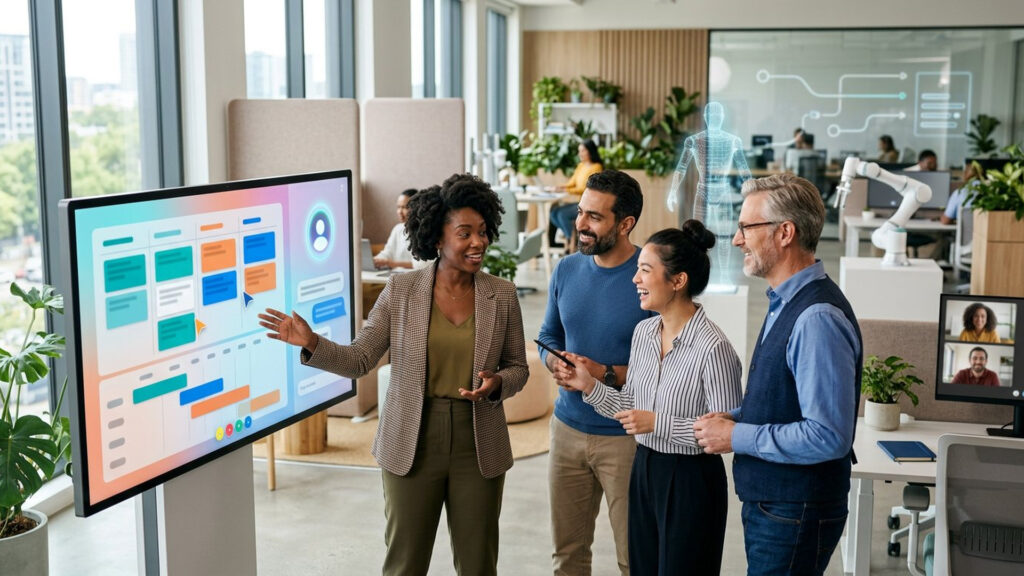
Modern future of work discussions increasingly focus on how artificial intelligence, automation, demographic change, hybrid work, skills development, and shifting worker expectations could reshape jobs and organizations. The future is unlikely to be defined simply by technology replacing people or offices disappearing. Different occupations, industries, regions, and workers will experience change differently, while organizational decisions and public policy will influence how technological gains, risks, and opportunities are distributed.
Generative AI has intensified these conversations because software can now perform parts of many knowledge based tasks, including drafting, summarization, coding assistance, data analysis, research support, and customer communication. At the same time, employers continue to face questions about productivity, skills shortages, employee wellbeing, workplace flexibility, cybersecurity, and the value of in person collaboration.
The most useful discussion therefore asks not merely which jobs will disappear, but which tasks will change, what new capabilities workers will need, and how organizations can redesign work responsibly.
What Are Future of Work Discussions?
Future of work discussions examine how employment, occupations, workplaces, skills, management, technology, and labor markets may evolve.
These conversations occur among business leaders, employees, governments, researchers, labor organizations, educators, and technology companies.
Important subjects include:
• Artificial intelligence
• Automation
• Remote and hybrid work
• Workforce skills
• Job redesign
• Employee wellbeing
• Workplace flexibility
• Demographic change
• Digital collaboration
• Cybersecurity
• Productivity
• Employment policy
• Freelance and platform work
• Lifelong learning
No single forecast can reliably predict all these areas because labor markets respond to economic, technological, political, and social change.
Why Future of Work Discussions Matter
Work provides income, but its impact extends further.
Employment structures influence communities, education, housing, transportation, family life, public finances, business competitiveness, and individual wellbeing.
Changes in work can therefore create consequences throughout society.
Technology Is Changing Tasks
Technological change often affects tasks within occupations rather than eliminating entire occupations immediately.
A professional role may contain administrative, analytical, interpersonal, creative, and decision making tasks. AI could automate or accelerate some while leaving others largely human controlled.
This task level perspective provides more nuance than labeling whole professions as safe or obsolete.
Organizations Need to Plan Before Change Arrives
Companies implementing AI or automation without workforce planning can create fragmented processes, security risks, employee uncertainty, and duplicated work.
Strategic preparation involves deciding which processes should change and what people will need to perform effectively within the new system.
9 Trends Shaping Future of Work Discussions
The following themes are likely to remain central to workplace strategy, although their importance will vary across industries.
1. Artificial Intelligence at Work
Generative AI has made sophisticated language and multimodal capabilities broadly accessible.
Employees can use AI to help draft documents, analyze information, generate software code, summarize meetings, create content, and support other tasks.
AI Is More Likely to Transform Many Jobs Than Affect Them Uniformly
The impact depends on task composition.
Roles containing large volumes of standardized digital information may expose more tasks to automation or augmentation than jobs requiring substantial physical work in unpredictable environments.
Even highly exposed occupations can retain important human responsibilities.
2. Automation Beyond Office Work
Automation is not limited to generative AI.
Industrial robotics, warehouse systems, autonomous technologies, software automation, computer vision, and process control continue changing physical and administrative work.
Human and Machine Collaboration
Automation can shift workers from direct task execution toward supervision, exception handling, maintenance, quality control, or customer interaction.
Whether this improves work quality depends partly on how organizations redesign roles.
3. Hybrid Work Will Continue Evolving
The rapid expansion of remote work demonstrated that many knowledge based activities can occur outside conventional offices.
Organizations have since adopted a wide range of remote, hybrid, and in person models.
There Is No Universal Best Hybrid Schedule
The appropriate arrangement depends on work characteristics.
Software development, laboratory research, manufacturing, healthcare, retail, hospitality, and construction have fundamentally different physical requirements.
Even within one organization, different teams may benefit from different schedules.
4. Skills Based Workforce Planning
Employers are increasingly interested in the capabilities required to perform work rather than relying solely on traditional job titles.
Skills based approaches can help organizations identify gaps and create more targeted development plans.
5. Continuous Learning
Workers can no longer assume that capabilities acquired at the beginning of a career will remain sufficient indefinitely.
Technology and business models change too quickly.
Employers, educational institutions, and workers increasingly need models for ongoing learning.
6. Human Skills Will Remain Important
AI can generate fluent language and analyze large amounts of information, but workplaces also depend on judgment, communication, empathy, negotiation, leadership, accountability, and contextual understanding.
These abilities can become more valuable when routine production is automated.
7. Employee Wellbeing Will Remain a Management Issue
Digital work can provide flexibility while also creating risks of constant availability, meeting overload, isolation, or blurred boundaries.
Work design matters alongside wellness benefits.
8. Workforce Demographics Will Change
Aging populations, migration, changing retirement patterns, and younger generations entering employment will affect labor supply differently across countries.
Organizations may need to redesign work for a more age diverse workforce.
9. Work Will Become More Data Driven
Digital workplace systems generate extensive information about productivity, communication, and behavior.
Using this data responsibly will become an increasingly important governance challenge.
AI and the Future of Work
Artificial intelligence dominates current debate partly because its potential applications extend across many occupations.
AI as an Assistant
In augmentation oriented workflows, AI performs selected tasks while people remain responsible for broader outcomes.
Examples can include:
• Drafting initial text
• Summarizing documents
• Suggesting software code
• Classifying information
• Translating draft content
• Generating creative concepts
• Searching internal knowledge
Human review is particularly important where errors have significant consequences.
AI as Automation
Some workflows can be redesigned so software completes a larger share of the process with limited intervention.
Automation is more appropriate when outputs can be validated reliably and the consequences of mistakes are manageable.
High Stakes Work Needs Stronger Oversight
Healthcare, financial services, law, critical infrastructure, employment decisions, and other consequential fields require careful governance.
Organizations should not assume an AI system is reliable simply because its output sounds confident.
Will AI Replace Jobs?
Some jobs may decline, others may expand, and many will change.
The scale and timing remain uncertain.
Jobs Are Bundles of Tasks
Consider an accountant.
The occupation can include data entry, reconciliation, analysis, communication, regulatory interpretation, client advice, investigation, and professional judgment.
AI may affect these tasks differently.
New Jobs Can Also Emerge
Previous technological transitions created roles that had not existed earlier.
AI is already contributing to work in model evaluation, AI governance, data operations, safety, implementation, integration, and workflow redesign.
However, new job creation does not guarantee that displaced workers will transition automatically or without disruption.
Future of Work Discussions Around Remote Work
Remote work remains one of the most visible changes in employment.
Benefits of Remote Work
Depending on the role and person, potential advantages include:
• Reduced commuting
• Geographic flexibility
• Access to wider talent pools
• Greater schedule flexibility
• Fewer office interruptions
These benefits are not experienced equally.
Challenges of Remote Work
Potential difficulties include isolation, communication friction, unsuitable home working environments, cybersecurity risks, and weaker informal knowledge sharing.
Hybrid Work
Hybrid models attempt to combine remote flexibility with in person interaction.
Success depends on intentional work design rather than merely specifying a number of office days.
The Future of Offices
Offices are unlikely to vanish universally.
Their role may continue shifting from being the default location for individual computer work toward supporting collaboration, social interaction, client meetings, specialist equipment, and organizational culture.
Office Design
Future workplaces may emphasize:
• Collaborative spaces
• Quiet focus areas
• Flexible meeting rooms
• Video collaboration facilities
• Shared desks
• Accessible design
• Social spaces
Building strategy should follow actual workforce behavior rather than trends alone.
Skills for the Future of Work
Technical abilities matter, but they form only one part of future readiness.
AI Literacy
Workers increasingly need to understand what AI can and cannot do.
Useful AI literacy includes knowing how to provide effective instructions, verify outputs, protect sensitive data, recognize limitations, and use approved tools.
Data Literacy
Employees across many functions increasingly encounter dashboards, analytics, metrics, and automated recommendations.
Understanding basic data interpretation can improve decision quality.
Cybersecurity Awareness
A more digital workplace creates additional security exposure.
Workers should understand phishing, account security, sensitive information handling, approved software, and incident reporting.
Critical Thinking
When machines can produce answers quickly, evaluating those answers becomes more important.
Workers need to distinguish plausible language from reliable evidence.
Reskilling and Upskilling
These terms are related but not identical.
Upskilling
Upskilling develops additional capabilities that improve performance in an existing or evolving role.
An analyst learning AI assisted data tools is one example.
Reskilling
Reskilling prepares someone for substantially different work.
It can become important when technology or economic change reduces demand for particular tasks.
Training Needs Real Application
Completing an online course does not automatically create competence.
Employees need opportunities to practice new skills in realistic work environments.
Leadership and the Future of Work
New technology does not eliminate the need for effective management.
In some ways, it makes leadership more important because teams face faster organizational change.
Leaders Need to Explain Why
Employees are more likely to understand change when organizations clearly explain the business problem being addressed.
Introducing AI solely because competitors are doing so can create poorly defined projects.
Psychological Safety
Workers should be able to report errors, risks, and unintended consequences without inappropriate retaliation.
This becomes important when organizations are experimenting with immature technologies.
Productivity in Future of Work Discussions
Productivity is often cited as the primary justification for automation.
Yet measuring productivity in knowledge work can be difficult.
Output Is Not the Same as Value
An AI system might help employees write twice as many documents.
That is only a productivity gain if those additional documents are useful.
Organizations should measure meaningful outcomes rather than volume alone.
Watch for Hidden Work
Automation can shift effort rather than eliminate it.
Employees may save time drafting but spend additional time correcting errors, verifying claims, reformatting output, or resolving downstream problems.
Employee Monitoring and Workplace Data
Remote and digital work has expanded the availability of employee activity data.
Organizations should use this information carefully.
Activity Metrics Can Be Misleading
Mouse movement, keyboard activity, or online status do not necessarily measure meaningful productivity.
Employees can optimize visible activity without improving outcomes.
Privacy Matters
Monitoring employees can trigger privacy, labor, data protection, and employment law requirements.
Rules vary by jurisdiction.
Transparency and proportionality are important even where monitoring is legally permitted.
Future of Work and Cybersecurity
More cloud systems, personal devices, AI tools, and remote connections can expand the digital attack surface.
Shadow AI
Employees may use unapproved AI services because they are convenient.
This can expose confidential business information if data governance is weak.
Approved AI Tools
Organizations should define which systems employees can use and what information can be entered.
Policies need to be practical enough that employees can still perform their work effectively.
Future of Work and Education
Education systems face pressure to prepare students for work that will continue changing after graduation.
Teach Adaptability
Specific software skills can become outdated.
Foundational knowledge, problem solving, communication, quantitative reasoning, digital literacy, and learning ability provide broader adaptability.
AI in Education
Students need to learn both how to use AI and when independent thinking is required.
Assessment design may need to evolve so educational institutions can evaluate genuine understanding.
Future of Work and Freelancing
Digital platforms have made project based and freelance work more accessible across many professional categories.
Potential Benefits
Independent work can provide flexibility, broader client access, and control over projects.
Potential Risks
Freelancers can face unpredictable income, limited benefits, administrative responsibilities, and weaker employment protections.
Legal distinctions between contractors and employees remain important.
Future of Work for Small Businesses
Small companies can potentially benefit substantially from AI because automation can give small teams capabilities that previously required larger departments.
Practical Applications
Small businesses may use approved AI tools for:
• Administrative drafts
• Customer service assistance
• Marketing ideation
• Data organization
• Research support
• Internal documentation
Sensitive or consequential work still requires appropriate review.
Start With a Business Problem
Do not purchase technology before defining the process that needs improvement.
A simple workflow change can sometimes provide more value than a sophisticated AI system.
Future of Work for Large Enterprises
Large organizations face additional challenges involving governance, legacy infrastructure, regulatory obligations, and workforce scale.
Enterprise AI Governance
Organizations may need policies covering:
• Approved AI systems
• Data handling
• Model evaluation
• Human oversight
• Security
• Procurement
• Intellectual property
• Regulatory requirements
• Incident management
Governance should enable responsible use rather than functioning only as a prohibition.
Workplace Equality and Automation
Technological change can create benefits and disadvantages for different groups.
Bias in Automated Decisions
AI systems used in recruitment, evaluation, scheduling, or promotion can reproduce or amplify problematic patterns when data, models, or implementation are flawed.
Automated employment decisions therefore require careful validation and legal review.
Accessibility
Technology can also improve workplace accessibility through transcription, speech interfaces, translation, assistive writing, and other tools.
Accessibility should be included in design from the beginning.
Future of Work Policy Discussions
Governments face questions about labor rights, AI regulation, education, social protection, taxation, and economic competitiveness.
Worker Protection
Policy debates include how existing labor protections apply when algorithms influence hiring, management, scheduling, or termination.
AI Regulation
Different jurisdictions are developing different regulatory frameworks.
Multinational employers need to account for rules applying where workers and systems operate.
How Organizations Can Prepare for the Future of Work
Future readiness does not require predicting 20 years accurately.
Organizations can instead build adaptability.
Map Tasks and Skills
Identify what employees actually do rather than relying exclusively on job titles.
Determine which tasks are repetitive, judgment intensive, physical, interpersonal, regulated, or information heavy.
Test Technology Carefully
Pilot tools in controlled settings before large deployments.
Measure output quality, time savings, errors, employee experience, and security implications.
Invest in Employees
Workers need time and resources to learn new systems.
Training should be tied to real workflows.
Keep Humans Accountable
When an automated system contributes to an important decision, responsibility should remain clear.
Organizations should avoid creating environments where employees simply defer to software.
Common Mistakes in Future of Work Discussions
Forecasts can become overly simplistic.
Common mistakes include:
• Assuming AI will replace every job
• Assuming technology will have no employment impact
• Treating all remote work as identical
• Measuring productivity through activity alone
• Ignoring worker perspectives
• Automating broken processes
• Neglecting cybersecurity
• Underinvesting in training
• Treating predictions as established facts
• Assuming one workplace model suits every occupation
Future scenarios should be presented with appropriate uncertainty.
How to Run Better Future of Work Discussions
Organizations can make these conversations more productive by connecting them to specific decisions.
Include Different Perspectives
Invite leadership, employees, technology teams, HR, security, legal specialists, and operations representatives where relevant.
Different functions often see risks that others overlook.
Ask Concrete Questions
Useful questions include:
• Which tasks are changing now?
• Which skills are becoming more important?
• Where can AI genuinely improve quality?
• Which decisions require human judgment?
• What data should never enter public AI tools?
• How should hybrid work be evaluated?
• Which employees need reskilling?
• How will productivity be measured?
• What risks could automation introduce?
These questions turn abstract predictions into practical planning.
Frequently Asked Questions
What are future of work discussions?
Future of work discussions examine how AI, automation, workplace models, demographics, skills, employment relationships, and economic change may reshape jobs and organizations.
Will AI replace human workers?
AI may automate some tasks and contribute to changes in certain jobs, while augmenting or creating other work. The effects will vary substantially by occupation and industry.
Is hybrid work the future?
Hybrid work will likely remain important for many knowledge based roles, but jobs requiring physical presence will continue to use different workplace models.
What skills will matter in the future of work?
AI literacy, critical thinking, communication, data literacy, cybersecurity awareness, adaptability, specialized domain knowledge, and interpersonal judgment are likely to remain valuable.
How should companies prepare for workplace automation?
Map current tasks, identify suitable automation opportunities, test technology, assess risks, retrain employees, measure outcomes, and maintain human oversight for consequential decisions.
Why are future of work discussions important?
They help employers, workers, educators, and policymakers anticipate changing skill requirements, organizational risks, technology opportunities, and potential labor market disruption.
Conclusion
Future of work discussions are increasingly centered on how AI, automation, hybrid workplaces, changing skills, and demographic shifts interact rather than on any single technology. Many occupations will evolve at the task level, making continuous learning and thoughtful job redesign increasingly important for employers and workers. Organizations that measure real outcomes, protect sensitive information, involve employees, and maintain human accountability will be better positioned to adopt new tools responsibly. The future of work cannot be predicted precisely, but businesses and individuals can prepare by building adaptable skills, systems, and workplace practices.