
Ever spent hours reviewing a chapter only to forget half of it two days later? You aren't alone. Traditional study routines—like re-reading highlighted notes—often trick...
Ever spent hours reviewing a chapter only to forget half of it two days later? You aren’t alone. Traditional study routines—like re-reading highlighted notes—often trick us into feeling prepared when we really aren’t. Switching over to Active Recall Practice changes how your brain processes information, turning study time into actual long-term memory.
Discover how Active Recall Practice can help you retain facts faster, boost exam performance, cut down study time, and replace weak study habits.
How Active Recall Practice Can Support Learning
Most students spend their study sessions flipping through pages, running highlighters over sentences, and nodding along. But when test day arrives and the desk is empty, grabbing those facts back out of your head feels surprisingly tough. Why? Because reading passively only builds basic familiarity—it doesn’t train your brain to retrieve facts.
That’s where Active Recall Practice flips the script. Instead of looking at the answers right away, you force your mind to pull information out from memory completely unassisted.
Think about the mental effort it takes to recall a song name or someone’s home address. That slight mental strain is the exact trigger that builds stronger memory pathways. When you test yourself regularly during weekly study blocks, pulling up facts under exam pressure becomes second nature.
Better Ways to Use Active Recall for Studying
Shifting to this approach doesn’t mean tossing out your textbooks or slides. It simply changes what you do after reading a section for the first time.
A simple place to start? Try the cover-and-test trick. Read a single page, cover it with a notebook, and speak out loud or write down everything you just learned. Once you hit a wall, uncover the page and check what you missed.
You can also turn your study outlines into questions rather than plain facts. Instead of writing down “Photosynthesis helps plants make food,” write “How do plants make their own food?” Answering that prompt forces your brain to stay active every time you review.
Choosing the Right Tools for Self-Testing
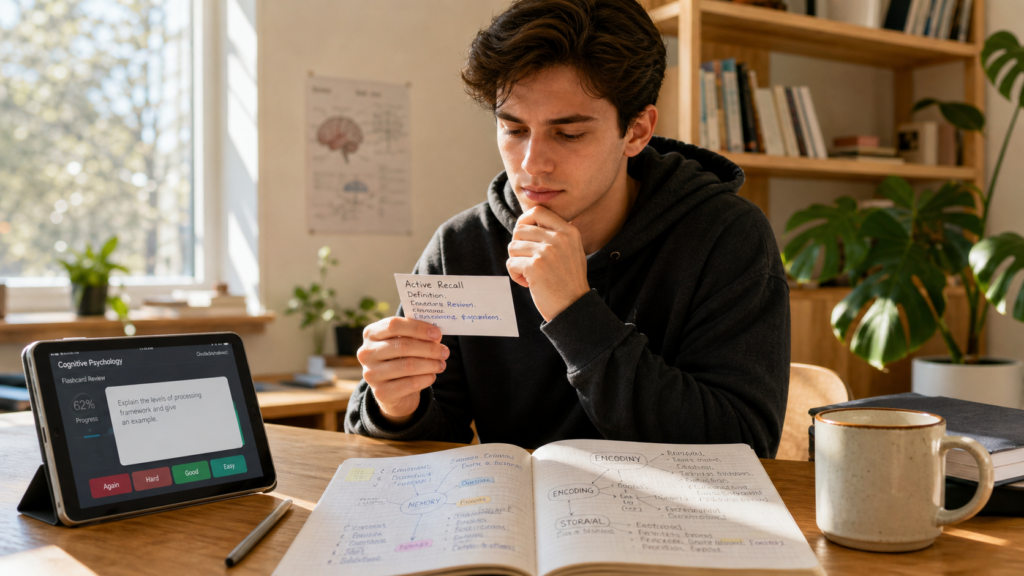
You don’t need fancy platforms to test yourself daily, though a few simple apps can speed things up. Classic index cards work wonders for learning foreign vocabulary, key dates, or science formulas.
If you like digital tools better, flashcard apps or simple two-column spreadsheets do the trick just as well. Just make sure whatever tool you use hides the answer until you make a real attempt to guess it first.
Making Difficult Topics Easier
Some subjects—like organic chemistry, tax laws, or long math proofs—feel almost impossible to memorize by reading alone. Trying to swallow dense paragraphs line by line usually leads straight to burnout.
Breaking complex material down with Active Recall Practice keeps tough subjects manageable. Start by testing yourself on basic terms first. From there, move on to multi-step problem solving and practical scenarios.
Imagine prepping for a tough biology module loaded with detailed diagrams. Instead of staring at a completed chart, grab a blank outline and label the parts from memory. Seeing where you get stuck immediately pinpoints what needs extra work.
And don’t sweat your mistakes along the way. Getting an answer wrong during practice is actually a good thing—it alerts your brain to pay closer attention when you check the right response.
Saving Time During Study Sessions
It might sound strange, but quizzing yourself continuously actually saves a ton of time. Reading the same chapter four times in a row takes hours and leaves you tired with very little retained.
Self-testing cuts down your study hours by showing you your weak spots right away. If you quiz yourself on ten concepts and easily answer eight, you know you don’t need to waste time reviewing those eight tonight. You can drop them and focus entirely on the two tricky ones.
Saving time isn’t about cutting corners. It’s about working smarter so you spend less time staring at pages and more time mastering what matters.
Combining Testing with Spaced Repetition
Active testing works best when you space it out properly. Quizzing yourself on a topic ten times in a single evening won’t do much if you ignore it for the rest of the month.
A much better system is spreading your self-testing over days and weeks. Test yourself on a topic today, check it again two days later, and review it a week after that.
As facts stick better, you can stretch out the gaps between study blocks. Spacing out your reviews keeps details fresh without requiring exhausting late-night cram sessions right before midterms.
Building a More Effective Daily Routine
Switching up your habits takes a little patience if you are used to passive reading. Start small during your next study window instead of trying to change everything at once.
Try starting your next session with a blank sheet of paper. Spend five minutes writing down everything you remember from yesterday’s lecture. When your brain runs out of steam, open your notes and fill in the missing pieces with a red pen.
Making Active Recall Practice a regular habit builds real confidence over time. When you walk into an exam room, you won’t just hope you remember—you’ll know you can recall the material because you’ve proven it to yourself all week long.
Final Thoughts
Studying doesn’t have to be a frustrating loop of reading and forgetting. By focusing on pulling information out of your mind rather than just shoving it in, you take total control of your learning. Used consistently, self-testing clears up confusing topics, sharpens your memory, cuts down study stress, and leads to much better grades.