
Cryptocurrency users frequently move between stable-value digital assets and more volatile cryptocurrencies as part of trading, investing, payments, or portfolio management. Exchanging Tether (USDT) for Bitcoin...
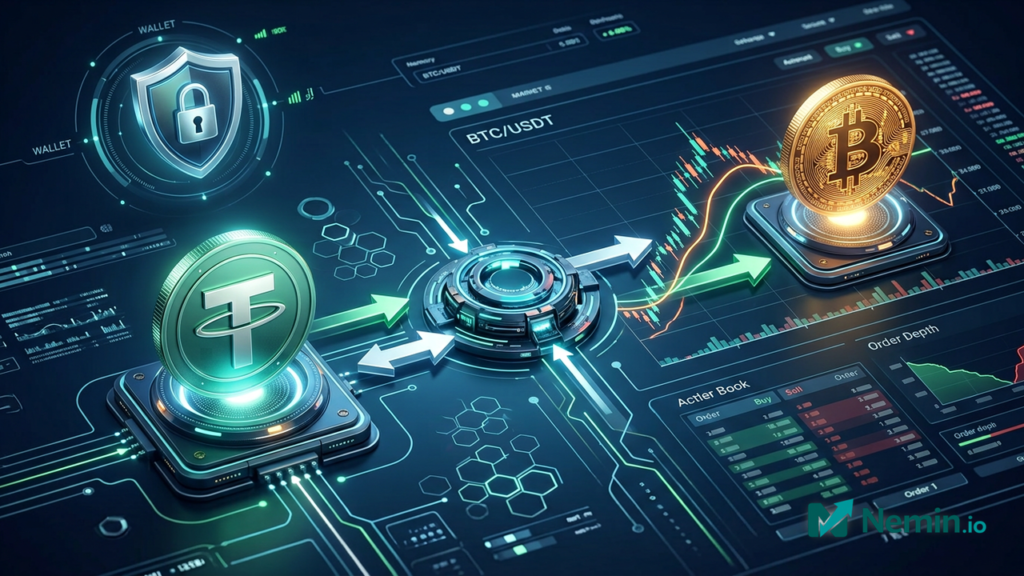
Cryptocurrency users frequently move between stable-value digital assets and more volatile cryptocurrencies as part of trading, investing, payments, or portfolio management. Exchanging Tether (USDT) for Bitcoin (BTC) is one of these common conversions: USDT is designed to track the value of the U.S. dollar, while Bitcoin is a market-priced crypto asset whose value can change substantially over short periods. The conversion itself can be performed through centralized exchanges, decentralized services where compatible infrastructure exists, or other cryptocurrency swap providers. Choosing an appropriate method requires more than comparing a displayed exchange rate; fees, liquidity, custody, blockchain networks, security, execution type, and local regulatory requirements can all affect the final result.
This guide explains how a USDT-to-BTC exchange works, what features to compare, the main risks, and practical precautions users can consider before making a transaction. It is educational information rather than personalized financial or investment advice.
What Does Exchanging Tether (USDT) for Bitcoin (BTC) Mean?
Exchanging Tether (USDT) for Bitcoin (BTC) perform different functions within the digital asset ecosystem.
Tether (USDT) is a stablecoin issued by Tether and designed to maintain a value pegged to the U.S. dollar. It exists on multiple blockchain networks. Bitcoin (BTC), meanwhile, is the native asset of the Bitcoin network and does not target a fixed price.
Converting USDT into BTC means selling or swapping a specified quantity of USDT and receiving Bitcoin based on the available exchange rate, minus applicable costs.
For example, if BTC were trading at $100,000, a theoretical $1,000 worth of USDT would correspond to 0.01 BTC before trading fees, spreads, price movement, or other charges. This number is only an illustration—not a current Bitcoin price quote.
1. Understand How Exchanging Tether (USDT) for Bitcoin (BTC) Works
On a cryptocurrency exchange offering a BTC/USDT market, users can typically place an order to buy BTC using USDT.
A simplified process involves:
- Selecting a reputable service available in the user’s jurisdiction.
- Completing any required account and identity verification.
- Funding the account with USDT or using an existing USDT balance.
- Selecting the appropriate BTC/USDT trading pair.
- Choosing an order type and reviewing the price and fees.
- Executing the transaction.
- Verifying the resulting BTC balance.
- Withdrawing BTC to a personal wallet if appropriate.
Exact procedures vary substantially between services. Users should rely on the provider’s official documentation before sending cryptocurrency.
2. Choose Between Market and Limit Orders
Order type can affect execution. A market order attempts to execute immediately against available orders in the market. It prioritizes execution speed rather than a particular price. In liquid markets, execution may occur close to the displayed quote, although rapid market movement or larger transactions can cause slippage.
A limit order specifies the maximum price a buyer is willing to pay for Bitcoin. It gives the user greater control over price but may remain unfilled if the market never reaches that level.
Neither order type is universally better. The appropriate choice depends on objectives, liquidity, urgency, and market conditions.
3. Compare the Full Cost, Not Just the Quoted Price
Exchanging Tether (USDT) for Bitcoin (BTC) and Understanding Fees
A displayed BTC price does not necessarily represent the total cost of a transaction. Exchanging Tether (USDT) for Bitcoin (BTC) Costs may include:
- Trading fees
- Conversion fees
- Bid-ask spreads
- Blockchain withdrawal fees
- Network fees
- Deposit fees in some circumstances
- Service charges
- Slippage
Before confirming a conversion, compare how much BTC will actually be received after all applicable costs.
Some providers advertise zero trading fees while earning revenue through spreads or other charges. This is why comparing the final execution amount can be more informative than looking at one fee category.
Before converting, check the Bitcoin price on Coinranking and compare prices across listed exchanges.
4. Pay Attention to USDT Blockchain Networks
One of the most important technical details is that Exchanging Tether (USDT) for Bitcoin (BTC) operates on multiple networks.
A platform might support USDT on Ethereum, Tron, Solana, or other supported blockchains. Deposit and withdrawal support differs between providers and can change over time.
Sending USDT through an unsupported network, or using incompatible deposit details, can result in delayed or potentially unrecoverable funds.
Before transferring USDT, verify:
- The cryptocurrency is USDT.
- The sending and receiving networks match.
- The address is correct.
- Any required memo or additional identifier is included.
- The platform currently supports the selected network.
For substantial transfers, users sometimes choose to perform a small test transaction first, taking fees into account.
5. Evaluate Liquidity Before Making the Swap
Liquidity describes how easily an asset can be traded without substantially affecting its price.
BTC/USDT is commonly offered by cryptocurrency trading venues, but liquidity differs among platforms and can vary with market conditions.
Higher liquidity generally means tighter bid-ask spreads and potentially lower slippage. Lower liquidity can result in the execution price moving further from the price initially displayed, particularly for larger orders.Liquidity becomes even more important when placing larger Bitcoin orders. Those looking to buy large amount of Bitcoin should pay close attention to order-book depth, as limited liquidity can affect the final execution price.
Users can examine order-book depth, trading activity, spreads, and execution information where those details are available.
6. Consider Custody and Security
Security When Exchanging Tether (USDT) for Bitcoin (BTC)
The method used for the conversion determines who controls the cryptocurrency during the process.
With a custodial centralized exchange, the platform generally controls the private keys for funds held in the account. With self-custody solutions, users retain greater control but also assume responsibility for protecting seed phrases and private keys.
Important security practices include using strong unique passwords, enabling robust multi-factor authentication, verifying website domains, avoiding unsolicited links, and safeguarding wallet recovery information.
Never provide a seed phrase or private key to someone claiming it is necessary to process an exchange.
7. Understand Price Volatility Before Converting
The risk profile changes significantly when moving from Exchanging Tether (USDT) for Bitcoin (BTC).
USDT is intended to maintain a stable relationship with the U.S. dollar, although stablecoins have their own issuer, reserve, counterparty, market, technical, and regulatory risks. BTC does not have a fixed dollar value and can experience substantial price fluctuations.
Once USDT has been converted into BTC, the dollar value of those funds can rise or fall significantly.
Anyone considering the transaction should understand Bitcoin volatility and avoid assuming that historical price increases guarantee future returns.
Centralized Exchanges vs. Other Swap Methods
Centralized cryptocurrency exchanges are a common option because they may offer order books, liquidity, account tools, customer support, and familiar trading interfaces. However, they introduce custodial and platform-related risks.
Some cryptocurrency swap services offer simpler conversions without a conventional trading interface. Convenience may come with different spreads, pricing structures, custody arrangements, or verification requirements.
Decentralized mechanisms can provide non-custodial alternatives in certain ecosystems, but converting blockchain-native representations or cross-chain assets can involve bridges, wrapped tokens, smart contracts, and additional technical risks. Native Bitcoin does not operate as an ordinary token on smart-contract networks.
The correct option depends on technical knowledge, jurisdiction, transaction size, custody preference, and risk tolerance.
8. Check Regulation, Availability, and Tax Considerations
Cryptocurrency rules differ significantly between countries and can change over time.
A platform available in one jurisdiction may be restricted in another. Identity verification, anti-money-laundering controls, transaction monitoring, reporting, and tax obligations may also apply.
In some jurisdictions, swapping one cryptocurrency for another can create a taxable event. Users should preserve transaction records, including acquisition costs, conversion values, dates, fees, and transaction identifiers, where appropriate.
For specific tax or legal questions, consult a qualified professional familiar with the relevant jurisdiction.
9. Verify Every Transaction Before Confirming
Blockchain transfers can be difficult or impossible to reverse. Small verification steps therefore matter.
Before sending funds or executing a swap, check the asset, network, destination address, transaction amount, expected BTC received, fees, and service details.
Be cautious of unusually attractive exchange rates. Cryptocurrency scams may use fake trading sites, impersonation, malicious wallet connections, phishing pages, or fabricated investment opportunities to obtain funds or credentials.
Use independently verified official websites and applications rather than links received through unsolicited messages.
Recommendations for a Safer USDT-to-BTC Conversion
Exchanging Tether (USDT) for Bitcoin (BTC): Practical Recommendations
A sensible process begins by deciding whether the conversion itself fits your financial objective. Once that decision is made, compare established providers based on more than advertised rates.
Look at liquidity, total costs, supported USDT networks, BTC withdrawal policies, security controls, regulatory availability, and custody arrangements. Review the complete transaction details before approval.
For beginners, a simple interface may reduce operational complexity, but ease of use should not replace security checks. More experienced users may value advanced order types and self-custody options, although these can introduce additional technical responsibilities.
There is no exchange method that removes cryptocurrency risk entirely.
Common Mistakes to Avoid
A frequent error is selecting the wrong blockchain network when depositing USDT. Another is assuming that the service displaying the lowest headline fee necessarily provides the best overall exchange rate.
Users should also avoid leaving more cryptocurrency than necessary on a service they do not intend to use for custody, while recognizing that self-custody introduces its own risks.
Other mistakes include responding to fake support representatives, copying cryptocurrency addresses without verification, approving unknown wallet permissions, ignoring tax recordkeeping, and trading during extreme volatility without understanding potential slippage.
Careful verification is often more valuable than completing the transaction a few seconds faster.
Frequently Asked Questions
1. What does Exchanging Tether (USDT) for Bitcoin (BTC) involve?
Exchanging Tether (USDT) for Bitcoin (BTC) involves converting USDT into BTC at an available market or quoted rate, with the final amount affected by fees, spreads, slippage, and other applicable costs.
2. Is USDT the same as Bitcoin?
No. USDT is a stablecoin designed to track the U.S. dollar, while BTC is the native cryptocurrency of the Bitcoin network and has a market-driven, volatile price.
3. Which network should I use when transferring USDT?
For Exchanging Tether (USDT) for Bitcoin (BTC) Use only a USDT network explicitly supported by both the sending and receiving services. Always verify network compatibility before initiating a transfer.
4. Is a market or limit order better for buying BTC with USDT?
Market orders prioritize immediate execution, while limit orders provide greater price control but may not execute. The appropriate choice depends on the user’s circumstances.
5. What fees apply when converting USDT to BTC?
Potential costs include trading or conversion fees, spreads, slippage, and deposit or withdrawal-related charges. The exact structure depends on the provider.
6. Is converting USDT to BTC risk-free?
No. Bitcoin has substantial price volatility, while exchanges, wallets, stablecoins, blockchain transfers, and custody methods each introduce additional risks.
Conclusion
For cryptocurrency users, Exchanging Tether (USDT) for Bitcoin (BTC) can be technically straightforward, but making the conversion responsibly requires attention to several details. The headline exchange rate is only one consideration: liquidity, trading costs, spreads, USDT network compatibility, custody, security, platform availability, taxes, and Bitcoin’s price volatility can all affect the transaction. Users should verify every address and network before transferring funds, understand the order type they select, compare the final amount of BTC they will receive, and use services appropriate for their jurisdiction. Most importantly, a technically successful exchange does not make Bitcoin a low-risk investment; the resulting BTC remains exposed to cryptocurrency market volatility.