
Regulatory compliance is becoming increasingly complex as businesses navigate evolving regulations, growing data volumes, and stricter reporting requirements. Manual reviews and disconnected systems can make...
Regulatory compliance is becoming increasingly complex as businesses navigate evolving regulations, growing data volumes, and stricter reporting requirements. Manual reviews and disconnected systems can make it difficult to identify risks, maintain accurate records, and respond to regulatory changes efficiently.
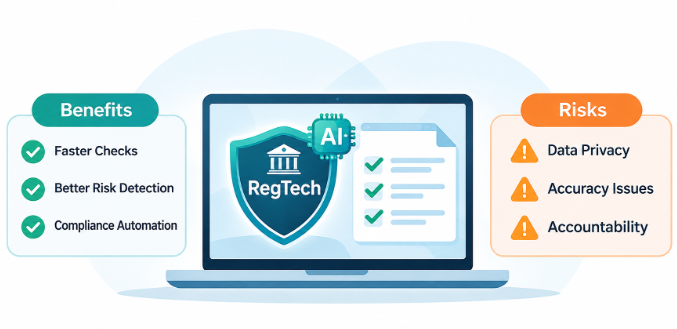
Artificial intelligence (AI) is changing how organizations manage these challenges by helping them analyze documents, detect unusual patterns, and streamline compliance tasks. However, adopting AI also raises concerns about data privacy, inaccurate outputs, and accountability. For businesses evaluating regtech software development services, understanding these benefits and risks is essential to determining where AI can improve compliance processes without compromising security or regulatory obligations.
What is AI in Regulatory Compliance?
AI in regulatory compliance refers to using artificial intelligence to help businesses interpret information, identify potential compliance issues, and manage regulatory processes more efficiently. Technologies such as machine learning, natural language processing (NLP), and intelligent document processing can help analyze large volumes of documents, detect unusual patterns, and extract relevant information from business records.
Regulatory Technology (RegTech) combines software and digital tools to help organizations manage compliance requirements, risk monitoring, and regulatory reporting. AI enhances these capabilities by supporting tasks that traditionally require extensive manual review. However, AI-generated findings still require validation, particularly when they influence important compliance decisions. Human oversight, reliable data, and clear accountability remain essential to ensuring that AI supports regulatory obligations rather than creating additional risks.
Five Benefits of AI in Regulatory Compliance
AI can help organizations manage compliance activities more efficiently by reducing repetitive work, identifying potential risks, and improving access to relevant information. Its effectiveness depends on data quality, implementation, and appropriate oversight.
1. Automating Repetitive Compliance Tasks
Compliance teams often spend considerable time reviewing documents, checking records, and verifying information. AI can assist with document classification, data extraction, and information validation, allowing employees to focus on complex cases that require professional judgment.
2. Improving Risk Detection
AI models can analyze transaction records and business activities to identify unusual patterns that may require investigation. These capabilities can help compliance teams prioritize reviews, although flagged activity must be assessed to distinguish genuine concerns from false positives.
3. Streamlining Regulatory Reporting
Preparing regulatory reports often involves collecting information from multiple systems. AI-assisted tools can organize relevant data, identify inconsistencies, and support report preparation. Human review remains important to verify accuracy before submission.
4. Monitoring Regulatory Changes
Regulations and reporting requirements can change over time. AI can help compliance teams analyze regulatory publications, identify potentially relevant updates, and determine which policies or processes may need further review.
5. Improving Operational Efficiency
By reducing repetitive administrative work and supporting faster information processing, AI can help compliance professionals dedicate more time to investigations, risk assessment, and strategic decisions. Businesses can evaluate these improvements by tracking processing times, error rates, and manual review requirements.
Key AI Compliance Risks Businesses Must Address
Although AI can improve compliance processes, its use introduces risks that organizations must manage carefully. Understanding these challenges helps businesses adopt AI responsibly while protecting sensitive information and maintaining regulatory accountability.
1. Data Privacy and Security
AI systems may process sensitive customer information, financial records, and internal business documents. Without appropriate access controls, encryption, and data-handling policies, organizations risk exposing confidential information or violating data protection requirements.
2. Inaccurate Results and False Positives
AI models can misinterpret documents, overlook important details, or flag legitimate activities as suspicious. Relying on these results without verification can lead to unnecessary investigations, reporting errors, or missed compliance issues. Human review is essential for validating important findings.
3. Bias and Lack of Transparency
Some AI models produce results that are difficult to explain or may reflect biases in their training data. In regulated environments, businesses need to understand why a system flags a transaction, recommends an action, or identifies a potential violation. Clear documentation and regular testing can help identify these problems.
4. Accountability and Regulatory Responsibility
Using AI does not remove an organization’s responsibility to meet its regulatory obligations. Businesses must establish clear ownership of AI-assisted decisions, maintain audit trails, and define when human approval is required. Regular reviews can help ensure that AI systems remain appropriate as regulations and business processes change.
How Businesses Can Implement AI for Compliance
Successful AI adoption starts with identifying compliance processes where automation can deliver measurable value without compromising accuracy or accountability. Rather than automating every task at once, businesses should begin with specific use cases and expand as they gain confidence in the results.
1. Identify Suitable Compliance Tasks
Review existing workflows to find repetitive, time-consuming activities, such as document classification, regulatory update tracking, and initial transaction screening. Prioritize tasks where AI can reduce manual effort while leaving complex decisions to qualified professionals.
2. Establish Data Quality and Governance
AI outputs depend on the quality and consistency of the information being processed. Organizations should review their data sources, define access permissions, and establish policies for data privacy, retention, and auditability before deploying AI tools.
3. Integrate AI With Existing Systems
Compliance teams often work with information spread across multiple tools, making it difficult to get a complete picture of potential risks. AI can help bring this information together, but it needs to work with the systems a business already uses. This is where AI integration services become relevant, connecting existing platforms so teams can review information more efficiently without disrupting established workflows. Businesses should also ensure that sensitive data remains secure and that AI-assisted decisions can be traced and reviewed.
4. Test, Monitor, and Refine
Start with a controlled pilot and evaluate its performance against defined criteria, such as processing time, error rates, and the number of findings requiring manual review. Gather feedback from compliance professionals, address weaknesses, and monitor performance regularly after deployment.
A phased implementation approach helps businesses introduce AI responsibly while maintaining human oversight and adapting to changing regulatory requirements.
Measuring the Business Impact of AI in Regulatory Compliance
Adopting AI for compliance is not just about reducing manual work. Businesses also need to determine whether these tools improve accuracy, strengthen risk management, and help teams respond to regulatory requirements more effectively.
Several practical metrics can help measure the results:
- Processing time: Track how long it takes to review documents, assess transactions, and prepare regulatory reports before and after implementation.
- Error rates: Measure whether AI-assisted checks help reduce data inconsistencies, reporting mistakes, and missed information.
- Risk detection: Evaluate whether the system identifies relevant issues while keeping false positives at manageable levels.
- Operational costs: Compare the resources required for routine compliance tasks before and after introducing AI.
- Audit readiness: Assess whether records, supporting documents, and decision histories are easier to retrieve during internal or external audits.
These metrics should be reviewed regularly rather than treated as one-time measurements. Compliance requirements, data quality, and business processes can change, affecting how well an AI system performs over time.
Ultimately, AI delivers value when it helps compliance teams make better-informed decisions, manage risks more consistently, and use their time more effectively. Human oversight remains essential, particularly when decisions carry significant legal or financial consequences.
Conclusion
AI is changing how businesses approach regulatory compliance by helping teams analyze information, identify potential risks, and reduce repetitive work. However, its effectiveness depends on reliable data, appropriate security measures, and human oversight. Organizations must also ensure that AI-assisted decisions remain transparent, traceable, and aligned with applicable regulations.
Businesses can start by identifying routine compliance tasks that consume significant time, then evaluate where AI can improve accuracy and efficiency. Workflow automation can complement these efforts by connecting recurring tasks, reducing manual handoffs, and helping teams follow consistent processes. With careful implementation and ongoing monitoring, organizations can use AI to strengthen compliance operations while keeping human judgment at the center of important decisions.