
Discovering large black ants crawling across kitchen counters, window frames, or wooden walls can be concerning, especially when they appear repeatedly. Carpenter ants are more...
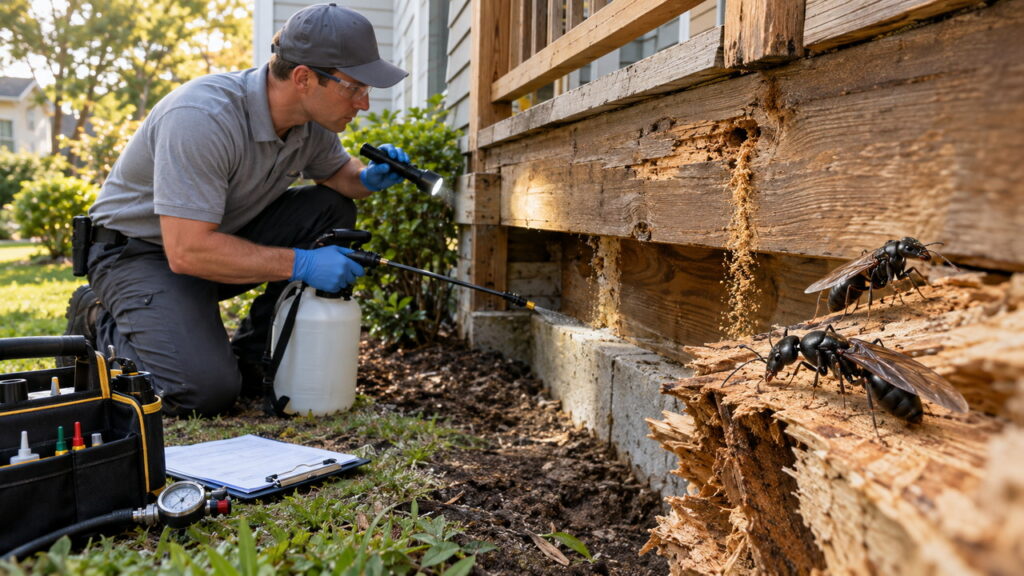
Discovering large black ants crawling across kitchen counters, window frames, or wooden walls can be concerning, especially when they appear repeatedly. Carpenter ants are more than occasional household visitors because some species establish colonies inside damp or deteriorating wood. Effective carpenter ant control involves identifying the insects, locating their nesting sites, correcting moisture problems, and choosing appropriate treatment methods.
Unlike termites, carpenter ants do not consume wood for nutrition, but their nesting activity can create galleries inside structural or decorative wooden materials. Ignoring an established infestation may allow colonies to expand into additional areas. Understanding carpenter ant behavior, warning signs, professional treatments, and long-term prevention can help homeowners protect their properties without relying on unnecessary or ineffective pesticide applications.
What Is Carpenter Ant Control?
Carpenter ant control is the process of identifying carpenter ants, locating their colonies, eliminating or managing established infestations, and reducing conditions that encourage future nesting. Successful treatment focuses on the colony and its environment rather than simply killing individual ants seen moving around a property.
Carpenter ants belong to the genus Camponotus and include numerous species found across North America and other regions. They commonly nest in wood, particularly where moisture, decay, or structural defects make excavation easier.
Professional carpenter ant control may involve inspections, moisture management, targeted insecticide applications, baiting, nest removal, and structural repairs. The appropriate approach depends on the species, colony location, infestation extent, and building conditions.
A comprehensive strategy also considers outdoor colonies because carpenter ants frequently travel between trees, landscaping, and buildings while searching for food.
Why Carpenter Ant Control Matters
Carpenter ants excavate galleries inside wood to establish nesting spaces. Although they do not digest wood like termites, extensive activity can contribute to the deterioration of affected wooden components.
Effective carpenter ant control helps limit additional nesting activity and identifies moisture conditions that may also be damaging the building. This combination is important because pest treatment alone does not correct leaking pipes, roof defects, or persistent condensation.
Not every carpenter ant sighting indicates structural damage. However, repeated indoor activity, especially near damp wood, justifies closer inspection.
How to Identify Carpenter Ants Correctly
Accurate identification is the first step in carpenter ant control. Several household ant species look similar, and confusing carpenter ants with other insects can lead to unnecessary or unsuitable treatments.
Carpenter ants vary in size and color depending on their species and colony role. Some are predominantly black, while others have reddish-brown or mixed coloration.
Physical Characteristics of Carpenter Ants
Carpenter ants have several identifying features that distinguish them from many other household ants. Their bodies typically have a narrow waist with one visible node, elbowed antennae, and a smoothly rounded upper thorax when viewed from the side.
Worker sizes can vary considerably within the same colony. Larger workers are often more noticeable indoors, but size alone does not establish identification.
For reliable carpenter ant control, identification should consider multiple physical characteristics rather than relying exclusively on color or body length. A pest management professional or local university extension service may help confirm the species.
Carpenter Ants vs Termites
Carpenter ants and termites both occur around wooden structures, but they have different feeding habits and biological characteristics.
Carpenter ants excavate wood to create nesting galleries, while termites consume cellulose-containing materials. Carpenter ants generally produce smooth, clean-looking galleries, whereas termite damage varies by termite species and may contain soil or other distinctive material.
Winged carpenter ants have elbowed antennae, a narrow waist, and front wings that are typically longer than their hind wings. Winged termites generally have straighter antennae, a broader waist, and two pairs of wings of approximately equal length.
Correct identification is essential because termite treatment and carpenter ant control require different strategies.
Why Carpenter Ants Enter Homes
Carpenter ants may enter buildings while searching for food, water, shelter, or suitable nesting locations. Their presence does not always mean a colony has developed inside the structure.
However, certain property conditions make indoor nesting more likely.
Moisture-Damaged Wood
Damp or decaying wood is especially attractive to many carpenter ant species. Water exposure can soften wood and make it easier for ants to excavate nesting chambers.
Carpenter ant control inspections often focus on areas around leaking windows, damaged roofing, plumbing penetrations, and poorly ventilated spaces.
Correcting moisture problems is essential for long-term prevention. Treating ants without repairing persistent leaks may leave conditions favorable for another infestation.
Trees and Vegetation Near Buildings
Carpenter ants commonly establish outdoor colonies in trees, stumps, fallen logs, and other wooden materials.
Branches touching a building can provide convenient travel routes. Ants may also move along fences, utility lines, or connected landscaping features.
Carpenter ant control should therefore include examining vegetation and outdoor nesting opportunities near the property.
Not every nearby tree needs removal. The goal is to identify actual infestation sources and reduce unnecessary access routes.
Food Sources
Carpenter ants feed on substances containing sugars and proteins, including honeydew produced by certain plant-feeding insects.
Indoors, they may investigate food spills, pet food, sugary liquids, and other accessible resources.
Cleaning these materials can help reduce indoor attraction, but sanitation alone rarely eliminates an established nesting colony.
Effective carpenter ant control combines food management with nest identification and suitable treatment.
Common Signs of a Carpenter Ant Infestation
Carpenter ants can remain unnoticed when colonies are located inside walls, ceilings, or concealed wooden structures.
Recognizing the warning signs helps homeowners determine when carpenter ant control may be necessary.
Large Ants Appearing Indoors
Repeated sightings of large ants, especially in the same rooms or near wooden building components, may indicate nearby nesting activity.
Carpenter ants often forage at night, although activity patterns vary by species and environmental conditions.
Seeing a few ants outdoors is usually less concerning than repeated indoor activity. However, indoor sightings do not prove that the main colony is inside the building.
A carpenter ant control inspection should examine movement patterns and potential entry points.
Sawdust-Like Material Near Wood
Carpenter ants may push excavated material out of their galleries.
This material is commonly called frass and can resemble coarse sawdust. It may contain wood particles, insect fragments, and other debris.
Finding frass beneath wooden frames, baseboards, or wall openings can be a useful warning sign.
However, sawdust can also originate from woodworking, deterioration, or other wood-boring insects. Professional carpenter ant control begins by confirming the source.
Rustling Sounds Inside Walls
Large or active carpenter ant colonies may produce faint rustling sounds inside wooden structures.
These sounds are not always audible and can be confused with other household noises.
If scratching or rustling occurs repeatedly near suspected nesting areas, an inspection may be appropriate.
Carpenter ant control professionals may use listening equipment or other inspection techniques when concealed activity is suspected.
Winged Ants Inside the House
Winged carpenter ants are reproductive members of a colony.
Their appearance indoors, particularly in significant numbers, can indicate a mature colony nearby.
However, winged ants can also enter buildings from outdoor colonies.
Finding them near windows or lights should prompt identification rather than immediate assumptions about structural damage.
Damaged Wooden Components
Carpenter ant galleries can occur inside window frames, door frames, wall studs, and other wooden materials.
Visible openings or hollowed areas may indicate nesting activity.
However, deteriorated wood can also result from fungal decay, moisture exposure, or other pests.
A carpenter ant control assessment should distinguish insect activity from unrelated structural problems.
Where Carpenter Ants Commonly Build Nests
Locating nesting sites is one of the most important parts of effective carpenter ant control.
Carpenter ants can establish colonies outdoors, indoors, or across multiple connected locations.
Window and Door Frames
Window and door assemblies are vulnerable to moisture intrusion when flashing, seals, or surrounding materials deteriorate.
Damp framing can provide favorable nesting conditions.
Carpenter ant control inspections may focus on trim, adjacent wall cavities, and visible signs of water damage.
The underlying moisture source should be corrected whenever possible.
Attics and Roof Structures
Roof leaks, condensation, and poorly maintained flashing can introduce moisture into attic materials.
Carpenter ants may establish nests in affected wooden components.
Professional carpenter ant control may require attic inspection, particularly when ants appear near upper-floor ceilings or windows.
Unsafe attic access and damaged framing should be left to qualified professionals.
Bathrooms and Kitchens
Plumbing leaks and recurring condensation can create damp environments around cabinets and wall cavities.
Carpenter ants may investigate these areas when suitable nesting materials are available.
Carpenter ant control should include examining accessible plumbing connections and surrounding wooden structures.
Repairing leaks can reduce conditions that support future infestations.
Decks, Porches, and Wooden Fences
Outdoor wooden structures are exposed to rain, humidity, and temperature changes.
Poor drainage and prolonged moisture exposure can contribute to deterioration.
Carpenter ant control around decks and porches should include inspecting structural connections, posts, and nearby vegetation.
Wooden components showing substantial damage may require repair or replacement.
Trees, Stumps, and Firewood
Outdoor carpenter ant colonies frequently occupy dead or decaying wood.
Tree cavities, stumps, fallen branches, and stored firewood can provide nesting opportunities.
Carpenter ant control does not necessarily require removing every outdoor nesting site. Treatment decisions should consider whether the colony is contributing to indoor activity or threatening vulnerable structures.
7 Effective Carpenter Ant Control Methods
Successful carpenter ant control usually involves several coordinated actions rather than one universal treatment.
The following methods address identification, colony management, building conditions, and long-term prevention.
1. Locate the Main Colony
Finding the colony is essential because eliminating individual foraging ants does not necessarily affect the nest.
Carpenter ants may establish a main colony in an outdoor tree or stump and maintain satellite colonies in nearby structures.
A carpenter ant control professional may follow foraging trails and inspect locations where ants repeatedly disappear into wood or structural openings.
Activity is often easier to observe during warmer evenings, although timing varies.
When tracking ants, avoid disturbing suspected nests unnecessarily. Disturbance can scatter workers and complicate inspection.
2. Eliminate Moisture Problems
Moisture management is one of the most valuable long-term carpenter ant control measures.
Inspect the property for leaking pipes, damaged gutters, roof defects, condensation, and poor drainage.
Repair water intrusion problems and allow affected materials to dry appropriately.
Wood that has lost structural integrity may require replacement.
Eliminating moisture does not automatically destroy an established colony, but it makes the environment less favorable for future nesting.
3. Use Appropriate Ant Baits
Some carpenter ant control programs use bait products designed for the target species.
Worker ants may collect bait and carry it back toward nesting areas, potentially exposing other colony members.
However, bait effectiveness depends on formulation, placement, food preferences, and colony conditions.
Carpenter ants may prefer different food sources at different times. A bait that receives little attention may not be suitable for the active colony.
Only use products labeled for the intended application and follow all instructions.
Avoid placing pesticides where children, pets, or food may be exposed.
4. Apply Targeted Treatments When Necessary
Professional carpenter ant control may involve applying registered insecticides to identified nesting areas or other approved treatment locations.
Targeted treatments are generally more purposeful than widespread spraying without locating the infestation.
Treatment selection depends on the colony, building construction, and product label.
Some applications require specialized equipment or licensed personnel.
Homeowners should not inject pesticides into electrical equipment, ventilation systems, or inaccessible spaces without professional guidance.
Unnecessary chemical applications can create risks without solving the infestation.
5. Remove Severely Damaged Wood
When carpenter ants occupy deteriorated wood, removing the affected material may help eliminate nesting spaces.
However, structural wood should not be removed without understanding its function.
Carpenter ant control involving wall studs, beams, roof framing, or other load-bearing components may require a qualified contractor or structural professional.
The surrounding area should also be inspected for additional galleries or moisture damage.
Replacing wood without addressing an active colony may not resolve the infestation.
6. Seal Entry Points
Carpenter ants can enter through gaps around windows, doors, utility penetrations, and building joints.
Sealing suitable openings can reduce access.
Carpenter ant control prevention may include repairing damaged weatherstripping, sealing appropriate exterior cracks, and maintaining window and door assemblies.
However, sealing should follow proper building practices.
Blocking drainage or ventilation openings can create moisture problems.
Entry-point sealing is most effective when combined with colony management and moisture correction.
7. Maintain the Property and Monitor Activity
Long-term carpenter ant control depends on reducing favorable nesting conditions.
Keep firewood away from direct contact with the home, maintain appropriate vegetation clearance, and repair deteriorating wooden components.
Monitor areas where ants were previously active.
Occasional outdoor ants may be normal, but recurring indoor activity deserves investigation.
A professional follow-up inspection may be appropriate after treating a significant infestation.
DIY Carpenter Ant Control vs Professional Treatment
Some homeowner actions can support carpenter ant control, but established colonies are not always easy to eliminate.
The correct approach depends on infestation size, nesting location, and whether structural damage is suspected.
When DIY Carpenter Ant Control May Be Reasonable
Basic prevention activities are generally manageable for homeowners.
These include correcting accessible moisture problems, cleaning food spills, storing firewood properly, and sealing suitable entry gaps.
Homeowners may also use registered ant bait products according to their labels.
DIY carpenter ant control is more appropriate when the infestation is limited, the nesting location is understood, and no significant structural concerns are present.
However, repeated indoor activity after treatment suggests that further investigation may be necessary.
When Professional Carpenter Ant Control Is Better
Professional assistance is advisable when ants repeatedly emerge from walls, substantial frass appears, or nests are suspected inside structural components.
A pest management professional can identify the species, investigate colony locations, and recommend suitable treatment.
Professional carpenter ant control may also be appropriate when previous treatments have failed or multiple nesting sites are suspected.
The contractor should explain the evidence supporting the treatment plan.
Risks of Improper DIY Treatments
Indiscriminate pesticide spraying may kill visible workers without eliminating the colony.
Some applications can also interfere with baiting by discouraging ants from visiting bait placements.
Improper carpenter ant control may expose occupants, pets, or beneficial organisms to unnecessary chemicals.
Foggers and broad indoor spraying are generally poor substitutes for locating and addressing carpenter ant nests.
Products should always be used according to their registered labels.
Carpenter Ant Control Treatments Explained
Different treatment methods work in different ways.
Understanding these differences can help homeowners evaluate recommendations.
Ant Bait Treatments
Baits contain food attractants combined with an active ingredient.
Worker ants must accept the bait for it to be useful.
Carpenter ant control using bait may require monitoring and adjustments based on observed activity.
Not every bait is effective against every carpenter ant species.
Dust Treatments
Some registered insecticidal dust products are used professionally in appropriate concealed spaces or identified nesting areas.
Application methods and restrictions depend on the product label.
Carpenter ant control dust treatments should not be applied indiscriminately in occupied rooms or ventilation pathways.
Professional assessment helps determine whether the method is appropriate.
Liquid Insecticide Treatments
Liquid products may be used in certain exterior or targeted applications when permitted.
Some treatments are designed to address ants traveling through specified areas.
However, carpenter ant control results depend on placement, product characteristics, and colony behavior.
Exterior spraying alone may not eliminate an indoor satellite nest.
Physical Nest Removal
When an accessible colony is located in deteriorated wood, removing the infested material may be appropriate.
This method can physically eliminate a nesting area while allowing damaged construction materials to be repaired.
Carpenter ant control involving structural repairs should be coordinated with qualified building professionals.
How Long Does Carpenter Ant Control Take?
The time required for carpenter ant control varies according to colony size, nesting location, treatment method, and property conditions.
A small, accessible nest may be easier to address than a colony distributed across multiple concealed locations.
Bait-based approaches may require time for ants to collect and distribute the material.
Direct treatment of an accurately located nest may reduce activity more quickly.
However, declining ant sightings do not always establish that every colony has been eliminated.
Professional carpenter ant control may include follow-up inspections to evaluate remaining activity and determine whether additional measures are needed.
Homeowners should ask contractors how treatment effectiveness will be assessed.
How Much Does Carpenter Ant Control Cost?
Carpenter ant control costs depend on the extent of infestation, property size, accessibility, treatment methods, and geographic location.
There is no reliable universal price for every property.
A limited outdoor nesting problem may require less work than an infestation involving concealed wall cavities or multiple satellite colonies.
Factors That Affect Treatment Costs
Several project characteristics influence pricing.
Inspection requirements: Complex infestations may require additional time to locate nests.
Property size: Larger buildings can involve more potential nesting locations.
Colony accessibility: Nests inside walls or roof structures may require specialized inspection methods.
Treatment selection: Baits, targeted applications, and follow-up visits have different costs.
Structural repairs: Damaged wood replacement is generally separate from pest control treatment.
Location: Labor rates and service pricing vary by region.
Follow-up services: Significant infestations may require additional monitoring.
A professional carpenter ant control estimate should explain the proposed services and any exclusions.
Is Professional Carpenter Ant Control Worth It?
Professional treatment may be worthwhile when the infestation is established or difficult to locate.
The main advantage is access to experienced inspection and treatment planning.
However, hiring a pest control company does not guarantee that structural repairs are included.
Carpenter ant control and building restoration are separate services, although they may need to be coordinated.
A written treatment plan helps homeowners understand what they are purchasing.
Carpenter Ant Control and Structural Damage
Carpenter ants are commonly associated with wood damage, but the actual risk varies.
Unlike termites, they do not consume wood as food.
Instead, they remove wood while creating nesting galleries.
Can Carpenter Ants Damage Structural Wood?
Yes. Established colonies can excavate wooden materials, including certain structural components.
However, the severity depends on colony size, duration, wood condition, and nesting location.
Carpenter ant control should be accompanied by structural evaluation when substantial galleries or deterioration are discovered.
Not every affected component requires replacement.
A qualified building professional can assess whether the remaining wood is structurally adequate.
How to Recognize Damaged Wood
Possible signs include galleries, accumulated frass, deteriorated wood, and recurring ant activity around a particular component.
However, surface appearance alone may not reveal concealed damage.
Carpenter ant control inspections may identify areas that require further evaluation.
A contractor should avoid unnecessarily destructive investigation without explaining why it is needed.
Repairing Wood After Treatment
Damaged components may require reinforcement or replacement.
Before repairs begin, the infestation and moisture source should be appropriately addressed.
Carpenter ant control does not restore the strength of wood already damaged by decay or excavation.
Repairs should use suitable materials and construction methods.
Carpenter Ant Control Around Kitchens and Bathrooms
Kitchens and bathrooms contain water sources that can create favorable nesting conditions when leaks occur.
They may also provide food sources that attract foraging ants.
Kitchen Ant Activity
Carpenter ants may investigate countertops, pantry areas, and food preparation surfaces.
Cleaning spills and storing food in suitable containers can reduce attraction.
However, repeated activity may indicate a nest elsewhere in the building.
Carpenter ant control should investigate movement patterns rather than treating the kitchen as the only possible source.
Bathroom Moisture Problems
Leaking fixtures, damaged seals, and condensation can affect wooden materials near bathrooms.
Carpenter ants may occupy damp framing behind walls or under flooring.
Carpenter ant control should include evaluating moisture conditions and arranging plumbing repairs where necessary.
Applying pesticides without addressing the leak may leave the nesting environment unchanged.
Carpenter Ant Control Around Trees and Landscaping
Outdoor carpenter ant colonies are part of natural ecosystems.
They contribute to the breakdown of dead wood and interact with other insects.
Their presence outdoors does not automatically require elimination.
Trees Near the House
Carpenter ants may nest in decaying sections of trees while foraging across nearby surfaces.
A tree containing carpenter ants is not necessarily dead or structurally unsafe.
Carpenter ant control decisions should consider whether the colony is entering the building or contributing to a specific problem.
Tree health and structural concerns should be assessed by a qualified arborist.
Firewood Storage
Firewood can contain insects, including carpenter ants.
Store firewood in a dry, suitable location away from direct contact with building walls.
Bring indoors only the amount needed for immediate use when practical.
Carpenter ant control prevention is easier when stored wood does not remain against vulnerable building materials.
Mulch and Landscape Moisture
Mulch helps manage soil moisture and support landscaping, but excessive moisture against wooden siding can contribute to deterioration.
Maintain appropriate separation between soil, mulch, and vulnerable building components.
Carpenter ant control should focus on correcting problematic moisture conditions rather than eliminating landscaping materials unnecessarily.
Carpenter Ant Control During Different Seasons
Carpenter ant activity changes with temperature, food availability, and colony development.
Understanding seasonal patterns can help homeowners interpret sightings.
Spring Activity
Carpenter ants often become more noticeable as temperatures rise.
Winged reproductive ants may emerge from mature colonies.
Spring carpenter ant control inspections may focus on locating nests before increased foraging activity spreads across the property.
However, seasonal emergence patterns vary geographically.
Summer Activity
Warm weather can support extensive outdoor foraging.
Carpenter ants may travel between nesting sites and food sources.
Summer carpenter ant control should include monitoring trails and inspecting potential entry points.
Activity observed outdoors does not necessarily indicate an indoor infestation.
Fall and Winter Activity
Carpenter ants generally become less active outdoors as temperatures decline.
However, colonies inside heated structures may remain active under suitable conditions.
Indoor winter sightings can justify further investigation.
Carpenter ant control should consider building temperatures and nesting locations rather than assuming all ants become inactive during winter.
How to Prevent Carpenter Ants From Returning
Prevention is an important part of long-term carpenter ant control.
The goal is to make the property less attractive for nesting and reduce opportunities for ants to enter.
Repair Water Leaks Promptly
Inspect plumbing connections, roofing, gutters, and exterior openings.
Correct leaks before prolonged moisture damages nearby wooden materials.
Moisture management is one of the most useful carpenter ant control prevention strategies.
Maintain Wooden Structures
Inspect decks, porches, window frames, and other exposed wooden components.
Repair deteriorating materials and maintain suitable protective finishes where appropriate.
Carpenter ant control is more effective when nesting conditions are addressed alongside insect activity.
Reduce Direct Vegetation Contact
Trim branches and vegetation where they create direct contact with vulnerable building areas.
Maintain appropriate access around the foundation for inspection.
These measures may reduce convenient travel routes, although ants can still enter through other pathways.
Carpenter ant control should not rely on vegetation trimming alone.
Keep Food Sources Managed
Clean food spills, secure waste containers, and store pet food appropriately.
These habits reduce opportunities for foraging ants.
However, food management does not eliminate an established colony.
Combine sanitation with moisture correction and suitable carpenter ant control treatment.
Inspect the Property Periodically
Look for recurring ant trails, frass, moisture problems, and deteriorating wood.
Early detection can make infestations easier to evaluate.
Professional carpenter ant control inspections may be useful for properties with a history of persistent activity.
Common Carpenter Ant Control Mistakes
Homeowners sometimes focus on visible ants without considering the colony’s location.
This can lead to repeated treatments that do not address the infestation.
Killing Only Visible Worker Ants
Foraging workers represent only part of a colony.
Eliminating individual ants may temporarily reduce sightings without affecting the nest.
Effective carpenter ant control focuses on locating and managing the colony.
Ignoring Moisture Damage
A leaking roof or plumbing connection can continue creating suitable nesting conditions.
Pesticides do not repair damaged building materials.
Carpenter ant control should include correcting moisture sources whenever possible.
Assuming Every Large Ant Is a Carpenter Ant
Several ant species have similar appearances.
Incorrect identification can lead to ineffective treatment.
Professional carpenter ant control begins with confirming the target pest.
Using Excessive Pesticides
Applying more pesticide than directed does not necessarily improve results.
It can increase exposure risks and violate product instructions.
Carpenter ant control should use the least disruptive effective methods appropriate to the infestation.
Ignoring Outdoor Colonies
An indoor ant trail may originate from an outdoor nesting site.
Treating only interior surfaces can miss the main colony.
Carpenter ant control inspections should consider the relationship between indoor and outdoor activity.
Choosing a Professional Carpenter Ant Control Company
A reliable pest control provider should investigate the infestation before recommending treatment.
The company should explain what evidence supports its conclusions and identify any property conditions that require correction.
Verify Licensing and Credentials
Pesticide applicator licensing requirements vary by jurisdiction.
Ask whether the company and technicians hold the credentials required for the proposed services.
Professional carpenter ant control should follow applicable pesticide regulations and product labels.
Ask About Inspection Methods
A contractor should explain how it identifies carpenter ants and investigates nesting locations.
Carpenter ant control inspections may include following trails, examining moisture-damaged wood, and inspecting accessible structural areas.
Be cautious of recommendations for extensive pesticide applications without a reasonable inspection.
Review the Treatment Plan
The plan should identify proposed treatment methods, target areas, safety instructions, and expected follow-up procedures.
Carpenter ant control may involve both chemical and nonchemical actions.
Ask whether moisture repairs or structural work are included.
Understand Guarantees and Follow-Up
Some companies offer follow-up visits or limited service guarantees.
However, terms vary.
A carpenter ant control guarantee may depend on conditions such as correcting moisture problems or maintaining recommended prevention measures.
Review written terms before agreeing to service.
Integrated Pest Management for Carpenter Ants
Integrated Pest Management, or IPM, is a decision-making approach that combines pest identification, monitoring, prevention, and appropriate control measures.
The U.S. Environmental Protection Agency promotes IPM principles as a way to manage pests while considering risks to people and the environment.
Inspection and Identification
The first stage involves confirming the pest and identifying the infestation’s location.
Carpenter ant control decisions should be based on observed evidence.
This helps avoid unnecessary treatment of harmless or unrelated insects.
Environmental Corrections
IPM emphasizes reducing conditions that support pest activity.
For carpenter ants, these conditions commonly include moisture-damaged wood, access routes, and suitable nesting materials.
Environmental improvements can support long-term carpenter ant control.
Targeted Treatment
When treatment is necessary, select methods appropriate to the pest and site.
Carpenter ant control may include baiting, direct nest treatment, or other registered applications.
The chosen approach should consider effectiveness, exposure risks, and environmental conditions.
Monitoring Results
After treatment, observe whether ant activity continues.
Monitoring helps determine whether additional colonies or entry routes remain.
Effective carpenter ant control uses follow-up findings to guide further action rather than automatically repeating the same treatment.
Are Carpenter Ants Dangerous to Humans?
Carpenter ants are not generally considered a major direct health threat to people.
They can bite when handled or disturbed, and some species may cause local irritation by applying formic acid.
However, carpenter ants do not typically create the same health concerns associated with certain disease-carrying pests.
The primary reason for carpenter ant control is protecting property and managing unwanted indoor infestations.
People with unusual or severe reactions to insect exposure should seek appropriate medical guidance.
Avoid handling ants directly, particularly when inspecting suspected colonies.
FAQ’s
1. What is the most effective carpenter ant control method?
Effective carpenter ant control usually combines accurate identification, locating the colony, correcting moisture problems, and applying suitable targeted treatments when necessary.
2. Can carpenter ants damage wooden houses?
Yes. Carpenter ants excavate galleries inside wood for nesting. Established colonies can contribute to damage, particularly in moisture-affected wooden components.
3. How long does carpenter ant control take?
Treatment time depends on colony size, nesting location, and methods used. Some infestations require follow-up monitoring or additional treatment.
4. Can I eliminate carpenter ants without professional help?
Minor problems may respond to moisture correction, sanitation, and properly labeled ant baits. Persistent indoor colonies or suspected structural damage warrant professional assessment.
5. Does carpenter ant control prevent future infestations?
Treatment can address existing colonies, while repairing leaks, maintaining wood, sealing suitable entry points, and monitoring activity help reduce future infestation risks.
6. How much does professional carpenter ant control cost?
Costs depend on property size, infestation severity, nest accessibility, treatment requirements, and location. A written inspection-based estimate provides the most useful pricing information.
Conclusion
Carpenter ant control is most effective when homeowners focus on the colony, nesting conditions, and underlying moisture problems rather than simply eliminating visible ants. Accurate identification, careful inspection, targeted treatment, and appropriate structural maintenance can help manage existing infestations while reducing conditions that encourage future activity.
Whether carpenter ants appear around windows, wooden framing, outdoor decks, or nearby trees, early investigation can help prevent problems from becoming more extensive. Combining practical prevention with professional carpenter ant control when necessary provides a sensible approach to protecting wooden structures and maintaining a healthier, more comfortable home.