
Solar street lights can illuminate roads, pathways, parking areas, and public spaces without relying solely on a nearby electricity supply. Their performance depends on more...
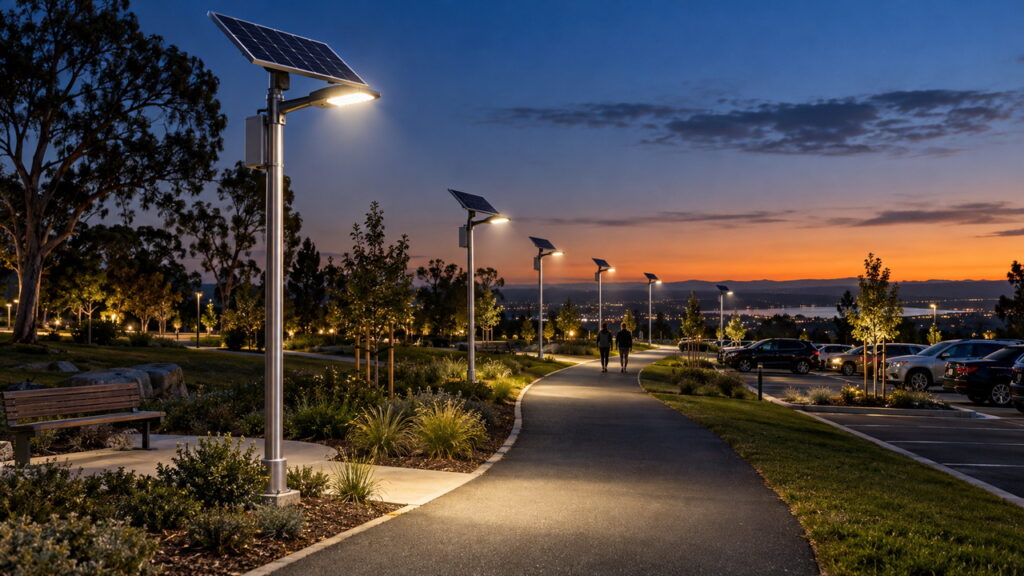
Solar street lights can illuminate roads, pathways, parking areas, and public spaces without relying solely on a nearby electricity supply. Their performance depends on more than the LED fixture: solar exposure, battery capacity, lighting design, controls, pole placement, and maintenance all matter.
This guide explains how solar street lighting works, what to compare before buying, and how to plan an installation for its location. It also covers costs, safety, and common limitations so you can assess whether a solar system suits your site.
What Solar Street Lights Are and How They Work
Solar street lights use photovoltaic panels to collect sunlight and charge a battery that powers an outdoor luminaire after dark. A controller manages charging and lighting schedules, while an LED fixture produces the illumination.
Many standalone solar street lights store energy in a battery during daylight and operate independently of a utility connection. Other designs combine solar generation with grid power or backup supply, so check the system configuration instead of assuming that every product is fully off-grid.
Main System Components
A typical solar street-light system includes a photovoltaic panel, battery, charge controller, LED luminaire, pole, mounting hardware, and electrical connections. Some designs integrate several components into one unit, while others place the panel, battery, and light in separate locations.
The controller helps manage charging and can operate features such as dusk-to-dawn switching, dimming, and motion response. Its settings should match the lighting plan and the battery’s requirements; a controller cannot compensate for an undersized panel or poorly selected battery.
Main Types of Solar Street Lights
The most suitable arrangement depends on the site, maintenance access, solar exposure, and amount of lighting required. Common designs include integrated, split, and hybrid systems.
| System type | General design | Main consideration |
|---|---|---|
| Integrated | Panel, battery, controller, and LED are combined in a compact fixture. | Convenient installation, but check service access, orientation, and heat management. |
| Split | Panel is mounted separately from the luminaire, with the battery and controller in a fixture, pole, or cabinet. | Flexible positioning, but requires suitable wiring and component protection. |
| Hybrid | Solar power works alongside a grid connection or other backup supply. | Can provide another power source, but needs careful electrical design and controls. |
Integrated solar street lights can suit sites where simple mounting is valuable and the panel receives adequate sunlight in its fixed position. A split arrangement may be more suitable when the best panel location differs from the best light position.
Hybrid solar street lighting can be useful where a project needs backup power or has specific operating requirements. It is not the same as a standalone system, and any connection to utility power should be designed and installed in accordance with applicable electrical rules.
Advantages and Limitations of Solar Street Lights
A solar system can avoid or reduce the need to trench and install a new electrical supply to each lighting point. That may be useful in remote locations or on projects where extending power infrastructure is difficult, although the panel, battery, pole, and installation still have costs.
Solar street lights can operate without drawing routine lighting energy from the grid when configured as standalone systems. They may also allow a project to add lighting where utility connections are unavailable, subject to site conditions, maintenance access, and reliable solar exposure.
There are trade-offs. Output and charging depend on weather, season, shade, panel condition, and system sizing. A run of cloudy days may reduce the available energy, while a poor installation angle or growing tree canopy can affect charging over time.
Batteries need monitoring and eventual replacement, and solar equipment can be exposed to theft, vandalism, dust, salt, or extreme temperatures. Solar street lights therefore should not be treated as maintenance-free or assumed to provide uninterrupted lighting in every climate.
Where Solar Street Lights Can Be Used
Solar lighting is considered for rural roads, pedestrian paths, parking areas, parks, campuses, bus stops, industrial yards, and locations where extending a grid supply may be impractical. The suitability depends on the required light level, the local solar resource, and whether the installation can be safely maintained.
Solar street lights may also serve private roads, driveways, and access areas. Public roads and high-use sites need more careful lighting and structural design than a small private path. Requirements can include road-authority approval, specific photometric performance, and engineering review.
How to Plan Solar Street Lights
A reliable project starts with the lighting task and site conditions, not a product’s advertised wattage. These seven planning steps help turn a general requirement into a system specification.
1. Define What the Lighting Must Do
Identify the area to be lit, who uses it, and when it needs illumination. A pedestrian path, vehicle road, loading area, and parking lot have different visibility and safety needs.
Solar street lights should be selected according to the site’s intended use, not just the brightness claimed in a product listing. Confirm whether lighting must run all night, operate at reduced output after a set time, or respond to activity.
2. Survey the Site and Solar Resource
Check for shade from trees, buildings, signs, and nearby structures throughout the day and across seasons. A location that receives direct sun in summer may be shaded in winter as the sun’s path changes.
Record the likely panel orientation, tilt, nearby obstructions, local weather, and ease of access for cleaning or repair. Use local solar-resource information as an initial guide, then have the system designed around site conditions rather than a generic regional average.
3. Calculate the Nightly Energy Demand
Start with the luminaire’s actual electrical input and the hours it will operate. If the light dims during part of the night, calculate each operating period separately instead of treating the fixture as if it runs at full output continuously.
For example, a hypothetical 40-watt luminaire operating at full power for 12 hours would use 480 watt-hours before controller losses or any dimming schedule. This simple example is not a product recommendation; confirm real power consumption from the manufacturer’s technical documentation.
4. Decide How Much Battery Autonomy Is Needed
Autonomy describes how long a system can operate without enough new solar energy to fully recharge. The needed reserve depends on local weather, the importance of the lighting, operating hours, and whether another power source is available.
When sizing batteries for solar street lights, account for usable battery capacity rather than relying only on the nominal figure. Battery chemistry, permitted depth of discharge, temperature, system efficiency, and expected aging all affect the amount of energy available to the luminaire.
5. Match the Solar Panel to the Location
A panel’s rated output is measured under defined test conditions, not guaranteed for every installation. Actual generation depends on sunlight, panel angle, orientation, shading, temperature, dirt, and system losses.
A preliminary calculation relates daily energy demand to local peak-sun hours and a suitable system derating factor. Treat this as a planning estimate, not a final engineering design; solar street-light systems should be checked against less favourable seasonal conditions and the manufacturer’s charging specifications.
6. Specify the Light, Not Just the Wattage
Wattage describes electrical power consumption, not how light falls on the road. Compare lumens, optics, mounting height, spacing, and distribution, then consider the illumination and uniformity required for the specific site.
Ask for photometric files, often supplied in IES format, so a lighting professional can model how a proposed luminaire performs at the planned height and spacing. A high lumen number alone does not show whether solar street lights will illuminate the right places or create glare.
7. Plan the Pole, Controls, and Installation
Select poles and foundations for the fixture’s weight, panel size, local wind exposure, soil, and applicable structural requirements. A large panel can increase wind loading, so the pole and foundation must be suitable for the complete assembly.
Decide how lights will switch, dim, or respond to movement, and include a plan for maintenance access. For solar street lights, a workable installation is one that can be safely inspected and repaired, not merely mounted in a visually convenient location.
Light Quality, Coverage, and Glare
Good outdoor lighting is about visibility and distribution, not just maximum brightness. A fixture that produces a bright spot directly beneath the pole may still leave dark areas between poles or create uncomfortable glare for road users.
For roadway applications, the lighting design may need to address maintained illumination, uniformity, glare, and the relevant road or pedestrian classification. In the United States, the Illuminating Engineering Society’s RP-8 guidance is a reference for roadway lighting design; local authorities and project requirements determine which rules apply.
Colour temperature and colour rendering can also affect the appearance of a space. Choose these characteristics for the application and local requirements rather than assuming one colour is best everywhere. Consider shielding and optics that limit unwanted light spill into homes, habitats, and the night sky.
Battery Choices and Performance
Battery selection affects cost, storage capacity, operation, and maintenance. Lithium iron phosphate (LiFePO4) batteries are used in some solar street lights, while lead-acid types remain available in some systems; compare the complete product specifications rather than relying on chemistry names alone.
Check battery capacity in watt-hours as well as amp-hours. Amp-hours do not describe stored energy fully unless the battery voltage is also known. Ask for the usable capacity, operating temperature limits, charging requirements, and the manufacturer’s guidance on expected replacement and end-of-life handling.
Battery placement varies. It may be integrated into the fixture, housed in the pole, or installed in a separate cabinet. Whichever arrangement is used, protect it from water ingress, excessive heat, tampering, and conditions outside its stated operating limits.
In cold climates, verify that the battery and charging system are designed for local temperatures. Some battery systems require specific controls to manage charging in cold conditions. For solar street lights in hot or coastal environments, check temperature ratings, corrosion resistance, enclosure protection, and maintenance access.
Panel Orientation, Weather, and Site Conditions
A solar panel needs access to sunlight, but the best orientation and tilt depend on location and system design. Do not assume that the panel’s position on the pole automatically gives it an ideal angle. A site assessment should also consider seasonal sun paths and possible future shade.
Dust, bird droppings, pollen, snow, and salt deposits can reduce panel output if they cover the surface. The rate of buildup varies by location, so include inspection and safe cleaning in the maintenance plan.
Consider local wind, rainfall, heat, cold, and potential impacts when selecting components. Check the luminaire’s ingress-protection rating and, where relevant, impact rating against the conditions it will face. A rating applies to a specified product and test; it does not guarantee that every part of an installation is protected.
Controls and Lighting Schedules
A dusk-to-dawn controller can switch solar street lights on when daylight falls and off when it returns. Some systems use a timer, dimming schedule, or motion sensor to adjust output during quieter hours.
Controls can help manage energy use, but settings must still meet the site’s lighting needs. A motion sensor may not be suitable where continuous illumination is required, and dimming should be assessed against safety, accessibility, and applicable design requirements.
Ask how settings are configured and whether authorized staff can change them. Confirm what happens if a sensor, controller, or communications link fails. The simplest system that satisfies the operational requirement may be easier to maintain than one with unnecessary remote features.
Installation, Safety, and Compliance
Installation involves more than attaching a luminaire to a pole. The project may require foundation design, structural assessment, safe lifting, electrical work, traffic management, and permission from a landowner or road authority.
Solar street lights still have electrical components, including batteries and photovoltaic wiring. Follow manufacturer instructions and applicable local electrical codes. Grid-connected or hybrid systems require particular care; use appropriately qualified electrical professionals for work that falls within licensing requirements.
Poles and panels must be designed for expected wind and environmental loads. Check for underground utilities before excavation, and plan safe work around overhead lines, traffic, and pedestrians. In the United States, 811 can be used to request marking of many underground utilities before digging; private lines may require separate locating.
Confirm permits, road-authority approvals, and any planning or environmental requirements before installation. Where the lighting serves a public road or a safety-critical area, involve the relevant authority and a qualified lighting or structural professional. A standalone solar system is not automatically exempt from local rules.
Solar Street Lights Costs and Long-Term Value
Prices vary with light output, panel and battery capacity, pole and foundation requirements, controls, installation access, and local labour. Large public or industrial installations also need to account for design, approvals, traffic management, commissioning, and ongoing inspection.
Compare the full cost of ownership, not just the purchase price. Include installation, battery replacement, cleaning, repairs, monitoring, and disposal. For a remote site, avoiding a long trench or new grid connection may matter; where power is already nearby, a grid-connected light could be the more practical option.
Ask suppliers for an itemized quote and the technical data behind their recommendation. Check the warranty terms for the battery, panel, LED, controller, and installation separately. Product warranties differ, and a warranty should not be treated as a promise of a particular lighting performance or service life.
Maintenance and Troubleshooting
Routine inspections help keep solar street lights operating as intended. The schedule depends on the environment, equipment, and importance of the lighting, so follow the manufacturer’s maintenance instructions and local operating requirements.
Check panels for shading, dirt, damage, or loose mounts. Inspect visible wiring, fasteners, enclosures, and poles for wear or corrosion, and review controller indicators or system records if available. Cleaning should use appropriate methods and safe access equipment; do not climb a pole or work at height without suitable training and protection.
If a light does not turn on, check whether the issue affects one unit or several. A single failure may involve its fixture, battery, controller, wiring, or sensor, while a group of failures can suggest a shared environmental or configuration problem. Use a qualified technician for electrical diagnosis and repairs when required.
Keep a record of inspections, faults, battery changes, and repairs. These notes can reveal recurring issues, such as seasonal shading or water ingress, and help managers plan replacements. Dispose of or recycle batteries through appropriate local channels rather than placing them in ordinary waste where prohibited.
Common Buying and Design Mistakes
Choosing a system solely by advertised wattage or lumen output is a frequent mistake. Neither number alone shows how much useful light reaches the intended area or how long the fixture can operate through poor weather.
Another mistake is treating the battery’s nominal capacity as fully available energy. Ask for usable capacity and the operating assumptions behind any autonomy claim, including the lighting schedule and local solar conditions.
Do not overlook future shade, access for service, wind loading, or vandalism risk. Solar street lights can be technically suitable on paper yet perform poorly if trees grow over the panels, batteries are difficult to reach, or the pole is inappropriate for the site.
Finally, be cautious about claims of zero maintenance, guaranteed all-weather operation, or fixed energy savings. Ask the supplier to explain the assumptions, provide product documentation, and distinguish measured performance from marketing estimates.
FAQ’s
1. How do solar street lights work?
Photovoltaic panels charge a battery during daylight, and a controller powers the LED luminaire according to its programmed schedule or sensor inputs.
2. Do solar street lights work on cloudy days?
They can continue operating if the battery has stored enough energy, but cloudy weather may reduce charging. Performance depends on system sizing, weather, and operating settings.
3. How long do solar street lights stay on at night?
Operating time depends on the battery, solar charging, luminaire load, dimming schedule, and system condition. Check the manufacturer’s stated assumptions.
4. What should I compare when buying solar street lights?
Compare photometric performance, battery and panel specifications, autonomy assumptions, controls, environmental ratings, warranty terms, installation needs, and maintenance support.
5. Do solar street lights need a grid connection?
Standalone systems can operate without one. Hybrid models may use grid power or another backup source, so check the design and installation requirements.
6. How often do solar street lights need maintenance?
It varies by location and equipment. Follow the manufacturer’s schedule and inspect panels, batteries, controls, poles, and fixtures as the site requires.
Conclusion
Solar street lights can be a practical option where reliable sunlight, suitable equipment, and accessible maintenance make a standalone or hybrid system a good fit. The right choice depends on the lighting task, seasonal solar conditions, battery reserve, photometric design, pole structure, and local requirements—not a headline wattage alone.
Before purchasing, compare documented specifications, request a site-specific design, and understand the full installation and maintenance costs. Well-planned solar street lights can serve roads and outdoor spaces effectively, but realistic sizing and ongoing inspection are essential for dependable performance.