
Maintaining a pristine, debris-free swimming pool used to demand laborious manual vacuuming or relying on inefficient pressure-side sweepers that consumed immense pump energy. The introduction...
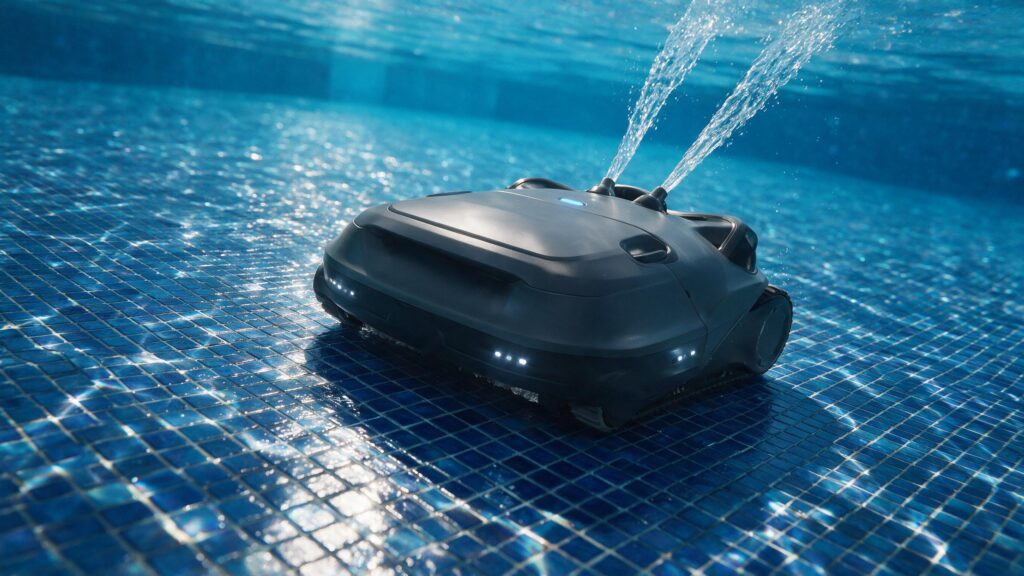
Maintaining a pristine, debris-free swimming pool used to demand laborious manual vacuuming or relying on inefficient pressure-side sweepers that consumed immense pump energy. The introduction of the modern robotic pool cleaner has revolutionized residential and commercial pool maintenance through autonomous robotics and sophisticated underwater guidance systems. However, navigating an aquatic environment presents unique engineering hurdles: GPS signals cannot penetrate water, chlorinated water alters acoustic sound velocity, and refractive light refractions challenge traditional optical cameras. Understanding how an intelligent robotic pool cleaner maps unfamiliar pool geometries, climbs vertical tile walls, and overcomes obstacles reveals the incredible technology powering effortless pool ownership.
What Is a Robotic Pool Cleaner and How Does It Navigate Underwater?
A robotic pool cleaner is a self-contained, electrically driven autonomous submersible robot engineered to filter debris, scrub surfaces, and navigate pool floors, walls, and waterlines without connecting to the pool’s primary filtration system.
| Navigation Component | Hardware Sensor Type | Aquatic Navigation Function |
|---|---|---|
| Inertial Measurement Unit (IMU) | 9-Axis Gyroscope + 3-Axis Accelerometer | Calculates heading, tilt angle, pitch, and rotational velocity underwater |
| Ultrasonic Sonar Transducer | High-frequency acoustic transceiver | Measures Time-of-Flight (ToF) distance to walls, steps, and drop-offs |
| Optical / Infrared Sensors | Waterproof infrared proximity diodes | Detects immediate physical obstacles and deep-end slope transitions |
| Waterline Pressure Sensor | Submersible barometric depth transducer | Senses atmospheric boundary to initiate lateral waterline scrubbing |
| Wheel Odometry Encoders | Magnetic Hall-effect rotational sensors | Measures precise linear distance traveled across pool floor tiles |
| Microcontroller Processing Unit | High-speed ARM Cortex processor | Executes SLAM pathfinding algorithms and adjusts motor drive speeds |
Unlike robotic vacuum cleaners in homes, an intelligent robotic pool cleaner, an autonomous robotic pool cleaner cannot rely on standard LiDAR laser towers or Wi-Fi triangulation because light wavelengths absorb rapidly and radio frequencies attenuate severely in water.
Instead, modern robotic pool cleaners utilize multi-sensor fusion. By integrating inertial dead reckoning with acoustic sonar pulses and wheel odometry, the internal processor constructs a real-time three-dimensional topographical map of the swimming pool, calculating the most efficient path to clean every square inch of surface area.
How Do Gyroscopes and Accelerometers Guide a Robotic Pool Cleaner?
Inertial Measurement Units (IMUs) form the core navigational backbone of modern robotic pool cleaners, allowing them to track their movement, orientation, and spatial changes through mathematical dead reckoning.
| Sensor Measurement | Kinematic Axis | How the Robotic Pool Cleaner Interprets Data |
|---|---|---|
| Yaw (Heading Angle) | Z-Axis (Rotational Turning) | Maintains razor-straight parallel cleaning lines across the pool floor |
| Pitch (Incline Angle) | Y-Axis (Forward Slope Tilt) | Detects transitions from shallow play areas down to deep diving wells |
| Roll (Lateral Tilt) | X-Axis (Side-to-Side Tilt) | Senses steep slope transitions, cove curvature, and uneven floor steps |
| Linear Acceleration | 3-Dimensional Movement | Calculates forward velocity and detects traction slip on slick algae |
1. Maintaining Laser-Straight S-Path Patterns
When a robotic pool cleaner travels across a smooth pool floor, water currents and jet flows constantly push the chassis off course. High-frequency 9-axis gyroscopes take thousands of orientation readings per second. If the robot drifts even two degrees off its intended heading, the microcontroller commands individual drive motors to adjust speed, bringing the cleaner back into a perfectly straight line.
2. Sensing Slopes, Coves, and Deep-End Drops
As the robotic pool cleaner moves from a 3-foot shallow end toward an 8-foot deep end, internal accelerometers measure the changing gravitational tilt angle. The robot recognizes the slope, increases motor torque to maintain steady momentum, and adjusts pump suction to ensure continuous floor adhesion without flipping over.
How Ultrasonic Sonar and Depth Sensors Map Pool Topography
To navigate complex, freeform pool shapes with Roman ends, swim-out benches, and Baja tanning shelves, advanced robotic pool cleaners employ active acoustic sonar.
| Sonar & Depth Metric | Operating Principle | Value in Robotic Pool Cleaner Navigation |
|---|---|---|
| Acoustic Time-of-Flight (ToF) | Emits 200 kHz sound pulses; clocks echo return time | Measures distance to opposite walls up to 30 feet away |
| Hydrostatic Pressure Sensing | Measures water column weight on diaphragm | Pinpoints exact operating depth within 0.5 inches |
| Bottom Topography Mapping | Combines sonar distance with continuous depth data | Generates complete 3D bathymetric mesh map of the pool |
| Dynamic Obstacle Avoidance | Identifies sudden acoustic profile shifts | Steers around submerged ladders, toys, and main drain grates |
1. Acoustic Time-of-Flight Mapping
Ultrasonic transducers mounted on the front and sides of the robotic pool cleaner emit high-frequency acoustic sound waves through the water. Because sound travels at approximately 4,900 feet per second (1,480 m/s) in water, the robot clocks the microsecond delay of returning echoes, calculating the exact distance to surrounding walls before physical contact occurs.
2. Identifying Steps, Benches, and Ledges
Traditional cleaners get high-centered or stuck when encountering shallow steps and raised safety ledges. Advanced sonar mapping allows the robotic pool cleaner to detect shallow ledges in advance, adjust its approach angle, climb cleanly onto the step, execute a 180-degree turn, and return to the main pool floor without user intervention.
Random Bump vs. Intelligent Systematic Grid Navigation: A Comprehensive Comparison
The evolution of robotic pool cleaners is defined by the transition from chaotic random-bounce algorithms to intelligent, sensor-driven systematic path planning.
| Performance Attribute | Legacy Random Bump Cleaners | Modern Systematic Robotic Pool Cleaners |
|---|---|---|
| Navigation Mechanism | Bumps wall, reverses, turns at random angle | Real-time SLAM mapping with structured S-path grids |
| Cleaning Coverage Efficiency | 70% to 80% (Misses random patches and corners) | 99% to 100% (Guaranteed edge-to-edge coverage) |
| Average Cycle Duration | 3.0 to 4.5 Hours per cleaning cycle | 1.5 to 2.0 Hours per cleaning cycle |
| Energy Consumption | High (Runs continuously to compensate for misses) | Low (Consumes up to 60% less electrical energy) |
| Mechanical Component Wear | Rapid tire, track, and motor brush wear | Minimal wear due to optimized movement paths |
| Cable Tangling Frequency | Frequent (Continuous chaotic rotational spins) | Zero (Optimized turns or cordless battery architecture) |
Why Random Bump Navigation Is Obsolete
Legacy cleaners lack the microprocessors found in a modern robotic pool cleaner and directional sensors. Unlike an intelligent robotic pool cleaner, when a random-bump cleaner hits a wall, a mechanical bumper triggers a blind pivot, sending the unit across the pool in a random direction. This results in the cleaner crossing the same center spots dozens of times while completely missing debris settled in quiet corners and along slope transitions.
The Superiority of Intelligent S-Pattern Pathing
A smart robotic pool cleaner begins its cycle by scanning pool boundaries. It then systematically traverses the floor in tight, parallel S-curves with calculated track overlap. Once the floor is spotless, it systematically transitions to vertical walls and the waterline, cutting cleaning time in half while delivering spotless results.
How a Robotic Pool Cleaner Climbs 90-Degree Walls and Cleans Waterlines
Climbing vertical tile, vinyl, fiberglass, or pebble surfaces underwater requires defying buoyancy and gravity through active hydro-propulsion and mechanical grip.
| Climbing Mechanism | Engineering Subsystem | Biomechanical Role in Wall Climbing |
|---|---|---|
| Vortex Suction Impeller | High-RPM brushless motor & axial flow impeller | Generates powerful negative pressure, pulling robot against wall |
| Dual Traction Treads | High-grip PVA or rubberized caterpillar tracks | Bites into slippery smooth tiles, fiberglass, and algae films |
| Waterline Detection Sensor | Dual conductivity pins or pressure sensors | Detects when the upper chassis breaks the water surface |
| Lateral Thrust Jet | Directional horizontal exhaust nozzle | Propels robot laterally along the waterline for horizontal scrubbing |
1. Generating Negative Hydrodynamic Pressure
When a robotic pool cleaner approaches a vertical wall, its internal flow sensor signals the main pump motor to ramp up to maximum RPM. The high-velocity impeller expels water upward at over 70 gallons per minute, creating a powerful low-pressure suction vortex beneath the chassis. This hydrodynamic vacuum locks the robot against the wall with hundreds of pounds of continuous force.
2. The Mechanics of Waterline Scrubbing
The waterline is where oily sunscreens, body oils, pollen, and algae concentrate. When the robotic pool cleaner ascends a wall, its top sensors detect the air-water boundary. The robot pauses, engages a lateral propulsion jet, and drives horizontally along the waterline, vigorously scrubbing the tile line with high-speed active brushes before descending backward to resume floor cleaning.
The Role of Artificial Intelligence and SLAM Algorithms Underwater
Simultaneous Localization and Mapping (SLAM) is the advanced algorithmic framework that enables a robotic pool cleaner to construct a map of an unknown environment while simultaneously tracking its current location within that map.
| SLAM Processing Phase | Computational Workflow | Real-World Underwater Outcome |
|---|---|---|
| Phase 1: Feature Extraction | Identifies geometric anchor points (corners, drain, steps) | Builds reference landmarks in digital spatial memory |
| Phase 2: Odometry Estimation | Tracks wheel revolutions and IMU angular velocity | Predicts real-time position between landmark scans |
| Phase 3: Loop Closure | Recognizes previously visited pool corners | Corrects accumulated dead-reckoning drift errors |
| Phase 4: Path Optimization | Dynamically updates cleaning path vectors | Eliminates redundant overlapping passes in real time |
| Algorithmic Stage | Primary Hardware Input | Internal Software Process | Navigational Action |
|---|---|---|---|
| Sensory Ingestion | 9-axis IMU + ultrasonic sonar | Ingests real-time spatial vectors and sound echoes | Calculates instantaneous distance to obstacles |
| Coordinate Update | Wheel encoders + depth sensors | Updates SLAM positional coordinates in digital memory | Corrects micro-drift from water current displacement |
| Path Optimization | Onboard ARM Cortex processor | Computes next parallel cleaning track vector | Generates continuous S-curve cleaning trajectory |
| Motor Execution | Brushless DC drive motors | Adjusts individual caterpillar track speeds | Drives cleaner smoothly along calculated path |
Self-Correcting Loop Closure
As a robotic pool cleaner moves underwater, wheel slip on smooth plaster creates minor positional calculation errors. When the robotic pool cleaner returns to a previously mapped landmark—such as the deep-end main drain or a known corner—its SLAM algorithm performs loop closure. It recalculates its true position, resets mathematical drift to zero, and ensures that no sectors of the pool are left uncleaned.
Corded vs. Cordless Robotic Pool Cleaner Navigation
The debate between traditional corded power supplies and modern cordless battery architectures directly impacts underwater mobility and navigation freedom.
| Engineering Factor | Traditional Floating Cable Cleaners | Modern Cordless Battery Cleaners |
|---|---|---|
| Navigational Freedom | Constrained by cable length, floating snags, and twist | 100% Unrestricted 360-degree autonomous navigation |
| Cable Tangling Mitigation | Requires mechanical swivel joints; prone to coiling | Zero cable entanglement or knotting risks |
| Run Time per Session | Unlimited continuous power from mains outlet | 2.0 to 3.5 Hours per single battery charge |
| End-of-Cycle Retrieval | Pulled to pool edge manually via power cable | Autonomous water-surface floating or auto-parking at edge |
| Weight & Handling | Heavy cable handling; transformer box storage | Lightweight single-unit pickup via ergonomic hook |
The Elimination of the Swivel Cable Bottleneck
For decades, floating power cords were the single most common failure point for robotic pool cleaners. Despite mechanical cable swivels, repetitive rotational turns caused cords to twist, coil, and snag around main drains or ladders, physically trapping the cleaner. Modern cordless robotic pool cleaners eliminate cords entirely, allowing their navigation software to execute complex, multi-rotational cleaning paths without physical constraints.
Intelligent Auto-Parking and Surface Floating
When a cordless robotic pool cleaner finishes its cleaning cycle or detects a low battery (under 5%), its navigation system executes an auto-docking sequence. The robot navigates to the shallow-end wall, parks neatly beside the water’s edge, or engages positive buoyancy tanks to float directly to the water surface for effortless, dry-handed retrieval.
5 Common Obstacles in Pools and How Smart Cleaners Overcome Them
Swimming pools feature various structural elements that can disrupt autonomous navigation if a robot lacks proper sensor intelligence.
| Pool Obstacle | Traditional Cleaner Failure Mode | How Smart Robotic Pool Cleaners Solve It |
|---|---|---|
| Raised Anti-Vortex Main Drains | High-centers on dome, wheels spin helplessly | Accelerometer senses high-center; reverses thrust to climb over |
| Removable Deck Ladders | Wedges into tight gaps between rungs and wall | Sonar detects obstacle; routes around ladder footprint cleanly |
| Baja Shelves & Tanning Ledges | Runs dry in 4 inches of water; burns pump motor | Hydrostatic depth sensor stops cleaner before entering dry zones |
| Deep-End Hopper Slopes | Tips backward or rolls sideways during turns | 9-axis gyroscope senses rollover risk; limits turning angles on slopes |
| Heavy Pool Return Jet Currents | Pushed off course, clean lines become skewed | Dynamic gyro-compensation increases motor drive on upstream side |
Step-by-Step Guide to Optimizing Your Pool for Maximum Cleaner Navigation
To ensure your robotic pool cleaner operates at peak navigational efficiency, follow these pre-deployment pool preparation guidelines.
| Optimization Step | Required Action | Navigation Benefit for Cleaner |
|---|---|---|
| 1. Return Jet Deflection | Angle wall return eyeball fittings downward 45 degrees | Prevents high-velocity surface currents from pushing cleaner off path |
| 2. Water Chemistry Balance | Maintain pH 7.2–7.6, Free Chlorine 1–3 ppm, zero algae | Prevents slick biofilm that causes track slippage and navigational drift |
| 3. Ladder & Toy Removal | Remove floating thermometers, pool toys, and vacuum hoses | Clears navigation pathways for uninterrupted systematic S-curves |
| 4. Basket Emptying Protocol | Empty internal filter basket after every cleaning cycle | Maintains maximum pump suction volume for flawless wall climbing |
- Step 1: Deflect Water Return Jets Downward: High-pressure surface return jets create horizontal crosscurrents that push lightweight robots off their charted paths. Angle all eyeball fittings toward the pool floor to minimize surface turbulence.
- Step 2: Balance Water Chemistry to Eliminate Algae Slicks: Even invisible micro-algae creates a slippery film across smooth fiberglass and vinyl liners, causing caterpillar tracks to slip and corrupting wheel odometry calculations.
- Step 3: Clear Floor Obstacles Before Launch: Remove floating chlorinators, cleaning poles, and sunken pool toys before dropping your robotic pool cleaner into the water to ensure unbroken mapping cycles.
- Step 4: Submerge and Purge Trapped Air: When placing the robotic pool cleaner in the pool, hold it submerged underwater and tilt it gently from side to side to release trapped air bubbles from the impeller housing, ensuring instant hydrodynamic suction upon startup.
Frequently Asked Questions
How does a robotic pool cleaner know the shape of my pool?
A smart robotic pool cleaner uses a combination of ultrasonic sonar pulses, inertial gyroscopes, and SLAM mapping software to measure pool boundaries and map the shape during its initial scan.
Can a robotic pool cleaner get stuck on main drains?
While older models often high-centered on raised drains, modern robotic pool cleaners feature intelligent anti-entanglement algorithms that detect spinning wheels and immediately reverse thrust to drive off obstacles.
How does a robotic pool cleaner know when it reaches the waterline?
The cleaner utilizes water-level sensors and barometric depth transducers that detect the sudden change in resistance and pressure when the upper chassis breaks the water surface.
Do robotic pool cleaners use cameras or GPS?
No, GPS signals and standard optical cameras perform poorly underwater; robotic pool cleaners rely on inertial measurement units (IMUs), acoustic sonar, and infrared proximity sensors for underwater navigation.
Why do some robotic pool cleaners clean in random patterns while others use straight lines?
Entry-level cleaners use basic random-bump mechanical timers, whereas premium robotic pool cleaners utilize advanced microprocessors running systematic S-path grid algorithms.
How does a cordless robotic pool cleaner get out of the pool when finished?
When a robotic pool cleaner cycle completes or battery drops below 5 percent, a cordless robotic pool cleaner automatically navigates to the pool wall and parks at the edge or floats to the surface for easy retrieval.
Conclusion
The remarkable intelligence of a modern robotic pool cleaner represents a triumph of aquatic engineering, uniting multi-sensor fusion, inertial dead reckoning, ultrasonic sonar, and artificial intelligence mapping algorithms. By overcoming the unique challenges of underwater physics—where GPS and optical cameras fail—these autonomous machines effortlessly map complex pool geometries, navigate around obstacles, climb vertical tile walls, and scrub waterlines with pinpoint precision.
Investing in an intelligent, systematic robotic pool cleaner eliminates the frustration of missed spots, tangled cables, and wasted energy associated with legacy pool maintenance equipment. By choosing a model equipped with advanced SLAM navigation and maintaining balanced pool water chemistry, you ensure complete, hands-free pool cleanliness, allowing you to spend less time maintaining your pool and more time enjoying crystal-clear water.