
Off-the-shelf templates and generic no-code wrappers may launch quickly, yet they rarely survive real customer growth, complex backend integrations, or demanding security audits. Forward-looking startups...
Off-the-shelf templates and generic no-code wrappers may launch quickly, yet they rarely survive real customer growth, complex backend integrations, or demanding security audits. Forward-looking startups and global enterprises invest in custom mobile app development services to engineer fast, intuitive, AI-ready applications built around exact business workflows rather than rigid cookie-cutter constraints. Building with a product-first mindset prevents expensive ground-up rebuilds twelve months after launch.
Understanding what full-cycle custom mobile app development services include, how native iOS, Android, and Flutter architectures compare, and how to control project scope empowers founders and IT directors to ship mobile products users actually retain. From initial product consulting and human-centered UX design to cloud scaling and post-launch optimization, structured engineering turns ambitious app concepts into reliable revenue channels.
What Custom Mobile App Development Services Actually Cover
Building a successful mobile application involves far more than writing screen layouts in code. Real-world custom mobile app development services combine strategic discovery, user interface research, platform architecture, backend API engineering, multi-device quality assurance, app store compliance, and long-term maintenance. Mature engineering partners recognize that not every business needs every module on day one, helping stakeholders prioritize the exact capabilities that validate market demand efficiently.
Established providers with decades of delivery track records across startups and enterprises design software to handle growth gracefully. Rather than forcing a healthcare portal, fintech wallet, and on-demand logistics app into identical templates, custom mobile app development aligns data models, offline caching, authentication layers, and push notifications specifically around how end users behave in the field.
Mobile App Consulting and Product Discovery
Jumping straight into coding without validating product assumptions is one of the costliest mistakes in mobile app development. Dedicated consulting inside custom mobile app development services examines competing apps, uncovers unmet customer expectations, defines core MVP boundaries, and matches technical architecture to long-term goals rather than passing hype. Working through compliance mandates, monetization models, and third-party API limits during custom mobile app discovery eliminates expensive rework midway through delivery.
Defining a Realistic Minimum Viable Product Roadmap
Effective custom mobile app development services split ambitious product visions into disciplined release milestones. Phase one focuses on the single highest-value workflow users need weekly inside your custom mobile app, ensuring crisp performance and clean onboarding. Subsequent mobile app development sprints layer in advanced AI personalization, loyalty tiers, or enterprise reporting guided by real usage analytics instead of guesswork.
Human-Centered Mobile UI and UX Design
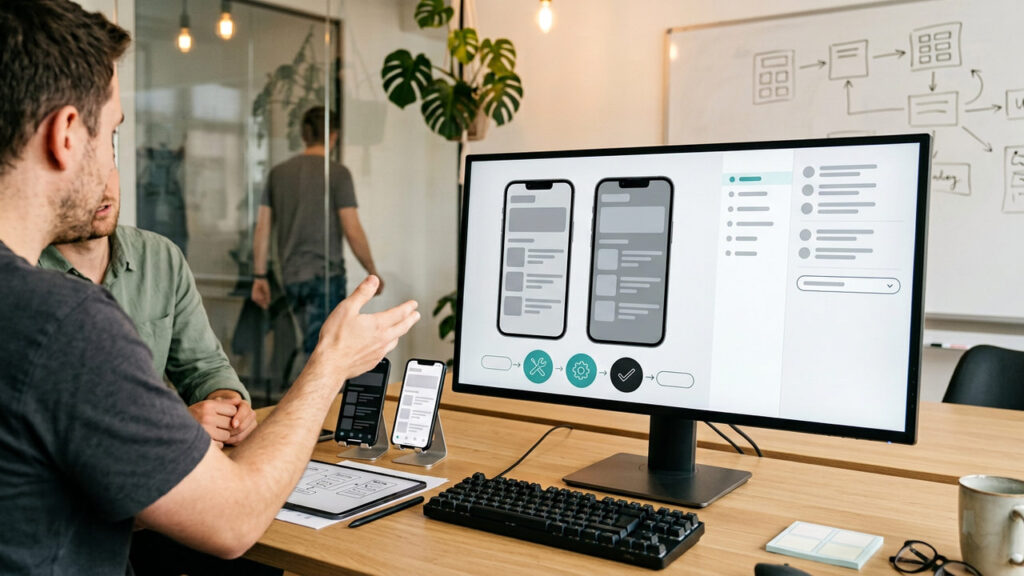
Mobile users judge a custom mobile app within seconds of opening the splash screen. Skilled designers within custom mobile app development services map thumb-friendly navigation zones, clear typography hierarchy, accessible color contrast, and frictionless onboarding flows before a single production screen is coded. Interactive wireframes and clickable prototypes allow stakeholders to test real user journeys early so every custom mobile application feels obvious without requiring lengthy tutorials.
Choosing the Right Platform Strategy in Custom Mobile App Development
Selecting between native iOS, native Android, and cross-platform frameworks like Flutter shapes budget, release velocity, device performance, and ongoing mobile app development services costs for years. Evaluating each technical path objectively prevents unnecessary compromise.
Native iOS App Development
Native iOS engineering utilizes Swift and Apple-supported frameworks while adhering closely to Apple Human Interface Guidelines. Choosing native iOS inside your custom mobile app development services unlocks smooth animations, tight integration with Apple Pay, Face ID, iCloud, and HealthKit, and seamless responsiveness across iPhones, iPads, and wearables. It delivers an unmistakable native feel for consumer brands and custom mobile applications.
Native Android App Development
Native Android development built with Kotlin and Java demands disciplined testing across a wide matrix of manufacturers, screen densities, chipsets, and active operating system versions. Strong custom mobile app development teams tune memory footprints, background sync tasks, and battery efficiency closely so the application runs smoothly not only on flagship phones but also on mid-range global Android hardware.
Cross-Platform Flutter App Development
Flutter enables engineering teams to ship both iOS and Android apps from one shared codebase while maintaining near-native rendering speed and expressive custom UI components. Within modern custom mobile app development services, Flutter excels when startups and mid-market brands prioritize faster time to market, consistent visual branding across platforms, and lower long-term maintenance overhead compared to staffing two separate native codebases.
Comparing Native vs Cross-Platform Custom Mobile App Development
Comparing core engineering trade-offs side by side clarifies which platform approach aligns best with your product complexity, release deadline, and budget.
| Decision Criterion | Native iOS and Android | Cross-Platform Flutter | Progressive Web App |
|---|---|---|---|
| Codebase Structure | Two separate platform codebases | Single shared codebase for both stores | Browser-based web codebase |
| Hardware and OS Depth | Immediate access to latest native APIs | Strong plugin ecosystem with native bridges | Limited background and hardware access |
| Initial Build Cost | Higher due to dual engineering streams | Significantly lower unified build effort | Lowest upfront engineering investment |
| UI Responsiveness | Peak platform-native feel and motion | Smooth 60 to 120 fps custom rendering | Dependent on mobile browser engine |
| Best Strategic Fit | Heavy AR, gaming, or deep OS integrations | Startups, ecommerce, SaaS, and enterprise apps | Content hubs and lightweight utilities |
Integrating AI and Cloud Backends Cleanly
Today’s custom mobile app development services routinely embed practical AI capabilities such as smart search, voice intake, personalized recommendations, optical document scanning, and real-time chat assistants. Pairing mobile clients with modular cloud microservices, encrypted APIs, and scalable databases guarantees that adding AI endpoints or handling seasonal traffic spikes never breaks core mobile responsiveness.
Step-by-Step Lifecycle of Custom Mobile App Development Services
Transparent agile delivery keeps stakeholders informed at every sprint while minimizing launch surprises. Mature custom mobile app development teams execute six structured stages from concept to continuous growth.
- Discovery and Technical Architecture defining user personas, competitive gaps, compliance requirements, API specifications, and sprint budgets.
- Wireframing and Interactive UX Prototyping validating navigation flows, accessibility, and screen transitions with real stakeholder feedback.
- Agile Sprint Engineering building frontend mobile interfaces, cloud backend services, payment gateways, and third-party ERP or CRM connectors in two-week demos.
- Automated and Real-Device QA Testing verifying functional flows, battery impact, weak-network resilience, security penetration checks, and screen compatibility.
- App Store and Google Play Deployment handling store metadata, privacy declarations, review guidelines, crash telemetry, and phased rollouts.
- Post-Launch Support and Evolution monitoring live user analytics, patching OS updates swiftly, and releasing data-backed feature improvements.
Estimated Scope and Timeline Benchmarks by App Complexity
Every custom mobile application varies based on compliance depth, custom animations, and third-party integrations, yet understanding realistic complexity tiers helps teams plan budgets and launch dates accurately.
| App Complexity Tier | Typical Capabilities | Estimated Timeline | Recommended Team Focus |
|---|---|---|---|
| Focused MVP App | Core user auth, 8 to 15 screens, standard APIs, push alerts | 8 to 14 weeks | Cross-platform Flutter, lean UX, core cloud backend |
| Mid-Complexity Commercial App | Payments, real-time chat, geolocation, custom admin portal | 4 to 7 months | Full custom mobile app development squad with dedicated QA |
| Enterprise or Regulated Platform | HIPAA or PCI controls, ERP sync, offline mode, AI modules | 7 to 12+ months | Senior architects, native or Flutter leads, DevSecOps |
Security, Compliance, and Scalability Standards You Must Require
Because mobile apps process payment tokens, personal health records, location streams, and corporate credentials, security cannot be bolted on after beta testing. Dependable custom mobile app development services embed privacy and resilience into every architectural layer.
- End-to-end TLS encryption in transit paired with secure device keychain storage rather than plain-text local files.
- Modern OAuth 2.0, OpenID Connect, biometric Face ID or fingerprint gates, and role-based backend authorization checks.
- Industry compliance alignment for healthcare HIPAA workflows, financial PCI-DSS payment tokenization, and regional GDPR or CCPA consent controls.
- Resilient offline synchronization and automated crash analytics so field workers and commuters stay productive even on spotty cellular connections.
Evaluating a Custom Mobile App Development Partner Before Signing
Look beyond polished sales slides when selecting custom mobile app development services. Review live apps the vendor currently maintains on the Apple App Store and Google Play, ask how they handle source code IP ownership from day one, verify agile sprint demo cadence, and confirm who remains available for post-launch OS upgrades once initial development concludes.
Pros and Cons of Investing in Custom Mobile App Development Services
Evaluating both strategic benefits and upfront commitments helps leadership decide whether custom engineering or an off-the-shelf SaaS app fits their current growth stage.
Key Advantages
- Delivers tailored user experiences, unique branding, and proprietary workflows that differentiate your product clearly from template competitors.
- Ensures full intellectual property ownership with clean architecture designed to scale smoothly without hitting rigid vendor ceilings.
- Integrates seamlessly with existing enterprise ERP, CRM, payment processors, IoT hardware, and custom AI services.
- Enables rigorous security, compliance auditing, and device-level performance tuning required by regulated industries and enterprise buyers.
- Supports agile long-term evolution guided directly by live customer retention data and changing market opportunities.
Trade-Offs to Plan For
- Requires higher initial capital investment and longer discovery timelines compared to launching a basic drag-and-drop template wrapper.
- Demands ongoing post-launch maintenance budgets to keep pace with annual iOS and Android operating system releases and evolving store policies.
- Depends heavily on clear product ownership and regular stakeholder feedback during agile sprints to prevent mid-project scope creep.
Industry Applications of Custom Mobile App Development Services
Because operational rules, regulatory standards, and user expectations vary widely across sectors, tailored custom mobile app development services look very different in healthcare compared to retail or supply chain logistics. Understanding real industry patterns helps executives scope custom mobile app architecture cleanly from the start.
Healthcare, Telemedicine, and Patient Engagement Apps
Clinics, hospital networks, and wellness startups depend on custom mobile app development services to deliver secure video consultations, appointment booking, electronic prescription tracking, and wearable remote monitoring. Strict encryption, role-based access controls, audit logging, and HIPAA-aligned cloud infrastructure ensure patient privacy stays protected without making mobile check-ins frustrating for older or non-technical patients.
Fintech, Mobile Banking, and Digital Payment Platforms
Financial apps live or die on speed, precision, and zero-trust security. Specialized custom mobile app development integrates biometric Face ID verification, multi-factor session controls, real-time fraud alerts, instant ledger updates, and PCI-compliant payment tokenization. Clean interface hierarchy transforms intimidating budgeting, lending, or investment workflows into effortless daily habits on smartphones.
Ecommerce, On-Demand Delivery, and Retail Loyalty Apps
Direct-to-consumer brands invest in custom mobile app development services to move beyond rented social audiences and boost repeat purchase rates. Native push notifications, one-tap Apple Pay or Google Pay checkout, real-time order tracking maps, and personalized AI product feeds routinely outperform mobile web browsers on conversion speed and lifetime customer value.
Field Service, Logistics, and Enterprise Workforce Apps
Warehouse teams, delivery drivers, and field technicians often operate inside basements, rural highways, or industrial yards with unreliable wireless signal. Custom mobile app development services build resilient offline-first data syncing, barcode and QR scanning, GPS route optimization, digital signature capture, and instant ERP synchronization so front-line crews stay productive anywhere.
Post-Launch Optimization and Growth Metrics for Custom Mobile Apps
Shipping version one to the Apple App Store and Google Play marks the starting line rather than the finish line. Mature custom mobile app development services embed clean telemetry from day one so product leaders make iteration decisions based on live customer behavior instead of internal opinions.
- Crash-free session rate and cold-start load speed verifying technical stability across active iOS and Android devices in every custom mobile app release.
- Day-1, Day-7, and Day-30 user retention tracking whether onboarding screens genuinely guide new downloads to repeatable weekly value.
- Funnel conversion drop-offs pinpointing exact screens inside your custom mobile app where users hesitate during registration or checkout.
- App store rating velocity and support ticket themes surfacing high-priority polish opportunities for upcoming custom mobile app development sprints.
Common Mistakes That Derail Mobile App Projects
Avoiding four well-known pitfalls keeps custom mobile app development services on schedule and aligned with measurable business outcomes.
- Cramming every hypothetical feature into version one instead of shipping a sharp, reliable custom mobile app MVP that solves one urgent problem cleanly.
- Skipping early UX wireframing inside your custom mobile app development plan, forcing engineers to rewrite completed screens once stakeholders see live builds.
- Treating App Store and Google Play compliance reviews as an afterthought during launch week rather than planning privacy disclosures inside your mobile app development services roadmap early.
- Underestimating post-launch analytics, OS updates, and iterative polish after your custom mobile app goes live.
FAQ’s
What are custom mobile app development services?
Custom mobile app development services cover end-to-end consulting, UI/UX design, native or cross-platform coding, backend integration, QA testing, store launch, and ongoing maintenance tailored to one business.
Should I choose native iOS and Android or Flutter for my custom mobile app?
Choose Flutter when fast dual-platform launch, unified design, and lower upkeep matter most; choose separate native Swift and Kotlin builds for intensive graphics or deep hardware-specific features.
How long does custom mobile app development usually take?
A focused MVP typically takes 8 to 14 weeks, a mid-complexity commercial app takes 4 to 7 months, and complex regulated enterprise platforms generally require 7 to 12 months or more.
How much do custom mobile app development services cost?
Project budgets depend on screen count, backend integrations, security compliance, and platform choice, ranging from lean starter MVPs to multi-phase enterprise investments scoped during discovery.
Do I retain full ownership of source code and intellectual property?
Yes, reputable custom mobile app development companies specify full client ownership of source code, designs, and repositories under NDA and master service agreements upon milestone completion.
What happens after my custom mobile app launches in the app stores?
Post-launch support tracks crash analytics, optimizes performance, applies annual iOS and Android OS compatibility updates, and releases incremental features based on real customer behavior.
Conclusion
Partnering with proven custom mobile app development services transforms raw product ideas into secure, high-performing iOS, Android, and Flutter applications engineered for real-world scale. By grounding every engagement in product discovery, human-centered UX design, clean cloud architecture, and thorough device QA, businesses avoid brittle templates and costly post-launch rebuilds.
Whether you are a startup launching a focused MVP or an enterprise modernizing mission-critical field operations, prioritizing clear milestones, strong security controls, and continuous post-launch iteration sets your mobile product up for lasting adoption and measurable return on investment.