
Finding dependable HVAC San Antonio services is not a casual home improvement decision, it is infrastructure planning for one of the hottest major cities in...
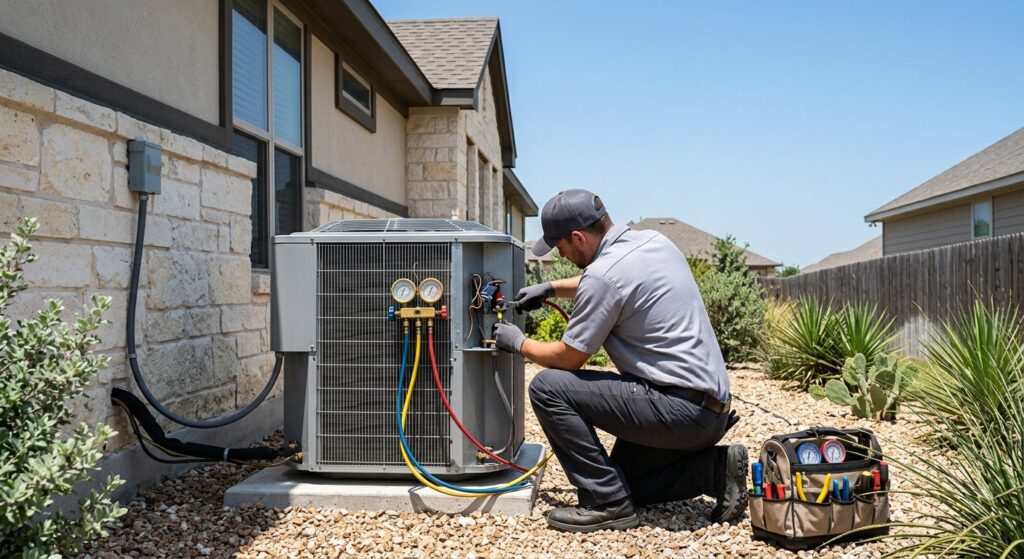
Finding dependable HVAC San Antonio services is not a casual home improvement decision, it is infrastructure planning for one of the hottest major cities in America. When summer temperatures hang above 100 degrees for days at a time, an air conditioner is not a comfort upgrade, it is a health and safety system, and the difference between a great contractor and a bad one shows up in your utility bills, your repair frequency, and occasionally your family’s wellbeing. This guide covers what San Antonio homeowners actually need to know in 2026: what a new system or repair honestly costs in this market, how Texas licensing rules protect you, which CPS Energy rebates can knock hundreds of dollars off an upgrade, why efficiency ratings matter more here than almost anywhere else, and the nine steps that separate a smart purchase from an expensive one. Every figure and rule cited is current and verifiable, so you can act on it with confidence rather than folklore.
Key Takeaways
- The most common San Antonio replacement, a 3-ton central AC with gas furnace for a 1,500 to 2,500 square foot home, runs roughly $7,500 to $11,500 installed, with full projects ranging from about $5,500 to $18,000.
- Texas law requires every HVAC contractor to hold a TDLR Air Conditioning and Refrigeration license, verifiable in minutes at tdlr.texas.gov.
- CPS Energy’s STEP program pays heat pump rebates of $100 to $275 per ton based on SEER2 rating, up to $825 on a typical 3-ton system at SEER2 18 or higher.
- New systems installed in the South must meet federal minimums of 14.3 SEER2 for split air conditioners and 15.2 SEER2 for heat pumps.
- HVAC Depot stands out among San Antonio providers for its direct-to-consumer pricing model, one price regardless of brand, a 10-year parts and labor warranty, and 24/7 emergency service.
Why San Antonio Is One of the Toughest HVAC Markets in America
South Texas is an endurance test for cooling equipment. Bexar County sits in a hot-humid climate zone where air conditioners routinely run for months without a meaningful break, recent summers have delivered dozens of triple-digit days, and attic temperatures routinely climb past 130 degrees, cooking the equipment and ductwork that most San Antonio homes carry overhead. Equipment that lasts 15 to 20 years in milder climates often delivers 10 to 15 here, and undersized or poorly maintained systems simply surrender in August. That reality makes every decision in this guide more consequential than it would be in a milder market: sizing errors, cheap installations, and skipped maintenance all get amplified by the climate.
What the Climate Does to Equipment
Long runtimes mean compressors accumulate wear faster, capacitors and contactors fail more often, and marginal installations reveal themselves at the worst possible moment. Attic-mounted air handlers and duct runs lose cooling to conduction and leakage at rates that make duct sealing one of the highest-return investments in a San Antonio home. Dust and oak pollen clog filters quickly, choking airflow right when the system needs it most. All of those extra run hours also multiply what you pay CPS Energy, which is why every efficiency decision in this guide is a bill decision too.
The Winter Freeze Risk
San Antonio winters are mostly mild, which is exactly why they are dangerous. Homes built for heat are not built for hard freezes, and the February 2021 winter storm showed how quickly the region’s heating systems and plumbing can fail under conditions they rarely face. Any heating decision, whether a gas furnace or a heat pump, should account for backup heat during cold snaps, and every homeowner should know where their system’s emergency heat setting lives before the next Uri, not during it.
9 Powerful Ways to Stay Cool and Save Big
1. Size the System With a Real Load Calculation
The most expensive HVAC mistake in San Antonio is oversizing, and it happens constantly because bigger units sound safer in a hot climate. An oversized air conditioner cools the air so fast it shuts down before dehumidifying it, leaving homes cold, clammy, and uncomfortable while the compressor short cycles itself toward early failure. Humidity is the half of Texas comfort people underestimate: sticky air at 74 degrees feels worse than dry air at 78, and only a correctly sized, properly running system removes moisture at the right pace. The correct method is an ACCA Manual J load calculation covering your home’s square footage, insulation, windows, orientation, and air leakage. Any contractor who sizes your system by square-footage rules of thumb, or by simply matching the old unit’s tonnage, is guessing with your money.
2. Understand SEER2 and What Efficiency Actually Pays Back Here
Because San Antonio systems log more runtime than almost anywhere in the country, efficiency upgrades pay back faster here than in most of America. Federal minimums for southern states require 14.3 SEER2 on new split air conditioners and 15.2 SEER2 on new heat pumps, but equipment rated 16 to 18 SEER2 is widely available, and in this climate the higher tier usually earns back its premium through lower CPS Energy bills. Variable-speed systems add humidity control, which matters as much as temperature in South Texas summers. Ask any bidder for an operating cost comparison between tiers rather than a sales pitch. Pair the new system with a smart thermostat and the savings compound: the Department of Energy estimates that setting the thermostat back 7 to 10 degrees for eight hours a day saves as much as 10 percent a year on heating and cooling, and automation makes that discipline effortless.
3. Claim CPS Energy Rebates Before You Buy
San Antonio homeowners have a municipal utility advantage most of the country lacks. CPS Energy’s Save for Tomorrow Energy Plan pays heat pump rebates of $100 to $275 per ton depending on SEER2 rating: $100 per ton at SEER2 15 to 15.9, $175 at 16 to 17.9, and $275 at 18 or above, which means $825 back on a typical 3-ton system at the top tier. Rebates generally require ENERGY STAR qualifying equipment, professional installation, and application with proof of purchase, and income-qualified households should also ask about the Casa Verde and REAP programs, which fund weatherization and efficiency upgrades for eligible families. Program terms change, so confirm current requirements with CPS Energy before purchasing rather than after. One accuracy warning as you research: the federal 25C energy tax credit expired for equipment placed in service after December 31, 2025, so ignore older articles still promising a $2,000 federal heat pump credit in 2026. In San Antonio, the real money this year comes from CPS Energy programs, not Washington.
4. Get Three Itemized Quotes and Compare Them Honestly
Collect at least three written estimates and require each one to itemize equipment model and serial numbers, efficiency ratings, labor, materials, permit costs, and warranty terms. In this market, standard installation labor alone typically runs $1,200 to $3,500 depending on complexity, so a bid that hides labor inside a lump sum is a bid you cannot evaluate. The cheapest quote is frequently the most expensive one by the end of the first summer, because low bids usually recover their margin in change orders, omitted components, or thinner warranties.
5. Verify TDLR Licensing and Insurance Before Signing
Texas takes HVAC licensing seriously, and so should you. Every contractor must hold a Texas Department of Licensing and Regulation Air Conditioning and Refrigeration license: Class A for unrestricted work, or Class B for residential and light commercial jobs under 25 tons, and technicians must be registered with TDLR as well. Verify the license number at tdlr.texas.gov using the department’s license search, confirm the business name matches, and ask to see the EPA Section 608 certification of any technician handling refrigerant. Also request a current certificate of liability insurance directly from the insurer, because a laminated card in a truck means nothing on its own.
6. Do Not Replace What a Repair Can Save
The dirty secret of the HVAC industry is that a large share of sold replacements are unnecessary, and sales-commissioned technicians are financially motivated not to mention it. Many struggling systems need a capacitor, a contactor, a blower motor, or a refrigerant repair, not a $10,000 replacement, and older R-22 systems can sometimes be converted to modern refrigerants at a small fraction of replacement cost. A reasonable industry rule of thumb weighs the unit’s age in years multiplied by the repair cost, with totals above $5,000 tipping toward replacement. A contractor whose first instinct is diagnosis rather than replacement is worth keeping for decades, and their willingness to attempt a repair tells you their incentives are aligned with yours. Replacement genuinely is the right call when the compressor fails on a unit past warranty, when repairs become seasonal rituals, when energy bills climb without explanation, or when the system uses refrigerant whose rising cost makes every recharge a bad investment.
7. Protect the System You Own Through Texas Summers
Prevention is cheap; August emergencies are not. Build these habits into your household routine:
- Check filters monthly during cooling season and replace them at least quarterly, more often with pets
- Keep two feet of clearance around the outdoor condenser and rinse its coils each spring
- Watch the condensate drain line, since a clog in an attic air handler means water damage in the ceiling
- Schedule professional maintenance twice a year, ideally before summer and before winter
- Consider a surge protector for the condenser, because Texas grid events kill compressors
A maintenance plan with a local company costs a small fraction of one emergency replacement and typically includes the priority scheduling that matters when everyone’s AC fails in the same heat wave. Finally, remember that the ducts and the attic are part of the system too. ENERGY STAR estimates that typical duct systems lose 20 to 30 percent of conditioned air through leaks, and its recommended attic insulation levels for Texas climate zones run as high as R-60, so sealing ducts and topping up insulation often improves comfort more per dollar than any equipment upgrade.
8. Prepare Your Heating for Winter Freezes
San Antonio heating failures cluster during exactly the freezes when they become dangerous. Have the furnace or heat pump professionally inspected each fall, including heat exchanger and carbon monoxide checks on gas systems. Heat pump owners should understand how auxiliary and emergency heat work, and why running emergency heat as a default triples heating costs. insulate exposed pipes, know where your water shutoff lives, and keep the number of a 24-hour HVAC service saved in your phone before the forecast turns ugly, because that is the one night every company’s schedule is full. If you have any gas appliance, install carbon monoxide detectors on every level and test them before each winter, since carbon monoxide is colorless, odorless, and a cold-weather risk precisely when furnaces run hardest.
9. Choose a Local Contractor With Real Accountability
Every step above gets easier with the right company, so vet the vendor as carefully as the equipment. Look for TDLR licensing, transparent itemized pricing, repair-first diagnostics, in-house rather than subcontracted installers, and warranty terms in writing. For HVAC San Antonio homeowners can book directly, The HVAC Depot offers a model worth comparing: a direct-to-consumer approach that sells quality equipment across brands including Goodman, Carrier, York, and Amana at one price regardless of brand, with certified in-house technicians handling installation, a 10-year parts and labor warranty, optional annual maintenance plans, and 24/7 emergency service for the nights South Texas heat refuses to compromise. Whatever company you choose, read recent local reviews, pay attention to how a business responds to the occasional complaint rather than just the star count, confirm warranty coverage covers labor and not just parts, and pick the contractor who explains your options instead of rushing you toward a sales deadline.
How Much Do HVAC Services Cost in San Antonio?
San Antonio pricing sits below many major metros, helped by lower labor costs and a competitive contractor market, and industry trackers report the metro’s average heat pump installation cost among the lowest of any major Texas city. Current 2026 figures for the local market:
| Service | Typical 2026 Range | Notes |
|---|---|---|
| Central AC replacement only | $3,500 to $9,500 | 2.5 to 3.5 tons, standard installation |
| Full system, AC plus gas furnace | $7,500 to $11,500 | The most common 3-ton replacement |
| Heat pump system | $5,500 to $14,500 | Varies widely with efficiency tier |
| Ductwork replacement | $2,000 to $3,000 per ton | About $6,000 to $9,000 for 3 tons |
| Standard installation labor | $1,200 to $3,500 | Depends on access and complexity |
What Changes Your Quote
Expect variation between homes and between bids for these reasons:
- System size in tons, set by a Manual J calculation rather than guesswork
- Efficiency tier, with 16 to 18 SEER2 equipment carrying a premium that rebates partially offset
- Ductwork condition, since leaky or undersized ducts undermine any new system
- Attic access difficulty, electrical panel capacity, and structural surprises
- Refrigerant line set, pad, thermostat, and code-related upgrades
- Warranty length, especially whether labor is covered and for how many years
Permits Protect You
The City of San Antonio and surrounding municipalities require mechanical permits for system replacements, and your contractor should pull them as part of the job. Permits trigger inspections covering refrigerant handling, electrical work, and combustion safety, and unpermitted installations can complicate home sales and void equipment warranties. Treat a contractor’s suggestion to skip the permit as the red flag it is.
Frequently Asked Questions
How much does a new HVAC system cost in San Antonio?
The most common replacement, a 3-ton AC and gas furnace, runs about $7,500 to $11,500 installed, while central AC alone typically costs $3,500 to $9,500. Full projects range from roughly $5,500 to $18,000 depending on size and efficiency.
How long do AC units last in San Antonio?
Most systems deliver 10 to 15 years here, shorter than the 15 to 20 years common in milder climates, because of long runtimes and extreme attic temperatures. Consistent professional maintenance is the biggest factor in reaching the high end.
Do I need a permit to replace my HVAC system?
Yes, most San Antonio area municipalities require a mechanical permit, and your contractor should pull it. Unpermitted work risks failed inspections, warranty complications, and problems at resale.
What rebates are available for HVAC upgrades in San Antonio?
CPS Energy’s STEP program pays heat pump rebates of $100 to $275 per ton based on SEER2 rating, and income-qualified households may qualify for Casa Verde or REAP assistance. Confirm current terms with CPS Energy before you buy.
How do I verify an HVAC contractor in Texas?
Search the company’s license at tdlr.texas.gov, confirming an active TACLA or TACLB classification and a matching business name, then ask to see the technician’s EPA Section 608 card and request proof of liability insurance.
What size AC do I need for my home?
The only reliable answer comes from an ACCA Manual J load calculation. As a rough reference, many San Antonio homes of 1,600 to 2,400 square feet use 2.5 to 3.5 tons, but insulation, windows, and orientation move that number significantly.
Conclusion
HVAC San Antonio decisions carry more weight than the same decisions almost anywhere else in the country, because South Texas gives every mistake thousands of extra runtime hours to cost you money. Get the system sized with a real Manual J calculation, buy efficiency that the local climate and CPS Energy rebates help pay for, verify TDLR licensing and insurance before anyone touches your equipment, and give a repair-minded contractor the chance to save your existing system before you finance a replacement one. Protect what you own with filters, coil cleanings, and twice-yearly professional service, prepare your heating for the freezes that arrive without warning, and choose a local company whose warranty, pricing, and emergency availability are all in writing. Follow those nine steps and you end up where every San Antonio homeowner wants to be: paying less to CPS Energy, calling for repairs rarely, and staying comfortable through whatever the Texas sky decides to do next.