
Damaged sidewalks in New York City are more than an appearance issue. Cracked, uneven, deteriorated, or otherwise defective pavement can create accessibility concerns, potential trip...
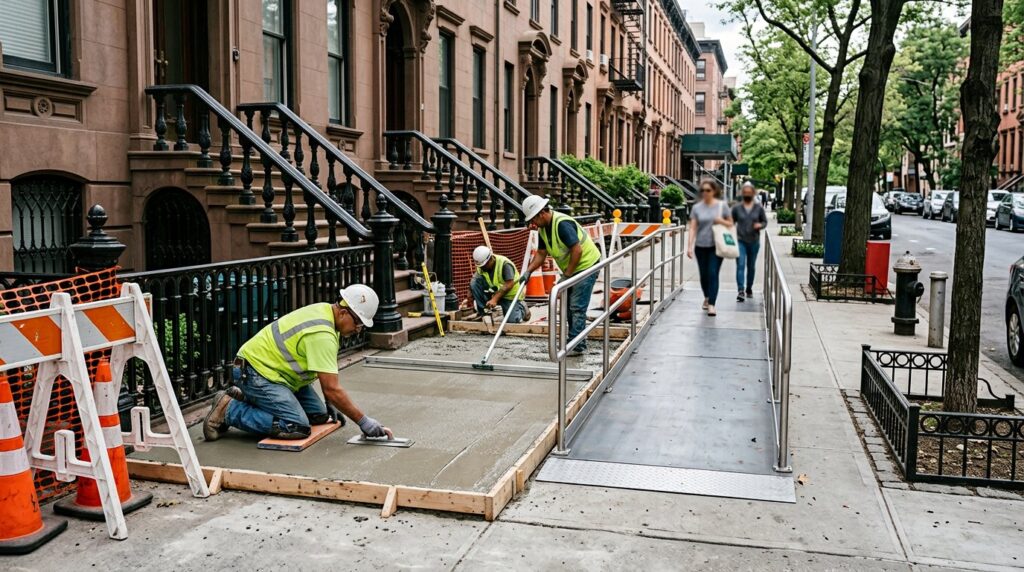
Damaged sidewalks in New York City are more than an appearance issue. Cracked, uneven, deteriorated, or otherwise defective pavement can create accessibility concerns, potential trip hazards, property maintenance responsibilities, and regulatory issues. Property owners researching QuickFix Sidewalk NYC may be looking for professional help with concrete sidewalk repair, NYC Department of Transportation inspections, sidewalk violations, or related restoration work. Before choosing any contractor, owners should verify the company’s current credentials, insurance, experience, permits, written scope, and familiarity with applicable NYC requirements rather than relying solely on advertising claims.
New York’s sidewalk environment is unusually complex. Repairs may interact with street trees, utilities, pedestrian routes, curb conditions, accessibility requirements, landmark considerations, and city permitting procedures.
The correct solution therefore depends on why the sidewalk is damaged, where the defect is located, and what regulations apply. Understanding the process makes it easier to assess contractor proposals and avoid repairs that address appearance without addressing the underlying issue.
What Is QuickFix Sidewalk NYC?
QuickFix Sidewalk NYC appears in searches related to sidewalk and concrete services in New York City. Because business information, licensing, services, and coverage can change, property owners should confirm the exact company’s current legal identity and service details directly before entering an agreement.
A sidewalk contractor may perform services such as concrete removal and replacement, damaged flag repair, violation related work, and other masonry or concrete services depending on its qualifications and offerings.
The company name itself does not demonstrate authorization to perform every type of work.
New York City sidewalk work can require permits and must comply with applicable Department of Transportation requirements. Contractors performing regulated work should follow current city procedures.
QuickFix Sidewalk NYC and Property Owner Responsibilities
Under New York City law, property owners generally have responsibility for maintaining sidewalks adjacent to their properties in a reasonably safe condition, subject to important legal distinctions and exceptions.
NYC Administrative Code Section 7 210 addresses liability for certain sidewalk conditions, while other city provisions and programs govern maintenance and repair.
The exact legal position can depend on property type and circumstances.
Owners facing a violation, claim, or complex responsibility question should rely on current NYC guidance and obtain appropriate legal advice when necessary rather than treating generalized contractor information as legal guidance.
Verify QuickFix Sidewalk NYC Before Hiring
Start by confirming the contractor’s full business identity, address, insurance, and relevant licensing.
NYC provides official tools that can help consumers research businesses and contractors subject to particular licensing or registration requirements. Permit information can also be checked through city systems where available.
Request recent references for comparable sidewalk projects.
Verify insurance through current documentation rather than accepting an unverified statement that the company is “fully insured.”
7 QuickFix Sidewalk NYC Repair Insights Property Owners Should Know
Sidewalk projects can appear simple, but concrete replacement in a dense urban environment requires coordination. These seven areas are especially important before authorizing work.
1. QuickFix Sidewalk NYC Work Should Start With the Actual Defect
Not every crack requires identical treatment.
Sidewalk defects can include vertical displacement, collapsed sections, cracking, missing concrete, trip hazards, improper slopes, loose surfaces, or conditions associated with tree roots.
The appropriate repair depends on the cause and applicable standards.
Simply filling a crack may not resolve movement beneath the slab. Likewise, replacing concrete without understanding a root related problem can lead to unnecessary tree damage or recurring pavement issues.
Have the condition assessed before selecting a repair method.
2. QuickFix Sidewalk NYC Repairs May Require DOT Permits
Work involving NYC sidewalks typically falls within the city’s street and sidewalk regulatory framework.
Permitting requirements depend on the specific work and location.
A contractor should be able to explain which permits are required, who will obtain them, and whether permit costs are included in the quotation.
Property owners can verify current requirements through the NYC Department of Transportation.
Never assume that a small repair is automatically exempt because it covers only a limited area.
3. QuickFix Sidewalk NYC Projects Must Consider Street Trees
Tree roots are a common complication in urban sidewalk projects.
Roots can displace pavement as trees mature, but cutting or damaging them indiscriminately can harm tree health and potentially create safety or regulatory problems.
New York City’s street trees are subject to city oversight.
When a sidewalk defect involves a street tree, property owners and contractors should follow current NYC Parks and DOT procedures relevant to tree related sidewalk work.
Do not authorize root cutting based solely on a contractor’s preference without establishing that the proposed work is permitted.
4. QuickFix Sidewalk NYC Quotes Should Define the Scope
A useful estimate should state what concrete will be removed and replaced, approximate quantities, site preparation, disposal, reinforcement where specified, concrete requirements, finishing, permits, pedestrian protection, and other included work.
Exclusions are equally important.
If curb repair, tree work, utility adjustments, or restoration is excluded, that should be clear before signing.
Detailed quotes also make it easier to compare contractors fairly.
A lower price may simply reflect a smaller scope.
5. QuickFix Sidewalk NYC Repairs Need Safe Pedestrian Management
Sidewalk work takes place in active public space.
Construction areas need appropriate barriers, signs, access management, and other protections consistent with current permit and safety requirements.
Maintaining accessible routes can also be relevant.
Contractors should plan how pedestrians will move around the work and how wet concrete will be protected during curing.
A rushed project that leaves an uncontrolled public hazard can create problems beyond the original damaged sidewalk.
6. QuickFix Sidewalk NYC Concrete Work Depends on Proper Installation
Concrete performance is influenced by far more than its appearance immediately after finishing.
Subgrade preparation, concrete specification, placement, jointing, weather conditions, curing, drainage, and other details can affect durability.
Requirements should follow the permitted plans or applicable NYC specifications where relevant.
Property owners do not need to become concrete engineers, but they should ask what specification the contractor intends to follow and how quality will be controlled.
7. QuickFix Sidewalk NYC Violation Work Needs Proper Closeout
Repairing the visible sidewalk does not necessarily mean every administrative issue is automatically resolved.
If work was undertaken because of a DOT sidewalk violation, property owners should understand the applicable process for inspection or dismissal after corrective work.
Keep permits, contracts, photographs, invoices, and other relevant records.
Check current NYC DOT procedures for requesting reinspection or confirming violation status rather than relying solely on verbal assurance from a contractor.
QuickFix Sidewalk NYC and DOT Sidewalk Violations
NYC DOT can inspect sidewalks and identify defects under city criteria.
A sidewalk violation generally provides notice that specified conditions need correction. It is important to read the actual notice carefully because it identifies the property and documented defects.
Do not assume every highlighted issue requires complete replacement of the entire sidewalk.
How QuickFix Sidewalk NYC Violation Repairs Should Be Planned
Begin by comparing the notice with existing pavement conditions.
A qualified contractor can then propose a scope intended to address identified defects while complying with applicable standards.
Ask the contractor to distinguish required violation work from optional cosmetic improvements.
This distinction can help control the budget while allowing owners to decide whether broader replacement makes sense.
QuickFix Sidewalk NYC Reinspection Considerations
Once corrective work is complete, follow the current NYC process for addressing the violation record.
Requirements and procedures can change, so consult NYC DOT’s official sidewalk repair and violation guidance.
Keep photographic records from before, during, and after construction when practical.
Documentation can be useful if questions arise about what work was completed or which contractor performed it.
QuickFix Sidewalk NYC for Cracked Concrete
Concrete develops cracks for many reasons.
Shrinkage, settlement, freeze and thaw exposure, root growth, loading, poor drainage, subgrade movement, and existing construction details can all contribute.
The presence of a crack alone does not identify its cause.
QuickFix Sidewalk NYC Crack Repair Versus Replacement
Some limited cracking may be repairable, while displaced or extensively deteriorated slabs can require more substantial work.
NYC regulatory criteria also matter when a defect is subject to a violation.
Ask whether the proposed method is primarily cosmetic or intended to satisfy applicable city requirements.
A contractor should not guarantee that a patch will permanently solve movement when the underlying cause remains active.
QuickFix Sidewalk NYC and Uneven Pavement
Vertical displacement deserves particular attention because it can affect pedestrian accessibility and trip risk.
The appropriate correction depends on severity, location, pavement condition, and cause.
Grinding may be suitable in some contexts, while removal and replacement may be necessary in others.
Current NYC standards and permit conditions should determine acceptable methods when regulated sidewalk work is involved.
QuickFix Sidewalk NYC and Tree Root Damage
Trees provide important urban benefits while creating engineering challenges when roots and pavement occupy limited space.
The goal should be to address sidewalk conditions without unnecessarily compromising tree health.
Coordination can take additional time.
QuickFix Sidewalk NYC Tree Related Repair Options
Depending on the site and city approval, possible approaches can involve adjusted sidewalk geometry, appropriate root management, alternative construction details, or other treatments.
Not every option works at every location.
A certified arborist or relevant city authority may need involvement for particular conditions.
Contractors should never present unauthorized root cutting as a routine shortcut.
QuickFix Sidewalk NYC and NYC Parks Requirements
NYC Parks oversees street trees, and work near them may be subject to specific procedures or approvals.
Property owners should consult current NYC Parks guidance when roots, trunks, tree pits, or other tree related conditions are involved.
This protects both the public tree and the property owner’s project.
It can also reduce the risk of completing concrete work only to discover that the tree related portion was handled incorrectly.
QuickFix Sidewalk NYC Cost Factors
A reliable sidewalk repair price requires site specific information.
Costs can vary with repair area, concrete quantity, demolition, disposal, site accessibility, permits, tree involvement, curb conditions, reinforcement, utility complications, and other requirements.
Online average prices should therefore be treated only as broad context.
Getting a QuickFix Sidewalk NYC Written Estimate
Ask for a written proposal describing measurable quantities where possible.
Determine whether permit fees, disposal, barriers, labor, materials, cleanup, and administrative work are included.
The payment schedule should also be documented.
Do not make significant decisions based solely on a verbal estimate provided after a brief look from the street.
A detailed proposal protects both homeowner and contractor by defining expectations.
Comparing QuickFix Sidewalk NYC With Other Quotes
Obtain comparable scopes.
If one contractor prices three flags and another prices six, their totals reveal little about relative value.
Look at concrete specifications, included permits, tree coordination, site protection, warranty terms, and closeout assistance.
References and demonstrated experience with NYC sidewalk requirements can be relevant alongside price.
QuickFix Sidewalk NYC Permit Planning
Permits are a core consideration because sidewalks are part of New York City’s public right of way environment.
Permit requirements and fees can change.
The NYC Department of Transportation should therefore be treated as the authoritative source for current procedures.
Who Should Obtain QuickFix Sidewalk NYC Permits?
The answer depends on the work and applicable city rules.
In many circumstances, the contractor performing street or sidewalk work must hold appropriate authorization and obtain required permits.
The written agreement should identify who handles applications and associated fees.
Owners should request the permit information where appropriate and confirm that work begins under the correct authorization.
QuickFix Sidewalk NYC and Utility Considerations
Sidewalks can contain or cover utilities and infrastructure.
Vaults, utility covers, service lines, cellar structures, hydrants, street furniture, and other features can complicate repair.
Do not move or alter infrastructure casually.
A contractor should identify conditions requiring coordination with utilities, city agencies, engineers, or other specialists before proceeding.
QuickFix Sidewalk NYC Accessibility Considerations
Sidewalks are pedestrian infrastructure and need to serve people with diverse mobility needs.
Slope, surface condition, curb ramps, obstructions, and clear routes can all affect accessibility.
Relevant federal, state, and city requirements may apply depending on the work.
QuickFix Sidewalk NYC and Pedestrian Routes
During construction, temporary conditions matter as well as the finished pavement.
Barriers and equipment should not create uncontrolled hazards.
Where a pedestrian route needs modification, the contractor must follow applicable permit and safety requirements.
Property owners should ask how public access will be managed before demolition begins, particularly on busy sidewalks.
QuickFix Sidewalk NYC Curb Ramp Work
Curb ramps have specialized geometric and accessibility requirements.
They should not be treated as ordinary flat concrete replacement.
If a project involves an intersection or pedestrian ramp, confirm what agency approvals, specifications, and contractor qualifications apply.
Detailed requirements should come from current official standards rather than generic internet diagrams.
QuickFix Sidewalk NYC Concrete Quality Considerations
New concrete should be installed according to applicable specifications and site conditions.
Weather can influence placement and curing, especially during very hot or cold conditions.
Experienced contractors should account for those variables.
QuickFix Sidewalk NYC Joint and Drainage Planning
Joints help manage where movement and cracking occur, although they cannot guarantee crack free concrete.
Existing grades also need attention.
Changing sidewalk elevations carelessly can influence drainage toward buildings, tree pits, streets, or neighboring pavement.
Where drainage or grading is complex, appropriate professional input may be necessary.
QuickFix Sidewalk NYC Curing Practices
Concrete requires time to develop its properties after placement.
Curing practices help maintain appropriate conditions during that process.
The exact method and timing depend on specifications, weather, mixture, and application.
Pedestrian access should not resume merely because the surface looks dry. Follow the contractor’s instructions and applicable specification regarding protection and opening the area.
How to Verify QuickFix Sidewalk NYC Credentials
Before signing, request identifying business information and relevant documentation.
Confirm that names on proposals, insurance records, permits, and payments are consistent or that any differences are properly explained.
Research publicly available records where appropriate.
QuickFix Sidewalk NYC Insurance Checks
Contractors should carry insurance appropriate to their work and contractual obligations.
Do not rely solely on a statement printed on advertising material.
Request a current certificate or other appropriate evidence and, for significant projects, consider verifying coverage with the insurer or broker.
Insurance requirements may also be specified by NYC permits, property managers, or other parties.
QuickFix Sidewalk NYC Reviews and References
Look for patterns rather than one unusually positive or negative review.
Recent references for comparable NYC sidewalk work can be particularly useful.
Ask previous clients about permit handling, punctuality, communication, cleanup, change orders, and whether administrative closeout was handled as expected.
No contractor’s review profile can guarantee the outcome of a future project, so combine references with documentary verification.
QuickFix Sidewalk NYC Contract Essentials
A written agreement should identify parties, property, scope, price, payment schedule, estimated timeline, permits, responsibilities, exclusions, warranty terms, and change procedures.
Review cancellation and dispute provisions as well.
Never sign incomplete paperwork.
QuickFix Sidewalk NYC Change Orders
Unexpected conditions can appear after concrete is removed.
Changes involving additional excavation, base work, utilities, tree conditions, or expanded replacement should be documented.
The change order should explain cost and any scheduling implications.
This prevents a situation in which substantial additional work appears only on the final invoice without clear prior authorization.
QuickFix Sidewalk NYC Project Documentation
Keep one digital folder containing the violation notice where applicable, photographs, proposals, contracts, permits, insurance information, invoices, payment records, change orders, and correspondence.
Good documentation makes project administration easier.
It also creates a useful record for future property transactions or disputes.
Photographing QuickFix Sidewalk NYC Repairs
Take clear photographs before work begins without obstructing construction crews or entering restricted work zones.
Additional photographs can document major stages where safe and appropriate.
After completion, record the repaired area and surrounding pavement.
Photographs do not replace inspections or official documentation, but they can provide useful contextual evidence of site conditions and completed work.
QuickFix Sidewalk NYC Final Project Checks
Before considering the project closed, confirm that contracted work is complete and the site has been cleaned appropriately.
Check whether permits require formal closeout and whether a sidewalk violation requires further action.
Obtain final invoices and warranty documentation.
Do not assume every city database will update instantly after work is completed. Follow the appropriate official process and retain records.
QuickFix Sidewalk NYC Maintenance After Repairs
New concrete still requires sensible care.
Avoid inappropriate deicing products or maintenance methods when they conflict with contractor or concrete supplier guidance.
Monitor nearby drainage and tree growth over time.
Extending the Life of QuickFix Sidewalk NYC Repairs
Address conditions that can contribute to recurring deterioration where practical and legally permissible.
Do not overload pavement with unauthorized vehicles or equipment.
If new displacement, major cracking, settlement, or tree related movement develops, have the condition evaluated before it becomes more severe.
Maintenance cannot prevent every form of deterioration, but early assessment can make future decisions easier.
Frequently Asked Questions
What services does QuickFix Sidewalk NYC provide?
Service offerings should be confirmed directly with the current business. NYC sidewalk contractors commonly handle concrete replacement, damaged pavement and violation related repairs.
Can QuickFix Sidewalk NYC repair a DOT violation?
A qualified contractor may perform corrective sidewalk work, but owners should verify permits, applicable NYC standards and the official process for clearing the violation afterward.
Does QuickFix Sidewalk NYC need a permit?
Many forms of NYC sidewalk work require DOT permits. The exact requirement depends on the project, so verify current rules with NYC DOT before construction begins.
How much does QuickFix Sidewalk NYC repair cost?
Cost depends on repair area, concrete work, demolition, permits, site access, tree involvement and other conditions. A detailed site specific written estimate is preferable.
Can QuickFix Sidewalk NYC remove tree roots?
Street tree roots should not be cut or removed without following applicable NYC requirements. Tree related repairs may require coordination with NYC Parks and other authorities.
How should I verify QuickFix Sidewalk NYC before hiring?
Check the company’s legal identity, applicable licenses, insurance, permits, references, detailed written scope, payment terms, warranty and experience with NYC sidewalk requirements.
Conclusion
QuickFix Sidewalk NYC may be considered by property owners dealing with cracked pavement, uneven concrete, tree related damage, or NYC DOT sidewalk violations, but contractor selection should always include independent verification. Successful sidewalk work requires more than pouring replacement concrete: permits, pedestrian safety, tree protection, grading, city specifications, documentation, and administrative closeout can all matter. Property owners should rely on current NYC DOT and NYC Parks requirements for regulatory questions and insist on a detailed written scope before construction. Careful planning helps create a repair that addresses both the physical defect and the obligations surrounding New York City’s public sidewalks.