
Heating represents a substantial energy requirement in homes, commercial properties, farms, public buildings, and industrial facilities, encouraging property owners to consider alternatives to conventional fossil...
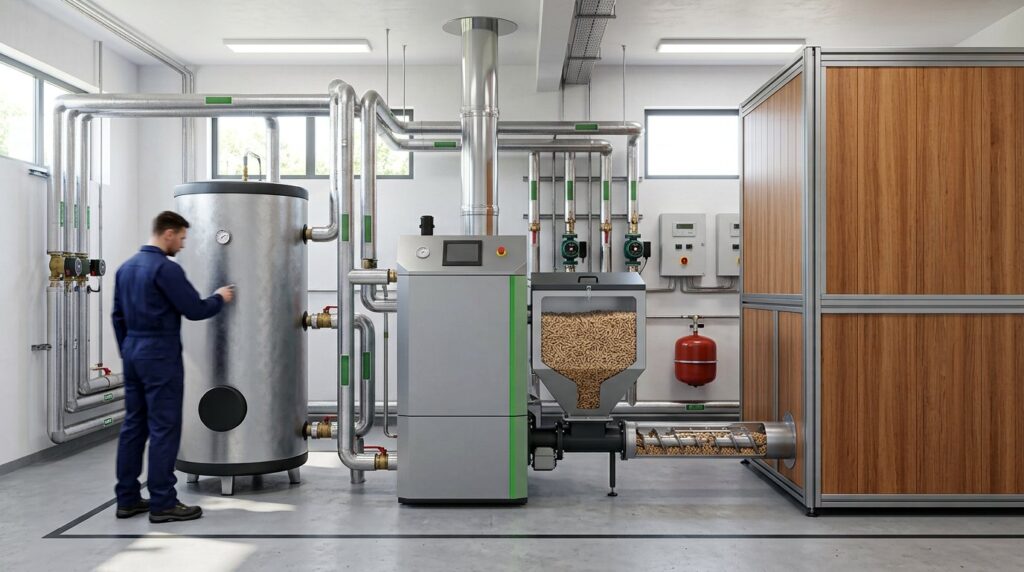
Heating represents a substantial energy requirement in homes, commercial properties, farms, public buildings, and industrial facilities, encouraging property owners to consider alternatives to conventional fossil fuel systems. Biomass boilers generate useful heat by burning biological fuels, commonly wood pellets, wood chips, or logs, and can supply space heating and hot water through a wet central heating system. Modern installations can automate fuel feeding, combustion control, and ash handling to varying degrees, but biomass heating still requires more planning than many gas or electric systems. Fuel storage, deliveries, local air quality, emissions, maintenance, chimney design, system sizing, and the sustainability of the fuel source all influence whether it is a sensible option.
Biomass is often described as renewable because plant material can be replenished. That does not mean every biomass installation is automatically carbon neutral or environmentally preferable.
Climate impact depends on factors including feedstock origin, forestry practices, processing, transportation, combustion efficiency, alternative use of the material, and the timeframe over which emissions and regrowth are considered.
A credible assessment therefore needs to consider both the heating system and its fuel supply.
What Are Biomass Boilers?
A biomass boiler is a combustion appliance that burns appropriately specified biological fuel and transfers the resulting heat to water.
That heated water can circulate through radiators, underfloor heating, fan convectors, hot water cylinders, or other compatible heating systems.
Wood is the most familiar fuel, although biomass as a broader category can include other biological materials.
Individual appliances are designed and certified for particular fuels.
Never assume that a boiler approved for pellets can safely burn logs, chips, waste timber, or agricultural residues.
Fuel specification directly affects combustion, emissions, reliability, ash production, and warranty conditions.
How Do Biomass Boilers Work?
Fuel enters a combustion chamber manually or through an automated feed system.
Controlled air supports combustion, and a heat exchanger transfers energy from hot combustion gases into the building’s heating water.
Exhaust gases then leave through an appropriately designed flue or chimney.
Controls regulate operation according to system design and heating demand.
Some installations include thermal stores or buffer tanks that can help manage heat output and cycling.
Ash and combustion deposits need periodic removal even in highly automated systems.
How Biomass Boilers Differ From Biomass Stoves
A boiler primarily transfers heat into water for distribution through a central heating system.
A stove often provides a significant proportion of its heat directly to the room where it is installed.
Some stove models incorporate boilers, creating overlap between the categories.
For whole building heating, system design should consider the complete heat load, distribution system, domestic hot water demand, and controls rather than choosing equipment based solely on nominal appliance output.
9 Key Benefits and Considerations of Biomass Boilers
Biomass can be attractive in suitable properties, but each potential benefit comes with practical considerations that need to be assessed.
1. Biomass Boilers Can Replace Some Fossil Fuel Heating
Biomass systems can provide an alternative to oil, LPG, coal, and in some circumstances gas heating.
They may be particularly relevant to rural properties without access to a mains gas network.
The environmental comparison is not identical everywhere.
Local electricity generation, heat pump performance, fuel sourcing, and existing heating equipment all affect which replacement option produces lower emissions or lower operating costs.
Compare realistic alternatives for the specific property rather than assuming biomass is automatically the best renewable technology.
2. Biomass Boilers Use Storable Solid Fuel
Unlike electricity or piped gas, wood fuel can be stored on site.
This can provide useful supply flexibility, especially for larger rural or commercial properties.
Storage also creates logistical requirements.
Fuel needs to remain within appropriate moisture and quality conditions. Pellet systems may require a silo or purpose designed store, while wood chip installations generally need substantially more volume.
Delivery vehicles require practical access.
3. Biomass Boilers Can Support Automated Heating
Pellet and some wood chip systems can offer automated feeding and combustion controls.
This makes them more convenient than manually loaded log boilers.
Automation does not eliminate maintenance.
Fuel feed components can jam, ash needs management, and sensors, fans, motors, ignition systems, and heat exchangers can require servicing.
Buyers should evaluate the complete maintenance workload before assuming a modern biomass system operates exactly like a gas boiler.
4. Biomass Boilers Can Serve Larger Heat Loads
Biomass technology is available across a broad range of outputs.
This makes it relevant to large homes, schools, farms, hotels, commercial premises, district heating, and industrial applications in appropriate circumstances.
Large heat demand can make fuel storage and delivery economics more practical.
However, sizing remains crucial.
An oversized system can cycle inefficiently, while undersizing can leave supplementary heating operating frequently.
A professional heat loss and demand assessment should guide selection.
5. Biomass Boilers Can Use Locally Available Fuel
In some regions, established forestry and wood processing industries provide dependable local pellet or chip supplies.
Shorter transport routes can offer logistical benefits.
“Local” is not automatically equivalent to sustainable.
Buyers should investigate fuel quality, source, certification where relevant, and continuity of supply.
Commercial projects may need formal fuel contracts to control specification, pricing, and delivery arrangements.
6. Biomass Boilers Can Integrate With Existing Wet Heating Systems
Because biomass boilers heat water, they can sometimes connect with existing radiator and hot water systems.
That does not make every existing system directly compatible.
Flow temperatures, hydraulic design, pipework, controls, pumps, heat emitters, thermal storage, and existing boiler arrangements may require modification.
A competent heating designer should assess the complete system.
Retaining old distribution infrastructure can sometimes reduce disruption, but only when it remains suitable.
7. Biomass Boilers Can Work With Thermal Storage
A buffer or thermal store can absorb heat produced by the boiler and make it available as the building needs it.
This can be particularly useful where the boiler operates efficiently in longer combustion cycles.
Whether storage is necessary and how large it should be depends on appliance type, control strategy, heat load, and manufacturer requirements.
Oversimplified online sizing formulas should not replace system design.
Tank space and structural loading also need consideration.
8. Biomass Boilers May Offer Predictable Fuel Purchasing Options
Businesses that consume substantial quantities may be able to arrange scheduled fuel deliveries or supply contracts.
This can support budget planning.
Fuel prices still fluctuate.
Pellet and chip prices respond to forestry markets, manufacturing costs, transportation, energy prices, seasonal demand, and other economic factors.
Operating cost comparisons should use current local quotations rather than historical averages.
9. Biomass Boilers Can Form Part of a Lower Carbon Strategy
Sustainably sourced biomass can play a role in some decarbonization pathways, particularly in applications where other low carbon technologies are difficult to deploy.
But combustion emits carbon dioxide at the point of use as well as particulate matter and other pollutants.
This is why policy increasingly emphasizes where biomass is most appropriate.
Energy efficiency improvements should normally be considered alongside heating technology so the building does not consume more fuel than necessary.
Biomass Boilers and Wood Pellet Fuel
Wood pellets are manufactured from compressed woody material and have relatively standardized dimensions compared with logs or chips.
Their consistent physical properties make automated handling possible.
Quality varies, so buyers should use fuel meeting appliance specifications.
Pellet Biomass Boilers
Pellets can be delivered in bags or in bulk.
Larger automatic installations often use a bulk store connected to the boiler through augers or pneumatic feeding systems.
Bulk delivery needs suitable vehicle access and carefully designed fill arrangements.
Fuel stores need to remain dry.
Pellets that absorb moisture can swell, disintegrate, and create feed problems.
Follow supplier and boiler manufacturer requirements when designing storage.
Fuel Standards for Pellet Biomass Boilers
In Europe, ENplus certification is commonly encountered in the wood pellet market and is based around pellet quality and supply chain requirements.
Boiler manufacturers may specify particular pellet classes.
Certification should be verified rather than inferred from vague phrases such as “premium pellets.”
Fuel outside the appliance specification can increase deposits, emissions, maintenance, or operating problems.
Wood Chip Biomass Boilers
Wood chips can be suitable for larger installations where there is adequate storage and reliable fuel delivery.
Their lower bulk energy density compared with pellets typically means they require more storage volume.
Moisture content can vary considerably.
Fuel Storage for Wood Chip Biomass Boilers
Stores need to accommodate delivery method and fuel handling.
Walking on or entering bulk biomass stores can be dangerous because of moving machinery, confined space risks, gases, dust, and unstable material.
Access should be controlled.
Commercial installations need suitable risk assessment and operating procedures.
Fuel store design should be integrated with the boiler project rather than treated as an afterthought.
Wood Chip Quality for Biomass Boilers
Particle dimensions, moisture, contamination, and fines can influence handling and combustion.
The boiler supplier should provide acceptable fuel specifications.
A system designed for one chip grade may not perform reliably with poorly screened or excessively wet material.
Establish quality requirements with the fuel supplier before regular deliveries begin.
Log Biomass Boilers
Log boilers typically require manual loading and therefore demand more owner involvement.
They can be practical where suitable firewood is readily available and users are comfortable managing fuel.
Logs require significant dry storage.
Moisture and Log Biomass Boilers
Burning inadequately seasoned wood reduces combustion quality and can increase emissions and deposits.
Use fuel within the moisture specification required by the appliance and applicable local rules.
A moisture meter can provide useful information when used correctly.
Wood should be measured and interpreted according to appropriate guidance because surface moisture alone may not represent the entire log.
Biomass Boilers Efficiency Explained
Boiler efficiency describes how effectively fuel energy is converted into useful heat under defined test or operating conditions.
Published figures should be interpreted carefully because laboratory performance and real building operation are not identical.
Fuel quality and maintenance matter.
What Affects Biomass Boilers Efficiency?
Important factors include:
• Fuel moisture and specification
• Boiler sizing
• Combustion controls
• Heat exchanger cleanliness
• Return water temperatures
• Cycling frequency
• Thermal storage
• Distribution losses
• Building heat demand
• Maintenance condition
Improving insulation and reducing uncontrolled heat loss can lower fuel consumption regardless of boiler efficiency.
Biomass Boilers Versus Heat Pumps
Heat pumps and biomass boilers operate fundamentally differently.
Heat pumps move environmental heat using electricity, while biomass boilers create heat through combustion.
Heat pumps can provide highly efficient low carbon heating in many buildings, particularly where the electrical grid is relatively low carbon.
Biomass can remain relevant where heat demand, building characteristics, electrical constraints, fuel availability, or high temperature processes make alternatives difficult.
A building specific assessment is more useful than declaring one technology universally superior.
Biomass Boilers Costs
The total cost includes much more than the appliance.
Fuel storage, flues, thermal stores, hydraulics, controls, electrical work, building modifications, delivery access, commissioning, and disposal of old equipment can all contribute.
Large commercial installations may also need civil works.
Biomass Boilers Installation Costs
Meaningful estimates require a site survey and heat load assessment.
A compact pellet boiler with an adjacent store is substantially different from a large wood chip plant with automated delivery infrastructure.
Obtain itemized quotations.
Compare equivalent specifications and confirm whether design, permissions, electrical work, fuel storage, commissioning, controls, and aftercare are included.
Biomass Boilers Running Costs
Estimate annual fuel consumption from realistic heat demand and system performance rather than boiler output alone.
Then apply current local delivered fuel prices.
Include electricity used by pumps, fans, controls, and feeding equipment.
Servicing, chimney cleaning, ash disposal, and replacement components should also be included in whole life cost calculations.
Biomass Boilers Fuel Price Considerations
Compare fuel prices using energy content and delivered cost rather than price per tonne alone.
Moisture content can significantly influence the useful energy obtained from wood fuels.
Storage losses and delivery charges also matter.
Commercial buyers should establish how fuel quantity and quality are verified.
Biomass Boilers Installation Requirements
Biomass systems need adequate plant space.
Clearances for servicing can be substantial, and engineers must be able to remove components without dismantling the building around the boiler.
Fuel stores often require even more room.
Flues for Biomass Boilers
Combustion gases need an appropriately designed chimney or flue.
Flue height, diameter, temperature classification, condensation, draught, termination, nearby buildings, and manufacturer requirements can all influence design.
Do not adapt an existing chimney without assessing suitability.
A liner or completely new flue system may be required.
Professional design should follow relevant building and appliance requirements.
Ventilation for Biomass Boilers
Combustion equipment requires appropriate air provision.
Plant rooms may also need ventilation for heat dissipation and safety.
Never block ventilation openings to reduce drafts or heat loss.
Requirements depend on appliance rating, room, flue arrangement, and local regulation.
Planning Permission for Biomass Boilers
Planning and building requirements differ by location.
In the UK, some installations may fall within permitted development conditions, while others need planning approval, particularly where chimneys or protected buildings are involved.
Building Regulations can apply independently.
Check current requirements with the local authority and competent installer before construction begins.
Biomass Boilers and Air Quality
Combustion releases pollutants.
Modern certified appliances and appropriate fuel can reduce emissions substantially compared with uncontrolled burning, but they do not eliminate them.
Particulate pollution is particularly important.
Biomass Boilers in Smoke Control Areas
In the UK, smoke control legislation can restrict appliances and fuels in designated areas.
Requirements should be checked with the relevant local authority and current government guidance.
Do not assume that a product described as environmentally friendly is automatically lawful in every smoke control area.
The specific appliance, fuel, and exemptions where applicable need verification.
Biomass Boilers Emissions Standards
Appliances can be subject to Ecodesign and other product requirements depending on market.
Commercial installations may face additional permitting or emissions requirements according to size and location.
Regulations evolve.
Installers and property owners should confirm current rules rather than relying on compliance claims from older product brochures.
Biomass Boilers and Carbon Emissions
Carbon accounting for biomass is complex.
Trees absorb carbon while growing, while harvesting, processing, transport, combustion, and land use influence the overall climate effect.
Time also matters because emitted carbon enters the atmosphere immediately when wood burns.
Are Biomass Boilers Carbon Neutral?
It is inaccurate to describe biomass combustion as automatically carbon neutral.
The climate impact depends on the complete supply chain and counterfactual scenario, including what would have happened to the biomass if it had not been used for energy.
Sustainably managed residues can have a different impact from harvesting high carbon stock forests specifically for fuel.
Organizations making environmental claims should use credible lifecycle evidence.
Sustainable Fuel for Biomass Boilers
Look for recognized sourcing standards where relevant and ask suppliers about feedstock origin.
Certification can improve transparency but should be understood according to what the scheme actually evaluates.
Local residues can sometimes provide a useful energy resource.
Avoid assuming that importing pellets over long distances necessarily makes biomass unsustainable or that local supply automatically makes it sustainable. Lifecycle analysis needs broader context.
Biomass Boilers Maintenance
Maintenance is essential for safe and efficient combustion.
Ash and deposits can reduce heat transfer and interfere with sensors or moving equipment.
Manufacturer servicing intervals should be followed.
Routine Biomass Boilers Maintenance
Tasks can include ash removal, heat exchanger cleaning, fuel feed inspection, combustion chamber cleaning, and checks of seals or sensors.
Automation level varies between appliances.
Operators should only perform tasks identified as suitable for users.
Electrical, combustion, flue, or complex mechanical repairs should be left to competent service personnel.
Biomass Boilers Ash Disposal
Wood ash can contain concentrated minerals and contaminants.
Disposal or beneficial use requirements depend on fuel type, local rules, and ash characteristics.
Do not assume all boiler ash is suitable as garden fertilizer.
Commercial operators may face specific waste classification and disposal obligations.
Annual Biomass Boilers Servicing
A professional service can include combustion checks, cleaning, component inspection, safety device testing, and flue assessment as appropriate.
Keep maintenance records.
Commercial or funded systems may have additional servicing or reporting requirements.
Regular maintenance also provides an opportunity to identify wear before an unexpected winter breakdown.
Biomass Boilers Safety
Biomass systems contain fire, hot surfaces, electrical equipment, fuel, moving feed mechanisms, and combustion gases.
Carbon monoxide is a serious hazard from faulty combustion systems.
Appropriate alarms can add protection where required or recommended.
Carbon Monoxide and Biomass Boilers
Carbon monoxide is colorless and odorless.
Correct installation, servicing, flue design, combustion air, and appliance operation are essential.
A carbon monoxide alarm is not a substitute for these controls.
Use alarms meeting applicable standards and follow installation and replacement instructions.
If an alarm activates, follow local emergency guidance and do not continue operating the appliance until the cause has been investigated.
Biomass Boilers Fuel Store Safety
Bulk stores can create hazards involving dust, confined spaces, moving augers, fire, and gases.
Access should be restricted.
Never enter a fuel store without understanding its hazards and required safety procedures.
Commercial installations should have formal risk controls and trained personnel.
Choosing Biomass Boilers
Start with the building rather than a boiler catalogue.
Determine current annual energy use, peak heat demand, available plant space, fuel delivery access, local emissions restrictions, and intended heating temperatures.
Then compare technologies.
Biomass Boilers Sizing
Oversizing should be avoided.
A heat loss calculation can identify peak demand, while annual consumption helps estimate fuel use.
Consider future insulation improvements.
If the building envelope will be upgraded, sizing the boiler against current excessive heat loss could leave the final system unnecessarily large.
Biomass Boilers Manufacturer Support
Availability of local service engineers and replacement parts is important.
A technically excellent boiler provides little practical value if specialist support requires lengthy international travel.
Ask about warranties and exclusions.
Determine which components are considered consumables and what maintenance is necessary to preserve warranty coverage.
Frequently Asked Questions
What are biomass boilers?
Biomass boilers burn approved biological fuels such as wood pellets, chips, or logs to heat water for central heating, hot water, or commercial heat applications.
Are biomass boilers environmentally friendly?
Their environmental impact depends on fuel sourcing, combustion emissions, efficiency, transport, forestry practices, and alternative heating options. They should not automatically be described as carbon neutral.
How efficient are biomass boilers?
Efficiency varies by appliance, fuel, sizing, controls, maintenance, and operating conditions. Compare independently tested product data and realistic whole system performance.
How much do biomass boilers cost?
Costs depend on output, fuel system, storage, flue, thermal storage, installation, building alterations, and maintenance. A site specific quotation provides the most reliable estimate.
Do biomass boilers need much maintenance?
They generally require more routine maintenance than many gas or electric systems, including ash management and cleaning. The workload varies substantially with appliance design and fuel.
Are biomass boilers suitable for every property?
No. Fuel storage, delivery access, emissions rules, plant space, maintenance, heat demand, and alternative technologies should all be assessed before installation.
Conclusion
Biomass boilers can provide dependable renewable fuel heating for homes, rural properties, commercial buildings, and larger heat users when the site, fuel supply, and heating demand suit the technology. Their viability depends on more than boiler efficiency, with storage, deliveries, emissions, flues, maintenance, fuel sustainability, and local regulation all influencing performance and cost. Biomass should therefore be compared objectively with heat pumps and other heating options using building specific information. A correctly sized system using appropriate fuel and professional installation can form part of a long term heating strategy without relying on oversimplified claims about cost or carbon neutrality.