
Grok 4.6 is xAI's flagship AI model, released on August 12, 2026, with a 500K-token context window and $2 per million input tokens and $6...

Grok 4.6 is xAI’s flagship AI model, released on August 12, 2026, with a 500K-token context window and $2 per million input tokens and $6 per million output tokens. Independent testing from Artificial Analysis gives Grok 4.6 an Intelligence Index of 61 at roughly 84 cents per task.
A widely shared comparison shows Claude Fable 5 costs about 3.75 times as much per task for only about 1.2 index points more. This guide explains what Grok 4.6 is, why the cost comparison matters, and the seven proven facts to check before you adopt it.

The most interesting number in the AI market this month is not a benchmark score, it is a price tag. Grok 4.6 launched on August 12, 2026, and within days it became the model everyone compared everything against, because it delivered frontier-level performance at a fraction of the cost of its rivals.
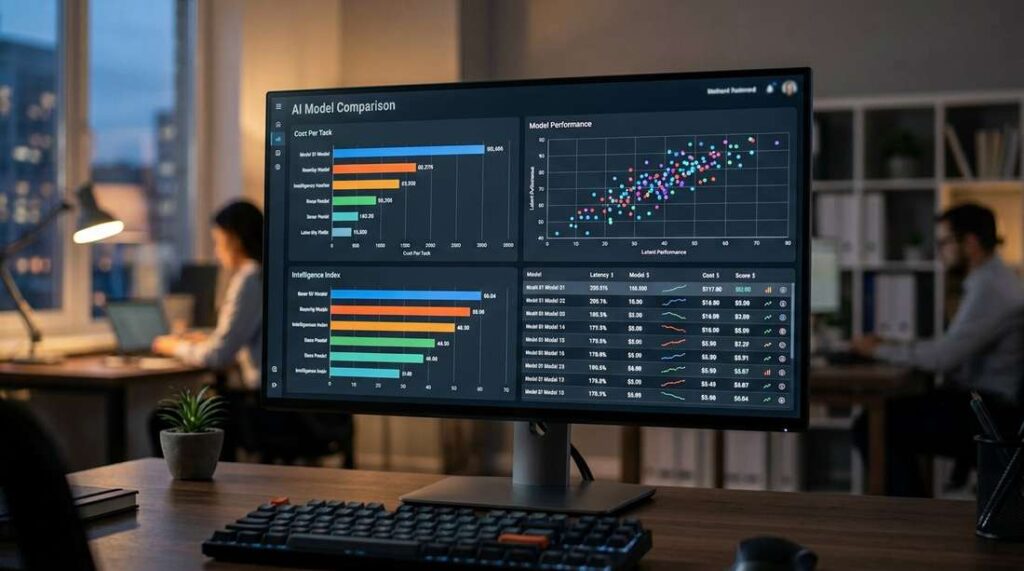
The comparison that turned heads is simple. Grok 4.6 scores about 61 on the Artificial Analysis Intelligence Index at roughly 84 cents per task, while Claude Fable 5 scores about 62 for roughly three and three-quarter times the cost per task, which works out to about 1.2 index points more for 3.75 times the money.
This guide covers what Grok 4.6 is, how the cost-per-task comparison was built, the seven proven facts you should check before adopting Grok 4.6, a side-by-side comparison with Claude Fable 5, and a decision framework for choosing between them.
What Is Grok 4.6?
Grok 4.6 is the latest flagship large language model from xAI, and it succeeds Grok 4.5 with the same 500K-token context window, the same text, image, and file input surface, and the same base pricing. It is listed as the latest model in xAI’s developer documentation, and it adds an xhigh reasoning level on top of the existing low, medium, and high settings.
The model supports configurable reasoning effort, native tool calling, structured outputs, and the full sampling surface, including temperature, top-p, seed, logprobs, and penalties. Because Grok 4.6 plugs into the OpenAI-compatible responses format on the xAI API, it drops into existing agent frameworks and tool-calling loops without a translation layer. Developers who have used OpenAI-compatible APIs will find Grok 4.6 familiar from the first request.
On the benchmark side, Grok 4.6 reports a headline score of 94.9 on GPQA Diamond and an Intelligence Index of 61 from Artificial Analysis, which ties it with GPT-5.6 Sol Max on the composite index. Its real signature, however, is not the score, it is the price at which the score is delivered.
How the 3.75 Times Cost Comparison Works
The comparison in the title of this guide comes from independent testing, not from a marketing page. Artificial Analysis measures two things together: the Intelligence Index, which grades raw reasoning, coding, and knowledge work, and the cost per task, which is the real-world cost of completing its standard task set with each model.
Grok 4.6 lands at about 61 on the Intelligence Index with a measured cost per task of roughly 84 cents. Claude Fable 5 lands at about 62, roughly 1.2 index points higher, but its measured cost per task is roughly 3.15 dollars, which is about 3.75 times the cost of Grok 4.6.
The lesson is that cost per token and cost per task are different numbers. Grok 4.6 uses its tokens efficiently, resolving tasks in fewer turns and with less output than models that charge more per token, and that efficiency is what makes the per-task economics so lopsided. For teams that run high volumes of agentic or coding work, that difference lands directly on the invoice, which is why the cost-per-task metric has become the standard way to compare Grok 4.6 with its rivals.
The 7 Proven Facts to Check Before You Adopt Grok 4.6
These seven facts are the ones that actually decide whether Grok 4.6 is the right model for your workload, and each one is verified against public benchmark and pricing data.
Fact 1: Grok 4.6 Keeps the 500K Context Window
The context window is unchanged from Grok 4.5 at 500,000 tokens, which is enough for long documents, large codebases, conversation histories, and file exports in a single request. That long context is a core reason teams choose Grok 4.6 over smaller models, because it simplifies pipelines that would otherwise need aggressive chunking, and it is the first thing most teams verify when they pilot Grok 4.6.
Fact 2: Standard Pricing Is $2 and $6 per Million Tokens
Grok 4.6 costs $2 per million input tokens and $6 per million output tokens on the standard tier, which is unchanged from its predecessor and far below the $10 and $50 that Claude Fable 5 charges at list price. Cached input is priced at $0.50 per million tokens, up from $0.30, which is a small change that matters for workloads with repeated system prompts.
Fact 3: The Intelligence Index Is 61
Artificial Analysis gives Grok 4.6 an Intelligence Index of 61, tying GPT-5.6 Sol Max and coming within about one to two points of the leading models from Anthropic. Independent verification placed the score at about 60.9, which confirms the headline number rather than disputing it.
Fact 4: Cost Per Task Is Roughly 84 Cents
The measured cost per task is the number that matters. Artificial Analysis puts Grok 4.6 at roughly 84 cents per standard task, which is a sharp rise from the 36 cents of Grok 4.5 but still far below premium rivals. That number is what makes Grok 4.6 attractive for high-volume work, because the per-task economics decide the monthly bill.
Fact 5: Claude Fable 5 Costs About 3.75 Times More for 1.2 Points
The headline comparison is verified. Claude Fable 5 scores about 1.2 index points higher than Grok 4.6 but costs about 3.75 times more per task, because it charges more per token and uses more tokens per task. For most workloads, that trade is hard to justify, and it is the reason the comparison spread so quickly.
Fact 6: There Is a 200K-Token Pricing Cliff
Grok 4.6 reprices the entire request when a prompt reaches 200,000 input tokens, doubling the rates to $4 per million input and $12 per million output for the whole request. The cliff does not apply only to the excess tokens, it applies to the full request, so long-context jobs need careful cost modeling before they run.
Fact 7: Grok 4.6 Is Available Through Many Integrations
Grok 4.6 is available through the xAI API, Cursor, Grok Build, OpenRouter, Vercel, and Cloudflare, and it is listed on OrcaRouter at the provider rate with zero markup. That breadth means teams can adopt Grok 4.6 without changing their existing tooling, and the OpenAI-compatible endpoint keeps integration to a configuration change.
What Grok 4.6 Does Well in Practice
Benchmark scores only matter if they show up in real work, and the practical strengths of the model are worth naming before you build a test plan.
Long-context reasoning. The 500K-token window lets the model work over an entire codebase, a long research report, or a multi-part conversation in one pass, which removes the need to summarize context down to fit. Teams that previously chunked documents into pieces can pass the full source material and get answers that draw on everything.
Efficient agentic execution. Independent measurements show the model completes tasks in roughly half the turns that some premium rivals need, and it uses fewer input tokens along the way. For agent loops that retry, check, and iterate, fewer turns per task is the difference between a cheap run and an expensive one.
Solid coding and tool use. The model supports native function calling and structured outputs, and its scores on coding benchmarks such as CursorBench and DeepSWE are competitive with models that cost several times more. It also works inside existing tools like Cursor, so a development team can switch models behind the same interface.
Multimodal input without extra services. Text, image, and file inputs arrive through one endpoint, so a request can combine instructions, a screenshot, and a file reference. That simplifies pipelines that previously needed separate OCR or vision services.
None of this means the model is the best at everything, and the evaluation section below explains how to check it on your own tasks.
How to Evaluate Grok 4.6 on Your Own Workload
The professional way to evaluate any AI model is to measure it on your real workload, and a structured evaluation takes less effort than most teams expect.
Start with a sample set that represents what your users actually ask. If you run coding agents, gather twenty to fifty real tasks from your backlog; if you run research or summarization, gather real documents and questions. Run the same set through the model and through your current model, then score the outputs on quality, correctness, and how much editing they need.
Track cost per completed task as you go. Record the input tokens, output tokens, and turns for each task, and multiply by the standard rates, so the comparison reflects your actual usage rather than a published average. Watch the 200K-token cliff if any of your tasks pass large documents, and model a worst-case month alongside a typical month.
Score reliability as well as quality. Note how often the model needs a retry, how confident it is when it is wrong, and whether its mistakes are easy to catch. A cheap model that quietly fails on your critical path is not cheap, and an expensive one that always works may be worth the premium.
Finally, involve the team that will operate the model. The developers, analysts, or operators who use it daily will notice fit issues that a benchmark cannot, and their feedback should carry weight in the final decision. When the evaluation is done, the choice between the value leader and the quality leader usually makes itself.
Grok 4.6 vs Claude Fable 5: Side by Side
The table below compares Grok 4.6 with Claude Fable 5 on the numbers that matter for a buying decision.
| Metric | Grok 4.6 | Claude Fable 5 |
|---|---|---|
| Developer | xAI | Anthropic |
| Release date | August 2026 | June 2026 |
| Intelligence Index | 61 | About 62 |
| Cost per task | About $0.84 | About $3.15 |
| Cost ratio | 1x | About 3.75x |
| Input price per 1M tokens | $2.00 | About $10.00 |
| Output price per 1M tokens | $6.00 | About $50.00 |
| Context window | 500K tokens | 1M tokens |
| Long-context surcharge | At 200K tokens | None |
The table makes the trade explicit. Grok 4.6 wins on cost per task, list price, and value per dollar, while Claude Fable 5 wins on raw index score, context length, and the absence of a long-context surcharge. Neither column is wrong, and the right choice depends on the workload.
Who Should Choose Grok 4.6
Grok 4.6 is the right choice for workloads where volume, cost per task, and speed of iteration matter more than the last index point. High-volume coding agents, batch research, document-heavy summarization, and tool-calling loops all fit, because each of these runs many tasks and the per-task savings compound. Teams that adopt Grok 4.6 for these patterns typically see their model bill drop while keeping quality within reach of the leaders.
Choose Grok 4.6 when your team can tolerate a slower time to first token, when your prompts stay below 200,000 tokens, and when you are willing to monitor output quality on your own examples. Choose it when you want frontier-adjacent capability at a price that makes running thousands of tasks per day affordable, and reserve judgment until a pilot of Grok 4.6 on real tasks confirms the numbers.

Who Should Choose Claude Fable 5 Instead
Claude Fable 5 remains the choice for judgment-heavy work where the top score is worth the price. Its 1-million-token context and absence of a long-context surcharge suit projects that routinely pass entire codebases or long documents, and its slightly higher index matters in evaluations where a point of quality is a competitive advantage.
Choose Claude Fable 5 when quality is the only metric, when prompts are long enough to trigger the Grok 4.6 pricing cliff, or when your budget is small enough that task count does not multiply. For teams that run a few high-stakes tasks per day, the 3.75 times cost per task is a rounding error; for teams running millions of tasks, it is the difference between solvency and a surprise.
The honest framework is to test both on your real workload, measure cost per completed task and quality on your own examples, and let the numbers decide rather than the benchmark headlines.
How to Model the Cost of Grok 4.6
Cost modeling for Grok 4.6 is straightforward if you track the right numbers. Start with your monthly task volume, then estimate the average input and output tokens per task, and multiply by the standard rates of $2 per million input and $6 per million output. A spreadsheet with these three inputs is enough to build a reliable Grok 4.6 cost forecast.
Add the cache factor if you send repeated system prompts or reference material, because cached input at $0.50 per million tokens changes the math for high-volume workloads. Then check your longest prompts, because any request at or above 200,000 tokens reprices at $4 and $12 for the entire request, and that cliff can double the cost of a single long job.
Compare the result against your current model spend. If you are paying premium prices per token today, a workload of 100 million input tokens and 20 million output tokens costs about $320 per month on Grok 4.6 at standard rates, where a premium rival at $5 and $25 would cost about $1,000 for the same volume. The measured per-task numbers from Artificial Analysis tell the same story, and the difference shows up on the first invoice.

The Risks to Watch With Grok 4.6
No adoption decision is complete without the risks, and Grok 4.6 has three worth naming. The first is the 200K-token pricing cliff, which quietly doubles the cost of long-context requests, so monitor prompt lengths before scaling. The second is quality variance, because independent testing found Grok 4.6 can be less reliable on some terminal and agentic coding benchmarks than its composite score suggests. The third is the newer evidence base, because Grok 4.6 is a fresh release and long-horizon behavior is still being documented.
Each of these risks is manageable, but only if your team tracks them from the start of any Grok 4.6 rollout. Teams that treat Grok 4.6 like any other production dependency, with monitoring, alerting, and rollback plans, get the cost savings without the surprises.
None of these are deal-breakers for the right workload, but they are exactly why the proven practice is to run your own evaluation on real tasks before committing. A model that wins on cost per task only helps if it also completes your tasks correctly.
Conclusion
Grok 4.6 has reset the value conversation in AI, because it delivers an Intelligence Index of 61 at roughly 84 cents per task while its closest premium rivals cost multiples more for single index points. The comparison with Claude Fable 5 captures the trade perfectly: about 3.75 times the cost per task for about 1.2 index points more, and Grok 4.6 wins that trade for most volume workloads.
For teams running high volumes of coding, agentic, research, or document work, Grok 4.6 is one of the most compelling models of 2026, and the seven proven facts in this guide give you the checklist to adopt it responsibly. Check the context window and pricing, verify the index and cost-per-task numbers, understand the 200K-token cliff, and confirm the integrations you need. The same checklist will serve you again when the next model ships, because the discipline of measuring Grok 4.6 on real tasks is the same discipline that evaluates any AI investment.
Run your own benchmark before you scale, model the full monthly cost, and compare Grok 4.6 against Claude Fable 5 or any premium model on your real tasks. If the numbers hold for your workload, Grok 4.6 will be the cheapest smart decision you make this year, and if they do not, the same process will tell you before you spend. Either way, the evaluation you run on Grok 4.6 makes your next model decision easier.
Frequently Asked Questions
What is Grok 4.6?
Grok 4.6 is xAI’s flagship AI model released on August 12, 2026, with a 500K-token context window and $2 and $6 pricing per million input and output tokens.
How much does Grok 4.6 cost?
Grok 4.6 costs $2 per million input tokens and $6 per million output tokens, with cached input at $0.50 and doubled rates for prompts at or above 200,000 tokens.
What is the Grok 4.6 Intelligence Index?
Artificial Analysis gives Grok 4.6 an Intelligence Index of about 61, which ties GPT-5.6 Sol Max and comes within one to two points of Anthropic’s leading models.
How does Grok 4.6 compare with Claude Fable 5?
Claude Fable 5 scores about 1.2 index points higher but costs about 3.75 times more per task, making Grok 4.6 the value leader for high-volume work.
What is the 200K-token pricing cliff?
Any Grok 4.6 request at or above 200,000 input tokens is billed at $4 per million input and $12 per million output for the entire request.
Is Grok 4.6 good for coding agents?
Yes, Grok 4.6 scores well on agentic and coding benchmarks and resolves tasks in fewer turns, which makes its per-task cost especially attractive.
What integrations support Grok 4.6?
Grok 4.6 is available through the xAI API, Cursor, Grok Build, OpenRouter, Vercel, Cloudflare, and OrcaRouter with an OpenAI-compatible endpoint.
Should I switch to Grok 4.6?
Test it on your real workload first, because the right choice depends on your task volume, prompt lengths, and quality requirements.
Sources and Disclaimer
This guide draws on public information about Grok 4.6 from xAI’s developer documentation and launch coverage, from independent benchmark and cost data published by Artificial Analysis, from the OrcaRouter model page for Grok 4.6, and from published comparisons of Grok 4.6 with Claude Fable 5 and Claude Opus 5. Benchmarks, pricing, and model availability change frequently, and measured results can vary by configuration, so verify current numbers with the model providers and run your own evaluations before making adoption or purchasing decisions. This article is informational and does not constitute investment, procurement, or professional advice, and it is not an endorsement of any vendor.