
Artificial intelligence is becoming an integral part of modern banking. Financial institutions use AI to detect suspicious transactions, assess credit risk, automate customer support, process...
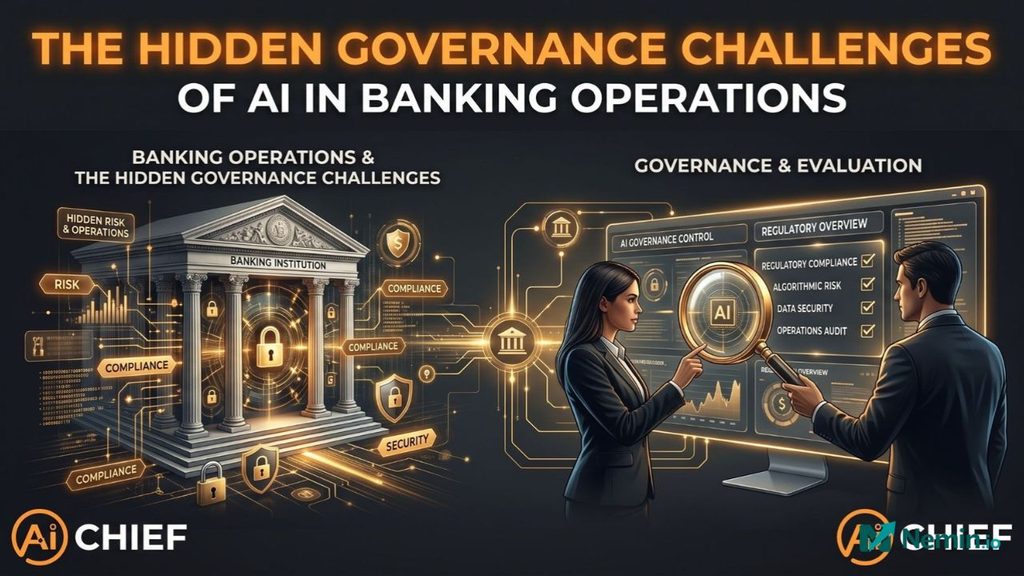
Artificial intelligence is becoming an integral part of modern banking. Financial institutions use AI to detect suspicious transactions, assess credit risk, automate customer support, process documents, and improve regulatory reporting. These applications can reduce manual work and help banks make faster, data-informed decisions.
However, the real challenge of adopting AI in banking extends beyond selecting an accurate model or integrating a new platform. Banks must ensure that AI-driven decisions remain explainable, secure, fair, auditable, and compliant with financial regulations. These requirements create a complex governance problem that is often less visible than the technology itself.
AI governance in banking involves much more than establishing an internal policy. It requires clear accountability, reliable data management, ongoing model monitoring, appropriate human oversight, and controls that remain effective as systems evolve. Without these foundations, even a technically impressive AI solution can introduce operational, financial, and reputational risks.
Why AI Governance Is More Complicated in Banking
Banking operations are interconnected. A model used to identify fraudulent transactions may affect payment processing, customer access, investigation workloads, and regulatory reporting. Similarly, an AI system that supports lending decisions can influence credit availability and expose a bank to discrimination claims if its outcomes are unfair.
Traditional software generally follows rules defined by developers. AI systems, particularly machine learning models and generative AI applications, can produce outputs influenced by patterns in training data, changing input conditions, and probabilistic reasoning. Their behavior may be difficult to explain through conventional software documentation alone.
This creates a fundamental governance challenge: banks must understand not only whether a system works, but also when it might fail, who is responsible for its decisions, and how those decisions can be challenged.
The problem becomes more complicated when banks deploy third-party AI services, foundation models, or external data providers. A bank may be responsible for the consequences of an AI-supported decision without having complete visibility into how the underlying model was trained or updated.
The Accountability Gap Between AI Systems and Banking Teams
One of the most significant governance weaknesses is unclear ownership. AI projects often involve data scientists, software engineers, compliance officers, risk managers, cybersecurity teams, and business departments. Each team may understand its own responsibilities, yet no single group necessarily has a complete view of the system’s operational impact.
Consider an AI assistant that summarizes suspicious transaction reports. The technology team may be responsible for integration, the financial crime team may review alerts, and compliance may oversee reporting obligations. If the assistant omits an important detail, responsibility for identifying and correcting the failure must be clearly established.
Banks need governance structures that assign accountability throughout the AI lifecycle, from initial approval to retirement. This includes defining who can authorize deployment, change model settings, approve new use cases, investigate incidents, and suspend a system when its performance becomes unreliable.
An AI governance committee can coordinate these responsibilities, but committees alone are insufficient. Effective governance also requires named owners, documented approval processes, escalation procedures, and evidence that controls operate in practice.
Data Quality, Privacy, and Third-Party Dependencies
AI systems depend on the quality, relevance, and permitted use of their data. In banking, information may come from transaction histories, customer records, identity verification systems, credit bureaus, support conversations, and external providers. Inconsistent records or outdated information can undermine model performance and lead to inappropriate decisions.
Data governance becomes especially difficult when information moves between systems. A customer record may be copied into an analytics environment, processed by an external AI provider, and incorporated into a generated report. Each transfer creates questions about access permissions, retention, confidentiality, and auditability.
Generative AI introduces additional concerns. Employees might enter account information, internal risk assessments, or customer complaints into tools that have not been approved for confidential financial data. Depending on the service and its configuration, this information may be stored or processed outside the bank’s intended security boundaries.
Banks should therefore establish approved-tool policies, data classification rules, access controls, retention requirements, and clear restrictions on sensitive inputs. Third-party assessments should examine not just a provider’s security claims but also data handling, subcontractors, incident notification, model updates, service continuity, and contractual responsibilities.
This is also why technology discovery requires careful evaluation. An AI tools directory can help banking professionals identify potential platforms for research and comparison, but appearing in a directory should never be treated as proof of regulatory compliance, security, or suitability for financial services. Resources such as AIChief, which organizes AI tools across different categories, can support initial discovery; banks must still conduct their own vendor due diligence before using a product in production.
Explainability and Fairness in Automated Decisions
Explainability is another major governance concern, particularly when AI influences decisions that affect customers. A bank may need to explain why a transaction was flagged, why an application was referred for additional review, or how an automated system contributed to a lending decision.
Some machine learning models are difficult to interpret, while generative AI systems can produce convincing explanations that do not accurately reflect the processes behind their outputs. A plausible answer is not necessarily a faithful explanation of a model’s behavior.
Banks should match their explanation methods to the risk and purpose of each application. This may involve documenting relevant decision factors, maintaining input and output records, testing outcomes across customer groups, and ensuring that employees can review or challenge consequential results.
Fairness testing is equally important. Historical banking data can reflect existing inequalities, incomplete records, or past decisions that disadvantage particular groups. A model trained on such information may reproduce those patterns even when sensitive attributes are excluded.
Governance teams should assess whether proxy variables create unintended disparities, whether performance differs across relevant populations, and whether human review is genuinely capable of correcting problematic outcomes. These checks should occur before deployment and continue as data and customer behavior change.
Model Drift, Generative AI Errors, and Operational Resilience
AI governance does not end when a model passes testing. Banking conditions change continuously: fraud techniques evolve, customer spending patterns shift, economic conditions affect credit risk, and new products introduce unfamiliar data. A model that performed well during validation may become less reliable in production.
Banks need ongoing monitoring that reflects the specific risks of each application. Depending on the use case, this may include tracking accuracy, false positives, missed fraud, unusual output patterns, processing delays, and differences between expected and observed results. Clear thresholds should trigger investigation, remediation, or suspension when necessary.
Generative AI requires additional safeguards because it can produce inaccurate information, fabricate references, or summarize documents incorrectly. An AI system that assists with compliance research or customer communication should not be assumed reliable simply because its answers sound authoritative.
Practical controls include grounding outputs in approved internal documents, checking generated responses against authoritative records, limiting the actions an AI agent can perform, and requiring human approval for high-impact decisions. Banks should also test how systems respond to malicious instructions, unexpected inputs, and attempts to expose confidential information.
Operational resilience matters just as much as model performance. If an AI service becomes unavailable, changes its behavior after an update, or produces a large volume of incorrect alerts, the bank needs a tested fallback process. Manual review procedures, incident response plans, and recovery arrangements help prevent an AI failure from becoming a broader operational disruption.
Regulatory Compliance and the Need for Auditable Evidence
Financial institutions operate within established frameworks for risk management, privacy, cybersecurity, consumer protection, and operational resilience. AI introduces new questions about how these obligations apply when decisions are partly or substantially automated.
The relevant requirements depend on the bank’s jurisdiction, the purpose of the system, the data involved, and the consequences of its outputs. For example, requirements relating to automated decisions, personal data, outsourcing, and model risk may overlap without being identical.
A written AI policy cannot demonstrate compliance on its own. Banks need evidence showing how risks were assessed, which controls were approved, what testing was performed, how changes were managed, and whether monitoring identified problems. This evidence should be available to internal audit, compliance teams, and regulators when required.
Maintaining an inventory of AI systems is a practical starting point. For each system, banks should document its business purpose, accountable owner, data sources, external dependencies, risk classification, approval status, and monitoring arrangements. The inventory should include embedded AI features in existing software, not only systems developed internally.
This approach helps banks identify unapproved applications, overlapping vendor dependencies, and systems that require stronger controls. It also makes it easier to prioritize governance resources according to potential harm rather than treating every AI use case as equally risky.
Building Governance Into Everyday Banking Operations
The most effective AI governance programs are integrated into existing business processes rather than operating as separate compliance exercises. Risk assessment should begin when a proposed use case is being considered, not after the technology has already been purchased and deployed.
Procurement teams should involve security, legal, compliance, and operational risk specialists before signing contracts. Development teams should document testing assumptions and limitations. Business owners should define acceptable performance and escalation thresholds. Internal audit should be able to assess whether the controls are designed appropriately and functioning as intended.
Employee training is equally important. Staff need to understand which tools are approved, what information can be shared, when AI-generated content requires verification, and how to report unexpected behavior. Training should reflect real banking tasks rather than relying exclusively on general AI awareness sessions.
Banks should also distinguish between assistance and authority. Using AI to summarize a document or organize an investigation is different from allowing an autonomous system to execute payments, block accounts, or make consequential eligibility decisions. The level of human oversight should reflect the potential impact, reversibility, and uncertainty of the task.
Conclusion
The hidden governance challenges of AI in banking operations are rooted in accountability, data management, explainability, third-party risk, and continuous oversight. These issues cannot be resolved through model accuracy alone or by adopting a single AI governance framework.
Banks need a lifecycle approach that combines clear ownership, documented controls, independent review, ongoing monitoring, and tested fallback procedures. They must also evaluate AI vendors carefully and ensure that employees understand both the capabilities and limitations of the tools they use.
As AI becomes more deeply embedded in financial services, responsible adoption will depend on how effectively institutions manage the risks surrounding the technology. Discovering new solutions through resources such as AIChief and other AI tools directories can help teams explore the available landscape, but sound governance must determine which tools are appropriate, how they are deployed, and when their use should be restricted.
Ultimately, trust in AI-powered banking will depend not simply on what these systems can accomplish, but on whether financial institutions can explain, supervise, and take responsibility for the outcomes they produce.