
Designing high-performance commercial, industrial, and architectural illumination systems requires far more than selecting attractive luminaires from a digital catalog. Engaging specialized LED fixture specification support...
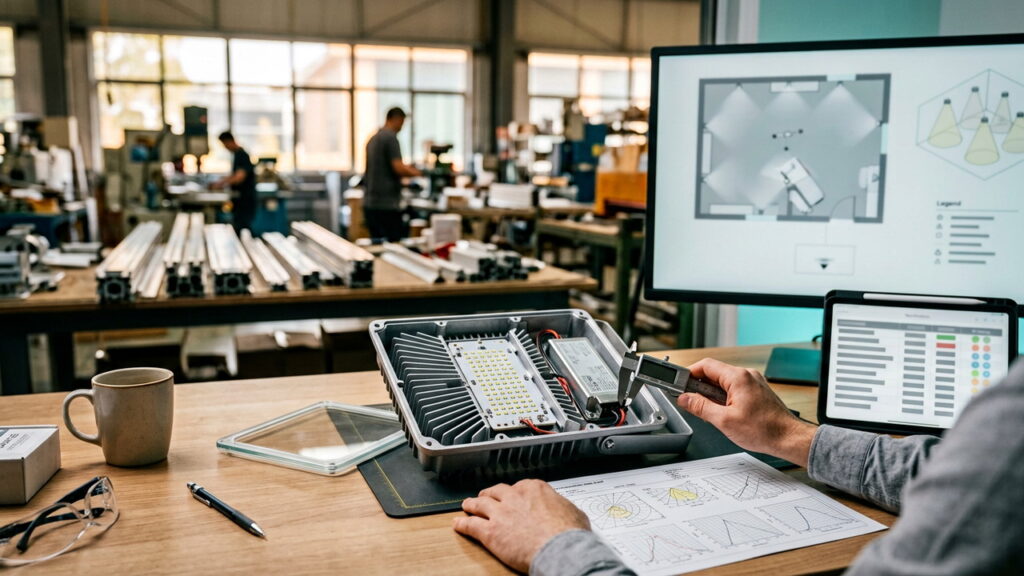
Designing high-performance commercial, industrial, and architectural illumination systems requires far more than selecting attractive luminaires from a digital catalog. Engaging specialized LED fixture specification support enables architects, electrical engineers, and design-build contractors to align photometric precision, control compatibility, and energy code compliance before construction begins.
When complex construction projects lack rigorous technical verification during the design phase, field teams frequently encounter dimming flicker, ceiling plenum conflicts, failed energy inspections, and costly change orders. Understanding how dedicated application engineers manage optical distribution, thermal longevity, and CSI Division 26 documentation empowers project stakeholders to deliver code-compliant spaces on schedule and within budget.
What Is LED fixture specification support and Why Architects and Engineers Rely on It
In the commercial construction industry, LED fixture specification support is a comprehensive engineering service that translates architectural lighting intent into verified technical documentation, point-by-point photometric simulations, and buildable luminaire schedules. Application specialists analyze room geometries, surface reflectances, mounting heights, and local energy codes to recommend exact optical distributions, lumen packages, and driver configurations for every space on a blueprint.
Architects and consulting electrical engineers rely on LED fixture specification support because modern solid-state lighting involves thousands of interdependent mechanical and electronic variables. Instead of spending puluhan hours cross-referencing driver cutsheets, emergency battery capacities, and ceiling grid tolerances, design teams leverage dedicated specialists to validate every electrical and mechanical detail upfront.
Bridging the Gap Between Architectural Vision and Photometric Reality With LED fixture specification support
Architectural renderings often depict dramatic, uniform illumination across lobbies, open offices, and healthcare corridors without accounting for physical beam spread limitations or ceiling obstructions. Utilizing LED fixture specification support bridges this gap by importing verified Illuminating Engineering Society (IES) photometric files directly into three-dimensional calculation software such as AGi32, DIALux evo, or Revit ElumTools. These simulations prove mathematically whether a proposed luminaire layout achieves target illuminance levels in footcandles or lux while maintaining strict uniformity ratios.
Beyond raw light levels, visual comfort dictates how occupants experience an interior environment over an eight-hour workday. Experienced engineers providing LED fixture specification support calculate Unified Glare Rating (UGR) values, vertical wall illuminance, and ceiling luminance ratios to prevent eye strain and harsh shadows. By modeling optical lenses—such as batwing distributions, micro-prismatic diffusers, or asymmetric wall-wash optics—early in schematic design, teams preserve aesthetic intent without sacrificing human visual comfort.
Mitigating Value Engineering Risks Through Dedicated LED fixture specification support
Value engineering frequently threatens lighting quality when general contractors or purchasing agents substitute specified architectural luminaires with unvetted, low-cost alternatives during the bidding phase. Without ironclad technical baselines established through LED fixture specification support, a generic replacement fixture may deliver adequate initial lumens while introducing severe color shift, audible driver hum, or rapid lumen depreciation. Protecting the integrity of a project requires documenting non-negotiable performance metrics directly inside the contract specifications.
When a project utilizes comprehensive LED fixture specification support to evaluate proposed contractor alternates, every substitute product undergoes strict line-by-line photometric and electrical auditing. Specialists compare TM-30 color fidelity scores, MacAdam ellipse color consistency, driver Total Harmonic Distortion (THD), and L70 lifespan projections against the basis-of-design luminaire. This objective engineering review blocks inferior substitutions while identifying legitimate cost-saving equals that still satisfy architectural performance standards.
Core Technical Deliverables Included in Professional LED fixture specification support
A complete specification package provides every stakeholder—from the consulting engineer and electrical distributor to the installing electrician and building inspector—with unambiguous technical instructions. Fragmented documentation forces field crews to guess which dimming wires, mounting brackets, or voltage taps apply to a given room. Engaging thorough LED fixture specification support ensures that every luminaire type on the fixture schedule is backed by coordinated drawings, calculations, and compliance certificates.
Photometric Layouts, IES File Modeling, and UGR Glare Calculations in LED fixture specification support
The cornerstone deliverable of any lighting design package is the point-by-point photometric layout, which maps exact footcandle grids across work planes, floors, and egress pathways. Technicians executing LED fixture specification support calibrate these models using realistic light loss factors (LLF), accounting for lumen maintenance depreciation, luminaire dirt depreciation, and room surface reflectance percentages. Calibrating calculations against IES Lighting Library standards—such as RP-1 for offices, RP-2 for retail, or RP-7 for industrial facilities—guarantees that light levels meet professional safety and productivity benchmarks.
Outdoor site lighting demands equally rigorous modeling to satisfy municipal dark-sky ordinances and property-line light trespass limits. Through specialized LED fixture specification support, application engineers evaluate Backlight, Uplight, and Glare (BUG) ratings alongside pole mounting heights and EPA wind-load calculations. Accurate site photometrics ensure parking lots, loading docks, and pedestrian walkways achieve mandatory minimum security footcandles without spilling unwanted glare into neighboring residential zones.
Dimming Protocols, Networked Controls, and Emergency Integration via LED fixture specification support
Incompatible pairing between solid-state drivers and networked lighting controls remains the single largest source of jobsite commissioning failures. A luminaire that performs flawlessly on a test bench can flicker, drop out at twenty percent dimming, or fail to turn completely off when connected to an mismatched wall dimmer or relay panel. Relying on expert LED fixture specification support eliminates these integration headaches by verifying control signal topography across every circuit before submittals are approved.
Modern commercial buildings increasingly require luminaire-level lighting controls (LLLC), daylight harvesting photosensors, and occupancy sensing to pass stringent energy inspections. Engineers delivering LED fixture specification support map out control zones, low-voltage wiring diagrams, and wireless mesh gateways so sensors communicate seamlessly with onboard drivers. Documenting startup current inrush profiles also helps electrical engineers size circuit breakers and relay contactors accurately to prevent nuisance tripping.
Coordinating 0-10V, DALI-2, and PoE Lighting Systems With LED fixture specification support
Selecting the right control protocol depends on whether a facility prioritizes simple analog zone dimming or granular, addressable building automation integration. During LED fixture specification support, specialists distinguish between sinking and sourcing 0-10V analog drivers, ensuring dim-to-off voltage thresholds and minimum dimming percentages match the specified wall stations. For advanced digital projects, technicians configure DALI-2 (Digital Addressable Lighting Interface) or D4i drivers that report real-time energy diagnostics and lamp failure alerts back to central building management systems.
Low-voltage Power over Ethernet (PoE) and DMX512 color-tuning architectures introduce additional data cable and power budget constraints. When architectural projects feature circadian tunable-white or RGBW dynamic facades, LED fixture specification support calculates universe channel capacities, Cat6 cable distance limits, and driver wattage draw per port. This granular coordination guarantees smooth, step-free dimming curves and synchronized color transitions across thousands of individual nodes.
Verifying UL 924 Emergency Egress and Battery Backup Compliance in LED fixture specification support
Life safety codes enforced by the National Fire Protection Association (NFPA 101) and International Building Code (IBC) mandate minimum illumination of one footcandle along egress paths for at least ninety minutes during utility power loss. Fulfilling this requirement through LED fixture specification support involves calculating exact emergency lumen output using the formula of battery wattage multiplied by luminaire efficacy in lumens per watt. Specialists place dedicated emergency battery packs or UL 924 automatic load control relays (ALCR) on the reflected ceiling plan to prove continuous egress coverage without dark spots.
Centralized inverters and generator transfer switches require careful separation between normal branch circuits and emergency control loops. Technicians handling LED fixture specification support verify that UL 924 bypass devices automatically override local dimming switches and occupancy sensors to force emergency luminaires to full brightness the instant normal power drops. Providing dedicated emergency photometric overlays alongside standard lighting layouts streamlines fire marshal plan review and final certificate of occupancy inspections.
Submittal Packages, CSI 3-Part Specs, and Fixture Schedules From LED fixture specification support
Clear written specifications prevent procurement ambiguity during competitive bidding and electrical distribution buyout. As part of comprehensive LED fixture specification support, technical writers prepare Construction Specifications Institute (CSI) MasterFormat Division 26 sections—specifically Section 26 51 00 for Interior Lighting and Section 26 56 00 for Exterior Lighting. These three-part documents outline general administrative standards, approved product tolerances, and field execution rules in legally binding construction language.
Accompanying the written specification is the project luminaire schedule and pre-highlighted submittal binder. Specialists managing LED fixture specification support configure exact manufacturer catalog part numbers—locking in lumen output, color temperature, cri rating, voltage, lens optic, mounting hardware, and finish—so contractors never order incomplete SKUs. Every submittal sheet is cross-referenced by fixture tag (such as Type A, Type B1, or Type EM) for rapid review by the engineer of record.
Comparing Lighting Technical Parameters Managed by LED fixture specification support
Specifying commercial luminaires requires evaluating how optical, chromatic, electrical, and environmental ratings interact within a specific building application. A food-processing plant, a surgical suite, and a corporate boardroom each demand vastly different technical tolerances. The table below outlines the critical engineering parameters audited during professional LED fixture specification support.
| Technical Parameter | Industry Standard / Metric | Target Specification Benchmark | Why It Matters in LED fixture specification support |
|---|---|---|---|
| Luminous Efficacy | IES LM-79 (Lumens per Watt) | 110 to 160+ lm/W (Application dependent) | Determines total wattage draw and Lighting Power Density (LPD) compliance |
| Color Rendering & Fidelity | CIE CRI (Ra / R9) & IES TM-30-20 | CRI 80+ (Commercial) / CRI 90+, R9 > 50, Rf > 85 | Ensures accurate skin tones, retail merchandise vibrancy, and clinical clarity |
| Color Consistency | ANSI C78.377 & MacAdam Ellipses | Within 2-step or 3-step SDCM | Prevents visible green or pink tint shifts between adjacent ceiling fixtures |
| Lumen Maintenance Lifespan | IES LM-80 & TM-21 Projections | L70 > 60,000 hrs to L90 > 100,000 hrs | Guarantees long-term light output at rated ambient operating temperatures |
| Visual Glare Control | CIE Unified Glare Rating (UGR) | UGR < 19 (Offices/Schools) / UGR < 16 (Labs) | Protects occupant visual comfort and prevents computer screen reflections |
| Electrical Power Quality | IEEE 519 THD & Power Factor | PF > 0.90, THD < 20% (or < 10% for Healthcare) | Prevents neutral wire overheating, harmonic interference, and utility penalties |
| Environmental Durability | IEC IP Rating & IK Impact Code | IP65/IP66 (Wet/Washdown) & IK08/IK10 (Vandal) | Protects diodes and drivers from dust, high-pressure water, and physical impact |
Evaluating these seven benchmarks simultaneously prevents single-metric tunnel vision, such as selecting an ultra-high-efficacy industrial fixture that produces blinding glare and poor color rendering. Disciplined LED fixture specification support balances efficacy, visual comfort, and longevity for each room type.
10 Best Proven Steps to Maximize Project ROI Using LED fixture specification support
Transforming a lighting concept into a trouble-free field installation requires a structured workflow from early conceptual design through final contractor buyout. Skipping coordination steps early in the schedule inevitably leads to expensive field rework when fixtures arrive on the jobsite with the wrong mounting brackets or control drivers. Follow these ten proven steps to maximize project return on investment through LED fixture specification support.
- Engage Application Engineers During Schematic Design: Bring in LED fixture specification support before ceiling grids and electrical panel schedules are frozen so luminaire layouts integrate cleanly with HVAC diffusers, fire sprinklers, and structural beams.
- Establish Room-by-Room IES Illuminance and UGR Targets: Define exact horizontal and vertical footcandle targets alongside maximum glare limits for every space type so LED fixture specification support models reflect actual occupant tasks.
- Verify Ceiling Plenum Depth and Mounting Grid Compatibility: Cross-check architectural reflected ceiling plans (RCPs) during LED fixture specification support to confirm whether recessed fixtures require T-bar lay-in flanges, drywall mud-in trimless frames, or aircraft cable suspension kits.
- Audit Chromaticity Using TM-30 and R9 Saturated Red Values: Move beyond basic CRI numbers by directing your LED fixture specification support team to mandate R9 values above 50 and 3-step MacAdam binning for architectural, healthcare, and hospitality zones.
- Run Complete Point-by-Point Photometric Simulations With Realistic Reflectances: Insist that LED fixture specification support calculations use accurate wall, ceiling, and floor reflectance percentages rather than inflated default assumptions that overestimate field light levels.
- Confirm End-to-End Driver and Control Protocol Interoperability: Have your LED fixture specification support specialists verify dimming curves, wiring topologies, and sensor compatibility between luminaire drivers and building lighting control panels.
- Incorporate Dedicated UL 924 Emergency Egress Calculations: Map all battery backup fixtures and central inverter circuits inside your LED fixture specification support package to prove code-compliant minimum one-footcandle egress lighting along every exit route.
- Cross-Check DLC Premium Listing Status for Utility Rebates: Direct your LED fixture specification support provider to prioritize DesignLights Consortium (DLC) listed part numbers that qualify the building owner for maximum utility cash incentives.
- Lock Down Complete Part Numbers and CSI Specifications: Eliminate contractor guesswork by having LED fixture specification support generate full manufacturer ordering codes, voltage callouts, and three-part CSI specifications prior to bid release.
- Enforce Strict Photometric and Electrical Audits on Contractor Alternates: Require any proposed value-engineering substitution to undergo a formal comparison audit through LED fixture specification support before granting engineer-of-record approval.
Following this ten-step sequence aligns owners, designers, and electrical contractors around objective engineering data. Projects that institutionalize LED fixture specification support experience fewer Requests for Information (RFIs), faster submittal approvals, and superior long-term energy performance.
Early Warning Signs That Your Construction Project Needs LED fixture specification support
Many design teams and electrical contractors attempt to assemble fixture schedules internally under tight deadline pressure, copying legacy specifications from older projects without verifying current optical or code updates. Because LED technology and energy regulations evolve rapidly, outdated spec sheets create immediate vulnerabilities during construction. Watch for these early warning signs that indicate your project urgently needs professional LED fixture specification support.
- The luminaire schedule lists discontinued catalog numbers, incomplete ordering strings, or missing voltage and dimming suffixes.
- Architectural reflected ceiling plans show recessed downlights or linear runs colliding directly with structural steel joists, ductwork, or acoustic baffles.
- No point-by-point photometric calculations exist to prove that the proposed layout satisfies local energy code Lighting Power Density (LPD) limits or IES footcandle recommendations.
- Emergency egress lighting relies on rule-of-thumb spacing rather than verified UL 924 ninety-minute battery output simulations.
- The specification calls for 0-10V dimming fixtures alongside phase-cut triac wall dimmers or incompatible digital control modules.
- General contractors submit low-cost value-engineering substitutes with no IES files, LM-80 test reports, or driver harmonic distortion data attached.
- Industrial or outdoor fixtures are specified without checking ambient temperature ratings, corrosive environment coatings, or municipal BUG dark-sky ordinances.
When two or more of these red flags appear during design development or pre-construction bidding, pausing to engage specialized LED fixture specification support prevents costly jobsite delays and failed municipal inspections.
Evaluating Service Providers for LED fixture specification support Across Project Types
Construction stakeholders can source technical lighting assistance from four primary channels: manufacturer application engineering departments, regional manufacturer representative agencies, independent architectural lighting design firms, and national electrical distributors. Each provider model operates with distinct software capabilities, brand access, and fee structures. Comparing how these partners deliver LED fixture specification support helps you align the right technical resource with your project complexity.
| Provider Type | Brand Independence | Core Technical Capabilities | Fee & Cost Structure | Best Project Fit for LED fixture specification support |
|---|---|---|---|---|
| Manufacturer Application Engineers | Single-brand or parent portfolio | Deep factory optical/driver data, custom modifications, AGi32 photometrics, thermal validation | Complimentary (bundled into factory equipment sales) | Industrial facilities, warehouses, roadway, sports lighting, custom linear runs |
| Lighting Representative Agencies | Multi-brand (50 to 100+ represented lines) | Full interior/exterior schedules, controls integration, CSI specs, submittal packaging, local code mastery | Complimentary design-assist for specifying engineers & architects | Commercial offices, schools, healthcare, multi-family, municipal buildings |
| Independent Lighting Designers (IALD/CLD) | 100% brand-agnostic | Bespoke architectural concepts, daylighting integration, custom luminaire design, full commissioning | Fee-based professional consulting retainer | Flagship hospitality, museums, luxury retail, complex architectural landmarks |
| Electrical Distributor Lighting Specialists | Broad stock & commercial vendor access | Rapid value-engineering cross-over audits, rebate filing, quick stock photometric layouts | Bundled into contractor material buyout | Design-build retrofits, tenant improvements, fast-track commercial rollouts |
When Manufacturer Application Engineering Teams Deliver the Best LED fixture specification support
Direct factory application engineering teams excel when a project involves extreme environmental demands, specialized optical physics, or custom mechanical fabrication. For example, high-bay cold-storage warehouses operating at minus thirty degrees Celsius, hazardous Class I Division 2 chemical plants, and high-mast sports stadiums require exact thermal and optical modeling straight from the luminaire laboratory. Utilizing factory-direct LED fixture specification support gives engineers immediate access to proprietary IES distributions, custom bracketry CAD files, and wind-load structural certifications.
Architectural linear manufacturers also maintain dedicated factory integration teams to handle continuous runs with mitered corners, acoustic felt baffles, and integrated emergency sections. When an architect sketches a complex geometric ceiling pattern, factory LED fixture specification support breaks the design down into exact buildable module lengths, feeder locations, and suspension points. This factory-level engineering eliminates field cutting errors and ensures continuous, shadow-free illumination.
How Local Lighting Agencies and Independent Consultants Customize LED fixture specification support
Most commercial buildings—such as schools, hospitals, and corporate headquarters—require thirty to eighty distinct fixture types sourced across multiple specialized manufacturers. No single factory builds the best cleanroom troffer, decorative pendant, exterior bollard, and theatrical cove light all under one roof. Regional lighting representative agencies solve this challenge by providing holistic LED fixture specification support across dozens of complementary architectural and commercial brands.
Because local agency application engineers work within the same municipal jurisdiction every day, they possess intimate knowledge of regional utility rebate programs, local dark-sky ordinances, and city plan-review interpretations. When a project demands complete brand neutrality and high-concept artistic direction, pairing an independent lighting consultant with agency technical support delivers unmatched creative and technical rigor across every phase of LED fixture specification support.
Energy Code Compliance, Rebates, and Sustainability Driven by LED fixture specification support
Modern building energy codes enforce aggressive caps on how many watts of lighting power can be installed per square foot of floor area. Failing an energy code audit during plan check stalls building permits, while failing final commissioning inspections delays certificate of occupancy sign-off. Integrating energy compliance directly into LED fixture specification support protects project schedules and lowers long-term operating expenses for building owners.
Navigating ASHRAE 90.1, IECC, and Title 24 Lighting Power Density With LED fixture specification support
Commercial energy codes—including ASHRAE Standard 90.1, the International Energy Conservation Code (IECC), and California Title 24 Part 6—calculate allowable Lighting Power Density (LPD) using either the Building Area Method or the Space-by-Space Method. During LED fixture specification support, engineers audit every room’s square footage against its exact luminaire wattage draw to generate automated COMcheck or Title 24 compliance forms. If a high-ceiling lobby exceeds its base wattage allowance, specialists apply code-approved decorative or control credits using the Space-by-Space calculation method to bring the entire building into compliance.
Beyond wattage caps, current codes mandate multi-level automatic daylight responsive controls, partial-off occupancy sensors in stairwells and corridors, and automatic receptacle shutoff coordination. A thorough LED fixture specification support package maps primary and secondary sidelit and toplit daylight zones directly onto the electrical plans. Clearly delineating which fixtures connect to photo-sensors ensures installing electricians wire control zones in strict accordance with inspector checklists.
Securing DLC Premium Utility Rebates and EPDs Through LED fixture specification support
Electric utilities across North America and Europe offer substantial prescriptive and custom cash rebates for installing high-efficiency solid-state luminaires paired with networked lighting controls. However, utility administrators strictly require luminaires to appear on the DesignLights Consortium (DLC) Qualified Products List (QPL)—often at the DLC 5.1 Premium tier—or carry ENERGY STAR certification. Incorporating rebate verification into LED fixture specification support ensures specified catalog numbers satisfy exact efficacy, glare, and spectral quality thresholds required for incentive payouts.
Corporate sustainability mandates such as LEED v4.1, WELL Building Standard, and net-zero carbon initiatives also place heavy scrutiny on embodied carbon and circadian health. Forward-thinking teams providing LED fixture specification support supply Environmental Product Declarations (EPDs), Declare Red List Free material transparency labels, and Equivalent Melanopic Lux (EML) circadian calculations. Documenting these sustainability credentials during specification preparation helps building owners earn coveted green building certification points effortlessly.
Pros and Cons of Utilizing External LED fixture specification support
Leveraging external application engineering teams from lighting agencies, manufacturers, or specialty consultants offers tremendous bandwidth relief for busy engineering practices, yet it also requires clear governance to protect specification neutrality. Project managers should weigh both the technical advantages and operational considerations before delegating specification tasks. Below are the primary pros and cons of utilizing external LED fixture specification support.
Pros of Utilizing Specialized LED fixture specification support:
- Provides immediate access to licensed AGi32, DIALux, and Revit photometric modeling experts without inflating internal engineering overhead.
- Eliminates dimming incompatibility and field commissioning failures by pre-validating driver protocols against networked lighting control panels.
- Accelerates permit approvals with accurate COMcheck, ASHRAE 90.1, Title 24, and municipal dark-sky BUG rating compliance packages.
- Reduces construction RFIs and change orders through exact catalog part numbers, ceiling mounting verification, and UL 924 emergency layouts.
- Maximizes building owner return on investment by aligning luminaire selection with DLC Premium utility rebates and long-term L90 maintenance profiles.
Cons and Operational Considerations:
- Complimentary agency or manufacturer support naturally favors the specific product lines represented by that organization, requiring the engineer of record to review three-name equal listings for public bids.
- Complex custom photometric modeling and multi-story 3D renderings require five to ten business days of lead time, making last-minute afternoon turnaround requests unrealistic on large campuses.
- Relying blindly on external layouts without providing accurate architectural ceiling heights, structural CAD backgrounds, or surface reflectance data can result in miscalculated field light levels.
- Value-engineering pressure during general contractor buyout can still override specifications unless the design team actively enforces submittal review audits.
Establishing clear communication protocols and sharing updated architectural backgrounds early neutralizes these potential drawbacks. When the engineer of record maintains final oversight while leveraging external technical execution, LED fixture specification support operates as a seamless force multiplier.
Project Timelines, Submittal Workflows, and Coordination Benchmarks for LED fixture specification support
Synchronizing lighting engineering milestones with the broader architectural and construction calendar keeps critical-path procurement on track. Because custom architectural luminaires and specialized outdoor poles often carry six-to-twelve-week manufacturing lead times, delays during specification or submittal review directly threaten project completion dates. The table below outlines standard workflow phases, deliverables, and turnaround benchmarks for LED fixture specification support.
| Construction Phase | Core LED fixture specification support Deliverables | Typical Turnaround Time | Primary Stakeholder Sign-Off |
|---|---|---|---|
| Schematic Design (SD) | Conceptual fixture cutsheets, preliminary budget ROM, basis-of-design concepts | 3 to 5 business days | Architect & Building Owner |
| Design Development (DD) | 3D AGi32/DIALux photometric layouts, ceiling plenum checks, preliminary fixture schedule | 5 to 10 business days | Consulting Electrical Engineer & Architect |
| Construction Documents (CD) | Final locked luminaire schedule, CSI 3-part specs, COMcheck/Title 24, UL 924 egress plans | 5 to 7 business days | Engineer of Record & Municipal Plan Reviewer |
| Bidding & Pre-Bid Alternates | Line-by-line photometric & electrical audit of contractor proposed equal substitutions | 2 to 4 business days | Specifying Engineer & Purchasing Agent |
| Construction Submittals | Pre-highlighted shop drawings, continuous linear CAD layouts, control wiring diagrams | 5 to 10 business days | Electrical Contractor & Engineer of Record |
| Commissioning & Handover | Aiming diagrams, sensor timeout schedules, O&M manuals, LM-80/warranty documentation | 3 to 5 business days | Commissioning Agent & Facility Manager |
Streamlining Pre-Bid Alternates and Equal Approvals With LED fixture specification support
Public works projects, university buildings, and hospital expansions typically require open competitive specifications that list three approved manufacturers or allow contractors to submit “or equal” alternates prior to bid day. Without a structured review workflow, electrical engineers get buried under hundreds of pages of unorganized contractor substitution requests forty-eight hours before bids close. Utilizing LED fixture specification support streamlines this bottleneck by establishing a standardized substitution checklist.
Any manufacturer or distributor requesting prior approval must submit native IES files, independent LM-79 test reports, driver specification sheets, and point-by-point calculations run under identical room parameters. Specialists managing LED fixture specification support overlay the proposed alternate’s photometric grid directly against the basis-of-design benchmark. If the substitute increases glare, creates dark spots between poles, or violates LPD wattage caps, the engineer receives a clear, documented technical basis for rejection within hours.
Post-Installation Aiming, Commissioning, and Warranty Handover in LED fixture specification support
Technical support does not end when luminaires are bolted to the ceiling grid or erected on parking lot poles. Sports complexes, facade floodlighting, and museum gallery track systems require exact field aiming angles—measured in horizontal azimuth and vertical tilt degrees—to replicate the computer photometric model. Comprehensive LED fixture specification support provides contractors with numbered aiming diagrams and laser target coordinates so night-shift aiming crews lock in optimal beam overlap on the first attempt.
During final project closeout, facility managers need organized Operation and Maintenance (O&M) documentation rather than scattered cardboard box inserts. A professional handover package compiled through LED fixture specification support includes driver replacement part numbers, programmed sensor timeout settings, dimming curve profiles, and five-to-ten-year warranty registration certificates. Delivering this structured archive ensures the building operates at peak visual and energy performance throughout its entire service lifecycle.
FAQ’s
What is included in professional LED fixture specification support for commercial projects?
Professional LED fixture specification support includes point-by-point AGi32 or DIALux photometric calculations, complete luminaire schedules, CSI Division 26 three-part specifications, dimming and control wiring coordination, UL 924 emergency egress layouts, and energy code compliance documentation.
How much does LED fixture specification support cost for architects and electrical engineers?
Most luminaire manufacturers and regional lighting representative agencies provide LED fixture specification support at zero direct cost as a complimentary design-assist service for specifying engineers and architects, while independent lighting consultants charge a project design fee for brand-agnostic specification services.
What file formats are needed to run accurate photometric layouts during LED fixture specification support?
Application engineers require architectural floor plans and reflected ceiling plans in AutoCAD (.DWG), Revit (.RVT), or scaled vector PDF formats along with ceiling heights, room surface reflectance estimates, and verified luminaire IES (.IES) photometric files.
How does LED fixture specification support prevent LED dimming flicker and control issues?
Specialists prevent dimming flicker during LED fixture specification support by verifying that luminaire driver protocols—such as sinking versus sourcing 0-10V, DALI-2, phase-cut, or DMX—match the exact electrical characteristics, minimum load limits, and inrush current ratings of the specified control system.
Can LED fixture specification support help qualify a building for DLC utility rebates and energy code approval?
Yes, LED fixture specification support verifies that specified catalog numbers carry active DesignLights Consortium (DLC) or ENERGY STAR listings for utility cash rebates while generating COMcheck, ASHRAE 90.1, IECC, or Title 24 compliance reports for building permit approval.
How do engineers evaluate value-engineering alternates using LED fixture specification support?
Engineers use LED fixture specification support to audit contractor-proposed alternates by running side-by-side photometric simulations and comparing efficacy, UGR glare ratings, TM-30 color fidelity, MacAdam color consistency, and L70 lifespan data against the basis-of-design fixture.
Conclusion
Delivering visually comfortable, energy-compliant, and architecturally inspiring illumination demands disciplined technical coordination from early schematic concepts through final jobsite commissioning. By integrating professional LED fixture specification support into your design and pre-construction workflow, you eliminate the guesswork surrounding photometric uniformity, control protocol compatibility, and municipal code enforcement.
Whether you partner with factory application engineers, local lighting agencies, or independent consultants, insisting on verified IES simulations, complete catalog specifications, and rigorous value-engineering audits protects your project from costly field surprises. Treat LED fixture specification support as an essential engineering safeguard, and your commercial lighting installations will consistently achieve lasting reliability, occupant visual comfort, and measurable financial return.