
Enterprise software is rapidly evolving beyond passive chat interfaces that wait for human prompts before generating a single text response. Deploying agentic AI enables organizations...
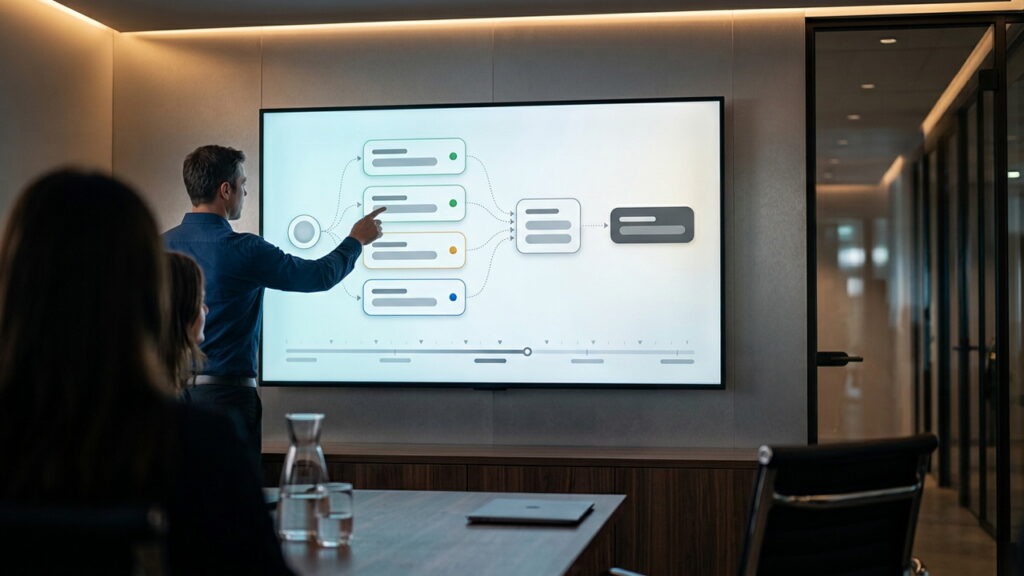
Enterprise software is rapidly evolving beyond passive chat interfaces that wait for human prompts before generating a single text response. Deploying agentic AI enables organizations to execute complex, multi-step business processes autonomously by combining large language model reasoning with secure API tool calling, persistent memory, and real-time environmental feedback.
While early generative assistants helped individuals draft emails or summarize documents faster, they still required constant human supervision to move data between applications. Understanding how autonomous reasoning loops, multi-agent orchestration, and human-in-the-loop guardrails function empowers technology leaders to transform fragmented departmental tasks into scalable, self-correcting operational workflows.
What Is agentic AI and How Does Autonomous Reasoning Work in Enterprise Systems?
In enterprise computing, agentic AI refers to an artificial intelligence system designed to pursue high-level goals autonomously by breaking complex objectives into executable subtasks, interacting with external software tools, evaluating intermediate results, and adapting its plan without continuous human prompting. Unlike static language models that only predict the next word, these systems possess agency to perceive state changes and trigger real-world actions across connected databases and applications.
Organizations adopt agentic AI because real-world business operations rarely follow a single linear prompt-and-response pattern. Resolving a supply chain disruption or investigating a cybersecurity alert requires querying multiple systems, validating permissions, comparing policy rules, and executing sequential updates across separate software environments.
The Core Four-Stage Loop Powering agentic AI From Perception to Action
Every production deployment of agentic AI operates on an iterative four-stage cognitive loop consisting of perception, reasoning, action, and reflection. During the perception phase, the system ingests structured telemetry, database records, webhook events, or natural language objectives to establish an accurate model of the current operational environment. This contextual awareness prevents the system from acting on stale assumptions before initiating a workflow.
Once context is established, the reasoning engine inside agentic AI decomposes the overarching goal into a logical sequence of steps using techniques such as ReAct (Reason and Act) or plan-and-solve prompting. The system then executes actions by calling authorized APIs, running code in a sandboxed interpreter, or querying enterprise search indices. Finally, the reflection layer inspects the output of each tool call, detects errors or incomplete data, and dynamically adjusts the remaining plan until the objective is verified complete.
How Memory Architecture and Tool Calling Elevate agentic AI Beyond Static Chatbots
Standard conversational chatbots suffer from stateless amnesia, forgetting operational context as soon as a browser session closes or a context window overflows. By contrast, enterprise agentic AI integrates a multi-tiered memory architecture encompassing short-term working memory, episodic execution logs, and long-term semantic vector storage. Retaining historical decisions and user preferences allows the system to improve accuracy across recurring business cycles without repeating past mistakes.
Structured function calling and tool use provide the mechanical hands that allow agentic AI to interact safely with deterministic enterprise software. Instead of guessing a mathematical calculation or fabricating a customer order status, the model generates a strictly typed JSON payload to query an ERP database, CRM platform, or SQL warehouse. Grounding autonomous reasoning in deterministic software tools bridges the gap between probabilistic language understanding and auditable business execution.
Key Differences Between Generative AI, Traditional Automation, and agentic AI
Technology executives frequently ask how autonomous agent architectures differ from existing Robotic Process Automation (RPA) scripts and standard generative copilots. While RPA excels at high-volume, deterministic screen scraping and generative copilots accelerate human content creation, agentic AI combines goal-directed adaptability with end-to-end execution across dynamic environments. The comparison table below defines the structural boundaries between these three automation paradigms.
| Architectural Dimension | Rule-Based RPA & Workflow Scripts | Standard Generative AI & Copilots | Autonomous Enterprise agentic AI |
|---|---|---|---|
| Primary Trigger Mechanism | Scheduled cron jobs or rigid if-then rules | Direct human prompt for every single turn | High-level goal assignment or event-driven webhook |
| Decision-Making Logic | Deterministic, hard-coded decision trees | Probabilistic single-turn text/code synthesis | Multi-step planning, reflection, and self-correction |
| Adaptability to UI or API Changes | Brittle; breaks immediately when fields change | Requires human user to re-prompt and adjust | High; interprets errors and selects alternative tools |
| External System Interaction | Pre-scripted macros and fixed connectors | Read-only context or copy-paste by human user | Dynamic API function calling and multi-system write access |
| Memory & State Retention | Stateless transaction logs | Limited to current session context window | Persistent short-term, episodic, and long-term memory |
| Optimal Enterprise Use Case | Repetitive form filling on legacy mainframes | Drafting copy, summarizing PDFs, coding assistance | End-to-end IT triage, procurement, and SecOps resolution |
Moving From Prompt-Response Copilots to Goal-Driven agentic AI
A generative copilot operates like a knowledgeable passenger who answers questions only when the human driver asks for directions at every intersection. If a financial analyst uses a standard copilot to reconcile quarterly vendor invoices, the human must still download spreadsheets, paste data into the chat window, verify discrepancies, and manually enter adjustments into the accounting ledger. Transitioning to agentic AI shifts the human role from manual operator to supervisory governor.
When assigned the same reconciliation objective, agentic AI autonomously retrieves pending invoices from the procurement portal, cross-references purchase orders in the ERP system, flags tax variances exceeding tolerance thresholds, and prepares draft journal entries for controller sign-off. By handling intermediate navigation and data formatting independently, agentic AI compresses multi-hour administrative bottlenecks into minutes of human review.
Combining Retrieval-Augmented Generation With Multi-Step agentic AI
Traditional Retrieval-Augmented Generation (RAG) pipelines follow a fixed path where a user query triggers a single vector similarity search to fetch relevant document chunks before generating an answer. However, single-shot retrieval often fails when an enterprise question requires synthesizing contradictory policy manuals, live inventory tables, and historical support tickets. Upgrading static RAG into an agentic AI retrieval workflow introduces iterative query refinement and source validation.
Inside an agentic RAG architecture, agentic AI evaluates whether the initial retrieved documents actually contain sufficient evidence to answer the query accurately. If gaps remain, the system autonomously rewrites the search query, consults a secondary relational database or graph index, and cross-checks citations before formulating its final output. This self-reflective retrieval loop dramatically reduces hallucinations in high-stakes legal, clinical, and engineering domains.
Technical Architecture and Orchestration Frameworks Behind Enterprise agentic AI
Building reliable autonomous systems requires a modular software stack that separates reasoning models from state management, tool permissions, and observability pipelines. Attempting to cram every business rule and API schema into a single monolithic prompt leads to context degradation, high token latency, and unpredictable tool execution. Mature engineering teams structure agentic AI around specialized orchestration frameworks and standardized communication protocols.
Single-Agent Versus Multi-Agent Topologies in agentic AI Deployments
For focused operational tasks involving five or fewer distinct tools, a single-agent architecture paired with a well-defined system prompt and state machine is usually the fastest and most cost-effective design. A single instance of agentic AI can reliably handle automated customer refund verification by checking order history, validating return shipping tracking numbers, and issuing credit memos. Keeping the architecture simple minimizes inter-agent communication overhead and simplifies debugging.
When workflows span multiple domains requiring specialized security permissions and deep domain instructions, architects deploy hierarchical or sequential multi-agent systems. In a multi-agent topology for agentic AI, a central supervisor or router agent receives the overarching objective and delegates subtasks to specialized worker agents—such as a SQL data analyst agent, a compliance auditing agent, and a customer notification agent. Isolating tools and system instructions per specialist agent prevents context window pollution and improves task accuracy.
Integrating APIs, Enterprise Databases, and Sandboxed Environments With agentic AI
Granting autonomous software direct access to production enterprise databases requires strict architectural isolation and least-privilege identity management. Rather than giving agentic AI unrestricted database credentials, engineering teams expose curated, read-only or schema-validated REST and GraphQL endpoints tailored to specific business actions. Every tool call is validated against JSON schema contracts before reaching underlying systems of record.
When an analytical workflow requires writing and executing custom Python scripts to clean data or generate statistical forecasts, agentic AI runs that code inside ephemeral, network-isolated container sandboxes. Sandboxed execution ensures that dynamically generated code cannot modify host infrastructure, access unauthorized internal subnets, or persist sensitive customer payloads after the task concludes.
Standardizing Context and Tool Access for agentic AI via Model Context Protocol
Historically, connecting language models to enterprise data sources required writing bespoke integration glue code for every combination of model provider and SaaS application. Today, engineering teams increasingly adopt open standards like the Model Context Protocol (MCP) and agent-to-agent communication schemas to unify how agentic AI discovers and invokes external resources. Standardized protocols allow developers to build a secure connector once and expose it uniformly across multiple autonomous workflows.
Through standardized context servers, agentic AI dynamically inspects available tool definitions, required input parameters, and access scopes at runtime without hard-coding proprietary wrappers. This decoupled architecture allows enterprises to swap underlying foundation models—moving between frontier reasoning models and smaller, fine-tuned local weights—without rewriting their entire integration layer for agentic AI.
Implementing Deterministic Guardrails and Human-in-the-Loop Controls in agentic AI
Autonomous capability must never mean unconstrained authority inside regulated corporate environments. Production-grade agentic AI embeds deterministic policy guardrails before and after every model inference step to enforce compliance boundaries, redact personally identifiable information (PII), and block prompt injection attacks. If an agent attempts to call an API with parameters outside approved financial or operational thresholds, the deterministic guardrail intercepts the call instantly.
Human-in-the-loop (HITL) checkpoints provide the ultimate safety brake for high-consequence state changes such as wire transfers, production code deployments, or contract terminations. When agentic AI reaches a designated high-risk action node, the orchestration engine pauses execution, serializes the current state to a database, and sends an interactive approval card to an authorized manager in Slack or Microsoft Teams. Execution resumes only after the human supervisor cryptographic signs off or modifies the proposed parameters.
High-Impact Enterprise Use Cases and Industry Applications for agentic AI
Organizations capture the fastest financial returns when they apply autonomous workflows to high-volume, multi-system processes that currently suffer from cognitive context-switching delays. Rather than boiling the ocean with open-ended company-wide experiments, successful enterprises target bounded operational bottlenecks with clear success metrics. The table below outlines proven enterprise use cases where agentic AI delivers measurable operational velocity.
| Enterprise Department | High-Impact Autonomous Workflow | External Systems & Tools Orchestrated | Primary Measurable KPI Improved by agentic AI |
|---|---|---|---|
| IT Service & DevOps | Automated incident root-cause triage and PR generation | Datadog/Splunk logs, GitHub repos, Jira, ServiceNow | Mean Time to Resolution (MTTR) reduced by 40% to 60% |
| Cybersecurity (SecOps) | Alert enrichment, phishing quarantine, and IOC hunting | SIEM platforms, EDR telemetry, threat intel feeds, IAM | False-positive triage labor reduced by 70%+ |
| Supply Chain & Procurement | Supplier delay re-routing and RFQ bid comparison | SAP/Oracle ERP, EDI feeds, carrier APIs, contract vaults | Stockout recovery time and procurement cycle speed |
| Finance & Accounting | Three-way invoice matching and anomaly investigation | NetSuite/Workday, bank feeds, OCR parsers, tax engines | Days Sales Outstanding (DSO) and audit accuracy |
| Customer Revenue Ops | Multi-system order modification and warranty claims | Salesforce/HubSpot, Stripe, WMS inventory, email/chat | First-Contact Resolution (FCR) and lower cost per ticket |
| Healthcare Administration | Prior authorization assembly and clinical coding audits | EHR systems (FHIR APIs), payer portals, ICD-10 guidelines | Claim denial rates and administrative processing time |
Autonomous Software Engineering, SecOps, and IT Service Management With agentic AI
Software engineering and IT operations represent the most mature frontier for enterprise agentic AI because codebases, compiler logs, and test suites provide immediate, deterministic feedback loops. When a production microservice throws an exception alert, an autonomous remediation agent can read the stack trace, locate the offending commit in version control, write a unit test reproducing the bug, generate a code patch, and open a pull request for senior engineer review. Because the agent runs the test suite inside a container before submitting its work, human developers only review verified solutions.
In cybersecurity operations centers, analysts face thousands of daily intrusion alerts that cause severe alert fatigue. Deploying agentic AI inside the security orchestration layer allows the system to autonomously correlate suspicious login attempts against threat intelligence feeds, inspect endpoint process trees, and isolate compromised virtual machines within seconds. Human security engineers receive a complete forensic dossier with recommended containment actions rather than raw, uncontextualized log lines.
Supply Chain Procurement, Financial Reconciliation, and Customer Operations Using agentic AI
Global supply chains and finance departments rely on reconciling unstructured supplier emails, PDF shipping manifests, and structured ERP database rows. When a severe weather event delays a maritime freight shipment, agentic AI can detect the carrier exception webhook, identify which downstream manufacturing work orders are impacted, check alternative air-freight rates, and draft purchase order modifications for the supply chain director. Proactive autonomous planning prevents assembly line halts before human planners even open their morning dashboards.
In customer support operations, traditional chatbots frustrate buyers because they can only paste links to help-center articles instead of actually fixing account issues. Empowered with scoped API permissions, agentic AI verifies customer identity, checks real-time warehouse packing status, updates delivery addresses in the logistics system, and processes partial shipping refunds in a single seamless conversation. Escalations to human agents include a structured summary of every diagnostic tool already executed.
9 Best Proven Strategies to Deploy and Scale agentic AI Safely
Moving autonomous systems from impressive laboratory prototypes into resilient enterprise production requires disciplined engineering governance. Many pilot projects stall because teams underestimate failure recovery, token cost multiplication, and security perimeter risks. Follow these nine proven strategies to deploy and scale agentic AI safely across your organization.
- Start With Bounded, High-Frequency Workflows With Clear Verification Criteria: Select initial use cases for agentic AI where success can be verified programmatically—such as schema validation, code compilation, or three-way data matching—before tackling ambiguous strategic tasks.
- Architect Explicit State Machines Instead of Unconstrained Autonomous Loops: Use graph-based orchestration frameworks to define valid state transitions and maximum iteration caps so agentic AI never gets trapped in infinite reasoning loops that burn compute budgets.
- Right-Size Models by Routing Subtasks Between Frontier and Small Language Models: Configure your agentic AI architecture to use frontier reasoning models for complex initial planning while delegating routine classification, formatting, and extraction steps to fast, low-cost small language models (SLMs).
- Enforce Strict Least-Privilege IAM Credentials for Every Agent Identity: Assign each instance of agentic AI its own non-human service identity with granular, role-based access controls (RBAC) rather than sharing broad administrator API keys across workflows.
- Separate Read-Only Discovery Tools From State-Modifying Write Actions: Allow agentic AI to execute read-only search and diagnostic queries autonomously, but require deterministic validation or human-in-the-loop approval before executing database deletes, external emails, or financial transactions.
- Sanitize All Untrusted External Inputs Against Indirect Prompt Injection: Implement input security scanners between retrieved web pages, emails, or third-party documents and your core agentic AI reasoning loop so malicious hidden text cannot hijack tool execution.
- Build Comprehensive Trajectory Evaluation Datasets Before Production Launch: Test agentic AI not only on its final text output, but on the exact trajectory of tool calls, parameter accuracy, and error-recovery paths across hundreds of edge-case simulation scenarios.
- Instrument End-to-End Distributed Tracing for Every Reasoning Step: Deploy OpenTelemetry-compatible observability tooling across your agentic AI stack to log every prompt, thought step, tool payload, latency spike, and token expenditure in a searchable audit trail.
- Establish Automated Rollback and Graceful Escalation Protocols: Program every agentic AI workflow with a deterministic fallback path so that if confidence drops below a set threshold or an external API times out twice, the system cleanly packages its state and routes the ticket to a human specialist.
Applying these nine engineering principles prevents rogue behavior and builds immediate trust with risk management, cybersecurity, and executive stakeholders. Organizations that treat agentic AI with the same architectural rigor as mission-critical microservices achieve far higher production adoption rates.
Early Warning Signs That Your Organization Needs Structured Governance for agentic AI
As business units race to adopt autonomous productivity tools, shadow deployments and unvetted agent scripts frequently proliferate across departments without central oversight. Unmanaged autonomy introduces severe operational, financial, and compliance liabilities that traditional IT policies were never designed to catch. Watch for these early warning signs that indicate your organization urgently needs unified governance for agentic AI.
- Individual departments are connecting third-party autonomous plugins directly to production CRM, ERP, or source-code repositories using shared personal API tokens.
- Cloud inference bills spike unexpectedly at the end of the month because unthrottled agentic AI loops retry failed API calls hundreds of times without circuit breakers.
- Security and compliance officers cannot reconstruct why an automated workflow modified a customer record or approved a vendor credit because intermediate reasoning traces were never logged.
- Multiple engineering squads are building redundant custom connectors to the same internal databases instead of sharing standardized, security-vetted Model Context Protocol servers for agentic AI.
- Customer-facing autonomous assistants occasionally issue unauthorized discounts or hallucinate policy exceptions due to missing deterministic output guardrails.
- Business workflows stall completely when an underlying foundation model updates its weights because teams lack automated trajectory evaluation suites to test agentic AI regressions.
- Sensitive intellectual property or customer PII is being stored inside unmanaged external vector databases used for long-term agent memory without encryption or retention policies.
Addressing these governance gaps early protects enterprise data integrity without stifling innovation. Establishing a central platform engineering patterns library gives product teams pre-approved guardrails, identity templates, and observability hooks for every new agentic AI initiative.
Pros and Cons of Adopting Autonomous agentic AI in Production Environments
Before committing enterprise engineering budgets to autonomous workflow transformation, technology leaders must weigh the substantial operational benefits against the real-world engineering complexities. Objective evaluation prevents over-engineering simple problems that could be solved with a ten-line Python script. Below are the primary pros and cons of deploying agentic AI in production environments.
Pros of Adopting Enterprise agentic AI:
- Executes complex, multi-system workflows end-to-end across unstructured documents and structured APIs without requiring human copy-pasting between screens.
- Adapts dynamically to unexpected API errors, schema variations, and ambiguous inputs through iterative reflection and self-correction loops.
- Frees high-cost domain experts—such as cybersecurity analysts, software engineers, and financial controllers—from repetitive data gathering and triage drudgery.
- Scales operational capacity instantaneously during seasonal demand surges or sudden security incidents without linear headcount growth.
- Improves decision accuracy over time by combining deterministic software tools, real-time enterprise retrieval, and persistent episodic memory.
Cons and Engineering Challenges of agentic AI:
- Multi-step reasoning and reflection loops consume significantly more input and output tokens than single-turn prompts, increasing both inference cost and response latency.
- Compounding error probabilities across long chains of ten or twenty autonomous steps can cause workflows to drift off course if intermediate verification checkpoints are missing.
- Introduces expanded cybersecurity attack surfaces, including indirect prompt injection, excessive agency abuse, and unauthorized cross-system data exfiltration.
- Requires specialized evaluation, tracing, and state-management infrastructure that is more complex to maintain than traditional deterministic microservices.
Balancing these trade-offs comes down to matching architectural autonomy to task complexity. When a process is purely linear and predictable, deterministic code remains ideal; when a process requires contextual judgment across shifting data sources, agentic AI delivers unmatched leverage.
Implementation Roadmap, Cost Drivers, and ROI Benchmarks for agentic AI
Scaling autonomous workflows across an enterprise succeeds best when structured as a phased capability maturity roadmap rather than an all-at-once overhaul. Starting with read-only diagnostic assistance allows teams to validate observability, latency, and security controls before unlocking autonomous write permissions. The table below outlines a proven four-phase implementation roadmap, governance scope, and expected ROI benchmarks for enterprise agentic AI.
| Deployment Phase | Timeline Window | Autonomy Level & Technical Scope | Governance & Security Controls | Target ROI & Performance Benchmark |
|---|---|---|---|---|
| Phase 1: Read-Only Diagnostic Agent | Weeks 1 to 6 | Single-agent architecture with read-only RAG and API lookup tools | RBAC read scopes, PII redaction, trace logging, 100% human execution | 30% to 40% reduction in manual research and ticket triage time |
| Phase 2: Human-in-the-Loop Execution | Weeks 7 to 12 | State-machine agent preparing draft payloads and staged tool calls | Mandatory HITL approval gates for all write/update API actions | 50%+ faster end-to-end cycle time with zero unauthorized state changes |
| Phase 3: Bounded Autonomous Action | Months 4 to 6 | Autonomous write execution within strict dollar/risk guardrails | Deterministic policy engines, budget circuit breakers, anomaly alerts | 60% to 75% straight-through processing rate on routine workflows |
| Phase 4: Multi-Agent Enterprise Mesh | Months 7 to 12 | Supervisor and specialist agents collaborating via MCP/A2A protocols | Centralized agent registry, automated red-teaming, FinOps routing | Compounding cross-department productivity and lower unit operating cost |
Managing Token Economics, Latency, and Inference Costs in agentic AI
Unlike a simple customer service chatbot that processes five hundred tokens per interaction, a single run of multi-step agentic AI might execute eight tool calls, inspect large JSON tables, and consume fifty thousand tokens behind the scenes. If every step invokes a heavyweight frontier model, unit economics can quickly erode the labor savings of automation. Smart FinOps engineering controls cost multiplication through prompt caching, context pruning, and tiered model routing.
By caching static system instructions and tool definitions at the inference layer, enterprises can slash input token costs and time-to-first-token latency by up to eighty percent on repetitive steps. Furthermore, stripping verbose HTML or unnecessary database columns from tool responses before feeding them back into the agentic AI working memory keeps context windows lean, fast, and economical.
Auditing Observability, Hallucination Recovery, and Security Compliance in agentic AI
Maintaining continuous reliability in production requires monitoring autonomous systems through a dedicated LLMOps and agent observability lens. Traditional application monitoring only tells you whether an HTTP endpoint returned a 200 OK status code, which is blind to semantic errors where an agent misinterprets a policy rule. Comprehensive observability for agentic AI tracks task completion rates, tool-call error frequencies, loop counts per run, and human-override ratios in real time.
When an audit reveals that human supervisors are modifying or rejecting a specific agent action more than ten percent of the time, engineering teams can inspect those exact execution traces to refine tool descriptions or add deterministic validation rules. Feeding verified human corrections back into automated evaluation suites ensures your agentic AI infrastructure grows safer, faster, and more accurate with every production cycle.
FAQ’s
What is agentic AI and how is it different from generative AI?
Generative AI focuses on creating text, code, or media in response to a direct human prompt, whereas agentic AI autonomously pursues multi-step goals by planning workflows, calling external software APIs, maintaining memory, and adapting its actions with minimal human intervention.
How does agentic AI work in enterprise software workflows?
Enterprise agentic AI works through an iterative four-stage loop—perceive, reason, act, and reflect—where an orchestration engine decomposes a business objective into subtasks, executes authorized API tool calls, inspects the resulting system state, and self-corrects until the goal is achieved.
What are the most effective real-world use cases for agentic AI today?
The highest-ROI enterprise use cases for agentic AI include autonomous IT incident root-cause triage, cybersecurity alert investigation, software bug remediation, three-way financial invoice reconciliation, supply chain exception routing, and multi-system customer order resolution.
Which frameworks and protocols are best for building enterprise agentic AI?
Leading frameworks for building stateful, production-grade agentic AI include LangGraph, CrewAI, Microsoft AutoGen, and LlamaIndex Workflows, increasingly paired with the open Model Context Protocol (MCP) to standardize secure access to enterprise data and tools.
Is agentic AI safe to connect to sensitive corporate databases and APIs?
Yes, agentic AI can be connected safely when engineered with least-privilege non-human identities, read-only default scopes, sandboxed code execution containers, indirect prompt-injection filters, and mandatory human-in-the-loop approval gates for high-risk write actions.
How much does it cost to build and run agentic AI in production?
Initial bounded pilot deployments of enterprise agentic AI typically cost between $25,000 and $75,000 in engineering integration, while ongoing monthly run costs depend on token volume and tool-call complexity, which teams optimize using prompt caching and small language model routing.
Conclusion
Transitioning from passive prompt-based copilots to autonomous, goal-driven workflows represents a foundational shift in how modern enterprises architect software and scale operational capacity. By grounding agentic AI in structured state machines, standardized tool protocols, and multi-tiered memory systems, organizations can automate complex cross-application processes that previously required hours of manual human coordination.
Long-term success depends on pairing autonomous capability with disciplined engineering governance, least-privilege security controls, and human-in-the-loop verification at critical decision nodes. Organizations that start with bounded, high-value use cases and instrument comprehensive observability across every reasoning step will turn agentic AI into a durable, self-improving competitive advantage.