
A well-built cabinet, panel, shop fitting or interior feature can still look unfinished when bright metal screw heads remain visible across an otherwise carefully coordinated...
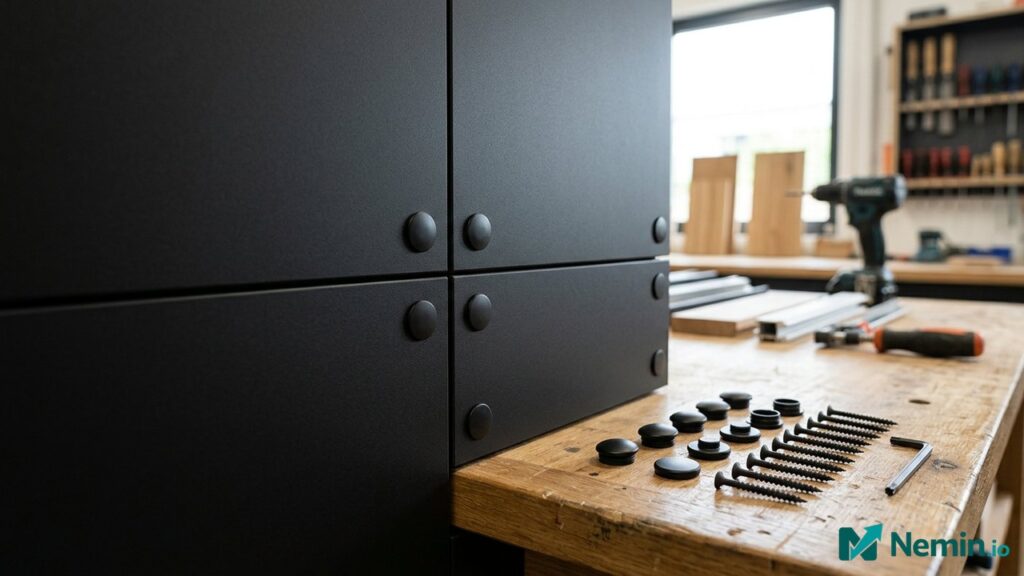
A well-built cabinet, panel, shop fitting or interior feature can still look unfinished when bright metal screw heads remain visible across an otherwise carefully coordinated surface. Black screw caps provide a simple way to conceal or visually soften selected fixings on black, charcoal and other dark materials, creating a cleaner transition between the screw and the surrounding finish. Depending on their design, screw caps can push into the screw recess, snap over a compatible fixing or attach through a separate cup or washer. Choosing the correct type matters because diameter, screw-head style, material, colour, exposure and future maintenance all influence whether a cap stays secure and looks intentional after installation.
Small details carry disproportionate visual weight in finish work. On rough structural construction, a visible screw head may be irrelevant. On cabinetry, retail displays, furniture or decorative wall panels, the same fixing can interrupt an otherwise continuous surface.
That does not mean every screw should be hidden. Some architectural and industrial designs deliberately expose fixings. The important point is consistency: if the project is intended to have a seamless black finish, uncovered bright screws can look accidental.
Black screw caps are inexpensive components, but selecting them after the entire build has been completed can lead to compatibility problems. Including them in the original fixing specification makes the final result much easier to control.
What Are Black Screw Caps?
Black screw caps are small covers designed to hide or reduce the visibility of screw heads. They are commonly made from plastic, nylon or other polymers, although decorative metal alternatives and related cover systems also exist.
The term describes several different products rather than one universal cap. Some black screw caps fit directly into the drive recess of a screw, while others snap over a base installed beneath the screw head. Hinged designs can remain attached to their base and close over the fixing after installation.
Because designs differ, a cap selected only by colour may not fit the intended screw.
Why Black Screw Caps Matter in Finish Work
Visible screws create contrast when silver, zinc-plated or brass-coloured heads sit against black surfaces. Covering those heads can help the fixing disappear visually into the surrounding material.
Black screw caps can also provide a more consistent appearance when numerous screws are arranged across a panel. Instead of seeing a series of different drive recesses, the viewer sees repeated small black circles.
The benefit is primarily aesthetic. A decorative cap should not automatically be treated as structural protection, waterproofing or a safety device unless the manufacturer specifically rates it for that purpose.
Black Screw Caps Versus Black Screws
One alternative is simply using screws with black-finished heads. This can be an excellent solution when the correct structural fixing is available in the required finish.
Black screw caps have different advantages. They can conceal the drive recess entirely, provide a larger decorative cover and sometimes allow standard screws to be used beneath the cap system.
| Feature | Black Screw Caps | Black-Finished Screws |
|---|---|---|
| Screw recess visibility | Usually concealed | Remains visible |
| Decorative coverage | Covers most or all of head | Head itself provides finish |
| Colour consistency | Depends on cap batch and material | Depends on screw coating |
| Installation | Adds another component or step | Standard screw installation |
| Replacement | Caps may be individually replaceable | Screw must usually be changed |
| Outdoor suitability | Product-specific | Coating and screw material specific |
| Structural role | Normally none | Screw performs structural function |
| Cost | Adds small component cost | Black coating may increase screw cost |
| Best use | Concealed decorative fixing | Exposed architectural fixing |
Neither option is always better. The project should determine the choice.
9 Benefits of Black Screw Caps
Black screw caps are most useful where visible fixing heads would undermine the intended finish. They can be used in joinery, furniture, interior panels, vehicle interiors, signage, display systems and selected exterior applications when the product is suitable for the environment.
Nine benefits make them worth considering: visual consistency, low cost, quick installation, broad size choice, compatibility with various projects, replacement potential, protection of the drive recess from some superficial dirt, easier colour coordination and a more finished appearance.
1. Black Screw Caps Reduce Visual Contrast
A bright screw head against a matte black board can become surprisingly prominent.
Installing a black cap makes the fixing less noticeable because the dominant visible colour becomes closer to the surrounding panel.
This is particularly effective where several fixings are arranged in a regular pattern.
2. They Can Improve the Final Appearance Without Major Rework
A project may be structurally complete before someone notices how distracting the screw heads look.
Where a compatible cap system can be fitted safely, black screw caps can improve appearance without repainting the entire panel or replacing every fixing.
Compatibility still needs checking because not every completed screw accepts a direct-fit cap.
3. Black Screw Caps Are Usually Quick to Install
Many designs simply push, snap or click into place once the correct screw has been fitted.
A small component can therefore finish dozens of visible fixing points relatively quickly.
Installation should remain careful. Forcing an incompatible cap can damage it or leave it sitting unevenly.
4. Multiple Cap Designs Are Available
There is no need to use the same product for every screw type.
Hinged caps, two-part caps, recess plugs and decorative domed covers can suit different installations. Some systems are designed around countersunk screws, while others cover broader fixing arrangements.
Understanding these differences prevents trial-and-error purchasing.
5. Black Screw Caps Can Work Across Many Materials
Suitable caps can be used with fixings in timber, plywood, MDF, laminates, composite boards and other materials when the underlying screw and installation are appropriate.
The cap does not determine whether the fixing is suitable for the substrate.
A structural screw must still be selected according to load and material requirements.
6. Individual Caps Can Often Be Replaced
A scratched or damaged cap can sometimes be removed and replaced without disturbing the underlying screw.
This is useful on furniture, displays and panels where appearance matters over a long service life.
Keep spare black screw caps from the original batch when colour matching is important.
7. Caps Can Keep Some Surface Dirt Out of the Drive Recess
A cap covering the screw head can reduce direct exposure of the recess to ordinary dust and debris.
This should not be confused with corrosion protection or waterproof sealing. Moisture can still reach the fixing through other routes, and the cap itself may not be weather-tight.
Exterior fixing corrosion resistance must come from the appropriate screw specification.
8. They Coordinate With Dark Hardware
Black hinges, handles, brackets and frames are common in contemporary interiors.
Black screw caps can connect visible fixings with this wider hardware palette, especially when the underlying surface is dark.
Matte and gloss levels should also be considered because a shiny black cap can still stand out against a flat black panel.
9. Black Screw Caps Make Details Look Intentional
Professional finishing is often about consistency rather than expense.
When every visible fixing is either deliberately exposed or consistently covered, the build feels more considered.
This is why small finishing components can influence perception even though they contribute little to the overall construction cost.
Types of Black Screw Caps
The phrase black screw caps covers several mechanisms. Identifying the correct design before ordering saves time and avoids purchasing caps that cannot attach to the selected screw.
Direct recess plugs, two-part snap caps and hinged systems are among the most common general categories.
Black Screw Caps Type Comparison
| Cap Type | How It Works | Common Advantage | Main Consideration |
|---|---|---|---|
| Drive-recess cap | Pushes into compatible screw recess | Minimal additional hardware | Must match drive type accurately |
| Two-piece snap cap | Base sits beneath screw, cover snaps on | Covers complete screw head | Must be planned before screw installation |
| Hinged cap | Integrated cover folds over fixing | Cap remains attached | Hinge remains part of appearance |
| Domed cover | Creates rounded decorative head | Smooth visual finish | Adds visible projection |
| Flat cover | Produces lower-profile appearance | Subtle finish | Compatibility varies |
| Decorative washer and cap | Washer supports screw and accepts cap | Strong defined finish | Larger visible diameter |
| Threaded decorative cover | Mechanically attaches to compatible fixing | Secure decorative attachment | Special hardware usually required |
Manufacturer terminology varies, so inspect diagrams and dimensions rather than relying solely on product names.
Push-In Black Screw Caps
Push-in caps are among the simplest solutions where the cap stem is designed to engage with a specific recess or fixing.
They can work particularly well when the screw type has already been selected and compatible plugs are available.
The main risk is size mismatch. A stem that is too small can fall out, while one that is too large may deform during installation.
Match the Drive Type
Phillips, Pozidriv, Torx and hex-drive fixings have different recess geometry.
A cap marketed for one drive should not automatically be forced into another.
Check the screw manufacturer’s or cap supplier’s compatibility information where available.
Two-Part Black Screw Caps
Two-part systems usually consist of a base and a decorative cover. The screw passes through the base, after which the cover snaps over it.
This approach completely conceals the screw head and can create a neat domed or flat finish.
Because the base is trapped by the screw, it generally needs to be included before tightening the fixing.
Plan Two-Part Caps Early
If a project contains hundreds of already-installed screws, converting to a two-part cap system can mean removing and reinstalling every fixing.
That may be worthwhile for high-finish joinery but is unnecessary work if a compatible direct-fit cap would achieve the desired result.
Specify black screw caps alongside screws during procurement whenever possible.
Hinged Black Screw Caps
Hinged caps combine a base and cover in one component.
Once the screw is installed through the base, the lid folds over and snaps closed. Because the cap remains attached, there is less risk of losing a separate piece during assembly.
The hinge itself can remain subtly visible depending on the design.
When Hinged Caps Work Well
They are useful in furniture, cabinetry and general interior assembly where installation speed matters.
They can also simplify maintenance because the cap can potentially be opened to reach the fixing, depending on the product.
Repeated opening may eventually affect certain hinges, so follow manufacturer guidance.
Black Screw Caps for Countersunk Screws
Countersunk screws are designed so the head sits flush or nearly flush within a countersunk hole.
Certain caps fit into the drive recess, while others use a base beneath the countersunk head.
A cap should not prevent the screw from seating correctly.
Countersinking Still Needs Care
Over-countersinking can crush softer boards, weaken the local surface or leave the fixing sitting too deep for the chosen cap.
Under-countersinking leaves the screw proud.
Use the correct bit and depth for the fixing and material.
Black Screw Caps for Furniture
Furniture is one of the most obvious uses because customers view and touch exposed fixings at close range.
Flat-pack furniture, shelving, wardrobes, desks and storage units can all benefit from hidden screw heads where construction requires visible fasteners.
Caps are particularly useful inside cabinets where fixings remain visible after assembly.
Match the Furniture Finish
Black does not mean one colour.
A warm charcoal laminate can make a pure glossy black cap appear unusually dark, while a matte black cabinet can make a polished cap look reflective.
Request samples when visual matching matters.
Black Screw Caps for Cabinetry
Cabinet interiors often expose screws at hinges, carcass connections or accessory fittings.
Some of these screws need to remain serviceable, making permanent fillers undesirable.
Removable black screw caps can conceal the fixing while preserving future access.
Do Not Hide Adjustment Screws Unnecessarily
Certain hinge screws are intended for alignment adjustments.
A decorative cap that must be removed every time the door needs adjustment may add unnecessary inconvenience.
Use caps where they improve appearance without obstructing normal maintenance.
Black Screw Caps for Wall Panels
Decorative wall panels can require mechanical fixing for stability or removal.
Visible screws may interfere with the appearance of black acoustic panels, laminates or composite boards.
Black screw caps can help the fixings blend into the panel when fully concealed installation is impractical.
Fixing Pattern Matters
Caps cannot correct randomly positioned screws.
Before drilling, establish an aligned fixing pattern with consistent spacing. Once capped, the repeated circles can become a deliberate design detail.
Precision in the layout matters as much as cap colour.
Black Screw Caps for Shop Fitting
Retail displays experience frequent customer contact and periodic reconfiguration.
Serviceable fixings can therefore be preferable to permanently filled screw holes. Black screw caps allow selected screws to remain accessible while improving visual presentation.
Durability becomes especially important in high-contact areas.
Keep Spare Caps on Site
Caps can be lost during display maintenance or damaged by repeated handling.
Store labelled spares with the shop-fitting maintenance materials.
Matching a discontinued black finish several years later can be surprisingly difficult.
Black Screw Caps for Office Furniture
Black frames and dark office furniture are common in contemporary workplaces.
Exposed silver screws can create unwanted contrast across desks, meeting tables and storage.
Black screw caps offer a low-cost way to make modular furniture look more finished.
Commercial Use Requires Durable Components
An office environment may involve frequent cleaning and repeated furniture movement.
Choose caps whose material and attachment system suit that level of use.
Very loose push-in caps can become a nuisance if they repeatedly fall out during cleaning.
Black Screw Caps for Vehicles and Marine Interiors
Caps can also appear in vehicle interiors, camper conversions, boats and other fitted environments.
These applications create additional demands from vibration, temperature and sometimes moisture.
A domestic furniture cap should not automatically be assumed suitable.
Check Environmental Ratings
For mobile or marine use, ask about UV resistance, temperature range and resistance to vibration or moisture where relevant.
The underlying screws need an appropriate corrosion-resistant specification too.
The cap is never a substitute for correct marine or automotive fasteners.
Exterior Black Screw Caps
Outdoor applications expose plastics and coatings to ultraviolet radiation, temperature cycles, rain and contamination.
Some caps are manufactured from UV-stabilised materials for exterior use, while others are intended only for indoor furniture.
Read technical specifications before installation.
Black Screw Caps Do Not Waterproof a Screw
A cap may visually cover the head while water can still travel underneath, around the cap or through the material interface.
If an exterior fixing requires waterproof sealing, use an engineered sealing method appropriate to the assembly.
Do not rely on a decorative push cap unless the manufacturer specifically certifies that function.
Materials Used for Black Screw Caps
Plastic is common because it can be moulded accurately, remains inexpensive and is available in many profiles.
Nylon and other polymer formulations may provide different levels of flexibility, impact resistance and environmental performance.
Metal decorative caps are also available for more specialist applications.
Black Screw Caps Material Comparison
| Material | Typical Strength | Important Consideration |
|---|---|---|
| General-purpose plastic | Low cost and broad availability | Indoor/outdoor suitability varies |
| Nylon | Tough and slightly flexible | Colour and UV stability depend on formulation |
| Polypropylene | Lightweight and chemical-resistant in many applications | Temperature and load suitability vary |
| ABS | Good finish and rigidity | Outdoor UV performance needs checking |
| Metal | Premium decorative appearance | Cost and corrosion specification matter |
| Coated metal | Can coordinate with architectural hardware | Coating damage can expose substrate |
The precise polymer matters more in demanding environments than in ordinary indoor cabinetry.
Sizing Black Screw Caps Correctly
A cap must match the attachment method, not simply the visible screw-head diameter.
For recess plugs, the drive size matters. For two-part caps, the screw diameter, head shape and base dimensions matter. For decorative covers, the external diameter becomes an aesthetic consideration as well.
Check technical drawings before ordering large quantities.
Black Screw Caps Sizing Checklist
| Specification | Why It Matters |
|---|---|
| Screw gauge or diameter | Determines base compatibility |
| Head style | Countersunk, pan, button or other |
| Head diameter | Determines required coverage |
| Drive type | Critical for recess-fitting caps |
| Drive size | Ensures secure plug fit |
| Cap diameter | Controls visible finished size |
| Cap height | Influences projection |
| Base thickness | Can affect screw seating |
| Panel colour | Determines visual match |
| Environment | Influences material selection |
A cheap sample pack can prevent an expensive bulk-order mistake.
Choosing Matte or Gloss Black Screw Caps
Surface sheen affects how visible the cap remains.
Matte caps absorb more light and often blend naturally with flat black boards or powder-coated structures. Gloss caps can coordinate with polished laminates and glossy painted surfaces.
Satin finishes sit between the two.
Colour Match Under Real Lighting
A cap that looks perfectly black under warehouse lighting may appear slightly blue or grey beside the installed panel.
Compare samples under the lighting used in the finished space.
For large commercial projects, approve the actual production sample before committing to thousands of pieces.
Black Screw Caps and Decorative Design
Not every cap needs to disappear completely.
Larger domed caps can become intentional dots across a panel, creating a repeated technical aesthetic.
This approach works particularly well in industrial, exhibition and modular designs.
Consistency Is More Important Than Invisibility
If the caps cannot perfectly match the panel, make their spacing and alignment deliberate.
Visual order can make a fixing system look professional even when it remains visible.
Random screw placement cannot be rescued by any cap colour.
Installing Black Screw Caps Properly
Installation varies by cap type, so supplier instructions should always be followed.
For push-in styles, the screw should be correctly seated before the cap is inserted. Two-part systems need the base positioned during screw installation.
Use clean hands when fitting caps onto easily marked finishes.
Black Screw Caps Installation Process
| Stage | Main Action |
|---|---|
| 1. Select fixing | Ensure screw suits structural requirement |
| 2. Confirm cap | Match cap to screw and drive |
| 3. Prepare hole | Drill and countersink where required |
| 4. Install screw | Tighten correctly without damaging substrate |
| 5. Check seating | Ensure screw and cap base sit evenly |
| 6. Fit cap | Push, snap or close according to design |
| 7. Inspect | Check consistent alignment and projection |
| 8. Test | Confirm cap remains secure |
| 9. Keep spares | Store replacements for maintenance |
Do not use the cap to disguise an incorrectly seated screw.
Removing Black Screw Caps
Removal can be necessary when furniture or panels require repair.
Some hinged covers reopen easily, while push-in and snap caps may need careful lifting. Aggressive prying can scratch the surrounding surface.
Use the removal method recommended by the manufacturer.
Expect Some Caps to Be Consumable
Low-cost plastic caps may deform during removal and be better replaced than reused.
Keeping spares makes this straightforward.
For critical access panels, choose a cap design specifically intended for repeated servicing.
Black Screw Caps and Fixing Strength
A decorative cap generally does not increase the structural strength of the screw.
The load capacity comes from the fixing, substrate, embedment, installation and overall connection design.
This distinction is especially important in construction work.
Specify the Screw First
Choose the correct screw for structural, corrosion and fire-performance requirements before considering the cap.
Then identify a compatible black screw cap that does not interfere with the fixing.
Never select an undersized or unsuitable screw merely because it fits an attractive cap.
Black Screw Caps and Fire-Rated Assemblies
Fire-rated doors, wall systems and other tested assemblies can have strict fixing requirements.
Adding, substituting or covering components should not be assumed acceptable without checking the relevant system documentation.
Decorative caps may also have material behaviour that matters in certain regulated environments.
Follow Tested Specifications
Where fire performance is required, use the exact approved or specified components and seek competent guidance.
Aesthetic finishing must not compromise certification.
This is one area where visual consistency is secondary to safety.
Black Screw Caps and Electrical Installations
Electrical accessories often contain manufacturer-designed screw covers.
Do not improvise with unrelated caps if doing so could obstruct ventilation, access, identification or safety.
Electrical equipment should be installed according to its instructions and applicable regulations.
Keep Serviceable Parts Accessible
A cap should never make routine isolation or maintenance unnecessarily difficult.
Where black screw caps are used near technical equipment, maintenance staff should know how they are removed.
Documentation is useful on larger commercial projects.
Durability of Black Screw Caps
Durability depends on material, environment and contact.
An indoor cap inside a cabinet may last for years with little wear, while an exterior cap exposed to sun and frequent handling can fade or become brittle sooner.
Manufacturer warranty and technical information can help establish suitability.
What Causes Black Screw Caps to Fail?
Common problems can include poor fit, incorrect sizing, excessive heat, ultraviolet degradation, chemical exposure and repeated removal.
A cap that continually falls out is often a compatibility problem rather than something that needs stronger adhesive.
Permanent glue can make future screw access difficult and may damage the finish.
Cleaning Black Screw Caps
Most indoor caps need little more than ordinary surface cleaning.
Strong solvents can damage plastics or alter sheen, so follow supplier recommendations. Test unfamiliar cleaning products on an inconspicuous spare cap first.
Commercial cleaning teams should be told when sensitive decorative finishes are used.
Avoid Abrasive Cleaning
Scrubbing can turn a matte surface shiny or scratch glossy caps.
A slightly damaged cap may become more visually noticeable than the original screw.
Replacing an inexpensive damaged cap is often easier than attempting to polish it.
Black Screw Caps Versus Filling Screw Holes
Filler can create a highly seamless finish, especially where screws are never expected to require access.
The disadvantage is permanence. Accessing the screw later may damage the filled and painted surface.
Black screw caps preserve serviceability.
Which Finishing Method Is Better?
| Requirement | Black Screw Caps | Filler and Paint |
|---|---|---|
| Future screw access | Easy to moderate | Difficult |
| Installation speed | Fast | Slower |
| Seamless appearance | Good but cap remains visible | Potentially excellent |
| Reusability | Depends on cap | No |
| Repairs | Simple cap replacement | Surface repair required |
| Modular furniture | Excellent | Usually less suitable |
| Painted joinery | Useful but visibly capped | Often preferred for seamless work |
| Temporary displays | Very suitable | Usually unnecessary |
Choose according to whether the fixing needs future access.
Black Screw Caps Versus Decorative Washers
Decorative washers intentionally emphasise rather than conceal fixings.
They can produce a more mechanical or architectural appearance. Caps are preferable when the intention is to minimise screw visibility.
Some systems combine both functions through a washer base and snap-on cover.
Match the Design Language
Minimal cabinetry often benefits from low-profile caps.
Industrial displays may suit larger black washers or exposed fixings.
The correct choice depends on whether the fixing should disappear or become part of the design.
Buying Black Screw Caps in Bulk
Large construction and shop-fitting projects may require hundreds or thousands of caps.
Bulk purchasing can reduce unit costs, but colour and compatibility should be approved first.
Ordering the wrong drive size in quantity quickly eliminates any saving.
Keep Batch Consistency in Mind
Plastic colour can vary slightly between production batches.
For highly visible large projects, purchasing enough black screw caps from one approved batch plus maintenance spares can improve consistency.
Store spare components labelled with the project and supplier details.
Cost of Black Screw Caps
Individual caps are usually inexpensive, but price varies by design, material, quantity and manufacturer.
Specialist exterior, architectural or metal caps can cost more than simple indoor plastic plugs.
Labour is also part of total cost on large installations.
Black Screw Caps Cost Factors
| Cost Factor | Why It Matters |
|---|---|
| Cap type | Multi-part designs use more material |
| Material | Metal and engineered polymers can cost more |
| Size | Larger caps generally use more material |
| Finish | Specialist matte or colour-matched finishes may add cost |
| Quantity | Bulk pricing can reduce unit cost |
| Exterior rating | UV-resistant products may cost more |
| Custom colour | Requires specialised production |
| Packaging | Trade packs can be more economical |
| Installation labour | Significant across thousands of fixings |
| Spare stock | Adds small upfront cost but simplifies maintenance |
Request current supplier pricing rather than relying on generic unit-price estimates.
Where to Use Black Screw Caps
Black screw caps can work anywhere a compatible visible screw would benefit from a more controlled appearance and the environment suits the cap material.
Common examples include cabinetry, furniture, retail displays, wall panels, office fixtures, exhibition systems and selected vehicle interiors.
Exterior use requires more careful material selection.
Good Applications for Black Screw Caps
Potential applications include:
- Black kitchen cabinetry
- Wardrobe interiors
- Retail display units
- Exhibition stands
- Acoustic wall panels
- Office furniture
- Shelving systems
- Camper interiors
- Stage and event scenery
- Decorative joinery
- Signage assemblies
- Equipment housings where permitted
Always verify technical suitability for the specific assembly.
When Not to Use Black Screw Caps
A cap is unnecessary when the fixing is intentionally exposed or completely concealed through another construction method.
It may also be inappropriate where heat, fire regulations, hygiene requirements or repeated technical servicing conflict with the product.
Exterior structures need particular scrutiny.
Do Not Let Finishing Hide Defects
A cap should conceal a correctly installed fixing, not hide stripped drives, cracked substrates or poorly positioned screws.
If the connection is defective, repair it first.
Finishing details work best when the underlying construction is already sound.
Common Mistakes With Black Screw Caps
The most frequent error is buying according to visible diameter without checking the attachment mechanism.
Another is mixing glossy caps with matte panels and expecting them to disappear.
A third is treating ordinary furniture caps as waterproof exterior fixing covers.
Avoid These Black Screw Caps Errors
When selecting black screw caps, avoid:
- Ordering before confirming screw type
- Mixing incompatible drive sizes
- Choosing colour without checking sheen
- Assuming all black plastics are UV stable
- Using decorative caps as waterproof seals
- Hiding structurally incorrect screws
- Gluing removable caps unnecessarily
- Forgetting future access requirements
- Using domestic caps in demanding commercial environments without checking suitability
- Ignoring fire-rated assembly requirements
- Purchasing bulk quantities before testing samples
- Failing to keep maintenance spares
Most problems can be prevented with one small trial installation.
How to Choose Black Screw Caps in Five Steps
Start with the screw rather than the cap. Confirm the fixing required by the substrate and structural application, then identify compatible cap mechanisms.
Next, compare colour, sheen and environmental requirements before ordering samples. Test those samples on the actual finished material under real lighting.
Only then should bulk purchasing begin.
Black Screw Caps Selection Guide
| Stage | Main Decision | Key Question |
|---|---|---|
| 1. Choose screw | Structural and material suitability | Is the fixing correct for the job? |
| 2. Identify cap type | Push-in, snap or hinged | How will it attach? |
| 3. Confirm dimensions | Drive, head and cap size | Will it fit securely? |
| 4. Match appearance | Black tone and sheen | Does it blend with the surface? |
| 5. Check environment | Indoor, exterior or specialist | Will the material survive conditions? |
This order ensures appearance never dictates an unsafe fixing choice.
Why Black Screw Caps Can Make or Break the Finish
Quality construction is often judged through details people notice subconsciously.
Perfectly aligned panels with bright, inconsistent screw heads can look unfinished. The same panels with deliberate black fixings can appear substantially more resolved.
Black screw caps are therefore less about hiding workmanship and more about completing it.
Finishing Touches Need Early Planning
Hardware finishes, sealants, trims and caps are often selected near the end of a project.
By then, incompatible screws may already have been installed and access may be restricted.
Specifying black screw caps at the same time as the main fixings creates better control and usually reduces rework.
FAQ’s
What are black screw caps used for?
Black screw caps conceal or reduce the visibility of exposed screw heads on furniture, cabinetry, wall panels, displays and other compatible assemblies, creating a cleaner finished appearance.
Do black screw caps fit every screw?
No. Black screw caps may need to match the screw’s drive type, drive size, head style or diameter depending on the cap design. Always check manufacturer specifications.
Can black screw caps be used outdoors?
Some can, provided the manufacturer rates the material for exterior exposure. Check UV and weather resistance, and never assume a decorative cap waterproofs the underlying fixing.
Are black screw caps removable?
Many are removable, although some inexpensive caps may become damaged during removal. Hinged or serviceable systems can be better where frequent screw access is expected.
Are black screw caps better than black screws?
Neither is universally better. Black screws retain a visible drive recess, while black screw caps can conceal the whole head. The right choice depends on appearance, access and installation requirements.
Can black screw caps hide structural screw problems?
No. Black screw caps are finishing components and should only cover correctly selected and installed screws. Damaged, loose or unsuitable fixings need repair rather than cosmetic concealment.
Conclusion
Black screw caps are small components, but they can have a noticeable impact on cabinetry, furniture, shop fitting and architectural panels where bright screw heads would interrupt a dark finished surface. Push-in, hinged and two-part black screw caps offer different levels of coverage and serviceability, so the correct option should be selected according to screw type, environment and required appearance.
Choose black screw caps only after confirming that the underlying fixing is technically correct, then match diameter, attachment method, colour and sheen using a physical sample where possible. For large projects, test the complete screw-and-cap combination before bulk ordering and keep spare caps for future maintenance. When planned as part of the original fixing system, this inexpensive finishing detail can make the difference between a build that merely looks complete and one that feels professionally resolved.