
Food has always travelled with people, and contemporary dining makes those journeys particularly visible. Modern cuisine draws on inherited recipes, migration, regional ingredients, scientific understanding, restaurant culture...
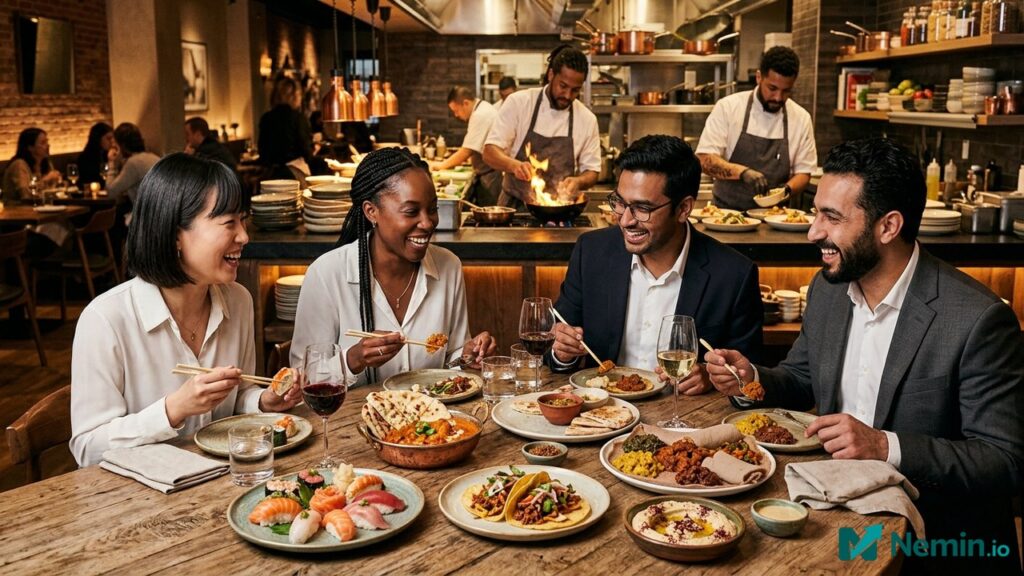
Food has always travelled with people, and contemporary dining makes those journeys particularly visible. Modern cuisine draws on inherited recipes, migration, regional ingredients, scientific understanding, restaurant culture and the increasingly rapid exchange of ideas between chefs and home cooks. A contemporary dish might use a centuries-old fermentation method in a new context, reinterpret a family recipe through local produce or combine influences from several culinary traditions. At its best, this kind of cooking does more than produce novelty. It can encourage conversations about identity, history, authenticity, adaptation and the difference between thoughtful cultural exchange and careless appropriation.
There is no single Modern cuisine. The phrase can describe high-end tasting menus, contemporary neighborhood restaurants, cross-cultural street food, new interpretations of regional dishes and home cooking shaped by internationally available ingredients.
What makes the subject interesting is not simply that chefs combine flavours from different countries. Culinary traditions have influenced one another for centuries through trade, migration, empire, displacement and ordinary human contact. Many dishes considered deeply traditional already contain ingredients that originated elsewhere.
The modern difference is visibility and speed. Social media, international travel, migration and global restaurant networks allow cooking techniques and ideas to move extraordinarily quickly. That creates exciting possibilities, but it also makes questions of attribution and cultural context increasingly important.
What Is Modern Cuisine?
Modern cuisine is a broad term for contemporary cooking that responds to current ingredients, techniques, cultural influences and dining habits. It often respects established culinary traditions while allowing chefs to reinterpret their forms, presentation or context.
A Modern cuisine restaurant might use traditional methods without presenting dishes exactly as previous generations did. Another might combine culinary influences from several parts of a chef’s own family background. A third could focus almost entirely on regional ingredients while using contemporary plating and technology.
Modern does not automatically mean complicated, expensive or experimental. A simple dish can be thoroughly contemporary if it reflects today’s cultural and culinary circumstances.
Modern Cuisine Versus Traditional Cuisine
Traditional and contemporary cooking are not opposites. Modern food frequently depends on knowledge developed through older practices.
| Culinary Area | Traditional Approach | Modern Cuisine Approach |
|---|---|---|
| Recipes | Often inherited through communities and families | May reinterpret inherited forms |
| Ingredients | Strongly connected with local availability | Local and international ingredients may coexist |
| Technique | Established methods | Traditional and newer techniques can combine |
| Presentation | Shaped by regional convention | Often more flexible or experimental |
| Cultural influence | Historically accumulated | Frequently made explicit |
| Technology | Based on available tools | Can use precision equipment and modern processes |
| Dining format | Culturally established patterns | Can range from street food to tasting menus |
| Storytelling | Often embedded within community | Frequently communicated directly to diners |
Neither category is more authentic by default.
Modern Cuisine Is Often More Historical Than It Appears
Tomatoes are strongly associated with Italian cooking, chillies with many Asian cuisines and potatoes with numerous European traditions, yet all originated in the Americas before spreading globally after European contact.
This does not make the resulting cuisines less authentic. It demonstrates that culinary identity develops over time.
Modern cuisine continues that process, although at a much faster and more consciously documented pace.
9 Ways Modern Cuisine Creates Cultural Conversations
Food can make complex cultural histories tangible. A diner may encounter unfamiliar ingredients, learn why a technique matters or discover that a familiar dish has a more complicated origin story than expected.
Nine themes are especially important: migration, identity, ingredient exchange, reinterpretation, technique, storytelling, authenticity, appropriation and collaboration.
1. Modern Cuisine Makes Migration Visible
People carry food memories when they move.
Recipes adapt because ingredients differ, kitchens change and children grow up surrounded by several culinary environments. Over time, these adaptations can become meaningful traditions in their own right.
Modern cuisine frequently emerges from these experiences rather than from chefs arbitrarily combining unrelated flavours.
2. Food Can Express Multiple Identities at Once
A chef can be British and Indian, French and Senegalese, Mexican and American, or connected to several places simultaneously.
The food they create does not necessarily need to fit neatly into one national category.
Modern cuisine can provide a language for expressing these overlapping identities without pretending cultural experience is simple.
3. Modern Cuisine Reveals How Ingredients Travel
Coffee, sugar, rice, spices, chillies and many other ingredients have complex global histories.
Their movement has been shaped by trade, migration, colonialism and, in some cases, forced labour and exploitation.
A thoughtful culinary conversation can acknowledge these histories without reducing every meal to a lecture.
4. Traditional Recipes Can Be Reinterpreted
A recipe can change while retaining an intelligible connection to its origins.
Chefs may alter presentation, use locally available produce or adjust technique while preserving fundamental flavour relationships.
The quality of the reinterpretation depends on understanding what is being changed and why.
5. Modern Technique Can Illuminate Old Practices
Fermentation, smoking, curing and preservation are ancient practices in many cultures.
Contemporary kitchens may use controlled temperatures and scientific measurement to understand them more precisely, but the underlying knowledge predates modern laboratory-style equipment.
Giving historical practices appropriate credit prevents innovation narratives from erasing earlier expertise.
6. Restaurants Can Tell Cultural Stories
Menus can provide context about ingredients, regions and people.
Staff can also explain a dish’s inspiration when diners are interested. This can make unfamiliar food more accessible without presenting a culture as exotic spectacle.
Modern cuisine storytelling works best when it is specific and accurate.
7. Authenticity Becomes a More Interesting Question
People frequently ask whether a dish is authentic, but authenticity is difficult to define when recipes change across generations and locations.
A grandmother’s recipe may differ from another family living two streets away.
Modern cuisine encourages a more useful question: authentic to whom, where and at what point in time?
8. Cultural Appropriation Can Be Discussed More Clearly
Culinary borrowing is not automatically harmful. Food cultures have always exchanged ideas.
Concerns become more significant when powerful businesses profit from a marginalised community’s food while erasing its origins, misrepresenting it or treating its people disrespectfully.
Modern cuisine can encourage better practice through attribution, collaboration and genuine understanding.
9. Collaboration Can Create New Culinary Language
When chefs from different backgrounds work together as equals, the result can move beyond superficial fusion.
Techniques and ingredients can interact because the people involved understand their meanings and practical uses.
Collaboration turns cultural conversation into an actual relationship rather than a marketing concept.
Modern Cuisine and the Meaning of Fusion
Fusion is one of the most controversial terms in contemporary food.
At its simplest, it means combining elements associated with more than one culinary tradition. The concept itself is not new, because cuisines have always changed through contact.
The problem arises when fusion becomes random mixing without understanding.
Thoughtful Fusion Versus Confused Fusion
| Thoughtful Approach | Weak Approach |
|---|---|
| Understands the source traditions | Uses stereotypes about cuisines |
| Combines compatible techniques intentionally | Adds fashionable ingredients arbitrarily |
| Credits influences | Presents borrowed ideas as entirely original |
| Respects ingredient function | Uses ingredients mainly for novelty |
| Builds coherent flavour | Prioritises shock value |
| Learns from relevant cooks or communities | Assumes technique without context |
| Communicates clearly | Uses vague exotic language |
| Allows a dish to evolve naturally | Forces several cultures onto one plate |
Modern cuisine becomes more convincing when creativity follows knowledge.
Modern Cuisine and Cultural Identity
Food can be one of the most durable connections people retain with family history.
A smell or flavour can recall a specific kitchen, celebration or relative. This emotional role explains why debates about modifying traditional dishes can become surprisingly intense.
People are not always arguing about ingredients; they may be defending memories and identity.
Recipes Change Within Families
Even supposedly fixed family recipes evolve.
One generation may use an ingredient because it was inexpensive, while another substitutes something available in a new country. Cooking equipment changes, and health requirements may alter preparation.
Modern cuisine can emerge from these ordinary adjustments without requiring a celebrity chef.
Migration as a Force Behind Modern Cuisine
Migration reshapes both the food of destination countries and the cooking of migrant communities.
Ingredients become available through specialist shops, restaurants introduce new flavours to broader audiences and second-generation cooks often navigate multiple culinary traditions.
This process has shaped cities such as London, New York, Toronto, Singapore, Sydney and many others.
Diaspora Cuisine Is Not Necessarily a Lesser Version
Food adapted outside its place of origin is sometimes dismissed as inauthentic.
That judgement can ignore the circumstances under which communities cooked with limited ingredients and changing customer expectations.
Diaspora cuisine can develop its own history and significance.
Modern Cuisine in London
London provides a particularly visible example of contemporary cultural exchange because its restaurant scene reflects communities with roots around the world.
British food itself has also been shaped by centuries of trade, empire and migration.
Modern London restaurants can therefore tell stories about Britain as well as the places their dishes reference.
Beyond the Fine-Dining Restaurant
Modern cuisine is not limited to expensive tasting menus.
Street markets, bakeries, cafés, supper clubs and family restaurants can all participate in culinary innovation.
Sometimes the most significant cultural changes happen through everyday food rather than highly conceptual dishes.
Modern Cuisine and Street Food
Street food makes culinary ideas accessible in a different format from formal restaurants.
Traders often specialise in a small number of dishes, allowing strong focus on one technique or flavour profile.
Modern street food can also reflect migration and entrepreneurship directly.
Small Menus Can Tell Big Stories
A stall serving one regional dumpling, sandwich or rice dish can introduce customers to a culinary tradition without offering a huge menu.
When operators explain the dish clearly and accurately, curiosity can lead diners toward broader exploration.
The food should still be allowed to be food rather than carrying the impossible burden of representing an entire country.
Modern Cuisine and Fine Dining
Fine dining provides resources for intensive technique, ingredient sourcing and elaborate presentation.
It can also create problems when chefs treat everyday foods from another culture as valuable only after placing them in an expensive restaurant.
Credit and context matter.
Elevating Food Can Be a Problematic Phrase
Calling a traditional dish elevated after a fine-dining chef modifies it can imply the original version was somehow lower or unsophisticated.
Many humble-looking dishes involve sophisticated knowledge developed over generations.
Modern cuisine can refine presentation without suggesting cultural legitimacy begins in a luxury dining room.
Modern Cuisine and Traditional Techniques
Modern chefs frequently rediscover methods that communities have used for generations.
Fermentation is one obvious example. Preservation through microbes is fashionable in contemporary restaurants, but fermented foods have long histories across Africa, Asia, Europe and the Americas.
The modern contribution may involve measurement, experimentation and new applications rather than invention of fermentation itself.
Old Technique, New Context
| Traditional Technique | Contemporary Application |
|---|---|
| Fermentation | Controlled restaurant ferments and sauces |
| Smoking | Precise temperature-controlled smoking |
| Pickling | Seasonal preservation and flavour development |
| Drying | Concentrated vegetables, fruits and proteins |
| Curing | Contemporary charcuterie and fish preparation |
| Grinding | Fresh spice pastes and custom blends |
| Wood-fire cooking | Modern open-fire restaurants |
| Slow cooking | Precision time and temperature management |
| Stone milling | Contemporary artisan grains and flour |
Acknowledging historical expertise makes innovation narratives more accurate.
Modern Cuisine and Fermentation
Fermentation has become particularly prominent in contemporary restaurant language.
Chefs may ferment vegetables, grains, dairy products or other ingredients to create acidity and complex flavour.
Food safety is essential because fermentation is a biological process, not simply leaving food at room temperature.
Home Fermentation Requires Reliable Guidance
People experimenting at home should use trustworthy food-safety resources.
Different ferments need different salt concentrations, temperatures and handling methods.
A restaurant chef’s social-media video should not automatically replace tested food-safety guidance.
Modern Cuisine and Molecular Gastronomy
Molecular gastronomy became widely associated with scientific approaches to cooking and with techniques such as gels, foams and spherification.
The term is often used loosely in popular culture. Many contemporary chefs use modern food science without describing their cuisine as molecular gastronomy.
Technique should support the dining experience rather than exist purely to demonstrate technology.
Modern Cuisine Is More Than Technical Tricks
A perfectly made foam does not automatically create a meaningful dish.
Flavour, texture, temperature and cultural context still matter.
The best technique often becomes almost invisible because it serves the food rather than demanding attention for itself.
Modern Cuisine and Seasonal Ingredients
Contemporary cooking often emphasises seasonality and local sourcing.
This can create interesting conversations when global techniques are applied to local ingredients. A chef may use a preservation method learned from one cuisine with produce grown nearby.
Such combinations can be thoughtful when influences are acknowledged.
Local Does Not Automatically Mean Better
Local sourcing can reduce certain transport distances and support regional producers, but environmental impact depends on production method, season, storage and many other factors.
Similarly, imported ingredients can be culturally important and economically significant to producing communities.
Modern cuisine benefits from nuance rather than simple sustainability slogans.
Modern Cuisine and Sustainability
Restaurants increasingly discuss food waste, plant-forward cooking, responsible seafood and lower-impact sourcing.
These are meaningful areas, but sustainability claims need evidence.
A restaurant using one locally grown vegetable should not automatically describe its entire operation as sustainable.
Reducing Food Waste
Chefs can use trim, stems, peels, bones or surplus ingredients creatively when food safety permits.
| Kitchen Approach | Potential Purpose |
|---|---|
| Whole-vegetable cooking | Reduce usable plant waste |
| Stock production | Use appropriate trimmings |
| Fermentation | Preserve selected surplus ingredients |
| Pickling | Extend usefulness of seasonal produce |
| Portion management | Reduce plate waste |
| Menu flexibility | Use ingredients according to availability |
| Nose-to-tail cooking | Use more of an animal where culturally and ethically appropriate |
| Accurate purchasing | Reduce over-ordering |
Waste reduction should never involve serving food that is unsafe.
Modern Cuisine and Plant-Based Cooking
Plant-based food has moved beyond being treated merely as an alternative menu.
Many culinary traditions already contain extensive vegetable, grain, legume and pulse dishes, meaning contemporary plant-focused cooking can learn from existing cuisines rather than pretending vegetables were recently invented as a restaurant concept.
Modern chefs also experiment with new plant proteins and techniques.
Avoid Reducing Plant-Based Food to Substitutes
A vegetable does not need to imitate meat to justify its place at the centre of a dish.
Traditional cuisines provide numerous examples of satisfying plant-based food built around legumes, grains, vegetables, nuts and spices.
Modern cuisine can innovate while recognising that history.
Modern Cuisine and Social Media
Social media allows dishes to reach millions of viewers before anyone tastes them.
This has increased the visual importance of food and accelerated culinary trends.
It has also encouraged dishes designed primarily for photographs.
A Viral Dish Is Not Automatically a Good Dish
Height, dramatic pours and unusual colours perform well on video, but they do not guarantee flavour or cultural relevance.
Modern cuisine ultimately has to be eaten.
Restaurants that prioritise visual spectacle at the expense of taste may generate attention without creating lasting culinary influence.
Modern Cuisine and Storytelling
Menus increasingly describe farms, producers, family histories and regional inspirations.
Storytelling can deepen appreciation when it is accurate.
Problems arise when narratives are invented because they sound romantic or when cultures are described through exotic stereotypes.
Name the Influence Specifically
Instead of calling a dish vaguely Asian-inspired, a menu may be able to identify the actual region, technique or dish that influenced it.
Specificity acknowledges that Asia contains enormously diverse culinary traditions.
The same principle applies to Africa, Latin America, Europe and every other broad geographical label.
Modern Cuisine and Cultural Appropriation
Cultural appropriation in food is complex because cooking has always involved borrowing.
A useful way to think about the issue is not whether cultural exchange should stop but how power, credit and representation operate within that exchange.
Who receives recognition and profit can matter.
Questions Modern Cuisine Should Ask
When borrowing from a tradition, chefs and businesses can consider:
- Where did the technique or dish originate?
- Have we learned enough to describe it accurately?
- Are we crediting the people or tradition that influenced us?
- Are we using stereotypes in marketing?
- Are we claiming to have invented something with a longer history?
- Are we collaborating with knowledgeable people?
- Does our pricing language imply the original food was inferior?
- Are we respecting culturally significant ingredients or practices?
- Can we explain why the combination makes culinary sense?
These questions do not eliminate every disagreement, but they encourage more responsible creativity.
Modern Cuisine and Authenticity
Authenticity is often treated as a binary label: a dish is either authentic or fake.
Real culinary history is more complicated. Recipes vary by region, class, religion, household, season and available ingredients.
A dish can be traditional in one town and unfamiliar 50 miles away.
Authentic to What?
Instead of asking simply whether Modern cuisine is authentic, ask what claim is actually being made.
Is the chef reproducing a documented regional preparation? Reinterpreting a childhood dish? Using one traditional technique within a new composition?
Clear description reduces the need for false authenticity claims.
Modern Cuisine and Restaurant Menus
A menu can communicate cultural respect through language.
Names should be spelled correctly where possible, and explanations should inform rather than caricature.
At the same time, menus need to remain understandable for diners unfamiliar with the cuisine.
Translation Can Help Without Erasing Original Names
A dish can retain its original name while adding a concise description.
This allows diners to learn terminology without being left confused.
Modern cuisine benefits when unfamiliarity becomes an invitation to learn rather than an excuse to rename everything.
Modern Cuisine and Food Allergies
Cross-cultural menus can contain unfamiliar ingredients, making accurate allergen communication particularly important.
Nuts, sesame, dairy, gluten, shellfish and other allergens can appear in sauces, garnishes or fermented products where diners do not expect them.
Restaurants must follow applicable food-allergy regulations.
Cultural Exploration Should Never Require Guessing About Allergens
Staff need reliable ingredient information.
Diners with serious allergies should communicate requirements clearly and ask questions where necessary.
A dish being traditional, modern or fusion does not change food-safety responsibilities.
Modern Cuisine at Home
Home cooks participate in cultural exchange too.
Cooking a dish from another cuisine can be a meaningful way to learn, particularly when recipes come from knowledgeable sources and ingredients are understood rather than substituted randomly.
Perfect authenticity is not required to cook respectfully.
Learn Before You Improvise
Make the original or a well-documented version first when possible.
This teaches what each ingredient and technique contributes. Once the structure is understood, adaptation becomes more intentional.
Modern cuisine works best when creativity grows from knowledge.
Modern Cuisine and Family Recipes
Family recipes represent living culinary archives.
Measurements may be imprecise because experienced cooks rely on sight, smell and touch. Recording these methods can preserve knowledge that would otherwise disappear.
Modern interpretation does not require abandoning the original.
Keep Both Versions
A chef might document a grandparent’s recipe as faithfully as possible and also create a contemporary version.
The two dishes can coexist.
One preserves family memory while the other shows how culinary identity continues evolving.
Modern Cuisine and Travel
Travel can introduce people to unfamiliar dishes, but tourists should resist treating local cuisine as a checklist of exotic experiences.
Food belongs within social and cultural contexts.
Markets, family restaurants and regional specialities can teach as much as famous destination restaurants.
Avoid Declaring One Version Definitive
Eating one bowl of a regional dish does not make someone an expert on the entire cuisine.
Ask questions and notice variations.
Modern cuisine conversations become richer when curiosity replaces certainty.
Modern Cuisine and Global Ingredients
Access to international ingredients has transformed home and restaurant cooking in many cities.
Specialist grocers and global supply chains make previously difficult-to-find ingredients available far from their places of origin.
This access also raises questions about sustainability, labour and fair trade.
Ingredient Provenance Matters
A restaurant may know the farm producing its local vegetables while having little information about imported spices, coffee or chocolate.
Modern cuisine can broaden the sourcing conversation beyond local versus imported.
Ethical supply chains are complex and require evidence rather than decorative menu claims.
Modern Cuisine and Colonial History
Food histories can include uncomfortable realities.
Sugar, tea, coffee, spices and other commodities are connected with histories of empire, slavery, forced labour and extraction.
Acknowledging these histories does not mean every restaurant meal must become a political seminar.
It does mean simplistic stories about ingredients “arriving” in Europe can obscure how and why those movements occurred.
Modern Cuisine as Cultural Diplomacy
Shared meals can create opportunities for people to encounter unfamiliar traditions in an accessible setting.
Restaurants, community dinners and festivals can bring people together around food.
Food alone cannot resolve political or social conflict, but it can provide a starting point for conversation.
Eating Is Not the Same as Understanding
Enjoying another culture’s cuisine does not automatically mean understanding or respecting the people associated with it.
Cultural appreciation requires more than consumption.
Modern cuisine can open a door, but curiosity needs to continue beyond the plate.
Modern Cuisine and Chef Collaboration
Collaboration is one of the strongest ways to exchange culinary knowledge responsibly.
Two chefs can work together, share techniques and discuss how ingredients function within their respective traditions.
The relationship matters more than simply placing two famous culinary labels beside each other on a menu.
Equal Credit Matters
Collaborative events should identify contributors accurately.
If one chef or community provides the cultural knowledge while another receives nearly all publicity, the partnership can become unequal.
Modern cuisine is more credible when exchange is reciprocal.
Modern Cuisine and Restaurant Design
The cultural conversation continues beyond the food.
Music, décor, uniforms and menu language all contribute to how a restaurant represents a place or tradition.
Design can celebrate culture without turning it into a collection of clichés.
Avoid Theme-Park Authenticity
A restaurant does not become culturally accurate by filling every wall with stereotypical imagery.
Contemporary communities are contemporary.
Modern cuisine deserves spaces capable of representing cultures as living, changing and diverse.
Modern Cuisine Trends Worth Understanding
Trends can reveal broader shifts even when individual fashions disappear.
Fermentation, open-fire cooking, plant-forward menus, reduced food waste, regional specialisation and cross-cultural collaboration all reflect wider conversations in food.
Not every restaurant needs to follow every trend.
Trend Versus Lasting Change
| Culinary Development | Why It May Matter |
|---|---|
| Fermentation | Renewed attention to preservation and microbial processes |
| Open-fire cooking | Reconnection with elemental cooking techniques |
| Plant-forward menus | Greater attention to vegetables and legumes |
| Regional specificity | Movement away from broad national labels |
| Low-waste cooking | Greater focus on ingredient utilisation |
| Chef collaboration | More visible cultural exchange |
| Tasting-menu storytelling | Food used to communicate personal narratives |
| Precision technology | Greater control over temperature and texture |
| Local-global cooking | Local produce used through international techniques |
The most lasting ideas usually solve culinary or cultural problems rather than merely creating visual novelty.
How to Experience Modern Cuisine More Thoughtfully
Diners do not need specialist culinary education.
Read menus, ask respectful questions and remain open to unfamiliar flavours. If a dish references a tradition you do not know, curiosity can lead to further learning.
Avoid judging an entire cuisine from one restaurant experience.
Modern Cuisine Dining Guide
| Stage | What to Consider |
|---|---|
| Choose a restaurant | Look beyond viral popularity |
| Read its story | Understand the chef’s background and approach |
| Review the menu | Notice regional and cultural specificity |
| Ask questions | Clarify unfamiliar ingredients respectfully |
| Communicate allergies | Never rely on assumptions |
| Taste openly | Avoid comparing everything with familiar food |
| Notice technique | Consider how preparation shapes flavour |
| Consider context | Learn about influences if interested |
| Credit sources | Share dish and chef names accurately |
| Explore further | Try traditional and contemporary versions |
Dining becomes more interesting when food is treated as both pleasure and knowledge.
Common Modern Cuisine Mistakes
The most common mistake is confusing novelty with creativity. Another is calling every combination of international ingredients fusion without understanding how those ingredients traditionally function.
Restaurants can also damage credibility by making unsupported historical claims.
Avoid These Modern Cuisine Errors
When discussing or creating Modern cuisine, avoid:
- Treating traditional food as unsophisticated
- Claiming ancient techniques as recent inventions
- Using broad labels such as Asian when regional detail is available
- Calling expensive reinterpretations automatically elevated
- Borrowing cultural symbols purely for decoration
- Ignoring the history of key ingredients
- Presenting one recipe as definitive for an entire culture
- Confusing viral presentation with culinary quality
- Making sustainability claims without evidence
- Ignoring allergen communication
- Using authenticity as a weapon against diaspora cuisine
- Treating cultural appropriation as either completely simple or completely irrelevant
- Forgetting to credit collaborators and influences
Specificity and humility improve culinary conversations.
The Future of Modern Cuisine
Modern cuisine will continue changing because culture continues changing.
Migration, climate, technology and changing agricultural systems will influence what ingredients are available and how people cook them. Chefs will continue rediscovering old techniques while applying them in new contexts.
The most interesting future may not be defined by ever more technical cooking.
Modern Cuisine Will Become More Personal
Some of the strongest contemporary restaurants increasingly reflect individual biographies rather than broad luxury conventions.
A chef’s family, migration history, region and local environment can all appear on the menu.
This makes Modern cuisine less about one international style and more about many specific voices.
Technology Will Support Rather Than Replace Craft
Precision ovens, fermentation controls, data and other technologies can improve consistency.
They cannot decide what a dish means culturally or whether it tastes good.
Human judgement remains central.
Why Modern Cuisine Matters Beyond Restaurants
Food provides an unusually accessible way to discuss global history.
A spice blend can lead to questions about migration. A family recipe can reveal how communities adapted after moving. An ingredient can expose histories of trade and empire.
These conversations can happen around an expensive restaurant table or in an ordinary home kitchen.
Modern Cuisine Is a Continuing Conversation
There is no point at which cuisine becomes complete.
Every generation receives techniques and recipes, then makes decisions about what to preserve, change, combine or reject.
Modern cuisine is simply the current chapter of that much longer process.
FAQ’s
What is Modern cuisine?
Modern cuisine is contemporary cooking shaped by current techniques, ingredients, cultural influences and dining habits. It can reinterpret traditions, combine culinary histories or present familiar food in new contexts.
Is Modern cuisine the same as fusion food?
Not necessarily. Fusion is one possible form of Modern cuisine, while contemporary cooking can also focus on regional traditions, seasonal ingredients, updated techniques or a chef’s personal cultural history.
How does Modern cuisine connect different cultures?
Modern cuisine reflects migration, ingredient exchange, collaboration and shared techniques. When influences are credited accurately, food can introduce diners to histories and traditions beyond their own experience.
Can Modern cuisine still be authentic?
Yes, although authenticity is complex. A contemporary dish can be authentic to a chef’s family, diaspora experience or regional interpretation without reproducing one supposedly fixed historical recipe.
Is cultural borrowing acceptable in Modern cuisine?
Culinary exchange is longstanding, but thoughtful borrowing involves understanding, attribution and respect. Problems can arise when origins are erased, stereotypes are used or other communities’ knowledge is presented as a new invention.
What trends are shaping Modern cuisine?
Fermentation, plant-forward cooking, regional specificity, low-waste approaches, chef collaboration, open-fire techniques and precision technology are among important contemporary influences.
Conclusion
Modern cuisine matters because food never develops in isolation. Migration, family history, trade, regional ingredients and inherited techniques continually influence what appears on contemporary plates. The most interesting cooking acknowledges these layers rather than pretending every new presentation represents an entirely new invention.
Modern cuisine can create meaningful cultural conversations when creativity is paired with knowledge and respect. Chefs and diners can celebrate experimentation while crediting traditions, questioning simplistic ideas about authenticity and remaining curious about where ingredients and techniques came from. In that sense, a modern dish can do something deceptively simple: taste good while encouraging people to understand one another a little better.
Pingback: Strawberry Plants: 10 Powerful Secrets for Year-Round Yields