
Every CEO knows AI matters. The headlines are impossible to ignore, competitors are moving, and boards keep asking what the plan is. Yet inside most...
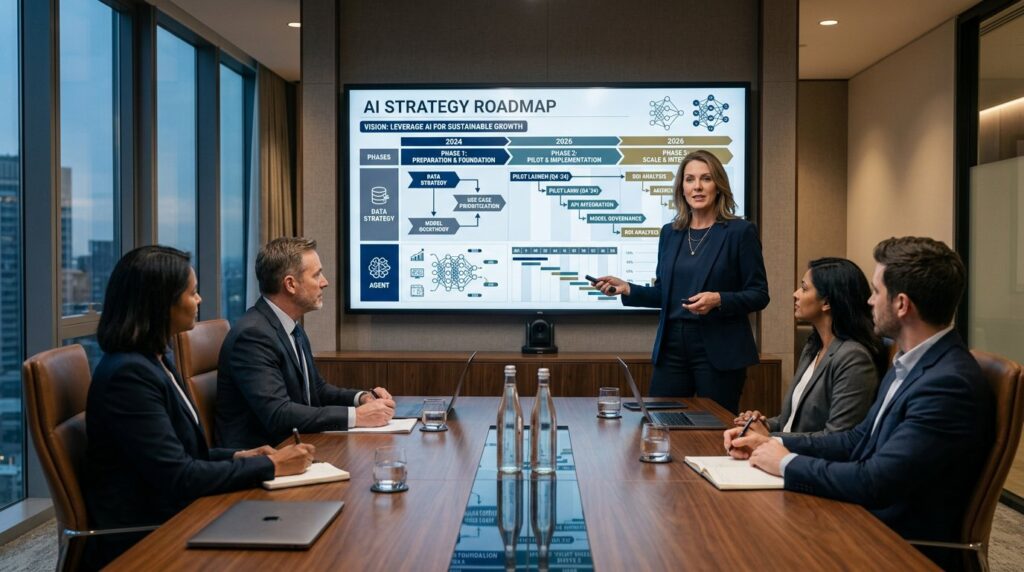
Every CEO knows AI matters. The headlines are impossible to ignore, competitors are moving, and boards keep asking what the plan is. Yet inside most mid-market companies, no one can answer the most basic question: where do we actually start. That gap between ambition and execution is exactly what AI consulting is designed to close. This guide explains what AI consulting really involves, the services you should expect from a qualified consultant, and the checklist to use when choosing a partner.
If you only have a minute, here is the short answer. AI consulting is a professional service that helps a business decide what AI to build, how to build it, and how to make it stick. The best firms do not just hand you a report. They audit your workflows, prioritize opportunities, document the processes the AI will run, train your people, and stay to deploy the system. The value is in the roadmap and the follow-through, not in a slide deck.
What Is AI Consulting, Exactly?
AI consulting is the practice of guiding a company through the adoption of artificial intelligence, from the first assessment through deployment and ongoing improvement. It sits between the abstract promise of AI and the messy reality of running a business.
The Problem Most Companies Have
Most organizations are not short on ambition. They are short on clarity. Tools get bought, pilots get launched, and still nothing changes the way the company operates. The reasons are consistent: no shared understanding of where AI fits, no documentation of the work that AI should take over, and no ownership after the pilot ends.
An AI consultant brings two things that are usually missing. The first is an outside view grounded in what actually works in production, not in theory. The second is a methodical process that turns a vague intention into a specific, prioritized set of initiatives with owners and timelines. That combination is what separates a genuine AI consulting engagement from a generic training course or an expensive pitch.
Why the Stakes Are Higher Than They Look
There is a reason urgency around AI keeps rising. Building the technology is becoming easier; the real constraint is deciding what to build and what to leave alone. The companies that work this out early tend to compound, because every automated process frees capacity that gets reinvested. The companies that wait tend to fall into a different trap, competing on price with tools their rivals already use.
This is not a prediction about the future; it is an observation about how markets move. When a capability becomes a commodity, the advantage moves to whoever adopted it first and reinvested the savings. For a mid-market firm, that adoption gap is the single most consequential decision on the table.
What Good AI Consulting Is Not
It helps to clear up a few misconceptions before you evaluate a partner. These are common ways a well-intentioned engagement goes sideways, and recognizing them early will save you time and money.
- It is not a prediction of the future. A consultant is not paid to be right about markets; they are paid to make your business run better.
- It is not a software reseller. A firm first in selling a license is a vendor, not a consultant.
- It is not a one-time workshop. A single training session rarely changes a business, so real consulting extends into implementation.
- It is not a report that lives in a drawer. The deliverable only matters if it gets acted on.
The 10 AI Consulting Services That Matter
The scope of a good engagement is broader than most buyers expect. These are the ten services that deliver measurable value, and the ones you should ask about before signing.
Strategy and Assessment Services
1. AI Readiness Audit
Before recommending anything, a consultant should assess where you are today. An AI readiness audit maps your data, systems, workflows, and team capabilities to reveal gaps and surface the highest-value opportunities. It answers whether you are ready to move fast or whether the foundation needs work first. A strong audit also surfaces whether problems like data quality or unclear ownership are going to block progress, so you can fix those before spending on tools.
2. Strategic AI Roadmap
A roadmap is the core deliverable of most consulting engagements. It lays out a prioritized sequence of initiatives, each with a clear business case, an owner, and a timeline. A good roadmap tells you what to build, but just as importantly, what to leave alone for now. That second half matters because the most expensive AI mistake is not the wrong tool; it is investing in an initiative that never should have made the list.
3. Use-Case Prioritization
Not every process benefits from AI, and the ones that do are not equally valuable. A consultant scores candidates against effort, impact, and risk so your team spends its budget where it compounds rather than where it is fashionable. The discipline here is saying no. Early wins matter, so the strongest roadmaps sequence a few quick wins to build momentum, then invest in the deeper initiatives.
4. Process and Workflow Documentation
AI does not run on intentions; it runs on documented workflows. This is the unglamorous work that separates projects that stall from projects that ship. Mapping the actual steps, decisions, and exceptions in a process gives the AI something concrete to execute. Without this, teams end up with general-purpose tools and no clear way to apply them, which is why so many pilots never turn into working systems.
Implementation and Enablement Services
5. Tool and Model Selection
The market is crowded and every vendor claims to be best in class. A consultant evaluates options against your stack, your data, and your constraints, so you are not choosing a model because of hype. This is where fine-grained model knowledge pays off, because the right choice depends on the task, the data involved, and how the tool integrates with the systems you already run.
6. Data and Governance Setup
AI runs on data, and data raises questions about access, quality, privacy, and ownership. Good consulting establishes the guardrails up front: what data is allowed, who can access it, and what happens when a model makes a decision. Getting this right before deployment is far cheaper than unwinding it later, and it is what makes the difference between a tool the team trusts and one they quietly avoid.
7. Guardrails and Risk Policy
A responsible partner helps you define how AI is used safely, including rules about sensitive information, human oversight, and auditing. Governance is a differentiator, because unmanaged AI is a liability the moment it touches customer data. A clear policy on where humans stay in the loop and how outputs get reviewed is part of a mature AI consulting engagement, not an afterthought.
8. Team Enablement and Training
Adoption fails when the people who do the work do not change how they work. Training built around each role’s actual tasks, with a playbook they keep, turns a rollout into a habit rather than a one-time event. The best enablement is role-specific, so a sales rep and an analyst learn to use the same tools in ways that apply to their own work rather than in generic demonstrations.
Deployment and Long-Term Services
9. Custom AI Builds and Agent Development
For processes that need more than a packaged tool, a consultant designs and builds custom AI solutions, including agents that run the work according to your rules. This is where AI stops being a feature and becomes part of the operating model. An AI agent that handles routine follow-ups, assembles reports, or triages inquiries is doing the work that used to live on a checklist.
10. Implementation and Ongoing Support
The engagement does not end when the plan is approved. Someone has to deploy the system, integrate it with the tools you already use, and stay to measure results and iterate. Ongoing partnership is what separates a project from a capability, and it is the single biggest factor in whether the investment keeps paying off a year later.
What an AI Consulting Engagement Actually Looks Like
Understanding the shape of a typical engagement helps you gauge whether a firm is thorough or just well marketed. The process usually moves through three phases, and where you start depends on how far along the adoption curve you already are.
Phase 1: Discovery and Assessment
The engagement begins in discovery. A consultant goes inside the operation, walks through the workflows, names the gaps, and maps the opportunities. This phase produces the clarity document and the prioritized strategy. The goal is not to impress you with insight; it is to reach a shared understanding of where AI can move the needle and where it roughly cannot.
Phase 2: Enablement and Documentation
With the strategy set, the work turns to making it real. Processes get written down, the guardrails get documented, and the team gets trained. This is where the tools become useful to the people who use them, and where the initial excitement starts to translate into consistent habits rather than a one-off workshop.
Phase 3: Deployment and Embedding
Finally, the AI moves into the workflow. Agents are built and deployed, models are placed where the work happens, and the system is embedded so the business runs differently. The result compounds over time, because the work that used to consume hours now runs in minutes and the freed capacity gets reinvested.
The Real Business Benefits of AI Consulting
The value of a good engagement shows up in concrete ways, and it is worth knowing what to expect so you can judge whether the investment is paying off.
Faster Time to Value
A structured roadmap gets you to a working system sooner than a scattershot approach. Instead of months of pilots that never leave the lab, a prioritized plan sequences a few quick wins that build momentum and fund the deeper work.
Lower Risk of Wasted Spend
The most expensive mistake in AI adoption is investing in the wrong thing. A readiness audit and use-case prioritization guard against that by directing budget toward initiatives that fit your business rather than the ones that look impressive.
Consistent Adoption Across the Team
Training tied to real roles, combined with a playbook people keep, changes behavior rather than just informing it. This is the difference between a tool the whole team uses and one that a handful of enthusiasts rely on.
A Leaner Operating Model
As agents and automation take over routine work, the business stops spending its best hours on manual processes. The compounding effect is the point: capacity is freed, then reinvested, and the gap with competitors widens in your favor.
Sustainable Governance and Trust
By establishing rules for data, privacy, and oversight early, a consultant helps the team trust the system enough to actually use it. That trust is what makes the difference between a tool that sticks and one that gets quietly abandoned.
Services Comparison by Business Need
| Business Problem | AI Consulting Service Most Relevant | Typical Outcome |
|---|---|---|
| No clarity on where to start | AI Readiness Audit | A prioritized, justified roadmap |
| Tools bought but not used | Team Enablement and Training | Consistent adoption across roles |
| Processes done by hand | Process and Workflow Documentation | AI-ready, repeatable workflows |
| Wrong or redundant tools | Tool and Model Selection | A lean, cost-effective stack |
| Sensitive data and risk | Data and Governance Setup | Safe, auditable AI use |
| Work that should automate | Custom AI Builds and Agent Development | Agents that run the work |
How to Choose the Right AI Consulting Firm
Choosing a partner is a decision worth slowing down for, because the wrong one costs you time and momentum. Use these criteria to evaluate any firm you are considering.
Check for Real, Relevant Experience
Look for evidence that a firm has worked with companies like yours and solved problems you recognize. Ask for case studies, references, and specific examples of results tied to business outcomes, not just flashy demos. Relevance matters as much as volume, because a team that has operated in your kind of business will get to a useful recommendation faster.
Demand Process Over Platform Hype
A firm that leads with a single technology suggests a solution in search of a problem. A credible partner leads with your business and brings the right tools to the table. Model-agnostic firms are often safer bets, because they are free to recommend what actually fits rather than what they happen to sell.
Look for Strategic and Operational Depth
The strongest firms are fluent both in the strategy and in the details, from the architecture to the documentation. They can speak to the board and still write the SOPs that make the system work. If a firm can only talk at the executive level or only at the technical level, it may struggle to deliver on the other half.
Prioritize a Team That Will Work Alongside You
The best engagements embed consultants in the business rather than handing off a document. Ask how they keep the work going after the initial phase and whether they will train your team to run the system. A partner that stays invested through implementation is worth more than one that disappears after the report.
Validate the Approach to Risk and Governance
Ask directly how they handle sensitive data, privacy, and oversight. A firm with a clear governance stance is more valuable than a firm that promises speed without guardrails. The answer to this question tells you a great deal about whether they will protect you when things get complicated.
Understand What Is Included in the Price
The cost of AI consulting varies widely depending on scope and depth. Clarify what the fee covers, whether implementation is extra, and how ongoing support is billed, so there are no surprises later. Scope is the biggest driver of cost, so it is worth being precise about what you need before you compare quotes.
Common Mistakes When Hiring an AI Consultant
Even experienced leaders fall into the same traps. Knowing them in advance helps you avoid the most expensive ones.
- Hiring a vendor instead of a consultant. If the pitch is a product rather than an approach, you are buying software, not guidance.
- Skipping the discovery phase. Jumping straight to tools without understanding your workflows sets up a project that does not fit the business.
- Judging on the demo. A polished demonstration says little about whether the system will work inside your actual workflows.
- Ignoring adoption and training. The best system is worthless if the team does not use it, so training belongs in the plan from the start.
- Expecting a one-time fix. AI adoption is a process, and treating it as a single project is the fastest way to lose the gains you make.
- Not defining success up front. If you cannot say what a good outcome looks like, you will not know whether the engagement worked.
Frequently Asked Questions
What is AI consulting?
AI consulting is a professional service that helps a business decide which AI to adopt, how to implement it, and how to make it stick, spanning assessment, roadmap, documentation, training, and deployment.
How much does AI consulting cost?
Cost varies by scope, depth, and the size of the engagement. Small projects may be a few thousand dollars, while comprehensive mid-market engagements with implementation and ongoing support run substantially more.
Do we need AI consulting or should we just buy AI software?
If you already know exactly which problem you are solving and how, buying software may be enough. If you are unsure where AI fits, a consulting engagement usually pays for itself by preventing wasted spend.
How long does an AI consulting engagement take?
A focused audit and roadmap can be a matter of weeks, while a full engagement that includes training and deployment typically stretches over several months depending on scope.
How do I prepare for an AI consulting engagement?
Gather a broad view of your workflows, data, and goals, and be ready to be honest about what is working and what is not. The quality of the engagement reflects the quality of the context you provide.
Will AI consulting work for a mid-market company?
Yes. Mid-market firms with $5M or more in revenue are often the ideal fit, because they have the data and scale to benefit from AI and the agility to act on a roadmap quickly.
Conclusion
AI consulting is the bridge between the promise of artificial intelligence and the reality of a business that runs differently. Done well, it turns a vague sense of urgency into a prioritized roadmap, documents the workflows the AI will run, trains the people who will use it, and stays long enough to deploy the system that makes a difference. The value is not in a glossy report; it is in the compounding that begins when AI is embedded in the operation. As you evaluate partners, prioritize real experience, a process-driven approach, and a firm that will work alongside your team rather than hand you a document. The companies that figure out where AI fits in the next twelve months will compound, and a thoughtful consulting engagement is one of the most reliable ways to get there.