
After-sales service has become one of the clearest signals of whether a brand keeps its customers or loses them after the first purchase. The after-sales...
After-sales service has become one of the clearest signals of whether a brand keeps its customers or loses them after the first purchase. The after-sales service management system market hit $10.39 billion in 2024 and is projected to reach $30.5 billion by 2033, growing at a 14.41% CAGR. That growth reflects a shift: brands are treating post-purchase operations as infrastructure, rather than an afterthought.
Meanwhile, customer retention costs five times less than acquisition. Enterprise companies achieve 82% average retention. DTC subscription brands crossed 100% net revenue retention for the first time at scale in 2026, hitting a 102% median.
Still, the post-purchase experience remains fragmented for many organizations. Warranty claims land in shared email inboxes. Support tickets live in one system while returns live in another. Product registration data sits in spreadsheets. And the customer who bought through Amazon or a retail store stays invisible.
This guide covers seven after-sales service software tools across four categories: warranty management, customer support, CRM-integrated service, and returns management. Each solves a specific piece of the post-purchase problem.
TLDR
- Dyrect is the strongest pick for warranty registration, managing claims, and post-purchase revenue.
- YourGPT handles multi-channel AI customer support and sales.
- Salesforce Service Cloud ties service into enterprise CRM.
- Qualtrics tracks post-purchase satisfaction and customer feedback.
- HubSpot Service Hub connects service data to marketing and sales.
- Loop Returns converts refunds into exchanges.
- Freshdesk offers budget-friendly support with a free plan for small teams.
What Does After-Sales Service Software Actually Cover?
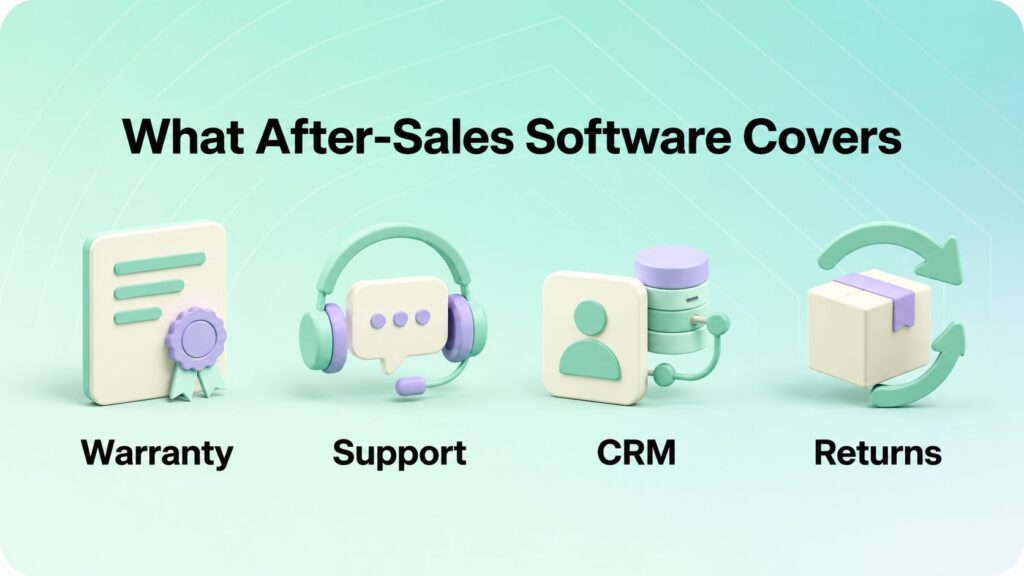
After-sales service software is any platform that manages interactions and operations after a customer completes a purchase. That includes warranty registration, claims processing, support ticketing, returns handling, exchanges, repair tracking, and ongoing customer communication.
However, “after-sales” is broad enough to span four distinct software categories. Understanding these lanes helps in choosing the right tools:
1. Warranty management and product registration handles the ownership lifecycle, including registration, warranty validation, claims intake, service workflows, and extended warranty sales.
2. Customer support ticketing manages inbound service requests across email, chat, phone, and social channels through a centralized agent workspace.
3. CRM-integrated service connects support tickets to the same customer records used by marketing and sales teams, so service data feeds into retention workflows.
4. Returns and exchange management automates reverse logistics, from return initiation through refund or exchange processing, with a focus on retaining revenue.
In practice, a strong after-sales operation typically uses tools from at least two of these categories working together.
How to Evaluate After-Sales Service Tools Before You Buy
Does It Automate or Just Digitize?
There is a meaningful difference between digitization and automation. Moving warranty claims from email to a dashboard is digitization. Auto-validating warranty eligibility based on serial number, purchase date, and coverage rules, then routing the ticket to the right agent with priority handling, is automation. The ROI gap between the two is significant. When evaluating tools, look for workflow automation that removes manual steps from intake through resolution, rather than simply organizing manual work in a cleaner interface.
Where Does Customer Data Go After a Claim or Ticket Closes?
If the tool resolves the ticket and the data ends in a closed-case archive, the retention value of every service interaction disappears. Strong after-sales service software feeds resolution data, product insights, and customer engagement signals into marketing and analytics tools like Klaviyo, HubSpot, or Salesforce. This turns service interactions into retention opportunities instead of isolated transactions.
Can It Scale Without Per-Agent Costs Spiraling?
Pricing models in this category vary widely, and they behave very differently as teams grow. Per-seat pricing (Salesforce, HubSpot) scales linearly with headcount. Quote-based pricing (Qualtrics) depends on the modules and usage you buy. Flat-rate and usage-based models (Dyrect, YourGPT and Loop) keep costs predictable. The right model depends on whether the team is growing in headcount, in ticket volume, or both.
7 Best After-Sales Service Software for Brands in 2026
| Tool | After-Sales Function | Best For | Starting Price |
| Dyrect | Warranty management and post-purchase automation | Brands automating warranty registration, claims, and service workflows | Free; paid from $19/mo |
| YourGPT | Omnichannel AI customer support | Mid-to-large teams managing support and sales | $39/agent/mo |
| Freshdesk | Affordable helpdesk | Small teams seeking solid support on a lean budget | Free; paid from $15/agent/mo |
| Salesforce Service Cloud | Enterprise CRM-integrated service | Enterprises running after-sales inside a Salesforce CRM | $25/user/mo |
| Qualtrics | Customer feedback and experience management | Mid-to-large brands measuring satisfaction after claims, repairs, and support | Custom pricing |
| HubSpot Service Hub | CRM-connected service | Growing brands using HubSpot for marketing and sales | Free; paid from $20/seat/mo |
| Loop Returns | Exchange-first returns management | Shopify brands converting refunds into exchanges | Free; paid from $155/mo |
1. Dyrect: Automate Warranty Registration, Claims, and Post-Purchase Revenue
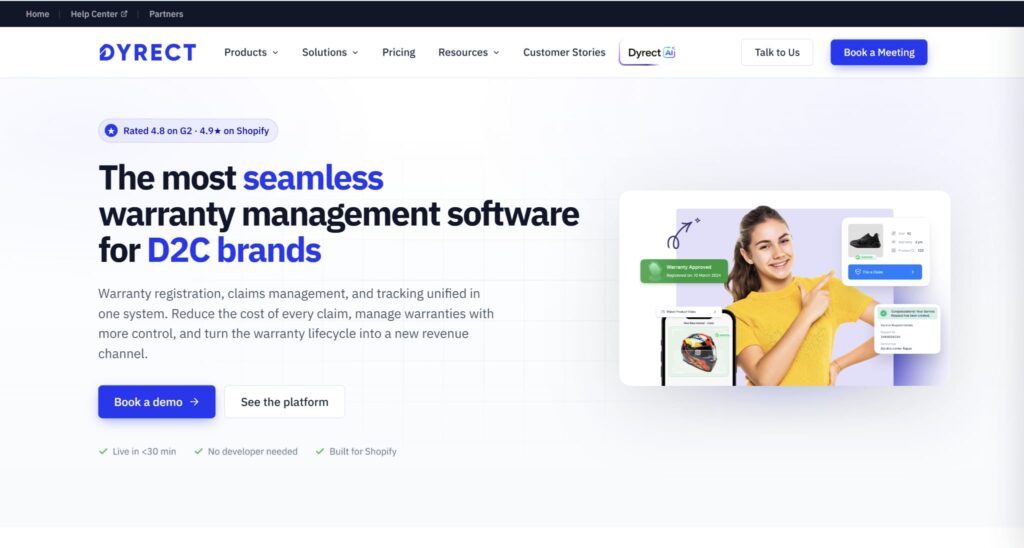
Dyrect is a warranty management and post-purchase experience platform built for consumer product brands. It replaces manual warranty processes, including spreadsheet-based registration tracking, email-based claims handling, and disconnected service workflows, with a single system that covers the full ownership lifecycle.
Product registration works across every sales channel. Customers register through QR codes on packaging, website registration pages, or automatic registration synced with Shopify orders. This captures first-party customer data from buyers who purchased through Amazon, retail stores, or any channel that shares zero buyer information with the brand. The registration flow includes OCR-powered receipt scanning that extracts purchase date, retailer name, serial number, and amount automatically.
Claims management runs the full lifecycle from a centralized dashboard. When a customer raises a claim, the system validates warranty eligibility using purchase date, coverage rules, and product data. Tickets are auto-assigned to agents with configurable routing and priority handling. Customers receive real-time status updates through email, SMS, or WhatsApp.
Service workflow tracking goes beyond ticket resolution. Dyrect manages repair and replacement workflows at the item level, including dealer and OEM billing flows for brands working with channel partners. The advanced plan includes repair tracking, billing, invoicing, and service center visibility.
Extended warranty and upsell capabilities add a revenue layer. Brands can create, sell, and manage protection plans at registration, checkout, and post-purchase touchpoints, turning warranty from a cost center into a revenue line.
Integrations include Shopify (native sync with products and orders), Klaviyo, HubSpot, Mailchimp, and Zendesk. An API is available for custom connections. Setup takes under 20 minutes.
Best suited for: Consumer product brands selling through ecommerce, retail, and marketplace channels that want to automate warranty registration, claims processing, and service workflows while capturing first-party customer data and generating post-purchase revenue.
- Free plan includes warranty registrations, claims management, self-service portal, digital warranty certificates, and Shopify product sync
- Paid plans start at $19/month
- 4.9/5 rating on Shopify App Store
Pros
- Complete warranty lifecycle in one platform: registration, claims, repair/replacement tracking, extended warranty sales
- Captures first-party data from marketplace and offline buyers through omnichannel registration
- Revenue generation through extended warranty upsell
- Free plan is feature-rich enough for early-stage brands
Cons
- Smaller integration ecosystem compared to established helpdesks like Zendesk
- Advanced repair workflow and billing features require higher-tier plans
Pricing: Free plan available. Paid plans start at $19/month on Shopify, scaling based on business size and volume.
2. YourGPT: Automate Support, Sales, and Ops Across Every Channel
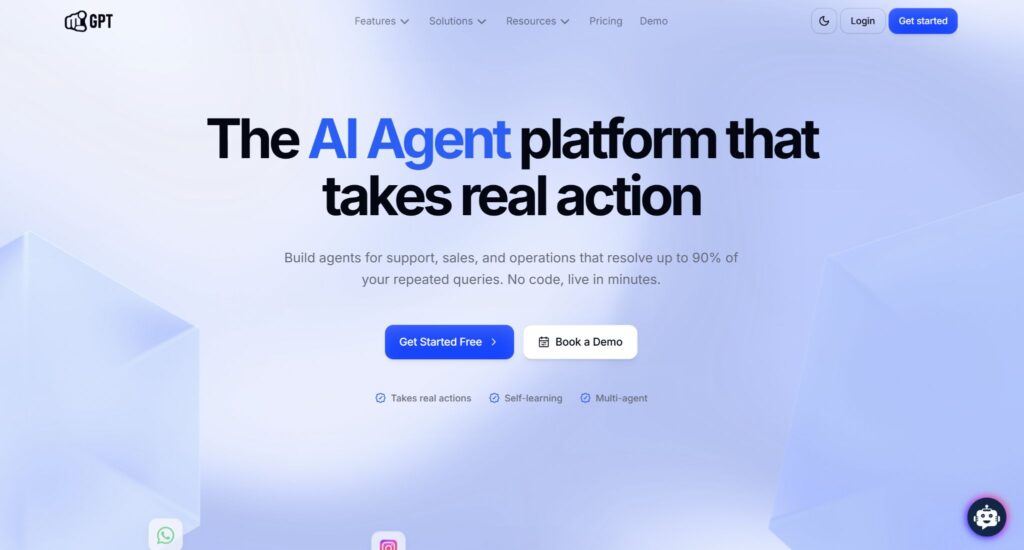
YourGPT is a no-code AI agent platform for customer support, sales, and operations. It was founded in 2023 and lets teams train agents on their own business data, such as websites, PDFs, Notion, and Google Drive, then deploy them without writing code. Agents take real action like refunds, order updates, and CRM changes, and reach up to a 90% resolution rate on repetitive queries.
For after-sales, YourGPT runs one agent across website, WhatsApp, Instagram, Telegram, Slack, email, and phone, in 100+ languages. It connects to tools like Shopify, Salesforce, and WordPress, and passes conversations to a human with full context when an agent can’t close them.
Agents learn from unresolved conversations, so knowledge gaps get filled without manual retraining. Separate agents can handle billing, refunds, technical support, and sales, and hand conversations to each other with context intact. Pricing is credit-based with no per-resolution fee on top of the plan.
Best suited for: Support, sales, and operations teams, from SMBs to enterprises, that want one AI agent across every channel without a development team.
Pros
- 90% resolution in production deployments, so fewer repetitive queries reach your team
- Omnichannel deployment from a single agent
- Executes multi-step actions across connected systems and APIs
- No-code setup that goes live in minutes and grows into advanced workflows
Cons
- Deeper workflow logic in AI Studio takes hands-on time to master
- Credit-based pricing, with no per-resolution plan available
- Only a 7-day free trial, no free tier
Pricing: Essential at $39/month. Professional at $79/month. Advanced at $349/month. All billed annually. Enterprise pricing is custom.
3. Freshdesk: Run Lean Support Operations on a Startup Budget
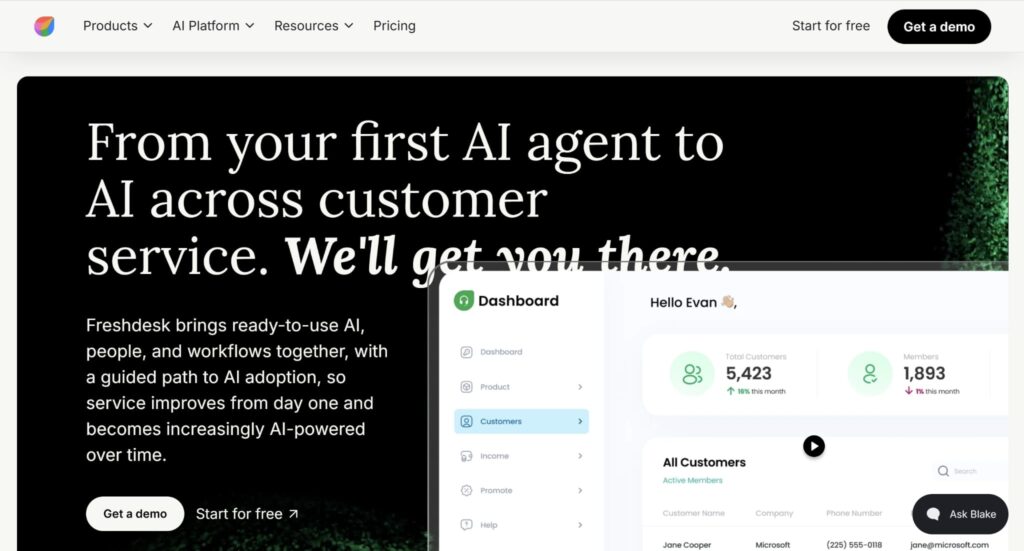
Freshdesk by Freshworks is the budget-friendly helpdesk alternative. It provides core ticket management, email support, multi-channel communication, and a knowledge base at a fraction of Zendesk’s cost, along with a free plan supporting up to 10 agents.
The platform handles after-sales support requests through ticketing, automation rules, canned responses, SLA management, and team collaboration features. In 2025-2026, Freshworks launched Freddy AI Copilot across Freshdesk for agent assistance, including automated responses and ticket suggestions.
One important distinction: live chat, phone support, and messaging apps (WhatsApp, Facebook Messenger) require upgrading to Freshdesk Omni, which is a separate product with its own pricing starting at $29/agent/month.
Best suited for: Small to mid-size support teams that need a solid, affordable helpdesk with predictable per-agent pricing and room to grow.
Pros
- Free plan for up to 10 agents makes it accessible for early-stage teams
- Predictable per-agent pricing scales in a straightforward way
- Freddy AI Copilot included on Pro plans for agent assistance
Cons
- Omnichannel support (chat, phone, messaging) requires a separate product at additional cost
- Customization is limited compared to Zendesk
- Advanced reporting and automation features are locked behind higher-tier plans
Pricing: Free for up to 10 agents. Growth at $15/agent/month. Pro at $49/agent/month. Enterprise at $79/agent/month. Freshdesk Omni starts at $29/agent/month.
4. Salesforce Service Cloud: Tie After-Sales Data to Enterprise CRM
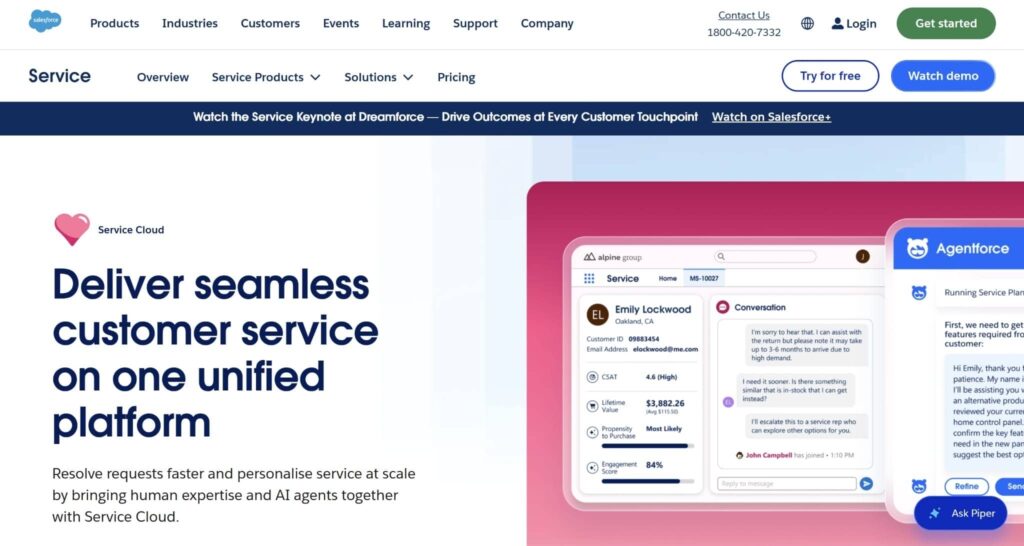
Salesforce Service Cloud is the service arm of the Salesforce CRM platform. It manages case workflows, service entitlements, omnichannel routing, and customer support, with everything tied to the Salesforce customer data model. This means service decisions reference prior purchases, contracts, and product entitlements because they live in the same system as sales and marketing data.
For enterprise organizations already running Salesforce, Service Cloud adds after-sales functionality without introducing a separate data silo. Capabilities include case management with configurable workflows, knowledge base, SLA controls, field service integration, and robust reporting dashboards for after-sales KPIs.
In 2026, Salesforce introduced Agentforce, its AI agent platform, billed per conversation on top of the seat license. Specific per-conversation rates require a sales conversation to determine.
Best suited for: Enterprise brands already running Salesforce for sales and marketing that want after-sales service data inside the same CRM, and have the implementation budget and admin capacity to maintain it.
Pros
- CRM adjacency is genuinely valuable: full customer history, purchase data, and service entitlements in one place
- Robust reporting and dashboards for after-sales KPIs
- Field service integration for on-site repair and installation
Cons
- Configuration takes months for complex after-sales workflows
- Pricing escalates quickly with add-ons, users, and third-party apps
- The $25 entry price is misleading; useful features sit behind Enterprise at $165/user/month
Pricing: Starter Suite at $25/user/month. Pro Suite at $100/user/month. Enterprise at $165/user/month. Einstein 1 Service at $500/user/month. Agentforce AI billed separately per conversation.
5. Qualtrics: Measure Post-Purchase Satisfaction and Act on Customer Feedback
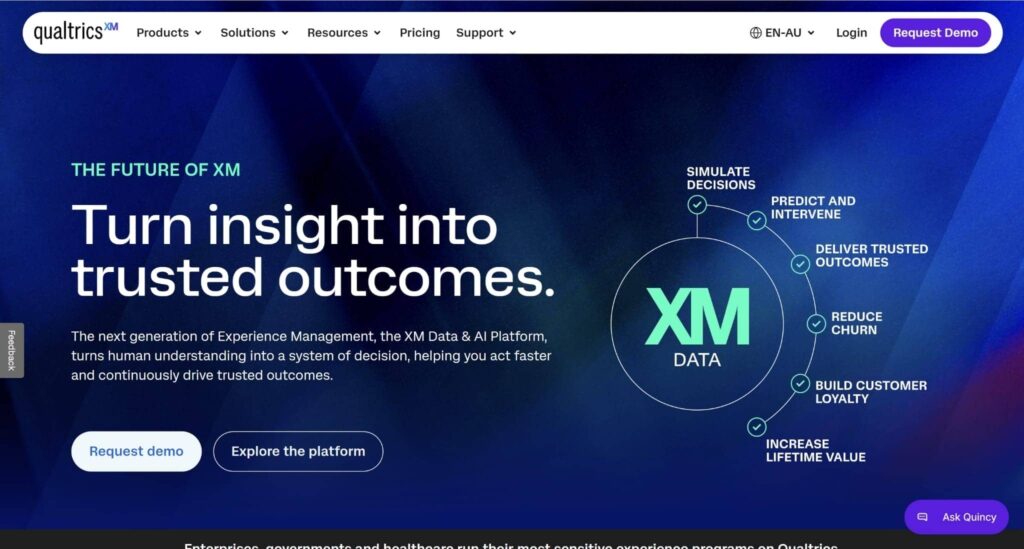
Qualtrics is a customer experience platform that collects and analyzes feedback across the customer journey. For after-sales, it covers what ticketing and warranty tools leave open: how customers feel about the product, the claim, and the support they received. Surveys, Net Promoter Score (NPS), and customer satisfaction (CSAT) tracking sit at the center of the platform.
Teams can gather feedback from surveys, websites, mobile apps, and contact center interactions, then review it in one place. Text and sentiment analysis surfaces repeat issues in open-ended comments. Automated alerts and workflows send low scores to the right team, so a poor claim or repair experience gets a follow-up.
Qualtrics also offers a customer service module for contact centers and integrates with Zendesk, Salesforce, Genesys, and HubSpot. It does not replace a helpdesk or a warranty system. It works alongside them and reports on how well they perform.
Best suited for: Mid-size and large brands that want to measure satisfaction after warranty claims, repairs, and support interactions, and act on the results.
Pros
- Tracks NPS and CSAT across the post-purchase journey
- Automated alerts and workflows turn low scores into follow-up actions
- Integrates with helpdesks and CRMs like Zendesk, Salesforce, and HubSpot
- Text and sentiment analysis surfaces repeat product or service issues
Cons
- Does not handle ticketing, warranty claims, or returns on its own
- Pricing is quote-based and aimed at larger organizations
- Advanced features take time to learn
Pricing: Custom pricing based on modules and usage. Request a quote from Qualtrics.
6. HubSpot Service Hub: Connect Service Tickets to Marketing and Sales Data
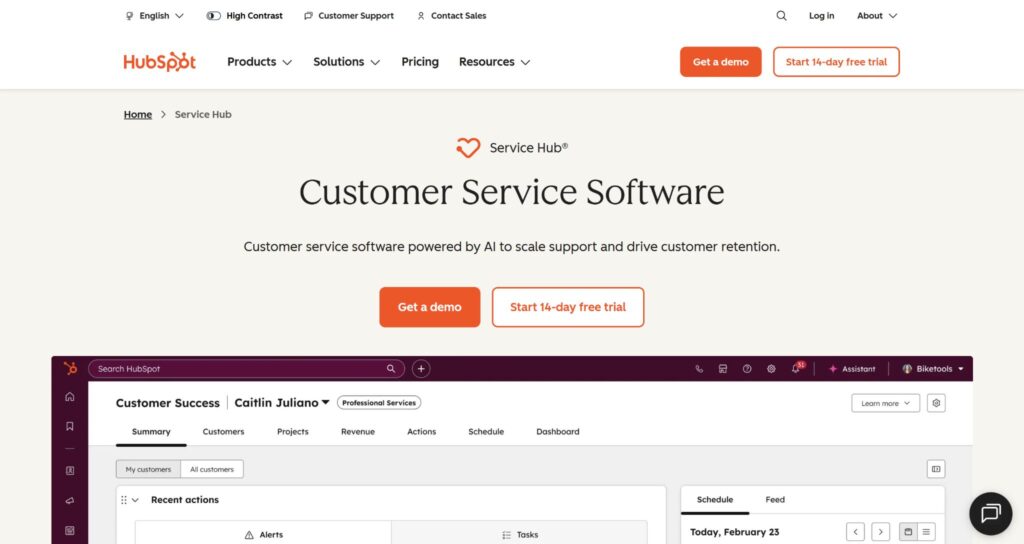
HubSpot Service Hub adds a customer service layer to the HubSpot CRM platform. For organizations already using HubSpot for marketing or sales, Service Hub means support tickets, customer feedback, and service interactions all tie back to the same contact record. This alignment between service, marketing, and sales data makes it straightforward to trigger post-service campaigns, track customer satisfaction over time, and identify at-risk accounts.
Core features include ticket management, shared inbox, live chat, chatbots, knowledge base (Professional and above), customer feedback surveys, SLA management, and Breeze Customer Agent (AI, available on Professional and Enterprise). AI credits are bundled with each tier rather than billed per resolution, which is a more predictable model compared to Zendesk or Salesforce.
Best suited for: Growing brands already using HubSpot for marketing or sales that want a connected service layer on the same customer database, especially mid-market teams with 5+ support agents.
Pros
- Service data connected to marketing and sales on the same CRM, enabling lifecycle workflows
- AI credits bundled with plans rather than billed per resolution
- Free plan offers meaningful functionality for small teams
- 94% positive review sentiment on Capterra
Cons
- The top complaint across review platforms is missing or limited features (117 mentions on G2/Capterra)
- Professional plan requires a 5-seat minimum ($500/month floor) plus a $1,500 one-time onboarding fee
- Knowledge base is available only on Professional and above
Pricing: Free tools ($0, up to 5 seats). Starter at $20/seat/month. Professional at $100/seat/month (5-seat minimum, $1,500 onboarding). Enterprise at $150/seat/month (10-seat minimum, $3,500 onboarding).
7. Loop Returns: Convert Refund Requests Into Exchanges and Retained Revenue
Loop Returns is a returns and exchange management platform built for Shopify. Its core approach is exchange-first: when a customer starts a return, Loop steers them toward an exchange or store credit instead of a refund. Loop serves over 5,000 Shopify merchants, has processed over 70.5 million returns, and reports more than $2 billion in retained revenue across its merchant base.
Key features include a branded self-service return portal, variant and sitewide exchange options, Bonus Credit (extra incentive for choosing exchange over refund), Instant Exchange (ship the replacement before the return arrives, on Advanced plan), automated return processing, fraud prevention, and return reason analytics. Loop integrates with 120+ tools including Klaviyo, NetSuite, and Shopify Flow.
Loop’s benchmark data shows average refund decreases of 20-25% and exchange rates around 40% across its merchant base.
Best suited for: Mid-market Shopify brands in apparel, footwear, and accessories processing 200+ monthly returns that want to convert refunds into exchanges and protect revenue.
Pros
- Exchange conversion is best-in-class; exchange-first UX is a genuine differentiator
- Deep, native Shopify integration (Checkout, Customer Accounts, POS, Flow)
- Return reason analytics help identify product quality issues early
Cons
- Shopify only; as of August 2026, there is no published native connector for any other platform
- Key features (Shop Now, Instant Exchange, Bonus Credit) require the $340/month Advanced tier
- Pricing transparency beyond the subscription is limited; volume-based fees beyond the base plan are contract-specific
Pricing: Checkout+ (free, limited). Essential at $155/month. Advanced at $340/month. Enterprise custom.
Which Tools Work Together? Common After-Sales Stacks
After-sales service rarely lives in a single tool. Here are the combinations that work well together based on business model:
Shopify D2C brands: Dyrect (warranty registration, claims, first-party data) + Qualtrics (post-purchase feedback and satisfaction tracking) + Loop Returns (exchange-first returns). This stack covers the full post-purchase lifecycle from registration through feedback through returns.
Mid-market omnichannel brands: Dyrect (warranty and product registration across all channels) + YourGPT or Freshdesk (multi-channel support). Dyrect integrates with both, so warranty data flows into the support workflow.
Enterprise organizations: Salesforce Service Cloud (CRM-integrated service with entitlements and field service) alongside specialized tools for warranty or returns based on product category.
HubSpot-first organizations: HubSpot Service Hub (support tied to CRM) + Dyrect (warranty management and post-purchase data). Dyrect integrates with HubSpot, feeding registration and claims data into lifecycle marketing workflows.
Frequently Asked Questions
What is after-sales service software?
After-sales service software is any platform that manages post-purchase operations and customer interactions. This includes warranty registration, claims processing, support ticketing, returns and exchange management, repair tracking, and ongoing customer communication. The category spans several software types, from warranty management platforms to helpdesks to CRM-integrated service tools.
How is after-sales service software different from a helpdesk?
A helpdesk manages inbound support tickets across channels like email, chat, and phone. After-sales service software is a broader category that can also include warranty lifecycle management, product registration, field service coordination, extended warranty sales, and reverse logistics for returns. Helpdesks like YourGPT and Freshdesk are one piece of the after-sales puzzle. Tools like Dyrect (warranty) and Loop Returns (returns) cover functions a helpdesk does not.
Which after-sales service tools work best for ecommerce brands?
For ecommerce brands on Shopify, the strongest combination is a warranty management platform like Dyrect for product registration and claims, Qualtrics for post-purchase feedback, and Loop Returns for exchange-first returns management. Brands that also need a helpdesk can add YourGPT or Freshdesk for support and evaluate multi-platform returns tools. The right mix depends on product type, sales channels, and monthly service volume.
How much does after-sales service software cost?
Pricing varies significantly by category and scale. Warranty management with Dyrect starts free with paid plans from $19/month. Helpdesks range from free (Freshdesk) to $169/agent/month. YourGPT starts as a 7-day free trial, pricing starts at $39/month. (HubSpot Starter) to $500/user/month (Salesforce Einstein 1). Returns management starts free and goes up to $340/month (Loop Advanced). Additionally, AI features on Salesforce now carry per-resolution charges on top of base subscriptions.
Do small brands need after-sales service software?
Yes, especially if the brand sells physical products. Small brands often manage warranty claims through email and track registrations in spreadsheets. This works at low volume, but breaks down as order volume grows. Starting with free-tier tools, like Dyrect for warranty registration and claims, Freshdesk for support tickets, or Loop Checkout+ for basic returns, gives small brands structured after-sales operations from day one. The cost of starting is zero, and the cost of delayed adoption is lost customer data, slower resolution times, and missed retention opportunities.