
In July 2025, Australia's Commonwealth Bank said a voice bot would replace 45 roles. Within weeks, it took the decision back. The bank admitted its...
In July 2025, Australia’s Commonwealth Bank said a voice bot would replace 45 roles. Within weeks, it took the decision back. The bank admitted its assessment had missed relevant business considerations.
That admission could appear in plenty of post-mortems. AI plans usually break at the estimate of the work. The technology rarely gets a fair test. That’s the stage where AI strategy consulting pays off, since changing a plan costs little.
Every automation plan depends on one critical number, like call volume or accuracy. For the bank, that number seems to have been call volume. If that figure is wrong, everything built on it fails too. Which number carries your plan, and has anyone tested it?
This piece collects what we’d check before approving any automation. It covers where estimates go wrong and how to test them. Running costs that surprise people later get their own section. Teams wanting a second opinion can lean on AI strategy consulting for the early rounds.
Three Public Stumbles Worth Reading Closely
These stories are well known, so we’ll skip the full retelling. What interests us is the number each plan leaned on.
Klarna’s chatbot handled most of its support chats. For a while, that looked like a win. Then the CEO admitted the bots were cheaper but delivered lower quality.
Chats handled is easy to count. Chats handled well takes more effort to measure, so it often goes unmeasured. An AI business strategy reporting only the first number looks healthy until customers leave. We’d pair every volume figure with a quality check, like repeat contacts within a week.
A cheap audit helps here. Read fifty conversations the bot closed as resolved. Count how many left the customer stuck. Even a handful tells you something the dashboard can’t.
Air Canada’s problem started from another assumption: that a chatbot’s words belong to the chatbot. A tribunal disagreed, finding the airline responsible for everything on its website. From a customer’s seat, there’s one brand and one voice. That makes every chatbot answer a company promise, whatever the vendor contract says.
The bank from our opening seems to have acted before testing its estimate. Announcing headcount changes early also makes retreat awkward, which can keep a shaky plan alive. Averages hide peaks, too. Support lines often get busiest on Monday mornings and after billing runs. A bot sized for the average can struggle exactly then.
Look at the three together and the weak spot is easy to name. Each plan leaned on one number nobody had stress-tested. An artificial intelligence strategy review should start by naming that number.
Why Weak Plans Still Get Approved
Savings show up immediately. A headcount line drops, and finance can see it by month-end. Quality problems arrive slowly and in smaller pieces. Longer queues come first, then repeat contacts, then a few angry posts online.
The slow costs only add up months later, after the announcement has been forgotten. The executive who championed it may have moved on, too. We think that timing mismatch explains more than any technical limit. It also explains why boards approve plans that look airtight. Nobody has priced them yet, so the plan can’t contain them.
Our fix is unglamorous. We’d take a rough guess over silence, with an owner named for each one. Our test for any enterprise AI strategy is whether those costs appear on the page.
Goal First, Metric Second
Picture a regional insurer whose board wants claims settled faster. Vendors pitch chatbots, document readers, and fraud models, and every pitch sounds plausible. The goal is the only reliable filter.
Claims spend most of their lives waiting, so we’d locate the longest wait first. It might be missing paperwork. Or it could be handoffs between adjuster teams. Whichever turns out true, the AI target follows from that answer. Say it’s missing paperwork. A tool that checks submissions at upload fits that problem. A smarter claims chatbot never touches it. Then the measure falls out of the target. Skip a link and the return estimate turns into a guess. Someone’s name belongs beside every metric.
Days to settle is the goal metric. Share of claims with complete paperwork on first submission is the task metric. Cost per claim rides along on the dashboard as a sanity check. Prompts sent, hours saved, and logins make tidy slides. None of them tells a board whether claims settle faster.
A Planning Method Built From Those Failures
We’d keep this simple. It’s three questions, answered in writing before any automation gets budget.
- What Exactly Is the Task?
Customer service is a bundle of different tasks. A refund request and a fraud scare call for very different handling. A bank’s phone line, for instance, mixes balance checks, card disputes, and bereavement calls. Klarna’s assistant carried the routine requests. Break any goal into task types first. Then hand the software the frequent ones where a mistake is cheap to fix. Pilots can mislead here, since teams tend to pick their cleanest cases first. Ask which tickets the pilot left out.
A realistic AI adoption strategy begins with one narrow slice, busy but forgiving. Expand only after that slice proves itself.
- Who Answers When It’s Wrong?
Air Canada argued that its chatbot was responsible for itself. It lost. Somebody inside the company has to own every answer the system gives. A named person should own the fix, too.
Air Canada’s bot even linked to a page that contradicted its answer. Policy text needs one source of truth, and bots should quote only from it. We can’t say that would have prevented this case. It does narrow the room for error.
We’d also want a visible route to a human, since Klarna returned to that idea. Transcripts matter too, since complaints get traced much faster with them.
- Can You Back Out Gracefully?
A public retreat is the costliest way to learn a plan was wrong. Keeping that kind of reversal cheap is a design choice. We believe human capacity should stay put until the system has handled full volume. Perhaps for a full quarter, though that depends on the business.
Any AI strategy framework should say how, and how fast, each step can be undone.
The Other Half of the Ledger Is Running Cost
Most business cases describe benefits in rich detail and costs in one line. Walmart found that out this year. It capped use of its internal coding assistant, Code Puppy, after costs climbed. Alongside that, it introduced a token system tying consumption to business value, per Bloomberg.
Usage-based pricing adds a twist. A popular tool gets used more, and every use costs something.
Here’s a small example of AI ROI once running costs enter the picture. The numbers are invented, so swap in your own. Say a support team handles 100,000 tickets a month at about $5 each. Now an AI agent resolves them. A quarter still reach a person for review at about $4 each. Model usage and platform upkeep are the small lines, as the table shows.
Hidden lines deserve a mention too. Vendor quotes rarely cover the people who review, monitor, and train around the system. In our example, review alone is the largest line.
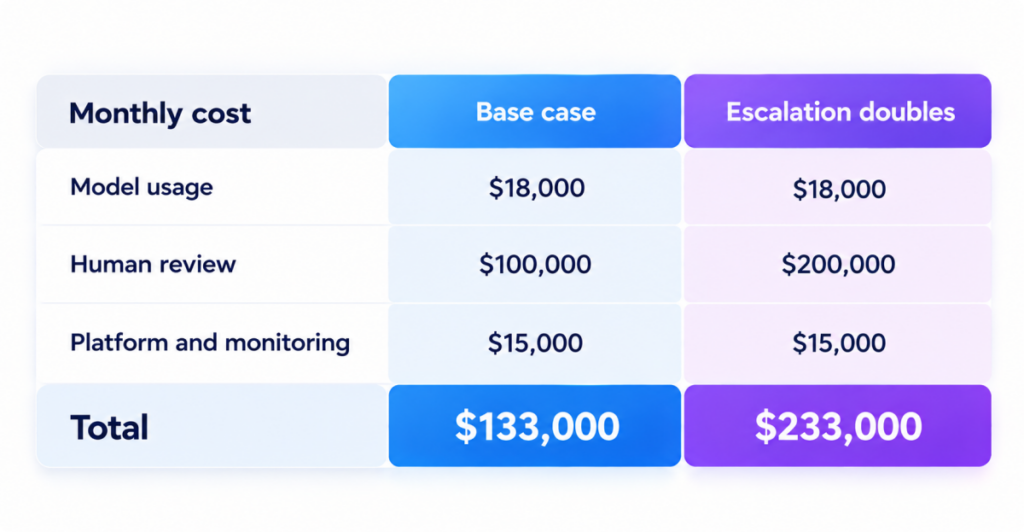
Against the old $500,000 monthly bill, the base case saves $367,000. If escalation doubles to 50%, savings drop to $267,000, roughly 27% lower. The model didn’t change at all. Only the share of tickets needing a person did.
One more detail. Savings survive even at full escalation here, since review costs less than fresh handling. We’d call that generous, because escalated customers often arrive annoyed and take longer.
It’s the kind of number a pilot should pin down before anyone cuts capacity. Any AI strategy consulting workshop worth its fee will push on it early.
Walmart’s token approach points toward a useful habit. Give each workflow its own budget. Track cost per resolved task, since seat counts say little. Then review the heaviest workflows weekly for the first quarter. Even a rough weekly report beats a surprise at quarter’s end.
What a Roadmap Should Say About Stopping
Most roadmaps list launches and dates. We’d want a third column on every roadmap, headed what would make us stop. A solid AI roadmap names its exit conditions early. It also names the person allowed to call a halt.
- Choose Stop Signals Before Launch
For support automation, sensible stop signals include escalation rate and repeat contacts. Cost per resolved ticket belongs on that list too. Thresholds are easiest to agree on before launch, while nobody is attached to the outcome.
Signals only work when somebody is paid to notice them. That person needs real authority to pause the project. Their own bonus shouldn’t depend on the project continuing. It sounds obvious, though it’s rarely set up that way.
- The Vendor Question
Prices and capabilities move fast, so a three-year commitment feels like guessing. Any artificial intelligence strategy should treat the model as a replaceable part. Route calls through a thin layer your team controls. Then swapping providers becomes a job of days.
Short contracts help wherever pricing is volatile. Quarterly retests matter too, since a cheaper model sometimes becomes good enough.
- Reviewing Sooner Than Feels Natural
Klarna took fifteen months to correct course. Commonwealth Bank needed under two months. An annual review looks too slow for either timeline. Monthly check-ins feel excessive in year one. Yet that’s when assumptions are least tested, so we’d keep them.
A short log of rejected ideas helps, since the same proposals return every budget season.
Where Outside Help Earns Its Fee
Some of this you can do alone. A second view still catches things internal teams overlook. The bank from our opening shows how a review can miss relevant business factors. Spotting that kind of omission is what an independent reviewer is paid for.
Good AI business consulting matters most in the early weeks. That’s when assumptions are still cheap to change, and a review costs little.
By the end of a good engagement, your team should hold a baseline finance trust. It should also hold a cost model with sensitivity cases, like the escalation example above. Written stop conditions complete the set.
Some companies need none of this. A two-person team automating an internal report can probably manage on common sense. Customers, regulators, and big budgets change the calculation.
When help is needed, look for AI strategy services covering running costs and exit conditions. Use-case scoring alone isn’t enough.
A few questions are worth putting to any partner.
- How have you modeled running costs when usage grows?
- Can you show a project you recommended stopping?
- Who on the team has run one of these in production for a year?
A hesitant answer to any of them reveals more than a polished case study.
Before Your Next Budget Meeting
Start with one automation that’s live or close to launch. Its business case leans on one number more than any other, so find it. For support projects, that’s often escalation rate, though volume or accuracy can play that role. Then push it the wrong way by half and watch what happens to the savings.
Sometimes the plan survives with room to spare. When it wobbles, you’ve found the real strategy work. That’s when AI strategy consulting helps most, since outsiders poke at assumptions freely.
We’d bring finance the revised numbers early, plus the assumption that worried us most.