
AI can write you a business plan, build your website, and even manage your inventory. But can it build something people actually remember you for?...
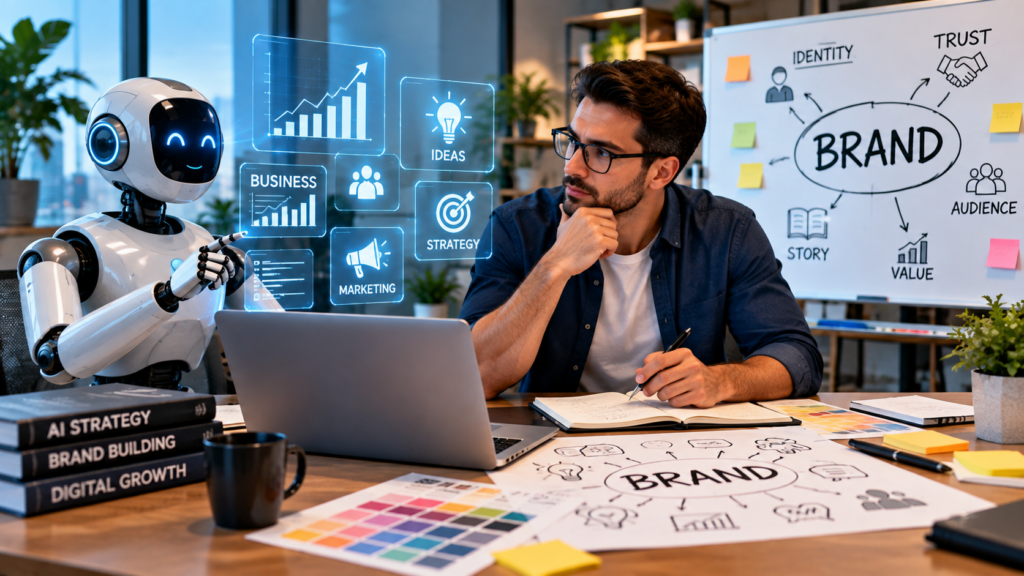
AI can write you a business plan, build your website, and even manage your inventory. But can it build something people actually remember you for?
There is a very big difference between a business and a brand. A business is the machine. It has operations, sales, logistics, and so much more. A brand is a feeling people get when they think of your business. And feelings are harder to code than workflows.
AI branding tools have come a long way on the visual and structural side. Business logos, color palettes, taglines, and brand guidelines are getting harder to distinguish as AI-made or designer-made. But some problems can’t be ignored.
If you’ve ever worked with a good logo design company, you already know branding is part art, part psychology, and part strategy. AI can help put the puzzle together, but it lacks the skills and experience to solve it all.
Here’s a breakdown of what it does well, and where it still needs help.
What AI Branding Tools Are Actually Good At
The biggest advantage AI tools give businesses is speed. Need a logo in five minutes? An AI logo generator will hand you a dozen options in a minute.
For AI for startups, this matters a lot. Every dollar counts when you are a new business. An AI logo maker gets you something usable without burning cash on a full designer. You can tweak it, and it’s cost-effective.
AI branding tools are good at:
- Consistency: Once it learns your colors, fonts, and tone, it applies them everywhere without drifting.
- Volume: It gets you dozens of tagline options, social templates, or ad variations in minutes.
- Speed to launch: You get a working brand kit before your competitors finish their first meeting.
- Low-cost experimentation: You get to test looks and directions without paying for every round of revision.
What required a whole team a few years back now takes a prompt.
Where Things Get a Little Tricky
AI branding tools match patterns. They’re trained on thousands of existing logos and taglines, so the output often looks fine but familiar.
You scroll past a dozen AI logos with the same rounded font and the same gradient blob. The results aren’t bad. They’re just not memorable. And memorability is the whole point of a brand.
According to Harvard Business Review, strong brands come from emotional connection and consistent storytelling over time. It’s not the visual polish alone that makes a “look genuine” effect.
AI can support that, but can’t originate it. It doesn’t know your founder’s story. The inside joke that became your company name. The exact frustration that started the business. Those details matter. They’re what make a brand human. And these stories should come from a human.
Business Building vs. Brand Building
Let’s explain the difference.
Where AI Does the Heavy Lifting: The Logic Side
Building a business is mostly logical. You have to put together systems, workflows, and repeatable processes. This is exactly what AI is built for. Feed it the rules, and it executes them without getting tired, with precision and logical reasoning.
AI business branding tools are useful here. They can resize your logo for every platform. They can draft twenty or more taglines before lunch. They can put together a brand voice in an afternoon. All of it is useful and fast.
Where Humans Still Decide: The Emotional Side
Building a brand almost always requires an emotional touch. It’s trust, recognition, and memorability you want to earn. That’s almost impossible without building an emotional connection.
Someone still has to pick which of those twenty taglines actually feels right. That’s judgment, not data.
This is where small business branding gets interesting. A small business often has more personality to work with than a big company does. The owner’s face, their voice, and their quirks are brand equity AI can’t replicate. Nothing like it exists anywhere for the AI to learn from.
The Human Filter Still Matters
Even solid AI for branding needs a second look from an actual branding expert. Not because the tools are broken, but because branding decisions carry judgment and weight that go beyond aesthetics.
A color can signal luxury or affordability. A font can feel playful or serious. AI can suggest options based on trends or what it already has stored in its database. It can’t fully predict how your specific audience will feel about your brand.
That’s why the approach has now changed. Founders now use AI for the first draft. Then bring in designers to sharpen the final outcome. Look at top-rated logo design companies today. You’ll notice most already use AI in their own logo design process.
Honestly, it helps with the speed. In a business market where founders don’t have time to wait for a six-week process, AI helps generate early concepts fast. Then they can be shaped by people who understand strategy and audience.
It’s not AI vs. humans. It’s humans plus AI. Each handling what they’re actually good at.
So, Can AI Build Your Brand?
Not entirely. AI branding can get you halfway there with consistency and speed. The final stretch is where your business becomes recognizable and genuinely yours. This is where it still needs a human hand.
Think of AI as a fast, tireless intern. It’ll draft anything in seconds. But someone with taste, knowledge, and expertise still has to decide what actually works for your brand.
The Nielsen Norman Group notes that good design decisions come from understanding real user behavior and emotional response, not just aesthetic trends. AI can replicate that. It can’t replace originality, creativity, and emotional judgment. That gap is the difference between AI branding and branding that’s built around your business.
Final Thoughts
AI can build your business faster, and it’s getting better at supporting your branding, too. What once took weeks now takes days.
But branding isn’t just output. It’s meaning. It’s the story behind your business. It’s the trust you build with people who buy from you. AI branding tools give you a strong starting point, not the finish line.
Use AI branding tools to move fast. Just don’t skip the human part. That’s where your business brand identity actually comes alive.