
Effective CCIE Data Center training prepares experienced IT professionals for Cisco's expert level data center certification by combining advanced technical study with extensive hands on practice. The...
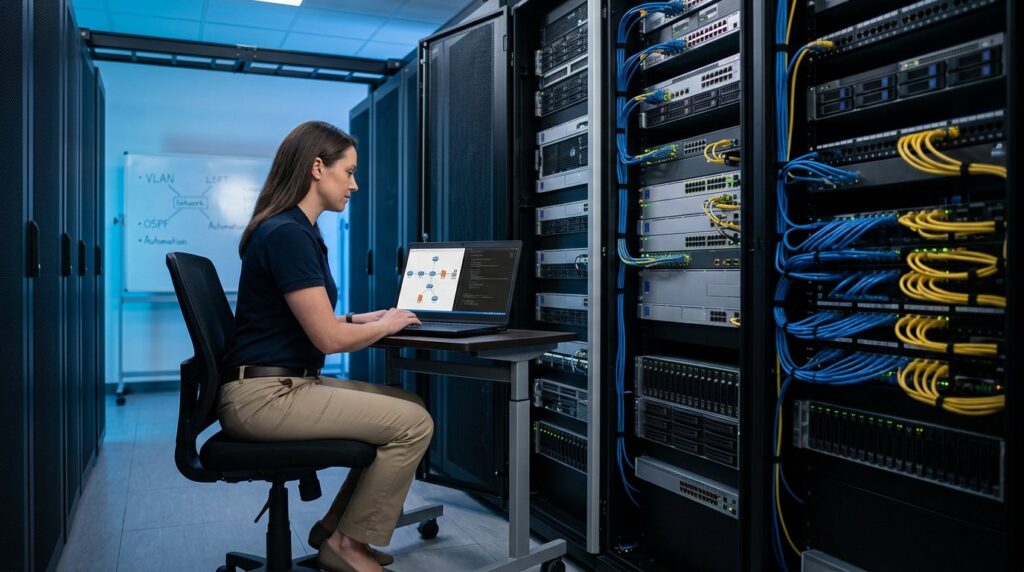
Effective CCIE Data Center training prepares experienced IT professionals for Cisco’s expert level data center certification by combining advanced technical study with extensive hands on practice. The certification path is not simply about memorizing commands. Candidates need to understand data center networking, compute, storage networking, automation, programmability, security, and operational workflows well enough to analyze unfamiliar scenarios and implement solutions under exam conditions. Because Cisco can revise certification blueprints, exam versions, policies, and prices, candidates should always use Cisco’s current official CCIE Data Center pages as the authoritative source when planning their preparation.
CCIE has long been associated with advanced Cisco technical expertise. The Data Center track focuses specifically on technologies and architectures used in modern enterprise data center environments.
A strong study plan should therefore integrate conceptual knowledge, configuration practice, troubleshooting, automation, documentation, and time management rather than treating each topic as an isolated chapter.
What Is CCIE Data Center Training?
CCIE Data Center training is structured preparation for the qualifying and practical examinations required under Cisco’s current CCIE Data Center certification program.
Training can be delivered through official Cisco learning products, authorized or independent instructors, self study, virtual labs, physical equipment, documentation, practice environments, or combinations of these approaches.
A comprehensive program may address:
• Data center networking
• Cisco Nexus technologies
• Data center fabrics
• Cisco Application Centric Infrastructure
• Compute platforms
• Cisco Unified Computing System concepts
• Storage networking
• Network services
• Security
• Automation
• APIs
• Programmability
• Assurance and monitoring
• Troubleshooting
The precise weighting and technologies should come from the current official exam blueprint.
Understanding the CCIE Data Center Certification Path
Cisco’s expert certification requirements have changed over time, so candidates should avoid relying on old blog posts or training courses without checking their current relevance.
Under Cisco’s modern expert certification structure, candidates generally complete a qualifying core examination and then the corresponding expert level practical examination.
The Qualifying Exam
For the CCIE Data Center path, Cisco has used a Data Center core examination associated with implementing and operating Cisco data center technologies.
The exact exam code, version, topics, and policies can change.
Confirm the currently required qualifying exam directly through Cisco before purchasing training.
The CCIE Data Center Lab Exam
After satisfying the qualifying requirement under Cisco’s rules, candidates can attempt the expert practical exam.
The practical examination evaluates applied expertise rather than multiple choice knowledge alone.
Check the Current Blueprint First
Before beginning serious preparation, download or review Cisco’s current exam topics.
Your study plan should map directly to those domains.
A training course based on an older blueprint can still contain useful technical knowledge but may omit new topics or overemphasize technologies that have changed in importance.
9 CCIE Data Center Training Tips for Better Preparation
CCIE preparation can involve hundreds of technical concepts, so organization is essential.
1. Build a Blueprint Based Study Plan
Use the official Cisco exam blueprint as your master checklist.
Break each domain into smaller topics and assess your current level.
A simple rating system might classify each topic as:
• Strong
• Functional but inconsistent
• Conceptually understood
• Requires practice
• Not yet studied
Update this assessment as your skills develop.
2. Combine Theory With Hands On Labs
Reading can explain how a technology works, but configuration and troubleshooting reveal whether you actually understand it.
For each major topic, move through a cycle of learning, building, breaking, troubleshooting, and rebuilding.
Deliberately Create Failures
A valuable lab should not always work perfectly.
Introduce realistic misconfigurations and practice identifying them from symptoms and operational data.
Troubleshooting becomes much harder if you only practice clean configurations.
3. Understand the Technology, Not Just Commands
Command memorization is fragile.
Software versions and interfaces change, while underlying networking principles remain more transferable.
Ask what each configuration accomplishes, which control plane or data plane behavior it influences, and how you would verify that it is functioning.
4. Practice Cisco ACI Thoroughly
Application Centric Infrastructure has been a major component of Cisco’s modern data center portfolio.
Training should include both architectural understanding and practical workflows appropriate to the current blueprint.
Do not rely solely on memorizing graphical interface steps.
5. Develop Automation Skills
Modern data center engineering increasingly incorporates APIs, structured data, scripting, automation platforms, and model driven interfaces.
Candidates should be comfortable reading and understanding automation related material included in the blueprint.
6. Practice Storage Networking
Storage networking can become a weak area for engineers whose everyday roles focus mostly on Ethernet and IP.
Dedicate specific lab and study time to storage concepts rather than leaving them until the end.
7. Learn Efficient Verification
Expert level troubleshooting requires identifying relevant information quickly.
Practice choosing the right operational commands and interpreting outputs instead of dumping enormous quantities of data and searching randomly.
8. Simulate Exam Conditions
Later in your preparation, perform extended practice sessions with time constraints.
Do not consult notes immediately after every uncertainty.
This reveals whether knowledge is actually retrievable under pressure.
9. Track Weaknesses Objectively
Keep a lab journal.
Record failures, incorrect assumptions, difficult technologies, useful verification techniques, and repeated mistakes.
Spend more time on weak areas than on topics you already enjoy.
Core Networking in CCIE Data Center Training
Advanced data center networking remains fundamental.
Candidates should understand both protocol behavior and Cisco implementation.
Layer 2 Technologies
Data center environments can involve VLANs, trunks, spanning tree related technologies, port channels, virtual port channel designs, and other switching concepts.
The current blueprint determines which technologies require examination level mastery.
Layer 3 Networking
Routing knowledge can include interior gateway protocols, BGP, route policy, first hop redundancy, and data center specific routing use cases where included.
Understand Failure Domains
Do not learn protocols in isolation.
Consider what happens when an interface, switch, peer, uplink, or control plane relationship fails.
Resiliency is a core part of data center design and operations.
Cisco Nexus Training
Cisco Nexus switches are strongly associated with Cisco data center environments.
Candidates should become familiar with the relevant Nexus software features and operational workflows in the exam blueprint.
NX OS Skills
Training can involve:
• Interface configuration
• VLANs
• Port channels
• vPC
• Routing
• Policy configuration
• Monitoring
• Troubleshooting
• Software related operational concepts
The exact commands can differ according to platform and software release.
Verification Matters
After configuring a technology, prove that it works.
Check control plane state, forwarding behavior, adjacency status, interface state, and relevant counters.
A configuration without verification is incomplete practice.
Cisco ACI in CCIE Data Center Training
Cisco Application Centric Infrastructure provides a policy based approach to data center networking.
It introduces terminology and operational models that can require substantial practice for engineers coming from conventional switch by switch configuration.
ACI Concepts to Understand
Depending on the current blueprint, study areas may include:
• Fabric architecture
• APIC
• Tenants
• VRFs
• Bridge domains
• Endpoint groups
• Application profiles
• Contracts
• External connectivity
• Fabric access policies
• Endpoint learning
• Troubleshooting
Candidates should understand how objects relate to actual forwarding behavior.
ACI Troubleshooting
Learn to move from a reported application symptom toward relevant policy, endpoint, routing, or connectivity information.
Do not approach ACI only as a configuration exercise.
Cisco UCS and Compute Training
CCIE Data Center covers more than networking switches.
Cisco Unified Computing System technologies integrate compute infrastructure with centralized management concepts.
UCS Concepts
Study the compute and management topics explicitly named by the current blueprint.
Depending on version, this can involve profiles, policies, server connectivity, firmware, pools, identity abstraction, and management platforms.
Service Profiles
Service profile concepts help separate selected server identity and configuration attributes from individual physical hardware.
Candidates should understand why this abstraction is useful and how associated policies interact.
Troubleshoot Compute Connectivity
A data center engineer should be able to investigate situations where server connectivity fails even when switching appears healthy.
This requires understanding how compute, adapters, fabric interconnects, policies, and networks relate.
Storage Networking Training
Storage technologies can require a different vocabulary from conventional IP networking.
Fibre Channel Fundamentals
Learn concepts such as fabrics, ports, zoning, addressing, name services, and relevant operational behavior according to the blueprint.
FCoE
Fibre Channel over Ethernet allows Fibre Channel frames to be carried over appropriate Ethernet infrastructure.
Candidates should understand its architecture and requirements where included in the examination topics.
Storage Troubleshooting
Avoid memorizing configuration templates without understanding the storage path.
Trace connectivity logically from initiator through the fabric toward the target.
Automation and Programmability
Automation has become increasingly important in modern Cisco certification tracks.
Python Foundations
Where Python related skills are relevant, candidates should be comfortable reading simple scripts and understanding data manipulation, variables, conditions, loops, functions, and API interactions at the level required by the blueprint.
The goal is practical infrastructure automation rather than becoming a general software engineer.
REST APIs
APIs allow software to interact programmatically with infrastructure controllers and devices.
Understand basic HTTP methods, responses, authentication concepts, and structured data where required.
JSON and XML
Structured data formats are common in automation workflows.
Candidates should be able to read nested data and identify relevant fields.
Automation Requires Verification Too
A script completing without an obvious error does not prove that the network reached the desired state.
Automated workflows should include validation.
Security in Data Center Training
Security is integrated into modern infrastructure rather than being a separate afterthought.
Access Control
Study authentication, authorization, policy enforcement, segmentation, and other security areas required by the current blueprint.
Management Plane Security
Administrative access to infrastructure should follow secure practices.
Candidates should understand the principles and specific technologies included in Cisco’s published topics.
Virtualization in the Data Center
Virtualized workloads change how networking and compute environments interact.
Understand Virtual Networking
Candidates may need knowledge of virtual interfaces, distributed connectivity, hypervisor interactions, and overlay technologies depending on the exam blueprint.
Overlay and Underlay Concepts
Modern data centers frequently separate an IP transport underlay from an overlay providing workload connectivity.
Understanding this architectural distinction is more useful than memorizing isolated configurations.
Designing Your CCIE Data Center Lab
Hands on practice is central to preparation.
Physical Hardware
A physical lab can provide experience with real cables, boot processes, console access, hardware behavior, and operational constraints.
The downside is cost, power consumption, noise, space, and the difficulty of acquiring equipment matching current exam technologies.
Virtual Labs
Virtualized environments can provide a practical alternative for many networking topics.
Licensing and platform support should be obtained through legitimate channels.
Hosted Rack Rentals
Commercial lab providers can provide remote access to physical or virtual equipment.
Before purchasing time, confirm that the topology and software versions actually support your study requirements.
CCIE Data Center Training Courses
A training course can provide structure but does not remove the need for independent practice.
Instructor Led Training
Instructor led programs can help when a candidate needs external structure and opportunities to ask technical questions.
Evaluate the instructor’s current experience rather than certification history alone.
Online CCIE Data Center Training
Online courses offer flexible scheduling and can work well alongside full time employment.
Look for courses that clearly identify which current exam blueprint they cover.
Boot Camps
A boot camp provides intensive preparation over a shorter period.
It is generally most useful after substantial foundational study rather than as a substitute for months of hands on learning.
Avoid Pass Guarantees
No legitimate course can guarantee that every student will pass an expert level practical examination.
Treat guaranteed pass claims cautiously, particularly when they involve unauthorized exam content.
Avoid CCIE Exam Dumps
Exam dumps or unauthorized recalled questions undermine the purpose of certification and can violate Cisco’s candidate agreements and testing policies.
They also produce weak practical preparation.
Use Legitimate Practice Questions
Practice questions should test concepts rather than reproduce protected live exam content.
Official learning resources, original instructor material, documentation, and self created labs provide a more defensible study strategy.
CCIE Data Center Study Plan
The appropriate timeline depends on existing experience.
An engineer already managing Cisco data center infrastructure has a different starting point from someone moving into the field.
Phase 1: Assessment
Map your skills to the blueprint.
Identify major gaps before purchasing large amounts of training material.
Phase 2: Foundation
Study each domain conceptually.
Build smaller labs focused on individual technologies.
Phase 3: Integration
Create scenarios connecting networking, compute, storage, and automation.
Real infrastructure problems rarely respect textbook chapter boundaries.
Phase 4: Troubleshooting
Break working environments deliberately.
Learn to identify root causes from limited information.
Phase 5: Timed Practice
Complete increasingly long practice sessions under realistic time constraints.
Review errors afterward and repeat weak scenarios.
How Long Does CCIE Data Center Training Take?
There is no universal preparation duration.
Relevant factors include:
• Existing Cisco experience
• Data center experience
• ACI familiarity
• Storage knowledge
• Automation skills
• Available study time
• Lab access
• Troubleshooting ability
A candidate with years of relevant production experience may progress considerably faster than someone encountering several domains for the first time.
Measure Readiness by Skills
Instead of focusing exclusively on months studied, ask whether you can configure, verify, explain, and troubleshoot blueprint topics without excessive reference material.
Time invested matters less than demonstrated competence.
CCIE Data Center Training Cost
Total preparation costs vary significantly.
They can include:
• Training courses
• Books
• Lab rentals
• Official learning products
• Travel
• Exam fees
• Accommodation
• Practice equipment
Cisco exam fees and policies can change.
Check Official Cisco Pricing
Before budgeting, verify current examination fees directly through Cisco and its official testing process.
Do not rely on old articles quoting fixed costs.
Budget for More Than the Exam
Travel and lab access can become significant expenses depending on location and preparation method.
Build a complete certification budget early.
How to Choose the Best CCIE Data Center Training
The best training is the option that addresses your specific skills gap and matches the current blueprint.
Evaluate Course Coverage
Ask:
• Which blueprint version is covered?
• When was the material last updated?
• How much lab practice is included?
• Are troubleshooting exercises included?
• Does it cover automation practically?
• What ACI lab access is provided?
• Who teaches the course?
• Are recordings available?
• How long is lab access retained?
Compare these factors before focusing on price.
Common CCIE Data Center Training Mistakes
Candidates can spend significant time studying inefficiently.
Common problems include:
• Studying from an outdated blueprint
• Watching videos without lab practice
• Memorizing commands without understanding behavior
• Avoiding weak storage topics
• Neglecting automation
• Practicing only successful configurations
• Using unrealistic lab scenarios
• Ignoring time management
• Overusing passive reading
• Relying on unauthorized exam dumps
Active troubleshooting should become a regular part of preparation.
How to Know When You Are Ready
Perfect knowledge is unrealistic, but major blueprint topics should feel operationally familiar.
Signs of Readiness
You should increasingly be able to:
• Explain why a technology works
• Configure it without copying complete templates
• Verify the resulting state
• Identify common failures
• Interpret relevant output efficiently
• Connect technologies across domains
• Work under time constraints
Weaknesses will still exist, but they should not dominate entire blueprint sections.
Career Value of CCIE Data Center
The certification can demonstrate substantial Cisco data center expertise, particularly when supported by real operational experience.
Possible roles associated with these skills include senior network engineer, data center engineer, infrastructure architect, consultant, and technical specialist.
Certification Does Not Replace Experience
Employers evaluate broader factors such as project history, troubleshooting ability, communication, design judgment, automation skills, and familiarity with their infrastructure.
CCIE can validate expertise, but it is strongest when combined with practical experience.
Maintaining Cisco Certification
Cisco certifications operate under recertification requirements that can change.
Candidates and existing CCIE holders should consult Cisco’s current recertification policy for available options, deadlines, and continuing education requirements.
Do not assume policies that applied when someone originally certified remain unchanged.
Frequently Asked Questions
What is CCIE Data Center training?
CCIE Data Center training prepares candidates for Cisco’s expert level data center certification through advanced study and hands on practice in networking, compute, storage, automation, and related technologies.
Which exam is required for CCIE Data Center?
Cisco requires a qualifying examination and corresponding expert practical exam under its current certification framework. Verify the current exam codes and versions directly with Cisco.
How long does CCIE Data Center training take?
Preparation time varies widely according to professional experience, blueprint familiarity, lab access, automation knowledge, and available study hours.
Is CCIE Data Center difficult?
It is designed as an expert level certification and requires broad technical understanding plus practical configuration and troubleshooting ability across multiple data center domains.
Can I prepare for CCIE Data Center online?
Yes. Candidates can combine online training, official documentation, legitimate virtual environments, hosted labs, and independent study, provided the resources cover the current blueprint.
Is CCIE Data Center worth it?
It can be valuable for professionals working extensively with Cisco data center technologies, but its career value depends on job goals, regional demand, practical experience, and the technologies used by prospective employers.
Conclusion
CCIE Data Center training should develop expert level problem solving rather than short term command memorization. Begin with Cisco’s current blueprint, identify your weakest domains, and combine technical study with extensive configuration, verification, troubleshooting, and automation practice. Training courses can provide structure, but sustained hands on work remains essential for practical exam readiness. By using legitimate resources and continuously testing skills against realistic scenarios, candidates can build expertise that remains valuable beyond the certification exam itself.