
Commercial cleaning is the professional cleaning of offices, retail spaces, healthcare facilities, and other business buildings, and technology is transforming how it works. The global...
Commercial cleaning is the professional cleaning of offices, retail spaces, healthcare facilities, and other business buildings, and technology is transforming how it works. The global commercial cleaning market is worth over 67 billion dollars, and modern commercial cleaning now uses robotics, IoT sensors, UV disinfection, electrostatic sprayers, and data dashboards to deliver cleaner, healthier, and more efficient results for businesses.
Commercial cleaning has quietly become one of the most technology driven industries in the business world. What used to be mops, buckets, and guesswork is now a data rich operation built on robots, sensors, and smart chemicals. Commercial cleaning in the modern sense is a professional service that keeps business spaces healthy, safe, and presentable, and technology is at the center of how it delivers value.
This guide explains how commercial cleaning is changing, why technology matters, the ten best technology trends in commercial cleaning today, how each trend benefits modern businesses, and how to choose a commercial cleaning partner that uses the latest tools. Whether you manage an office, a retail store, a clinic, or a warehouse, understanding the technology behind commercial cleaning helps you make smarter decisions and get a healthier workplace.
What Is Commercial Cleaning?
Professional cleaning of non residential buildings is the heart of the industry, including offices, retail stores, medical facilities, schools, restaurants, warehouses, and industrial sites. Unlike residential cleaning, the sector operates on a scheduled, contractual basis and follows standards for hygiene, safety, and appearance.
The industry covers many tasks. It includes daily cleaning of workspaces, restrooms, kitchens, and common areas, plus deeper services such as carpet cleaning, floor care, window washing, and disinfection. It also includes waste management, restocking supplies, and specialized work like post construction cleaning and medical grade sanitization.
The commercial cleaning market is large and growing. The global commercial cleaning market was estimated at roughly 67 billion dollars in 2025, and it is projected to nearly double by the mid 2030s, driven by rising hygiene standards, infection control awareness, and the adoption of automation. This growth is pushing cleaning companies to invest in technology that improves results and efficiency.
How Technology Is Transforming Commercial Cleaning
Technology is reshaping commercial cleaning in four big ways, and every modern business benefits.
From Guesswork to Data
Traditional commercial cleaning relied on schedules and habit. Modern providers use sensors and software to measure when a restroom needs attention, how much a floor is used, and whether a surface has been properly disinfected. Data turns the service from an expense into a managed, measurable operation.
From Manual to Automated
Robots now handle repetitive tasks like floor scrubbing and vacuuming, which frees human cleaners for detailed work that needs judgment. Automation makes the service more consistent, because machines do the same job the same way every time, and it helps companies manage rising labor costs.
From Generic to Smart Chemicals
New cleaning chemistry is changing commercial cleaning too. Electrostatic sprayers charge disinfectant droplets so they wrap around surfaces, and smart dispensers track chemical use and reduce waste. These technologies make the work more effective and more sustainable.
From Reactive to Proactive
The best providers now predict problems before they appear. IoT sensors alert teams when a paper towel dispenser is empty or a restroom is busy, and dashboards show facility managers exactly what was cleaned, when, and with what result. Proactive service prevents complaints instead of responding to them.
The 10 Best Technology Trends in Commercial Cleaning
These ten technology trends define modern commercial cleaning, and each one delivers real value to businesses.
1. Autonomous Floor Cleaning Robots
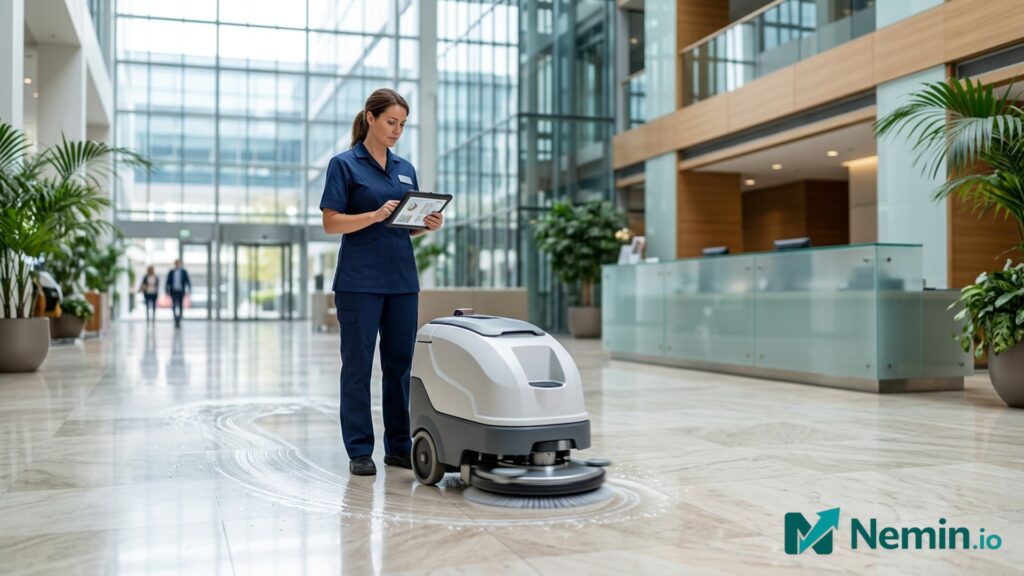
Floor cleaning robots are the most visible technology in the industry today. These machines scrub, sweep, and vacuum large floor areas automatically, navigating around people and obstacles with sensors and mapping software. Floor cleaning robots account for the majority of cleaning robot deployments, and they are especially valuable in offices, retail stores, and airports where floors see heavy traffic. For cleaning companies, robots reduce labor hours on repetitive work and deliver consistent results across every shift.
2. IoT Sensors and Smart Monitoring
Internet of Things sensors are turning commercial cleaning into a data driven discipline. Sensors in restrooms detect usage, foot traffic, and supply levels, and they trigger cleaning only when a space actually needs it. Facility managers get dashboards that show cleaning activity in real time. This approach, sometimes called smart cleaning, makes the service more efficient and more responsive, and it gives businesses proof that their facility was cleaned properly.
3. Electrostatic Spraying and Disinfection
Electrostatic sprayers charge disinfectant particles so they cling to surfaces evenly, including hard to reach areas, instead of just settling on top. This technology makes disinfection far more thorough, which matters for offices, schools, and healthcare settings. Electrostatic spraying covers surfaces faster than manual wiping, reduces chemical waste, and gives businesses confidence that high touch points are truly protected.
4. UV C Disinfection Technology
Ultraviolet light disinfection adds a powerful layer to commercial cleaning. UV C devices use ultraviolet energy to deactivate bacteria, viruses, and other pathogens on surfaces and in the air. Many providers use UV C as a supplemental step after standard cleaning, especially in healthcare, laboratories, and high risk facilities. UV C disinfection is fast, chemical free, and highly effective, which is why it is a growing part of the industry’s technology.
5. Data Dashboards and Reporting
Modern providers run on reports. Digital dashboards track cleaning completion, worker assignments, supply usage, and quality scores, and they share that data with clients in real time. Instead of trusting that cleaning happened, businesses see verified results. This transparency builds trust between companies and their providers, and it supports accountability at every level.
6. Automated Chemical Dispensing
Smart dispensing systems measure the exact amount of chemical needed for each task, mixed with water at precise ratios. Automated dispensing reduces waste, protects workers from concentrated chemicals, and ensures every surface is cleaned with the correct product. For cleaning companies, automated dispensing also lowers cost and improves safety, and for clients, it means more consistent results.
7. Mobile Apps and Workforce Technology
Cleaning crews now work with mobile apps that assign tasks, log completion, and report issues in real time. Supervisors track teams across multiple buildings, and clients receive instant updates on the schedule. Mobile technology improves communication, reduces errors, and makes teams faster and more organized, which directly improves service quality.
8. Smart Restroom Technology
Restrooms are the highest risk area in any building, and smart restroom technology is transforming the industry there. Sensor equipped restrooms monitor traffic, soap levels, paper supply, and even air quality, and they alert cleaning teams the moment attention is needed. Smart restrooms are cleaned based on actual use rather than a fixed schedule, which keeps them consistently fresh and reduces wasted effort in commercial cleaning.
9. Green Cleaning Technology and Sustainability
Technology is making commercial cleaning greener. Electrostatic sprayers use less chemical, automated dispensing cuts waste, and modern machines are more energy and water efficient. Many companies now use certified green products and paperless reporting, and they document sustainability metrics for clients. Green practices protect the environment, improves indoor air quality, and supports corporate sustainability goals.
10. Artificial Intelligence and Predictive Cleaning
Artificial intelligence is the newest force in commercial cleaning. AI analyzes sensor data and usage patterns to predict when and where cleaning is needed, which lets teams work proactively instead of reactively. AI also helps with scheduling, quality audits, and route planning for crews. As AI improves, the industry will become even more precise, efficient, and valuable to businesses.
How Technology Benefits Modern Businesses

Technology in this industry is not just about gadgets. It delivers concrete benefits that matter to business owners and facility managers.
Healthier workplaces. Advanced disinfection and air quality monitoring reduce germs and allergens, which leads to fewer sick days and healthier employees. A clean office is a competitive advantage for any business that cares about its people.
Lower costs over time. Automation and smart dispensing reduce labor hours and chemical waste. While technology requires investment, commercial cleaning that uses it well becomes more efficient, and those savings can be passed on or reinvested.
Better productivity. Employees work better in clean, organized spaces, and technology ensures those spaces stay consistently clean. When restrooms are never out of supplies and floors are always presentable, staff and visitors notice the difference.
Transparency and trust. Data dashboards give businesses proof of results, which builds trust between clients and providers. You no longer have to wonder whether the office was cleaned last night, because the report shows it.
Stronger first impressions. Retail stores, offices, and clinics win clients with clean, modern spaces, and technology keeps those spaces at their best. First impressions still matter, and smart commercial cleaning protects them.
Compliance and safety. Healthcare, food service, and industrial facilities face strict hygiene rules, and technology helps providers meet documented standards. Reports and sensors provide the evidence that compliance requires.
What Technology Cannot Replace in Commercial Cleaning
Technology transforms the industry, but it does not replace the people who make it work. Human judgment is still essential for tasks that machines cannot handle.
Detail cleaning, such as wiping desks, sanitizing keyboards, and polishing surfaces, still requires a trained human. Customer service, communication, and problem solving are human strengths, and a friendly professional cleaner makes a building feel cared for in a way a robot never will. Technology handles repetition, while people handle complexity, and the best commercial cleaning combines both.
For businesses, the lesson is simple. Look for a cleaning company that uses technology as a tool, not as a replacement for skilled workers. The ideal provider blends robots, sensors, and data with trained, supervised teams that take pride in their work.
How Technology Is Changing Commercial Cleaning Costs
Businesses often ask whether technology makes commercial cleaning more expensive, and the honest answer is more nuanced.
Some technology, like advanced disinfection systems and robotics, involves upfront investment, which can raise the price of premium commercial cleaning services. However, technology also reduces ongoing costs through lower labor hours, less chemical waste, and fewer callbacks. Many commercial cleaning companies report that automation reduces labor costs significantly, because labor accounts for a large share of cleaning expenses.
The trend is that technology improves the value of commercial cleaning more than it raises the price. Businesses get cleaner facilities, better reporting, and more consistent service, and commercial cleaning providers use technology to manage their own costs. When comparing commercial cleaning quotes, ask what technology is included, because it directly affects the quality you receive.
Working With a Modern Commercial Cleaning Company

Choosing the right commercial cleaning partner matters more than ever, and technology is now part of the evaluation.
Start by asking what technology the company uses. Does it offer floor cleaning robots, smart restroom monitoring, electrostatic disinfection, and digital reporting? A modern commercial cleaning company should be able to explain how its technology improves your facility.
Check the training of the staff. Technology only works when people know how to use it, so confirm that cleaners and supervisors are trained on the equipment and the reporting tools. Ask for references from businesses like yours, and visit a facility the company cleans if you can.
Look for transparency. The best commercial cleaning companies share dashboards and reports, and they treat your facility manager as a partner rather than a customer. Clear communication, documented results, and responsive service are the signs of a professional commercial cleaning provider.
Finally, start with a trial or a pilot area. Run commercial cleaning on a floor or a zone for a month, review the reports, and judge the results before signing a long contract. A trial lets you see the technology and the team in action with minimal risk.
Commercial Cleaning and the Return to the Office
Technology is also shaping how commercial cleaning supports the return to the office. As businesses bring teams back to shared spaces, they want visible proof that buildings are clean and healthy.
Modern commercial cleaning delivers that proof. Sensors show restroom freshness, dashboards show completed tasks, and disinfection logs show high touch points were treated. Some companies display cleaning schedules and results to employees, which reassures staff and supports wellbeing.
For modern businesses, commercial cleaning has become part of the employee experience and the employer brand. A visibly clean, well maintained office tells employees and visitors that the company cares, and technology makes that standard achievable and provable.
The Role of Training in Modern Commercial Cleaning

Technology only delivers results when the people behind it know how to use it well, which is why training is a core part of modern commercial cleaning. Reputable commercial cleaning companies invest in ongoing education for their teams, covering new equipment, safe chemical handling, disinfection protocols, and customer service.
A trained team makes every piece of technology more effective. The same floor robot performs differently depending on how it is programmed, and the same electrostatic sprayer works better in the hands of someone who understands surface chemistry. Training also reduces accidents, protects staff, and ensures consistent quality across every visit.
When you evaluate a commercial cleaning company, ask about their training program as seriously as you ask about their technology. The best providers treat training as an investment, not an expense, and it shows in the quality of commercial cleaning you receive.
Frequently Asked Questions
These are the questions business owners ask most about commercial cleaning and technology.
- What is commercial cleaning?
It is the professional cleaning and maintenance of offices, retail spaces, healthcare facilities, and other business buildings on a scheduled basis. - How much does the commercial cleaning market grow each year?
The global commercial cleaning market is growing at about 7 to 8 percent a year, and it was worth over 67 billion dollars in 2025. - Does commercial cleaning use robots?
Yes, floor cleaning robots are widely used in commercial cleaning, and they handle scrubbing, sweeping, and vacuuming in offices, stores, and airports. - Is commercial cleaning technology expensive?
Advanced technology involves some investment, but it lowers labor and chemical costs over time, which improves the overall value of commercial cleaning. - Can technology replace commercial cleaning workers?
No, technology handles repetitive tasks, but trained people are still essential for detail cleaning, customer service, and quality control. - How does technology make offices healthier?
Electrostatic disinfection, UV C cleaning, and smart restroom monitoring reduce germs and keep high touch surfaces protected. - What should I ask a commercial cleaning company about technology?
Ask about robots, sensors, disinfection methods, digital reporting, and staff training before choosing a commercial cleaning provider. - How do I choose a modern commercial cleaning company?
Look for transparent reporting, trained staff, verified technology, references, and start with a trial area before a long contract.
Conclusion
The industry has entered a new era, and technology is the driving force. The global market is worth over 67 billion dollars and growing, and modern commercial cleaning now combines robots, IoT sensors, electrostatic disinfection, UV C light, smart dispensers, mobile apps, and data dashboards to deliver results that were impossible a decade ago. For modern businesses, this technology means healthier workplaces, lower long term costs, better productivity, transparent reporting, stronger first impressions, and easier compliance with hygiene standards.
Technology does not replace the skilled people who make commercial cleaning work, but it gives them better tools, and the best commercial cleaning companies blend both. When you choose a partner, ask about their technology, check their training, and demand transparent reporting, because the right provider protects your people, your property, and your reputation. Commercial cleaning is no longer just about mops and buckets, it is a data driven investment in the health and success of your business, and the time to adopt it is now.