
Packaging often creates a customer's first physical interaction with a product, which makes box design important for protection, identification, logistics, and brand presentation. Businesses can...
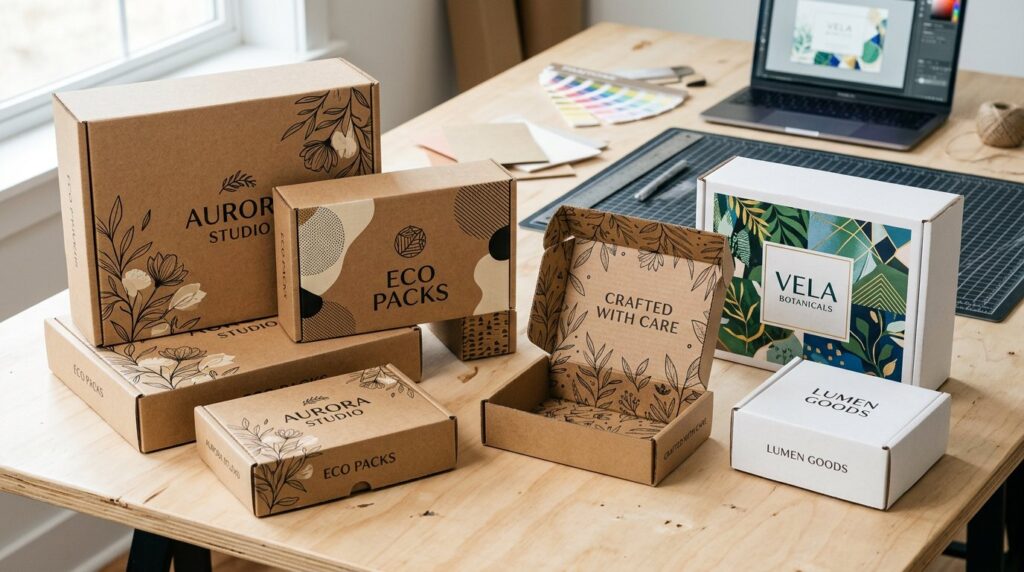
Packaging often creates a customer’s first physical interaction with a product, which makes box design important for protection, identification, logistics, and brand presentation. Businesses can use custom printed boxes to combine appropriately engineered packaging with logos, colors, product information, instructions, regulatory details, and other visual elements. From corrugated ecommerce shippers to folding cartons for retail shelves, the best format depends on product dimensions, weight, fragility, distribution conditions, printing requirements, budget, and order volume. Understanding these variables can help businesses avoid unnecessary packaging costs while creating a consistent and practical customer experience.
What Are Custom Printed Boxes?
Custom printed boxes are packaging containers manufactured or decorated with graphics created for a specific business, product, campaign, or application.
Customization can be relatively simple, such as printing a one color logo on a stock size corrugated box. More complex projects may involve custom dimensions, structural engineering, full color graphics, inserts, coatings, specialty finishes, and carefully controlled brand colors.
Common formats include corrugated shipping boxes, mailer boxes, folding cartons, rigid presentation boxes, product boxes, and other paper based packaging systems.
A custom box should not be selected purely for appearance. Packaging has to withstand relevant transportation, storage, handling, stacking, environmental, and product protection requirements.
How Are Custom Printed Boxes Made?
The production process depends on box style and printing technology.
A packaging supplier may begin with dimensions, structural requirements, board specifications, artwork, and anticipated distribution conditions. A dieline can then define the cut lines, folds, panels, glue areas, and printable zones.
After artwork approval, printing may occur before or after converting depending on the manufacturing process. Material is cut, creased, folded, glued, stitched, laminated, or otherwise converted into the final package.
Some packaging arrives flat for storage efficiency and is assembled during fulfillment.
What Can Be Printed on Custom Boxes?
Businesses commonly print logos, colors, product names, illustrations, handling instructions, websites, contact information, barcodes, QR codes, sustainability information, and legally required labeling where applicable.
The exact information should reflect the product and market.
Does Custom Packaging Need Legal Information?
Some products are subject to specific labeling, marking, warning, language, or traceability requirements.
Food, cosmetics, medicines, chemicals, batteries, children’s products, and regulated goods can have particularly detailed requirements. Businesses should verify applicable regulations rather than assuming attractive packaging is legally sufficient.
9 Powerful Benefits of Custom Printed Boxes
Custom packaging can provide practical and marketing advantages when it is properly designed.
1. Stronger Brand Recognition
Consistent use of a logo, color palette, typography, and visual style can make packaging easier for customers to associate with a brand.
This can be especially useful for ecommerce companies because a shipping package may be the first physical branded item customers encounter.
Brand recognition develops through repeated, consistent experiences rather than packaging alone, so print design should support the broader identity.
2. Professional Product Presentation
Well produced packaging can create a more deliberate presentation than an unmarked generic container.
For retail products, printed cartons can communicate the product category and important purchase information. For online orders, branded packaging can make fulfillment feel more cohesive.
Premium appearance should still be balanced against practical packaging needs and product economics.
3. Better Fit With Custom Dimensions
When structural customization is included, boxes can be designed around product dimensions rather than forcing products into oversized stock cartons.
A more appropriate fit may reduce empty space and the amount of additional void fill required.
However, minimizing box size should not compromise cushioning or protection. Fragile products may deliberately require clearance around the item.
4. Space for Product Information
The box surface provides room for useful information.
Businesses may include setup instructions, product benefits, care guidance, contact details, recycling directions, warnings, or other content appropriate to the item.
Prioritize information that helps customers rather than filling every panel with promotional copy.
5. Improved Unboxing Experience
A thoughtfully designed package can create an organized and visually consistent opening experience.
Interior printing, inserts, tissue, or other components may support presentation when they have a clear purpose.
Excessive packaging purely for appearance can add material, cost, weight, and waste. Effective unboxing design does not necessarily require multiple decorative layers.
6. Consistent Packaging Across Product Lines
A flexible visual system can connect several products under the same brand identity.
Businesses can use common colors and layouts while varying product names, sizes, illustrations, or regulatory information.
Digital printing can be particularly useful when multiple artwork versions are needed in comparatively modest quantities.
7. Potential Logistics Improvements
A properly engineered custom box can support efficient packing, palletization, storage, and transportation.
Box dimensions influence how much air is transported, how products stack, and how many units fit into storage or shipping configurations.
The best dimensions therefore consider the entire logistics system rather than only the product’s appearance on arrival.
8. Promotional Opportunities
Packaging can communicate campaigns, product launches, seasonal messages, loyalty information, or digital experiences.
QR codes can direct customers to instructions, registration, authenticity information, or online content when implemented thoughtfully.
Always test codes on printed production samples because size, contrast, surface finish, and distortion can affect scanning.
9. Differentiation in Competitive Markets
Distinctive graphics and structural packaging can help products stand out online or on retail shelves.
Differentiation is most effective when it supports clear positioning rather than making the package difficult to understand.
Customers should be able to identify the brand, product, and essential information without unnecessary visual clutter.
Types of Custom Printed Boxes
The right box structure depends heavily on how the product reaches the customer.
Custom Corrugated Boxes
Corrugated boxes are widely used for shipping and distribution. Their construction typically includes fluted material between linerboard layers, creating a structure designed to provide useful strength without excessive weight.
Corrugated board is available in different flute profiles and combinations.
Box strength depends on more than board thickness. Material properties, box dimensions, design, manufacturing quality, humidity, storage, stacking, and handling conditions all influence performance.
Custom Mailer Boxes
Mailer boxes commonly use die cut corrugated board and incorporate folding panels that create an integrated closure.
They are popular for ecommerce orders, subscription products, promotional kits, clothing, accessories, cosmetics, and other appropriately sized products.
Their presentation friendly structure also allows printing inside and outside when the manufacturing process supports it.
Folding Cartons
Folding cartons are typically manufactured from paperboard rather than corrugated board.
They are widely used for cosmetics, food, pharmaceuticals, personal care products, electronics accessories, and a large variety of retail goods.
Cartons can support detailed graphics and numerous finishing options but are not necessarily substitutes for protective shipping cartons.
Rigid Custom Printed Boxes
Rigid boxes use comparatively thick board and are generally supplied as formed packages rather than conventional folding cartons.
They are often associated with premium electronics, jewelry, cosmetics, gifts, and presentation products.
Rigid construction and finishing can create a substantial feel but typically involve higher material, production, assembly, storage, and freight costs.
Materials Used for Custom Printed Boxes
Material selection affects strength, appearance, print quality, weight, cost, and environmental characteristics.
Corrugated Fiberboard
Corrugated fiberboard is a common material for transit packaging.
Manufacturers can select board configurations based on the package’s required strength and distribution environment. Technical requirements may involve characteristics such as edge crush performance or other board and box strength measurements.
Work with a packaging professional when the contents are heavy, fragile, valuable, or exposed to demanding distribution conditions.
Paperboard
Paperboard provides a smoother substrate suited to detailed retail graphics.
Various grades are available, and the appropriate material depends on printing, stiffness, product compatibility, finish, regulatory considerations, and cost.
Kraft Packaging Material
Kraft based packaging is recognized by its natural brown appearance, although kraft papers can also be bleached, coated, colored, or printed.
Brown kraft surfaces can support a natural aesthetic but may alter the appearance of some printed inks compared with white substrates.
Recycled Content Materials
Many paper and corrugated packaging products are available with recycled fiber content.
The exact proportion and performance vary by board grade and supplier. Businesses making environmental claims should obtain documentation and avoid using vague or unsupported sustainability language.
Printing Methods for Custom Printed Boxes
Printing technology influences graphic quality, setup costs, production speed, color control, and economical order quantity.
Flexographic Printing
Flexography uses flexible printing plates and is widely employed for corrugated packaging, labels, bags, and other packaging applications.
It can be efficient for larger production quantities and straightforward brand graphics.
Modern flexographic systems can achieve sophisticated results, although practical capabilities depend on the press, substrate, inks, prepress, and converter.
Digital Printing
Digital printing transfers graphics without requiring conventional printing plates for each design.
It is attractive for short runs, multiple versions, personalization, prototypes, and projects requiring frequent artwork changes.
Unit cost and available finishing options vary by printer and order volume, so digital is not automatically the least expensive method for every job.
Offset Lithography
Offset printing can produce high quality detailed graphics and controlled color reproduction.
For certain corrugated applications, printed sheets or liners may be produced and subsequently laminated to corrugated material.
Offset production can involve greater setup than digital workflows but may become attractive for suitable higher volume projects.
Screen Printing
Screen printing may be used for specialized packaging applications and can apply bold areas of ink to selected surfaces.
Its suitability depends on material, design complexity, quantity, and production workflow.
Which Printing Method Is Best?
There is no universal best printing method.
Digital can suit shorter or versioned runs, flexography can be efficient for substantial corrugated production, and offset can provide excellent high resolution graphics for suitable projects.
A packaging converter can compare total production cost and quality requirements using actual artwork and quantities.
Custom Printed Boxes for Ecommerce
Ecommerce packaging faces a different environment from products placed directly onto retail shelves.
Individual parcels may pass through automated sorting systems, conveyors, vehicles, warehouses, and repeated handling before reaching the customer.
Design for Shipping Conditions
An ecommerce package must protect the contents throughout realistic distribution hazards.
These can include drops, compression, vibration, impacts, temperature changes, and moisture exposure.
For valuable or fragile products, appropriate packaging testing can provide much stronger evidence than relying on appearance or subjective impressions.
Avoid Oversized Ecommerce Boxes
Oversized packaging can increase material use, dimensional shipping charges where applicable, void fill requirements, and storage space.
Right sizing can improve efficiency, but leave enough room for necessary cushioning and protection.
Consider Return Shipping
Businesses with substantial return rates may benefit from packaging designed for practical resealing and return transport.
A second adhesive strip, clear opening instructions, or a reusable structural design can simplify the customer experience without requiring a separate return box.
Custom Printed Boxes for Retail Products
Retail packaging needs to balance visual communication with practical considerations such as shelf dimensions, merchandising, security, labeling, and transportation.
Design for Shelf Recognition
A customer should be able to identify the product quickly.
Brand name, product type, key differentiating information, quantity, and other necessary details should be visually organized rather than given equal emphasis.
Retail Barcodes
Barcodes need appropriate dimensions, contrast, quiet zones, positioning, and printing quality.
Packaging designers should follow the applicable barcode standards and verify finished samples before large scale distribution.
Glossy surfaces, folds, curves, and distorted printing can potentially reduce scan reliability.
How to Design Custom Printed Boxes
Good packaging design begins with structure.
Graphics should be developed after the packaging team understands dimensions, folds, seams, openings, closures, and areas that may be covered during assembly or shipping.
Start With Accurate Product Dimensions
Measure the product and all components that will ship inside the box.
Include accessories, documentation, inserts, protective material, and reasonable manufacturing tolerances when establishing internal dimensions.
A packaging professional can help translate product dimensions into appropriate box dimensions.
Use a Professional Dieline
A dieline provides the structural template used to position artwork.
Important graphics should remain inside specified safe areas and away from cuts, scores, glue zones, or hidden panels unless the design intentionally crosses them.
Keep Branding Clear
Use consistent logo treatment, typography, and brand colors.
Visual hierarchy matters more than placing the logo on every available panel. Minimal packaging can often produce a stronger identity than an overcrowded design.
Design for Both Screen and Physical Production
Colors displayed on monitors can differ from printed colors.
Substrate color, ink system, coatings, printing technology, and lighting conditions can all affect final appearance. Physical proofs or production samples are particularly valuable when brand color accuracy matters.
Color Management for Custom Printed Boxes
Color consistency is an important part of packaging production.
CMYK Printing
Many full color printing processes reproduce artwork using cyan, magenta, yellow, and black inks.
Colors created in RGB for screens may shift when converted for print because the available color gamuts differ.
Spot Colors
Spot color systems can help brands specify particular ink colors for greater consistency in compatible printing workflows.
Even then, substrate, coating, ink formulation, press conditions, and viewing light can influence appearance.
Proof Before Production
A proof allows artwork, text, placement, and often color expectations to be reviewed before a larger run.
For important packaging, also consider a physical structural prototype to confirm dimensions and assembly.
Custom Printed Boxes and Sustainability
Packaging sustainability requires a lifecycle perspective rather than relying on one material claim.
Right Sizing
Reducing unnecessary material while retaining adequate product protection can lower package mass and shipping volume.
However, insufficient protection can cause product damage and replacement shipments, which also carry environmental costs.
Recyclability
Many clean paperboard and corrugated boxes can be recyclable within appropriate collection systems.
Coatings, laminates, plastic windows, adhesives, metallic layers, contamination, and local recycling capabilities can influence actual recyclability.
Avoid printing broad recycling claims without considering the complete packaging construction and intended market.
Recycled Content
Recycled fiber can reduce demand for virgin fiber in suitable applications.
Where environmental attributes are important to customers or procurement requirements, request supplier documentation for recycled content and certified sourcing claims.
Are Custom Printed Boxes Eco Friendly?
They can be designed to reduce environmental impacts, but printing alone does not make packaging sustainable.
Material efficiency, responsible sourcing, recycled content, product protection, transportation, manufacturing, reuse potential, and end of life options all contribute to overall impact.
How Much Do Custom Printed Boxes Cost?
Pricing varies substantially based on dimensions, material, box style, quantity, printing method, number of colors, ink coverage, coatings, finishes, inserts, tooling, freight, and supplier location.
A universal per box price would therefore be misleading.
Quantity Affects Unit Cost
Many traditional manufacturing processes involve setup and tooling costs. Spreading those costs across a larger order can reduce the unit price.
Digital printing may make smaller orders economically practical because conventional printing plates are not required in the same manner.
Factor in Hidden Costs
Compare more than the quoted unit price.
Potential additional expenses include dies, printing plates, proofs, setup, storage, freight, import charges, fulfillment labor, damaged products, and obsolete packaging after a design change.
Minimum Order Quantity for Custom Boxes
Minimum order quantity, commonly abbreviated MOQ, is the smallest production quantity a supplier will accept for a particular configuration.
MOQs vary according to printing process, box construction, supplier equipment, materials, and level of customization.
Low MOQ Custom Printed Boxes
Startups and small brands may benefit from digital printing, stock box sizes with custom printing, printed sleeves, or labels where fully custom manufacturing would require more inventory than the business can use.
A slightly higher unit price can be financially preferable to purchasing thousands of boxes that later become obsolete.
Ordering Custom Printed Boxes Step by Step
A structured procurement process reduces mistakes.
Start by defining the product, dimensions, weight, distribution environment, quantity, desired delivery date, artwork, and budget. Then request recommendations from suitable packaging suppliers.
Obtain samples where possible and test the product inside the proposed package.
Review dielines and proofs carefully before production approval. Confirm quantities, tolerances, materials, colors, finishes, lead times, packing method, and delivery arrangements in writing.
Test Before a Large Order
A structural sample can reveal problems that are difficult to see on a computer screen.
Check product fit, assembly time, closure, protection, customer opening experience, label placement, and shipping performance.
For demanding distribution environments, consider recognized packaging test protocols appropriate to the product and supply chain.
Common Custom Printed Box Design Mistakes
One common error is prioritizing graphics before confirming structural requirements. A beautiful package that fails during shipping is not effective packaging.
Another is ordering excessive inventory before testing market demand or finalizing product information.
Businesses should also avoid tiny text, weak print contrast, excessive package size, unsupported environmental claims, incorrect barcodes, and graphics positioned across unintended seams.
Over Packaging
Additional inserts, layers, and decorative materials may make packaging appear premium, but they also add cost and waste.
Every component should have a functional or deliberate communication purpose.
Under Packaging
Reducing material too aggressively can expose products to damage.
The objective is optimized packaging, not simply the smallest possible amount of packaging.
How to Choose a Custom Printed Box Supplier
A reliable supplier should be able to discuss both printing and structural packaging requirements.
Review capabilities such as box styles, materials, printing equipment, color management, prototyping, quality assurance, lead times, and technical support.
For high volume projects, also consider production capacity, contingency planning, consistency between batches, and the supplier’s ability to document material or environmental claims.
Request Samples
Samples allow businesses to examine print quality, board construction, folding, seams, coatings, and overall workmanship.
A generic sample demonstrates production capability, while a custom prototype provides better information about the proposed package.
Compare Equivalent Quotations
Make sure suppliers are quoting genuinely comparable specifications.
A lower quote may use a different board grade, printing process, finish, quantity, delivery term, or level of testing. Compare the full specification before choosing based on price.
Frequently Asked Questions
What are custom printed boxes?
Custom printed boxes are packaging containers produced with business specific graphics, branding, product information, or designs and may also be manufactured to custom dimensions.
What materials are used for custom printed boxes?
Common materials include corrugated fiberboard, paperboard, kraft based boards, and grades containing recycled fiber, depending on protection and presentation requirements.
Which printing method is best for custom boxes?
Digital printing suits many shorter or variable runs, while flexographic and offset processes can be effective for larger quantities or particular graphic requirements.
Are custom printed boxes recyclable?
Many paperboard and corrugated boxes can be recyclable, but coatings, laminates, windows, contamination, and local collection systems can affect recyclability.
How much do custom printed boxes cost?
Cost depends on size, material, quantity, printing, tooling, finishes, freight, and structural complexity, so supplier quotations based on a complete specification are most accurate.
How do I choose the right custom box size?
Measure the product and all protective components, then select internal dimensions that provide sufficient protection without creating unnecessary empty space.
Conclusion
Custom printed boxes can combine product protection, efficient logistics, useful information, and recognizable branding within one packaging system. Successful packaging starts with the product and distribution environment, followed by suitable materials, dimensions, printing technology, and clear artwork. Prototyping and testing can identify expensive problems before a large production run begins. By balancing visual presentation with structural performance, cost, and material efficiency, businesses can create packaging that supports both operations and the customer experience.
Pingback: Retail Supplier Success 9 Powerful Strategies for 2026