
Understanding food labelling rules is essential for food manufacturers, importers, retailers, restaurants, online sellers, and other businesses responsible for information supplied with food. A compliant label does...
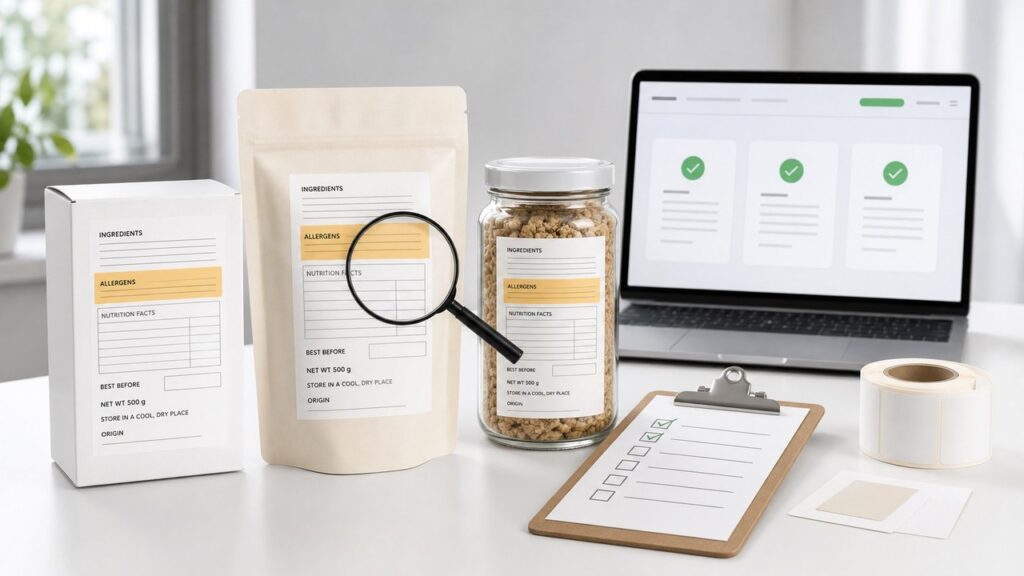
Understanding food labelling rules is essential for food manufacturers, importers, retailers, restaurants, online sellers, and other businesses responsible for information supplied with food. A compliant label does more than identify a product. Depending on the jurisdiction and type of food, regulations can govern ingredients, allergens, nutrition information, net quantity, date marks, storage conditions, responsible business details, origin information, and voluntary claims. Because requirements differ between countries and can vary by product category, businesses should identify the exact rules applying to each product and market before designing or approving packaging.
Food labels serve several purposes simultaneously. They allow consumers to identify what they are buying, compare products, understand ingredients, recognize allergens, and follow relevant storage or preparation instructions.
For businesses, inaccurate or incomplete information can create consumer safety, regulatory, commercial, and reputational consequences. Compliance should therefore begin during product development rather than being treated as the final stage of packaging design.
What Are Food Labelling Rules?
Food labelling regulations are legal requirements governing information supplied on food products and, in some jurisdictions, food offered online or through food service businesses.
The exact framework depends on where the food is sold.
In the United Kingdom, for example, food information requirements draw on retained and amended food information legislation alongside UK specific rules. There are also important differences between Great Britain and Northern Ireland because the applicable regulatory frameworks are not identical in every respect.
The European Union applies its own food information legislation, including Regulation (EU) No 1169/2011, while countries such as the United States, Canada, Australia, and New Zealand have separate systems.
Why Food Labelling Rules Matter for Consumers and Businesses
Accurate labelling supports informed purchasing and can have direct safety implications.
Allergen declarations are an obvious example. For someone with a food allergy, incomplete or inaccurate information can result in serious harm.
Other mandatory information helps consumers understand composition, nutrition, quantity, shelf life, storage, and preparation.
Businesses also need consistency between recipes, specifications, supplier information, packaging, websites, and other sales channels. A label can only remain accurate when the information behind it is controlled.
Who Is Responsible for Following Food Labelling Rules?
Responsibility varies according to jurisdiction, supply chain arrangement, and how the food is marketed.
Manufacturers, brand owners, importers, retailers, caterers, and online sellers can each have obligations depending on circumstances.
Businesses should identify the legally responsible food business operator and understand responsibilities across their supply chain.
A packaging printer or graphic designer should not be assumed to carry regulatory responsibility simply because they produced the physical label.
9 Essential Food Labelling Rules Businesses Should Understand
Although exact requirements vary, several areas repeatedly appear in food labelling frameworks. These principles provide a useful compliance foundation, but businesses should always verify market specific requirements.
1. Food Labelling Rules Require the Food to Be Clearly Identified
Consumers need to understand what the product actually is.
A brand name or imaginative product name does not necessarily replace the legally required name of the food. Depending on the product and jurisdiction, a prescribed legal name, customary name, or sufficiently descriptive name may be necessary.
Descriptions must not mislead consumers about the food’s nature or composition.
For example, imagery, prominent wording, or presentation should not create a false impression about ingredients or characteristics.
Check product specific standards because some regulated foods have defined compositional or naming requirements.
2. Food Labelling Rules Cover Ingredient Lists
Prepacked foods generally require an ingredient list unless a specific exemption applies.
Ingredients are normally listed in descending order by weight as used in the preparation of the food, subject to relevant rules and exceptions.
Compound ingredients can create additional requirements because their constituent ingredients may also need declaration.
Food additives may need to be identified using prescribed categories and names or permitted numbering systems depending on the applicable legislation.
Recipe changes therefore require label review. Even a small supplier substitution can alter ingredients or allergen information.
3. Food Labelling Rules Place Special Importance on Allergens
Allergen information is one of the highest priority areas of food compliance.
Different jurisdictions prescribe which allergens require mandatory declaration and how they must be presented.
In the UK and EU framework, 14 categories of allergens have specific declaration requirements. For prepacked food, allergens present as ingredients generally need to be emphasized within the ingredients list according to applicable rules.
Businesses should never assume that an informal statement such as “contains allergens” is sufficient.
The required presentation depends on the way the food is sold.
4. Food Labelling Rules Regulate Date Marking
“Use by” and “best before” communicate different concepts in jurisdictions that use these terms.
A use by date relates to food safety for products that are highly perishable from a microbiological perspective where the legislation requires that form of date marking. Food should not be consumed after its use by date.
Best before generally concerns quality rather than the same type of safety cutoff.
Businesses need evidence supporting assigned shelf life and should apply the correct type of date indication.
Storage instructions may also be required where conditions affect the validity of the date.
5. Food Labelling Rules Address Nutrition Information
Many prepacked foods require a nutrition declaration, though requirements and exemptions vary.
The UK and EU approach typically requires specified energy and nutrient information in a prescribed format and order for foods within scope.
The United States uses the Nutrition Facts label under a different regulatory framework.
Do not copy a nutrition panel from packaging designed for another market.
Even when the underlying food is identical, calculation methods, units, reference values, rounding conventions, presentation rules, and mandatory nutrients may differ.
6. Food Labelling Rules Apply to Net Quantity
Consumers should be told how much food the package contains using the appropriate measurement.
Depending on the product, this may involve weight or volume.
Rules can specify units, positioning, minimum character sizes, drained weight for certain foods, and other measurement requirements.
Quantity information should reflect applicable weights and measures law as well as food information requirements.
Promotional packaging changes should be checked carefully if package dimensions change while declared quantity remains the same.
7. Food Labelling Rules Can Require Origin Information
Country of origin or place of provenance is mandatory for some foods and circumstances, but it is not universally required in precisely the same way for every product.
Specific rules can apply to categories such as certain meats, produce, fish, honey, olive oil, and other products depending on jurisdiction.
Origin information may also become necessary when omitting it could mislead consumers.
Claims about local or regional provenance require particular care.
The origin of a brand, manufacturer, recipe, primary ingredient, and final manufacturing location can all be different.
8. Food Labelling Rules Control Nutrition and Health Claims
Statements such as “high protein,” “low fat,” or “source of fibre” are not simply creative marketing phrases in many jurisdictions.
Nutrition claims may only be used when defined conditions are satisfied.
Health claims can be subject to even stricter controls, including authorization requirements and wording or conditions of use.
Businesses should not imply that ordinary food prevents, treats, or cures disease where such statements are prohibited.
Marketing teams, website content writers, packaging designers, and social media teams all need to understand these limitations because claims can extend beyond the physical label.
9. Food Labelling Rules Require Information to Be Legible
Providing mandatory information is not enough if consumers cannot reasonably read it.
Rules may govern minimum type size, visibility, contrast, placement, and whether certain information must appear within the same field of vision.
Design teams should reserve sufficient space for regulatory text before finalizing branding.
Reducing mandatory information to an unreadable size to create more room for graphics can create compliance problems.
Labels also need to remain legible under normal conditions of sale.
Food Labelling Rules for Allergen Information
Allergen compliance begins with ingredient and supply chain control, not typography.
Businesses need accurate supplier specifications, recipe records, production procedures, and change management processes.
Labels can only communicate the information the business itself understands.
Food Labelling Rules for the 14 Allergens in the UK
In the UK, the regulated allergen categories include cereals containing gluten, crustaceans, eggs, fish, peanuts, soybeans, milk, nuts as specified by legislation, celery, mustard, sesame, sulphur dioxide and sulphites above specified conditions, lupin, and molluscs.
Exact legal definitions matter.
For example, broad colloquial terms and statutory allergen categories may not always align perfectly.
Businesses should use official Food Standards Agency guidance and relevant legislation when determining declarations rather than relying on simplified online lists.
Food Labelling Rules for Precautionary Allergen Statements
Statements such as “may contain” should not be used automatically on every package.
Precautionary allergen labelling is intended to communicate a genuine risk of unintended allergen presence where appropriate risk assessment supports its use.
Overuse can unnecessarily restrict food choices for people with allergies.
Businesses should have allergen management procedures addressing suppliers, storage, production, cleaning, cross contact, staff training, and change control.
Where specialist assessment is necessary, seek competent food safety advice.
Food Labelling Rules for Prepacked for Direct Sale Food
UK requirements for food that is prepacked for direct sale, commonly abbreviated as PPDS, changed following legislation widely associated with Natasha’s Law.
Since October 2021, qualifying PPDS food in the UK generally needs a full ingredients list with applicable allergens emphasized.
Whether a product qualifies as PPDS depends on how and where it is packed and sold.
Applying Food Labelling Rules to PPDS Products
A sandwich packaged on the premises before the consumer selects it may fall into PPDS requirements when the legal criteria are met.
That does not mean every food prepared by a restaurant or café is automatically PPDS.
Businesses need to classify each sales format correctly.
Guidance from the Food Standards Agency and relevant local authorities can help businesses determine which requirements apply to prepacked, PPDS, and non prepacked foods.
Food Labelling Rules for Nutrition Declarations
Nutrition labels help consumers compare nutritional composition, but businesses must ensure the values are generated appropriately.
Depending on the relevant legislation, values may be based on analysis, calculations from known or actual ingredient values, or established data, provided acceptable methods are followed.
Changes to recipes or suppliers can affect declared values.
Food Labelling Rules for Nutrient Presentation
Mandatory nutrients, units, sequence, energy presentation, and reference intake information are legally defined in many markets.
Optional nutrients may also be subject to rules.
Formatting needs to be considered during packaging development rather than added at the end.
Where space permits, tabular presentation may be required or preferred under the relevant framework, with linear presentation potentially permitted in certain circumstances.
Always confirm the current rules for the market concerned.
Food Labelling Rules and Serving Information
Nutrition requirements may primarily use values per 100 grams or 100 millilitres in some markets, while additional per portion information may be permitted under specified conditions.
Serving sizes should not be selected in a way that misleads consumers.
US serving size requirements operate differently from UK and EU practices.
International businesses should therefore maintain market specific artwork rather than trying to create one universal nutrition label without professional verification.
Food Labelling Rules for Date Marks and Storage
Shelf life determination should be evidence based.
Microbiological risk, formulation, processing, packaging, storage temperature, distribution, and expected consumer handling can all influence shelf life.
The manufacturer or responsible business needs a defensible basis for the selected date.
Food Labelling Rules for Use By Dates
Where a use by date is required, it should be treated as a food safety control.
Retailers and consumers should follow the applicable guidance concerning food after that date.
Storage conditions are particularly important because a date established for refrigerated storage may not remain valid when the product has been kept too warm.
Businesses should maintain appropriate temperature control throughout the relevant supply chain.
Food Labelling Rules for Best Before Dates
Best before dates primarily indicate the period during which a product is expected to retain its specific quality characteristics when stored appropriately.
Food may sometimes remain safe after this date, depending on the product and condition, although quality can decline.
This distinction can help reduce unnecessary food waste.
However, consumers should never apply best before guidance to a product carrying a use by date as though the two labels mean the same thing.
Food Labelling Rules for Country of Origin
Origin claims influence purchasing decisions and therefore need accuracy.
A Union Jack, geographic illustration, place name, or prominent regional language can potentially create an impression of origin even when a direct statement is absent.
Businesses should assess the overall presentation.
Food Labelling Rules for Primary Ingredient Origin
In applicable frameworks, additional rules can arise when the stated or implied origin of a food differs from the origin of its primary ingredient.
Specific disclosure requirements may then apply.
These requirements can become technically complex.
Businesses making prominent geographic claims should establish the origin of relevant ingredients and obtain specialist advice where necessary before approving artwork.
Food Labelling Rules for Local and Regional Claims
Terms such as “British,” “Scottish,” “Welsh,” “Cornish,” “Yorkshire,” or other geographic references should accurately reflect what the claim communicates.
Consumers might interpret a statement as referring to ingredients, manufacturing, recipe heritage, or company location depending on context.
Qualify claims when necessary.
Clear language is preferable to relying on fine print to correct a misleading overall impression.
Food Labelling Rules for Online Food Sales
Selling food online does not eliminate labelling obligations.
In many regulatory systems, consumers need access to specified mandatory information before completing a distance sale, with certain information potentially subject to different timing rules.
Businesses should ensure website listings remain synchronized with physical products.
Food Labelling Rules for Ecommerce Product Pages
Product pages should be updated when recipes, allergens, quantities, or other relevant mandatory information changes.
Relying exclusively on photographs of packaging can create accessibility and accuracy problems, especially if images become outdated.
Use structured product information where appropriate and maintain version control.
Third party marketplaces also require monitoring because outdated descriptions can remain live even after the manufacturer updates its own website.
Food Labelling Rules for Imported Products
A label compliant in the country of manufacture may not satisfy the rules in the destination market.
Language, responsible operator details, nutrition presentation, allergens, units, origin statements, claims, and other requirements can differ.
Importers should review labels before products reach retail shelves.
Food Labelling Rules Across Multiple Markets
Create a regulatory specification for each intended market.
Document which mandatory statements, translations, nutrition formats, claims, responsible business details, and warnings apply.
Machine translation alone is risky for legally significant food information.
Use competent translation and regulatory review processes where multiple languages or jurisdictions are involved.
Keeping Food Labelling Rules Updated
Food law changes over time.
Assign responsibility within the business for monitoring official regulatory updates and reviewing labels when rules change.
Useful UK sources include the Food Standards Agency, Food Standards Scotland, GOV.UK, local authority guidance, and relevant legislation.
Trade associations and professional advisers can provide additional assistance, but primary regulatory sources should remain central to compliance monitoring.
Food Labelling Rules and Misleading Marketing
A technically correct ingredients list does not necessarily make the entire package compliant if prominent marketing creates a misleading impression.
Images, names, colors, claims, and omissions all contribute to how consumers interpret a product.
Businesses should review the package as a whole.
Food Labelling Rules for Voluntary Claims
Statements such as “natural,” “traditional,” “fresh,” “artisan,” or environmental claims may be regulated by general consumer protection principles even when a specific food rule does not define every term.
Claims should be truthful, clear, and substantiated where necessary.
Environmental statements require increasing attention.
Claims about recyclable packaging, carbon impact, sustainable sourcing, or reduced waste should accurately communicate their scope and limitations.
Building a Food Labelling Rules Compliance Process
Reliable compliance requires coordination between product development, purchasing, technical teams, operations, marketing, legal advisers, and artwork suppliers.
A controlled product specification should act as a reliable source for label information.
Changes should trigger review.
Food Labelling Rules Artwork Approval Checklist
Before approving packaging, verify the product name, ingredients, allergen presentation, quantity, dates and storage instructions where relevant, nutrition declaration, business information, origin requirements, claims, instructions for use, and required warnings.
Also inspect formatting and legibility on the actual package size.
Computer screen previews can make text appear larger and clearer than it will be after printing.
Auditing Food Labelling Rules Compliance
Periodic audits can identify inconsistencies between recipes, specifications, labels, websites, and actual production.
Sample products from current production rather than reviewing design files alone.
Confirm that the correct artwork version is being used.
Maintain records of approvals, specification changes, supplier information, and corrective actions. Good documentation supports both everyday quality management and regulatory investigations if a problem arises.
Frequently Asked Questions
What are food labelling rules?
Food labelling rules govern mandatory and voluntary information supplied with food, including areas such as ingredients, allergens, nutrition, quantities, dates and certain claims.
What allergen information do food labelling rules require?
Requirements depend on jurisdiction and sales format. UK rules require specific regulated allergens to be declared and, for many prepacked foods, emphasized within the ingredients list.
Do food labelling rules apply to online sales?
Yes. Distance selling can carry food information obligations before purchase and at delivery. Exact requirements depend on the applicable jurisdiction and product.
What is the difference between use by and best before?
Use by relates to food safety for relevant highly perishable products, while best before generally concerns quality. Consumers and businesses should not treat the terms as interchangeable.
Do food labelling rules require nutrition information?
Many prepacked foods require nutrition information, subject to defined exemptions. Mandatory nutrients, calculations and presentation differ between regulatory markets.
Who enforces food labelling rules in the UK?
Enforcement responsibilities can involve local authorities and relevant food regulatory bodies, depending on the issue and UK nation. Businesses should consult current official guidance.
Conclusion
Food labelling rules protect consumers while giving businesses a framework for communicating accurate product information. Effective compliance requires control over ingredients, allergens, nutrition, date marking, origin information, claims, artwork, and online listings rather than focusing on packaging alone. Because requirements differ by jurisdiction and product category, official current guidance should always be checked before a product reaches the market. A documented review process can help businesses keep labels accurate as recipes, suppliers, legislation, and sales channels change.