
A residential garage floor in northern Utah deals with more than vehicle traffic. Winter road salts and deicing chemicals, snowmelt, abrasive grit, automotive fluids, hot...
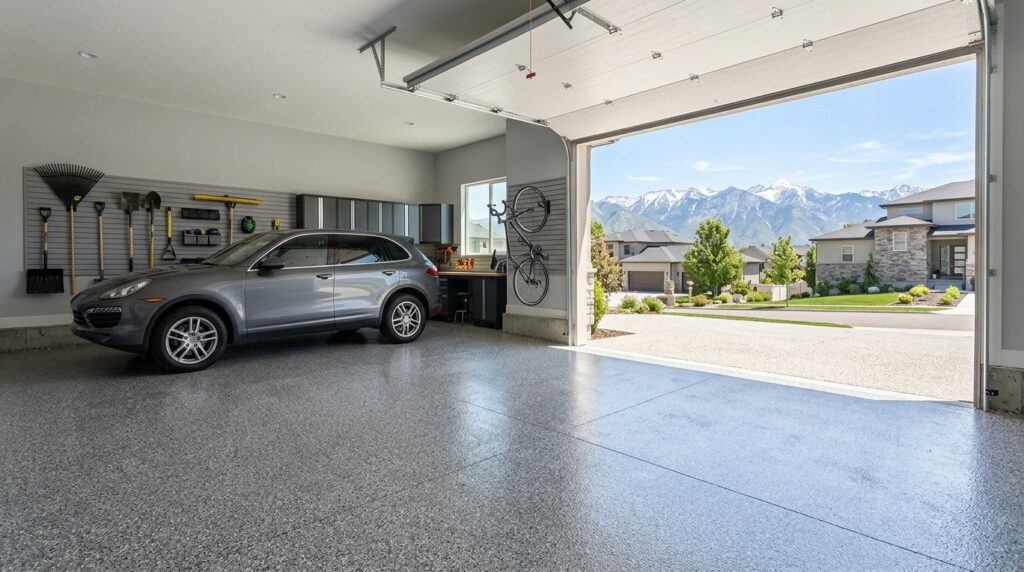
A residential garage floor in northern Utah deals with more than vehicle traffic. Winter road salts and deicing chemicals, snowmelt, abrasive grit, automotive fluids, hot tires, temperature fluctuations, and everyday impacts can all challenge bare concrete and poorly installed finishes. A professionally specified garage floor coating in Salt Lake City can create a more easily cleaned surface while improving appearance and helping protect compatible concrete from some forms of wear and chemical exposure. Long term performance, however, depends heavily on the condition of the slab, moisture, surface preparation, coating chemistry, application conditions, and installation quality, so choosing a coating by color or advertised warranty alone can lead to disappointing results.
What Is Garage Floor Coating in Salt Lake City?
Garage floor coating is a bonded surface system applied to prepared concrete to create a finished wearing surface. Depending on the system, it may include primer, base coat, decorative flakes or other broadcast media, and one or more topcoats.
Epoxy, polyurea, polyaspartic, polyurethane, and hybrid systems are among the terms commonly encountered when comparing garage flooring.
These products do not all perform identically, and even coatings within the same chemical category can have different formulations and specifications.
A successful installation therefore involves matching an actual product system to the slab and service conditions rather than assuming that every epoxy or polyaspartic coating will behave the same way.
Why Coat a Garage Floor in Salt Lake City?
Salt Lake City’s climate creates several practical reasons to consider a concrete coating.
Vehicles can carry snow, water, road salts, and grit into the garage during winter. During warmer months, the floor may experience heat, dust, automotive fluids, rolling loads, and sunlight near open garage doors.
A suitable coating can make routine cleanup easier and limit direct exposure of the concrete surface to certain contaminants.
It can also transform unfinished gray concrete into a visually consistent surface available in many colors and decorative styles.
Is a Garage Floor Coating the Same as Concrete Paint?
No. Although both products create a surface film, professional resinous flooring systems are generally designed differently from conventional floor paint.
A coating system may offer greater thickness, adhesion, chemical resistance, abrasion performance, or structural build than ordinary paint, depending on the formulation.
Does Thicker Always Mean Better?
Not necessarily.
Thickness matters, but proper adhesion, substrate preparation, material chemistry, cure, layer compatibility, and service conditions are equally important.
An improperly prepared thick coating can fail sooner than a correctly specified thinner system.
7 Top Benefits of Garage Floor Coating in Salt Lake City
A properly installed system can provide several useful advantages for Utah homeowners.
1. Added Protection for Concrete
A coating separates the upper concrete surface from direct exposure to many everyday contaminants and sources of abrasion.
This can help limit staining and surface wear within the coating’s rated capabilities.
A coating does not repair serious structural problems by itself. Significant cracking, movement, moisture, or concrete deterioration should be evaluated before coating.
2. Easier Cleaning
Bare concrete is porous and can collect dust, dirt, oils, and other contaminants.
A continuous coated surface is generally easier to sweep, vacuum, and clean because contaminants remain closer to the surface instead of readily entering open concrete pores.
The exact cleaning products used should be compatible with the installed system.
3. Improved Garage Appearance
Coatings can create a finished look that complements vehicles, cabinetry, wall colors, and other garage improvements.
Popular choices include solid colors, decorative vinyl flakes, quartz broadcast systems, and clear or pigmented topcoats.
The appearance should be considered alongside practical characteristics such as texture and slip resistance.
4. Better Resistance to Some Chemicals and Stains
Correctly selected resinous coatings can resist exposure to various automotive fluids, household chemicals, salts, and cleaning products better than untreated concrete.
Chemical resistance is product specific, however.
Fuel, brake fluid, acids, solvents, and other chemicals can affect coatings differently. Ask the installer for chemical resistance data when a particular exposure is expected.
5. Reduced Concrete Dusting
Some unfinished or deteriorating concrete surfaces release fine surface dust.
A coating applied to properly prepared and sufficiently sound concrete can encapsulate the wearing surface and provide a cleaner finish.
If the slab itself is weak or deteriorating, the underlying cause should be addressed rather than simply covered.
6. Customizable Surface Texture
Decorative broadcast materials and other texture components can change both appearance and underfoot characteristics.
This is important in garages because water and snowmelt may create wet areas.
No floor should be described as universally slip proof. Slip resistance depends on texture, contaminants, footwear, cleaning, slope, and whether the surface is wet or dry.
7. Potential Long Term Value
A high quality coating system can provide years of service when applied to a suitable slab and properly maintained.
Whether it represents good financial value depends on installation cost, expected service life, garage use, repair requirements, and homeowner priorities.
Types of Garage Floor Coating in Salt Lake City
The best coating system depends on the concrete, environment, budget, appearance, and desired return to service.
Epoxy Garage Floor Coating
Epoxy is a widely recognized resinous flooring technology.
Properly formulated epoxy systems can provide strong adhesion, good build, attractive appearance, and useful resistance to abrasion and chemicals.
Potential considerations include cure time, sensitivity to substrate conditions during installation, and ultraviolet exposure. Some epoxy products can yellow or change appearance when exposed to sunlight.
Polyurea Garage Floor Coating
Polyurea is a broad class of fast reacting coating chemistry.
Certain formulations are used as base or body coats in garage flooring because they can cure rapidly and provide useful physical properties.
The word polyurea alone does not define exact performance. Product data should be reviewed for adhesion, elongation, cure requirements, and intended application.
Polyaspartic Garage Floor Coating
Polyaspartic coatings are often used as rapid curing floor systems or protective topcoats.
Some formulations provide good UV stability and allow faster return to service than traditional multi day systems.
Rapid curing can also reduce working time, making substrate preparation and professional application particularly important.
Polyurethane Topcoats
Polyurethane or urethane coatings are commonly used as topcoats in certain resinous flooring systems.
Depending on formulation, they can contribute abrasion, chemical, or UV resistance.
A urethane topcoat should be compatible with the underlying system and installed according to manufacturer requirements.
Epoxy vs Polyaspartic Garage Floor Coating
This comparison is frequently oversimplified.
Epoxy Advantages
Epoxy can provide strong adhesion, substantial film build, and a wide range of decorative possibilities.
It has a long history in residential, commercial, and industrial flooring.
Polyaspartic Advantages
Suitable polyaspartic products can cure quickly and provide strong UV resistance, making them attractive for garages receiving significant sunlight.
Rapid cure can also shorten installation schedules.
Which Is Better for Salt Lake City?
Neither chemistry is universally better.
The right selection depends on the specific products, slab condition, moisture, installation temperature, sunlight exposure, required cure time, texture, and budget.
Hybrid systems can also use more than one resin technology to take advantage of different properties.
Ask for Product Data, Not Just Product Names
Two installers may both advertise polyaspartic floors while using substantially different products and application methods.
Request information on the actual coating manufacturer, product system, layer structure, preparation requirements, and written warranty.
Garage Floor Coating and Utah Winter Weather
Northern Utah winters can bring snow and deicing materials into residential garages.
Road Salt and Deicing Chemicals
Vehicles can track dissolved salts and deicers onto the floor, where they may remain after water evaporates.
Regular cleaning helps prevent residue accumulation.
Ask whether the proposed coating has documented resistance to the chemicals expected in your environment.
Snowmelt and Standing Water
Melting snow can create substantial water on garage floors.
The floor should have appropriate drainage and slope because a coating does not correct poor drainage.
Freeze and Thaw Considerations
Exterior and garage slab conditions can be influenced by moisture and temperature cycling.
A coating cannot prevent damage caused by fundamental substrate or drainage problems. Cracks, scaling, and moisture concerns should be evaluated before installation.
Concrete Preparation Before Garage Floor Coating
Surface preparation is one of the most important determinants of coating performance.
A premium resin applied over contaminated or inadequately prepared concrete can delaminate.
Mechanical Surface Preparation
Professional contractors commonly use diamond grinding or shot blasting where appropriate to remove weak surface material, contaminants, and previous coatings while creating a surface profile suitable for adhesion.
The exact preparation method should match the coating manufacturer’s specifications.
Dust Control
Mechanical grinding produces fine concrete dust that should be controlled with suitable industrial extraction equipment and work practices.
Crystalline silica exposure is a serious occupational health concern, so installers should use appropriate dust controls and protective procedures.
Cleaning Contaminated Concrete
Oil, grease, tire treatments, silicone, previous sealers, and other contaminants can interfere with adhesion.
Contamination may penetrate below the visible surface and require specialized preparation.
Acid Etching vs Mechanical Grinding
Acid etching has historically been used for some concrete preparation, but it does not address all surface conditions and can produce variable results.
Many professional resinous flooring installations rely on mechanical profiling because it provides controlled removal and surface preparation.
The coating manufacturer’s requirements should determine the procedure.
Repairing Cracks Before Coating
Concrete cracks are common and can result from shrinkage, settlement, temperature changes, loading, or structural movement.
Can Garage Floor Coating Hide Cracks?
A coating may visually cover appropriately repaired cracks, but it cannot guarantee that active movement will never cause a crack to reappear.
The cause and nature of the crack should be considered before repair.
Control Joints
Control or contraction joints are intentionally created to influence where concrete shrinkage cracking occurs.
Whether they should remain visible or be filled depends on the flooring system, joint behavior, and installer or manufacturer recommendations.
Filling a moving joint can lead to future cracking.
Moisture Testing Before Garage Floor Coating
Moisture from beneath a concrete slab can interfere with coating adhesion and contribute to blistering or delamination.
Why Moisture Matters
Concrete is permeable to water vapor.
Actual risk depends on slab construction, vapor retarder conditions, groundwater, drainage, climate, concrete age, and coating permeability.
Professional Moisture Assessment
Installers may use recognized testing methods to evaluate moisture conditions before selecting a system.
A simple visual inspection does not establish that a slab is dry enough for a particular coating.
What If the Slab Has High Moisture?
Depending on the cause and severity, options may include a moisture mitigation system, a different flooring specification, drainage corrections, or postponing installation.
The appropriate response requires diagnosis rather than merely applying additional topcoat.
Decorative Flake Garage Floors
Decorative flakes are popular in residential garages because they create visual variation and help disguise minor dirt or everyday marks.
Partial vs Full Broadcast
A light broadcast leaves more base coat visible.
A full broadcast applies flakes densely until the wet coating is substantially covered, after which loose material is removed before topcoating.
The final appearance and texture depend on flake size, color blend, coverage, scraping, and topcoat.
Choosing Flake Colors
Neutral gray, black, white, tan, and earth tone blends work with many garage interiors.
Consider cabinetry, walls, lighting, vehicle colors, and how easily dust or road debris will show on the selected floor.
Slip Resistance for Garage Floor Coatings
Smooth glossy floors can become slippery when contaminated with water, oil, snowmelt, or other substances.
Texture Options
Installers can incorporate compatible texture or aggregate into suitable coatings.
The amount and particle type can be adjusted to balance traction, appearance, and ease of cleaning.
More Texture Has Tradeoffs
A heavily textured surface can provide greater grip in some conditions but may be harder to mop or wipe clean.
Select texture based on realistic garage use rather than choosing the roughest available finish automatically.
UV Exposure and Garage Floors
Sunlight enters garages through open doors and windows.
Some resin systems are more resistant to UV related color changes than others.
Why UV Stability Matters
An epoxy surface exposed to sunlight may discolor or amber depending on formulation.
UV stable topcoats can help maintain appearance where the product is designed for such exposure.
For garages with strong western or southern sun exposure, discuss this factor during specification.
Hot Tire Pickup and Coating Performance
Hot tire pickup refers to coating damage or loss of adhesion where vehicle tires repeatedly contact the floor.
Proper product selection, preparation, cure, and installation contribute to resistance.
Allow Full Cure
A coating may feel dry before it has achieved its intended properties.
Do not park vehicles on the new floor until the installer and product manufacturer specify that vehicle traffic is permitted.
Temperature and environmental conditions can affect cure times.
Garage Floor Coating Installation Process
Individual systems differ, but professional installation commonly follows several broad stages.
Slab Inspection
The contractor inspects concrete condition, cracks, joints, contamination, previous coatings, moisture concerns, and site access.
Surface Preparation
The surface is mechanically prepared to create the profile required by the coating system.
Crack and defect repairs are completed as appropriate.
Base Coat Application
The installer mixes and applies the specified base material under suitable environmental conditions.
Accurate mixing ratios and working times are important for multi component coatings.
Decorative Broadcast
Flakes, quartz, or other aggregate may be broadcast into the wet layer.
Loose material is removed or processed before subsequent coats.
Topcoat
One or more compatible topcoats create the final wearing surface.
The floor then needs sufficient cure before foot traffic, storage, or vehicles return.
How Long Does Garage Floor Coating Installation Take?
Installation duration depends on the system and slab.
Some rapid cure systems can progress quickly, while multi coat epoxy systems may require longer intervals between stages.
Repairs, moisture mitigation, low temperatures, or complex preparation can extend the project.
One Day Garage Floor Coatings
Some professionally designed fast cure systems can be installed in a day under appropriate conditions.
One day should not automatically be interpreted as higher or lower quality.
The important questions concern surface preparation, material specifications, cure requirements, and whether environmental conditions support the stated schedule.
Garage Floor Coating Cost in Salt Lake City
Costs vary according to floor area, concrete condition, coating system, preparation, crack repair, moisture mitigation, decorative finish, vertical surfaces, accessibility, and warranty.
Because contractor pricing and material costs change, fixed online price claims can become inaccurate.
Get an Itemized Quote
A useful proposal should clarify:
• Square footage
• Surface preparation method
• Crack and joint treatment
• Coating products and layers
• Decorative broadcast system
• Topcoat
• Moisture related work
• Vertical surfaces where included
• Cure and return to service times
• Warranty terms
Compare Like With Like
The least expensive quote may use fewer coating layers, less preparation, different materials, or limited warranty coverage.
Compare the complete installation specification instead of price per square foot alone.
DIY vs Professional Garage Floor Coating
DIY kits can be suitable for homeowners willing to perform extensive preparation and follow product instructions carefully.
However, coating performance is highly sensitive to substrate conditions and preparation.
DIY Challenges
Potential difficulties include incomplete coating removal, hidden contamination, moisture, improper surface profile, temperature, incorrect mixing, short working times, bubbles, and uneven decorative broadcast.
Fast cure products can be particularly unforgiving.
Advantages of Professional Installation
Professional contractors generally bring concrete preparation equipment, dust extraction, repair materials, application tools, and experience evaluating substrates.
The value depends on contractor quality, so credentials and specifications still need careful review.
Garage Floor Coating Maintenance
Coated floors are relatively easy to maintain, but they are not maintenance free.
Routine Cleaning
Sweep or vacuum abrasive grit regularly.
For deeper cleaning, use a cleaner and method recommended for the specific coating.
Remove automotive chemicals promptly rather than allowing them to remain for extended periods.
Winter Cleaning
During Salt Lake City winters, road salts and deicing residue can accumulate.
Periodic cleaning reduces deposits and makes the garage more pleasant to use.
Protect Against Sharp Loads
Metal equipment, dragged appliances, snowblower edges, jacks, and other hard objects can scratch or gouge coatings.
Use appropriate lifting and protective practices when moving heavy items.
How Long Does Garage Floor Coating Last?
There is no universal lifespan.
Service life depends on coating chemistry, film thickness, concrete preparation, moisture, vehicle traffic, UV exposure, chemical exposure, maintenance, and installation quality.
Warranty vs Expected Lifespan
A long warranty does not necessarily mean every form of damage is covered.
Review exclusions relating to concrete movement, moisture, abuse, scratches, impacts, chemicals, UV exposure, and tire related damage.
Written details matter more than a headline warranty duration.
Choosing a Garage Floor Coating Contractor in Salt Lake City
The installer can be as important as the coating brand.
Ask About Preparation
A contractor should be able to explain how the slab will be mechanically prepared and how cracks, joints, contamination, and moisture will be handled.
Be cautious when preparation is described vaguely.
Verify Contractor Information
Check applicable Utah contractor licensing requirements and verify credentials through official state resources where relevant.
Also ask about liability insurance and workers’ compensation coverage as appropriate.
Request Local References
Examples of completed Salt Lake City area garages can demonstrate how the system performs under similar climatic conditions.
Older installations can provide more useful durability information than photographs taken immediately after application.
Review the Written Warranty
Ask who provides the warranty, what failures are covered, and what conditions are excluded.
Also determine whether the material manufacturer provides separate coverage from the installation contractor.
Best Time for Garage Floor Coating in Salt Lake City
Modern coating technologies allow installation across a range of conditions, but each product has defined temperature and humidity requirements.
Ambient and Concrete Temperature
The concrete slab temperature matters in addition to air temperature.
Installers should follow product requirements regarding application temperature, dew point, humidity, and cure.
Interior Climate Control
Heating a garage may expand installation opportunities during colder weather, but temporary heating needs to be managed safely and should not contaminate the coating environment.
Garage Floor Coating vs Concrete Sealer
A penetrating or film forming concrete sealer is not necessarily equivalent to a high build decorative coating system.
Concrete Sealers
Certain sealers are designed to reduce water or contaminant penetration while largely retaining the appearance of concrete.
Others form thin surface films.
Resinous Coating Systems
Coating systems build a more substantial finished surface and can incorporate decorative layers.
They generally require more extensive preparation and application work.
The best option depends on whether the goal is subtle concrete protection or a fully finished garage floor.
Frequently Asked Questions
What is the best garage floor coating in Salt Lake City?
There is no universal best system. Epoxy, polyurea, polyaspartic, urethane, and hybrid coatings can perform well when matched to the slab and professionally prepared.
How much does garage floor coating in Salt Lake City cost?
Cost depends on square footage, surface condition, preparation, repairs, coating chemistry, decorative finish, and moisture requirements. Current local quotes provide the best estimate.
How long does garage floor coating take to install?
Some fast cure systems may be installed quickly, while multi layer systems can require several days. Concrete repairs, moisture and weather conditions can extend the schedule.
Can garage floor coatings handle Utah winters?
Appropriately specified systems can handle residential garage conditions, but road salts, snowmelt, freeze related substrate issues, and routine cleaning should be considered.
Is epoxy or polyaspartic better for a garage floor?
Both can be suitable. Epoxy can provide strong build and adhesion, while many polyaspartic products offer rapid cure and good UV resistance. Product quality and preparation are critical.
Does a coated garage floor become slippery when wet?
Any surface can become slippery when contaminated or wet. Compatible texture additives and broadcast systems can improve traction, although they may affect cleaning and appearance.
Conclusion
A garage floor coating in Salt Lake City can improve concrete protection, cleanliness, appearance, and day to day usability when the system is matched to Utah conditions and the existing slab. Epoxy, polyurea, polyaspartic, and hybrid floors each have strengths, but thorough mechanical preparation, moisture assessment, repairs, and correct application are central to long term performance. Compare contractors using detailed system specifications and warranty terms rather than price or coating chemistry alone. A carefully prepared and maintained floor is far more likely to handle vehicles, snowmelt, road salts, sunlight, and regular garage use successfully.