
Small creative teams often test software alongside client work. In that setting, one polished output proves little. A useful evaluation needs a defined asset, repeatable...
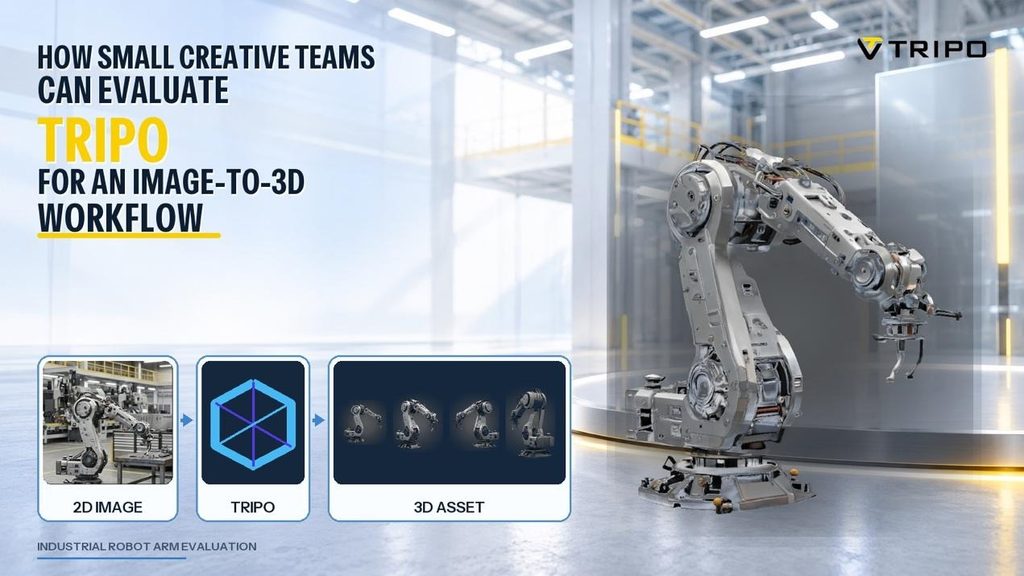
Small creative teams often test software alongside client work. In that setting, one polished output proves little. A useful evaluation needs a defined asset, repeatable review views, and a measure of the cleanup that follows generation.
Consider a three-person studio that creates visuals for automation vendors. For its Tripo pilot, the team uses a photo of an articulated industrial robot arm. The light-gray housings, dark joints, cable loops, bolted base, and end effector provide clear comparison points. The busy factory background and overlapping linkages make it a demanding test. The goal is a static visualization asset, not a working engineering model.
1. Set the buying question before the trial
The question is whether image-based generation can provide a reviewable starting mesh for an industrial robot visual without joint and cable cleanup outweighing the time saved. This keeps the test focused on workflow fit rather than one attractive camera angle.
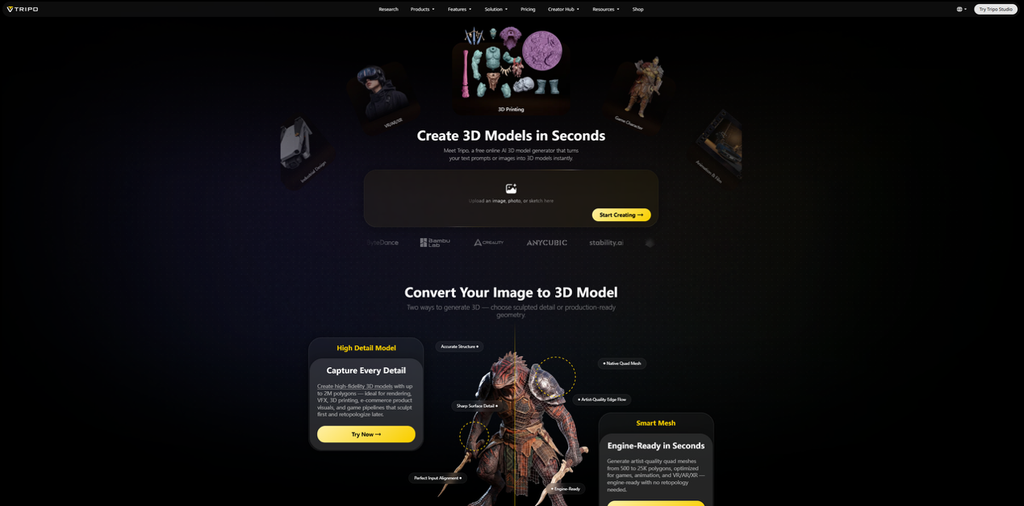
The pilot covers reference preparation, baseline generation, fixed-angle inspection, one retry, and internal handoff. Mechanical design, dimensional accuracy, motion, collision checks, and safety validation remain outside scope. The team also records its normal blockout time for a comparable static asset.
2. Prepare the reference and generate a baseline
The photo contains machinery, railings, a workbench, and floor markings that do not belong to the asset. Before upload, the team isolates the robot on a plain background while retaining the full shape from base to end effector and the cable loops above the shoulder. Small labels and loose parts can be removed, but joint proportions and cable paths stay unchanged. This cleaned reference is locked for the pilot.
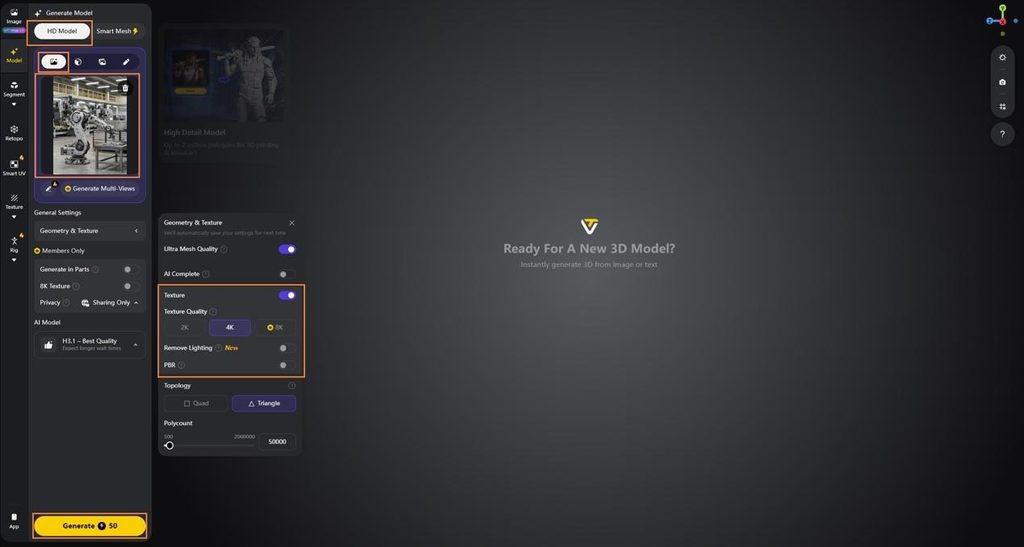
The artist uploads the cleaned robot reference to Tripo’s Image to 3D Model workflow and chooses the generation route that fits the pilot goal. The team records the option used, the number of attempts, review time, and estimated correction time. Recording those details matters more than copying today’s interface into the report; controls and availability may change, while the comparison method should remain reusable.
3. Inspect what the source image does not show
A single three-quarter photo cannot define the rear of the base, the inner faces of the joints, the underside of the wrist, or every cable mount. The team rotates the generated robot through fixed front, side, rear, and three-quarter views, then scores five criteria from one to five. Every score needs a short observation rather than a personal preference.
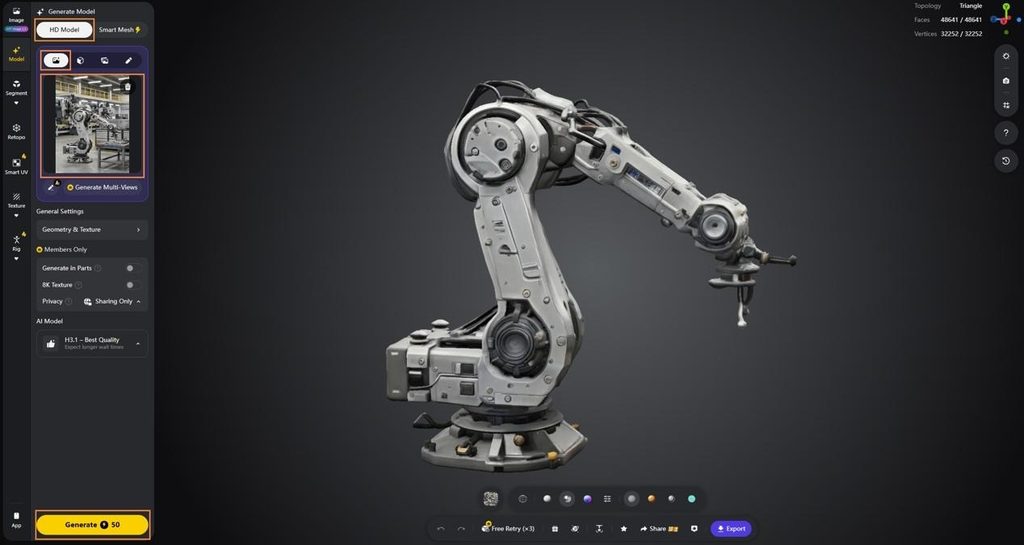
Silhouette fidelity: Does the robot preserve the relationship between the base, shoulder, elbow, wrist, and tool head from every review angle? A strong front view should not conceal an oversized rear housing or a shortened forearm.
Part separation: Are the base, shoulder housing, upper arm, elbow, forearm, wrist, end effector, and main cable loops still readable as separate elements? If two sections merge, the artist records the likely repair rather than simply marking the result wrong.
Hidden-surface plausibility: The reviewer checks the back of the base, the inner elbow, the underside of the wrist, and the rear cable mounts, where the source provides limited evidence. The question is whether Tripo’s interpretation is usable, repairable, or misleading for the intended visual.
Material readability: Before final look development, can a reviewer still distinguish the painted housings, dark joint assemblies, black cables, and exposed fasteners? Clear visual regions make the result easier to assess and art-direct.
Handoff effort: The artist records the time needed to inspect, organize, and prepare the asset for handoff. For this robot, the estimate includes separating moving sections, correcting joint interfaces, and rebuilding cable paths when required. This may matter more than generation time alone.
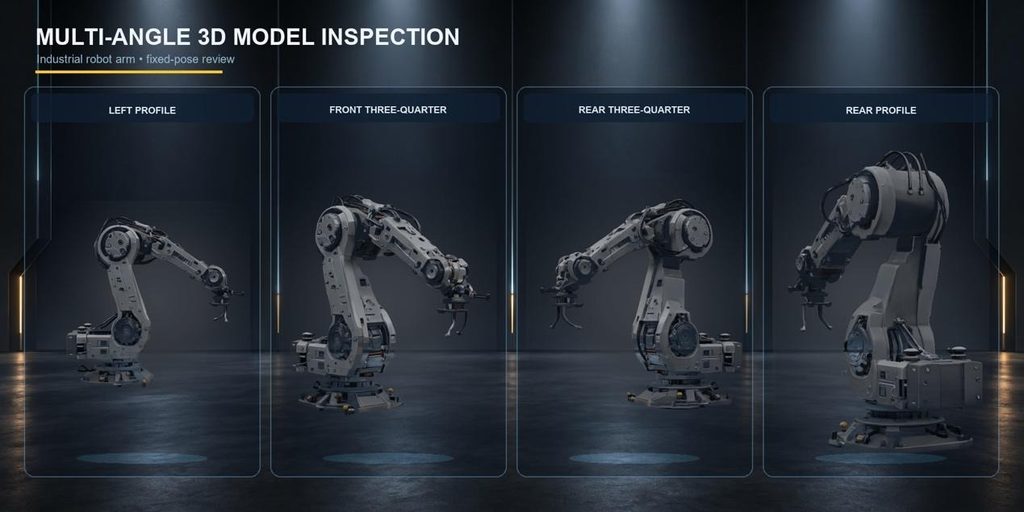
The robot’s landmarks keep the discussion specific. Instead of saying that version B feels better, a reviewer can note that its circular shoulder housing is closer to the photo, its elbow spacing is more believable, or its cable loops need less reconstruction. That language gives the 3D artist something actionable.
The team captures the same angles for every attempt. Generated results can vary, so fixed views are more useful than comparing each versions strongest frame.
4. Measure the handoff, not only the render
A visually appealing robot can still fail the pilot if the next person cannot revise it efficiently. The model may suit a distant factory visual but become expensive to adjust if a joint housing is fused to the arm or a cable has become part of the surface. A less polished result with cleaner part boundaries may be the better starting point.
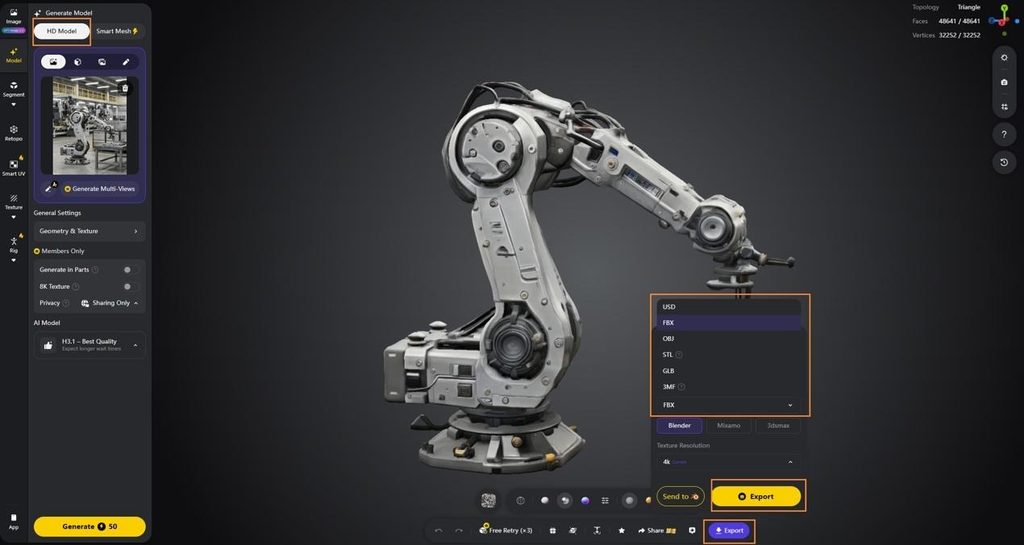
Each role reviews its own risk. The art lead checks shape and presentation. The 3D artist estimates cleanup and revision effort. The project manager checks whether files, notes, and responsibilities are clear. If export is part of the handoff, the artist opens the live export panel and selects a format that the destination tool accepts, then verifies the imported asset before counting the step as complete.
5. Turn the pilot into a software decision
The team should define its pass condition before seeing the result. One studio might require acceptable scores in overall silhouette, joint separation, cable readability, and handoff effort, plus a lower correction estimate than its manual blockout baseline. Another may accept more cleanup if early stakeholder review is the main benefit. The threshold belongs to the workflow, not to a universal product claim.
At the end of the pilot, the studio should be able to say yes, no, or only for a defined asset class, then point to the recorded evidence. For this robot arm, the answer might be that Tripo is useful for reviewable industrial-visualization starts, while joint interfaces, cable routing, the end effector, and hidden surfaces still need manual inspection. That conclusion is more valuable than a gallery of attractive candidates because it tells the team when to use the workflow again.