
Both models run the exact same chip and share the exact same core camera system, so this year, the real decision isn't about raw power...
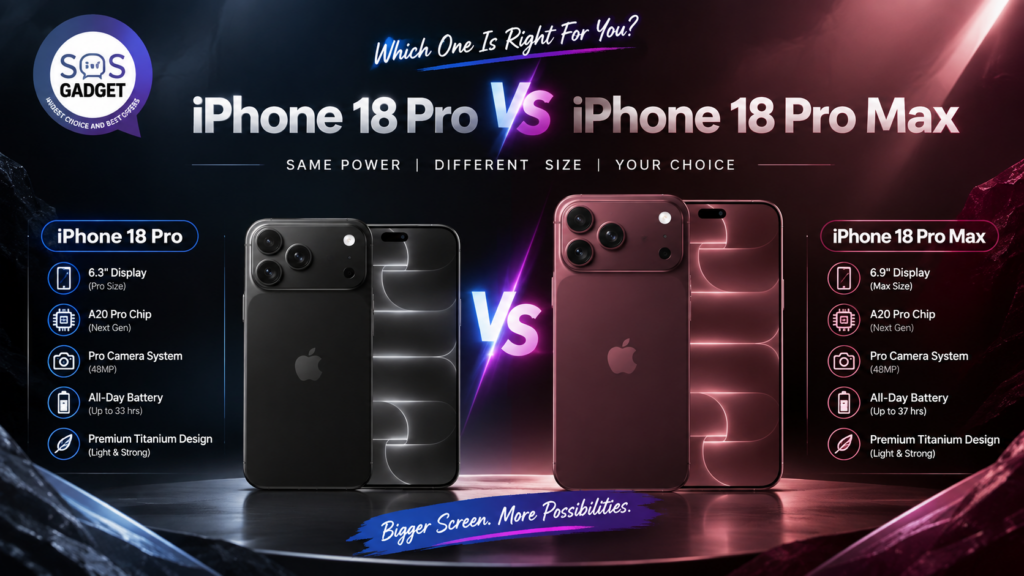
Both models run the exact same chip and share the exact same core camera system, so this year, the real decision isn’t about raw power at all. It comes down to size, battery life, and price.
This guide help every meaningful difference between the two, based on Apple’s official specification sheet, and helps figure out which one actually fits daily life and budget in Bangladesh, rather than which one sounds more premium on paper.
iPhone 18 Pro vs iPhone 18 Pro Max — Quick Comparison Table
| Spec | iPhone 18 Pro | iPhone 18 Pro Max |
| Display | 6.3″ LTPO Super Retina XDR OLED, 120Hz | 6.9″ LTPO Super Retina XDR OLED, 120Hz |
| Chip | Apple A20 Pro (2 nm) | Apple A20 Pro (2 nm)—identical |
| Camera | 48MP Wide, Ultrawide, 4x Telephoto | 48MP Wide, Ultrawide, 4x Telephoto—identical |
| Weight | 211g | 249g |
| Rated Battery (video playback) | Up to 36 hours | Up to 45 hours |
| Global Starting Price (256GB) | $1,199 | $1,299 |
| Expected Price in BD (256GB) | 1,90,000 (expected) | 2,10,000–2,50,000 |
Display & Size Differences
iPhone 18 Pro—6.3-Inch Display, Compact Build
The standard Pro keeps a more pocketable 6.3-inch LTPO Super Retina XDR OLED display, with the same 120Hz ProMotion refresh rate and 3,000-nit peak brightness found on the larger model.
iPhone 18 Pro Max—6.9-Inch Display, Bigger Canvas
The Pro Max steps up to a 6.9-inch panel, the largest screen Apple has ever put on an iPhone, using identical display technology, just more of it.
One-Handed Use vs Immersive Viewing
For everyday use in Bangladesh, standing on a crowded bus checking bKash, scrolling during a commute, or reading in one hand while holding a rickshaw rail with the other—the 6.3-inch Pro is noticeably easier to manage single-handed. The Pro Max, on the other hand, is a clear win for anyone who spends long stretches reading, watching video, or working across split-screen apps, where the extra real estate genuinely changes the experience.
Example: Sadia, who reads news and watches YouTube during her daily commute, finds the Pro Max screen makes a real difference for comfortable viewing—but her friend Nusrat, who mostly uses her phone one-handed while carrying groceries or holding a child, prefers the smaller Pro for exactly that reason.
Performance—Are They Really the Same Inside?
Shared Apple A20 Pro Chip
Apple’s own specification sheet confirms the A20 Pro chip is identical across both models, same 2 nm process, same 6-core CPU, same 7-core GPU, same dual 16-core Neural Engine. There’s no performance gap between the two.
RAM & Storage Options
Both phones ship with identical RAM and the same storage tiers, 256GB, 512GB, 1TB, and 2TB—meaning storage choice comes down to personal needs, not which model is picked.
Why Performance Isn’t the Deciding Factor Here?
Apple’s spec sheet separates the iPhone 18 Pro Max from the standard Pro on essentially four lines: screen size, physical size/weight, battery rating, and price. Everything else, chip, camera hardware, charging speed, connectivity, reads identically on both models. This is a genuinely different situation from past generations, where the Max model often had a real hardware edge.
Camera Comparison
Shared Core Camera System
Both the Pro and Pro Max carry the exact same 48MP Wide, 48MP Ultrawide, and 48MP Telephoto (4x optical zoom) camera system, along with an identical 18MP front camera. This year, Apple unified the camera hardware across both sizes rather than reserving anything for the larger model.
No Camera Feature Is Exclusive to Either Model
Unlike the iPhone 15 series, where the tetraprism zoom lens was Max-exclusive, the iPhone 18 lineup gives both models the same variable aperture main camera, the same Pro controls for manually adjusting aperture and shutter speed, and the same ProRes video recording capability.
Which Matters More for Everyday Photography vs Content Creators?
Since camera quality is identical, the decision here really comes down to handling rather than output. Content creators shooting handheld video for extended periods may prefer the Pro Max simply for its larger vapor chamber cooling and longer battery life during long recording sessions, not because the footage itself looks any different.
Battery Life & Charging
Pro Max’s Battery Advantage
Apple rates the Pro Max for up to 45 hours of video playback, compared to 36 hours on the standard Pro, a real gap driven by the larger body having more room for battery capacity.
Pro’s Trade-off
The smaller Pro trades that extra endurance for a lighter, more compact form factor, a fair trade for anyone who charges daily regardless of remaining battery percentage.
Charging Speed
Charging speed is identical across both models, Apple rates both for up to 50% charge in 15 minutes and roughly 6 hours of video playback from just 5 minutes of charging.
Real-Life Battery Test in a Bangladesh Context
Apple’s own research-based estimates put realistic daily use closer to 24 hours between charges for the Pro and 30 hours for the Pro Max, both well past a single day of heavy use. For Bangladeshi users dealing with unpredictable load-shedding, the Pro Max’s extra buffer offers real peace of mind, since a missed charging window is less likely to leave the phone dead by evening.
Build, Weight & Everyday Comfort
iPhone 18 Pro — Lighter, Easier Grip
At 211 grams, the standard Pro is noticeably lighter, which matters over a full day of handheld use, especially for anyone with smaller hands or wrist fatigue concerns.
iPhone 18 Pro Max—Heavier but More Screen Real Estate
The Pro Max weighs 249 grams, 38 grams more than the standard Pro, a difference that’s immediately noticeable when picking both up side by side, though most users adjust within a few days.
Pocket & Bag Fit
The smaller Pro fits more comfortably in tighter pants pockets, a genuinely practical consideration in Bangladesh’s climate, where lighter, slimmer clothing is common for much of the year. The Pro Max tends to sit better in a bag or a looser pocket, where its larger footprint isn’t as much of an issue.
Price Comparison in Bangladesh
iPhone 18 Pro Price by Storage Variant
Globally, the iPhone 18 Pro starts at $1,199 for 256GB, rising through 512GB, 1TB, and 2TB tiers. In Bangladesh, expect the entry 256GB variant to land somewhere around Tk 1,90,000, though official local pricing should be confirmed with an authorized retailer before ordering.
iPhone 18 Pro Max Price by Storage Variant
The Pro Max starts at $1,299 globally for 256GB. Based on current retailer estimates, Bangladesh pricing for the entry variant is expected to fall between Bdt 2,10,000 and 2,50,000, with higher storage tiers climbing well beyond that. Checking the Latest iPhone Price before ordering is worth doing, since local pricing can shift slightly with import costs.
Price Difference—Is the Extra Cost Worth It?
The global price gap is a consistent $100 across matching storage tiers, which typically translates to a somewhat larger gap in Bangladesh once import costs and VAT are factored in. Given that performance and camera quality are identical, that extra cost is paying specifically for screen size and battery life, nothing else.
Value-for-Money Verdict Based on Storage Tier
For buyers who don’t need maximum storage, the standard Pro at a lower storage tier often delivers better value than stretching for the Pro Max’s entry tier, since neither model offers a performance advantage to justify overspending on size alone.
Resale Value—Which Holds Value Better in Bangladesh?
Pro Max’s Typically Stronger Resale Demand
Across past generations, the Max model has generally held resale value slightly better in Bangladesh’s secondhand market, partly due to stronger brand perception around the “biggest and best” model, regardless of actual spec parity.
When the Standard Pro Makes More Financial Sense Long-Term?
For buyers who prioritize getting the best price-to-usage ratio rather than resale value, the standard Pro’s lower upfront cost combined with identical core performance often makes it the more financially sensible choice, especially for anyone planning to use the phone for its full lifecycle rather than reselling within a year or two.
Who Should Buy the iPhone 18 Pro?
Best For
One-handed users, buyers who prioritize a lighter daily carry, and anyone working with a tighter budget who doesn’t want to compromise on chip or camera performance.
Ideal User Profile
Students managing a phone through long university days, everyday users who mainly use their phone for calls, messaging, and social media, and first-time iPhone buyers who want flagship performance without the largest possible price tag.
Who Should Buy the iPhone 18 Pro Max?
Best For
Content creators recording extended video sessions, photographers who want maximum battery endurance during long shoots, and heavy multitaskers who live in split-screen apps throughout the day.
Ideal User Profile
Working professionals who rely on their phones for extended screen time, power users who dislike charging mid-day, and media consumers who want the largest possible viewing experience for video and reading.
Frequently Asked Questions
Is there a performance difference between iPhone 18 Pro and Pro Max?
No. Both models run the identical Apple A20 Pro chip, with the same CPU, GPU, and Neural Engine configuration, there’s no performance gap between them.
Which has better camera zoom—Pro or Pro Max?
Neither. Both models share the exact same 48MP triple camera system, including identical 4x optical zoom telephoto hardware. This year’s camera system is fully unified across both sizes.
How much price difference is there between the two in Bangladesh?
Globally, the gap is a consistent $100 across matching storage tiers. In Bangladesh, that typically translates into a somewhat larger difference once import costs are factored in, expected to be in the range of Tk 20,000–30,000 depending on the retailer and storage variant.
Which one has better battery life?
The Pro Max, by a meaningful margin, Apple rates it for up to 45 hours of video playback versus 36 hours for the standard Pro, reflecting the larger body’s extra battery capacity.
Is the Pro Max worth the extra cost for an average user?
For an average user who isn’t heavily dependent on all-day battery life or a larger screen for work, the extra cost mainly buys size and endurance rather than any functional upgrade, making the standard Pro the better value pick for most everyday use cases.
Final Verdict
Same brain, different body. With chip, camera, and charging speed identical across both models, this decision genuinely comes down to how the phone gets used day to day, not which one is “better” on a spec sheet. Anyone who wants a lighter, more pocketable phone without giving up flagship performance should go with the standard Pro. Anyone who spends long hours on video, reading, or multitasking, and doesn’t mind the extra weight and cost, will get real, tangible value out of the Pro Max’s bigger screen and longer battery life.