
Few building materials combine geology, function, and visual character as naturally as stone. Formed through geological processes over immense periods of time, natural stone is...
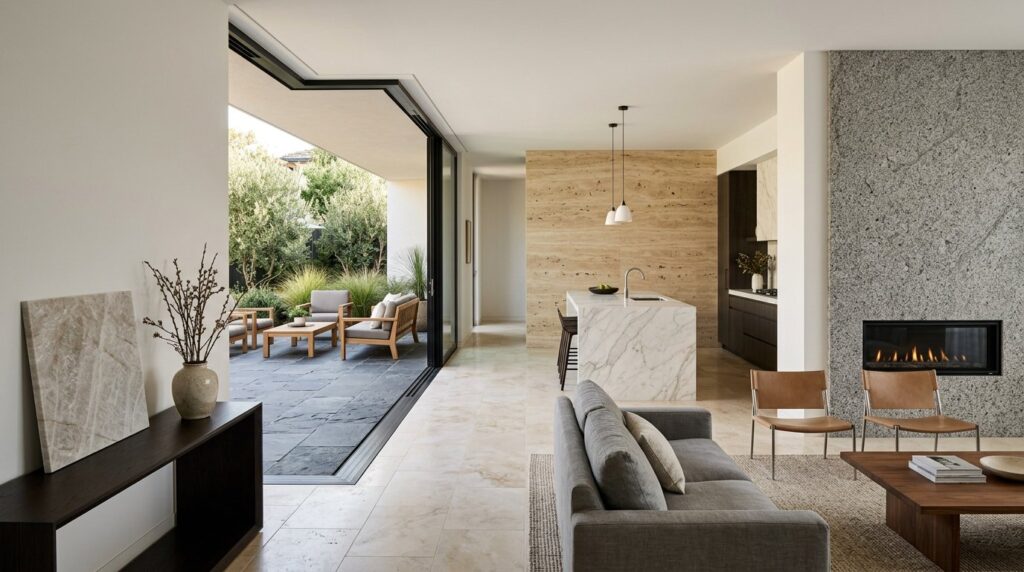
Few building materials combine geology, function, and visual character as naturally as stone. Formed through geological processes over immense periods of time, natural stone is quarried from the earth and processed into slabs, tiles, pavers, blocks, veneers, and architectural components for residential, commercial, and landscape applications. Granite, marble, limestone, travertine, slate, sandstone, and quartzite all belong to this broad material category, yet their properties can differ significantly. Choosing successfully means considering more than appearance because hardness, porosity, mineral composition, finish, environment, installation quality, and maintenance requirements determine how a specific stone performs.
What Is Natural Stone?
Natural stone is geological material extracted from naturally occurring rock formations and prepared for use in construction, architecture, landscaping, monuments, furniture, and decorative applications.
Unlike engineered materials manufactured by combining minerals with resins or other binders, natural stone originates as rock. It may be cut, shaped, polished, honed, textured, or otherwise mechanically processed into usable products.
Three broad geological rock groups provide useful context. Igneous rocks form from cooling molten material, sedimentary rocks develop through processes involving accumulated sediments or chemical and biological deposition, and metamorphic rocks form when existing rocks are transformed by heat, pressure, or related geological processes.
Commercial stone names do not always align perfectly with strict geological classifications. Buyers should therefore consider verified technical properties alongside the trade name.
How Is Natural Stone Produced?
Stone production begins at a quarry suitable for the desired material. Large blocks or pieces are separated from the geological formation using quarrying methods appropriate to the deposit.
Blocks intended for slabs may be transported to processing facilities, where specialized machinery cuts them into thinner sections. The surfaces can then receive polishing, honing, brushing, flaming, sandblasting, or other finishes where appropriate.
Slabs and tiles are subsequently fabricated to the dimensions required for countertops, floors, walls, stairs, facades, fireplaces, and other projects.
Why Does Every Natural Stone Slab Look Different?
Natural geological variation produces differences in color, veining, grain, fossils, mineral distribution, fissures, and pattern.
Even material from the same quarry can vary from one block to another. This variation is one of stone’s defining aesthetic characteristics, but it also makes physical sample selection important for projects where appearance matters.
Small samples may not represent the full pattern of a large slab.
Is Natural Variation a Defect?
Not necessarily. Veins, color shifts, fossils, pores, and mineral features can be normal characteristics of particular stones.
However, structural cracks, fabrication damage, excessive weakness, or defects that fall outside the relevant specification are different issues. A knowledgeable supplier or fabricator can help distinguish expected geological characteristics from potential problems.
9 Stunning Benefits of Natural Stone
Stone remains widely used because it can combine visual appeal with practical performance when the material is properly selected for the environment.
1. Unique Appearance
No two blocks of geological material are perfectly identical. Marble can show dramatic veins, granite often presents complex mineral patterns, and limestone may contain subtle tonal variations or fossils.
This individuality can create surfaces that are difficult to replicate exactly with manufactured materials.
2. Long Service Potential
Appropriate stone can provide a long service life when it is correctly specified, fabricated, installed, and maintained.
Historic stone architecture demonstrates the potential durability of certain materials, although this does not mean every stone is suitable for every environment.
Chemical exposure, freeze thaw cycling, moisture, abrasion, traffic, and structural movement can all affect longevity.
3. Wide Range of Colors and Textures
Natural stone is available in whites, creams, browns, blacks, grays, reds, greens, blues, and numerous mixed tones.
Surface finishing creates further variation. A polished slab can appear dramatically different from the same geological material with a honed or textured finish.
4. Indoor and Outdoor Applications
Suitable stones can be used for kitchens, bathrooms, floors, walls, stairs, fireplaces, patios, pathways, facades, pool surrounds, garden structures, and landscaping.
Outdoor use requires special care because not all stones or finishes tolerate freeze thaw exposure, water, deicing chemicals, or local climate conditions equally well.
5. Multiple Surface Finishes
Fabricators can finish compatible stone in ways that alter its appearance and surface characteristics.
Polishing can emphasize color and reflection, while honing produces a lower sheen. Textured treatments can provide a more tactile surface and may influence slip characteristics.
The correct finish depends on the stone and application.
6. Heat Resistant Mineral Material
Many natural stones tolerate elevated temperatures better than resin based materials, which contributes to their use around certain fireplaces and in kitchen environments.
However, heat tolerance does not mean stone is immune to thermal shock or damage. Extremely hot cookware and rapid temperature changes can potentially cause problems depending on material and installation.
7. Suitable for Custom Fabrication
Stone slabs can be fabricated into countertops, vanity tops, fireplace surrounds, stair components, shelves, tables, and other customized elements.
Professional fabrication allows cutouts, edge profiles, joints, and dimensional requirements to be coordinated with the project’s design.
8. Architectural Character
Stone can work with traditional, contemporary, rustic, minimalist, and luxury design styles.
Its connection to natural geological materials can add visual depth without relying entirely on decorative patterns or applied finishes.
9. Potentially Long Replacement Cycle
When durable stone remains functional and aesthetically appropriate for decades, less frequent replacement may be necessary compared with shorter lived finishes.
This can be relevant when assessing lifetime value and environmental impact, although quarrying, processing, transportation, installation, and maintenance must also be considered.
Popular Types of Natural Stone
Stone categories have substantially different properties. A material that performs exceptionally as an indoor countertop may not be the most appropriate choice for an exterior walkway.
Granite Natural Stone
Granite is an igneous rock commonly composed primarily of quartz, feldspar, and other minerals. In commercial stone markets, the term granite can sometimes encompass geologically related or similarly performing stones.
Granite is widely used for countertops, floors, stairs, monuments, wall applications, and exterior projects where the specific material is suitable.
It is generally known for useful hardness and abrasion resistance, although porosity and other properties vary between individual stones.
Marble Natural Stone
Marble is a metamorphic rock formed primarily from carbonate minerals such as calcite or dolomite.
Its distinctive veining and ability to take a high polish have made it a prominent architectural and sculptural material.
Calcite rich marble reacts with acids. Lemon juice, vinegar, and certain acidic cleaners can etch the surface, producing dull areas even when staining does not occur.
Limestone Natural Stone
Limestone is a sedimentary rock consisting largely of calcium carbonate minerals.
It ranges widely in density, porosity, fossil content, color, and texture. Limestone is commonly used for flooring, walls, facades, fireplaces, landscaping, and architectural detailing.
Like marble, many limestones are acid sensitive.
Travertine Natural Stone
Travertine is a form of limestone associated with mineral deposition from springs and similar environments.
It often contains characteristic pores or voids. Depending on the desired appearance, these openings may be filled during processing or installation or intentionally left visible.
Travertine is frequently used for flooring, walls, patios, and architectural finishes where its properties suit the project.
Slate Natural Stone
Slate is a fine grained metamorphic rock capable of splitting along characteristic planes.
It is used for roofing, flooring, paving, wall cladding, and other applications. Quality and durability vary by source, so slate intended for demanding exterior exposure should be appropriately specified.
Sandstone Natural Stone
Sandstone is a sedimentary rock composed of sand sized mineral or rock particles bonded by natural cementing materials.
Its colors and physical properties vary significantly according to mineral composition and formation.
Suitable sandstone is commonly used in paving, landscaping, walls, facades, and architectural elements.
Quartzite Natural Stone
True quartzite is a metamorphic rock formed from quartz rich sandstone and is dominated by quartz.
It can provide high hardness and attractive natural patterns, making it popular for countertops and architectural surfaces.
Some stones marketed commercially using quartzite terminology may have different mineralogical characteristics. Reliable supplier identification and testing information can therefore be valuable.
Natural Stone vs Engineered Stone
Natural stone and engineered stone are distinct product categories despite sometimes having similar appearances.
Natural stone is quarried rock that is cut and finished. Engineered stone typically combines mineral aggregates, often including quartz, with polymeric binders, pigments, and other ingredients.
Appearance Differences
Natural stone offers geological variation that cannot be exactly controlled from slab to slab.
Engineered products can provide greater consistency of color and pattern, which some design projects prefer.
Neither characteristic is objectively better. Selection depends on the intended aesthetic and performance requirements.
Maintenance Differences
Maintenance cannot be generalized solely by category.
Some natural stones are relatively dense, while others readily absorb liquids without suitable protection. Engineered surfaces can have different sensitivities, including potential damage from high heat or certain chemicals.
Follow care guidance for the exact product rather than generic assumptions.
Natural Stone vs Quartz Countertops
In countertop terminology, quartz often refers to an engineered composite rather than a solid slab of naturally occurring quartz mineral.
Quartzite, by contrast, is a natural metamorphic rock. These similarly named materials should not be confused when comparing countertops.
Natural Stone for Kitchen Countertops
Kitchen countertops require resistance to routine wear, food spills, moisture, cleaning products, and temperature changes.
Granite and quartzite are popular choices because many varieties provide useful hardness and durability. Marble is also used, particularly when its distinctive appearance is a design priority, but acid etching should be expected as a practical consideration.
Is Natural Stone Food Safe?
A countertop’s suitability for food preparation depends on the particular stone, finish, installation, condition, sealers or treatments, cleaning practices, and applicable product requirements.
Use products designed for countertop applications and follow manufacturer and fabricator care instructions.
Food safety should not depend on assuming that all natural materials are automatically hygienic.
Does Natural Stone Stain?
Some stones can absorb liquids and develop stains, particularly when porous and unprotected.
The likelihood depends on pore structure, liquid type, contact time, finish, treatment, and maintenance.
A penetrating sealer may reduce absorption in suitable stones, but sealing does not make a surface completely stain proof.
Natural Stone Flooring
Stone flooring can provide visual continuity and long term performance in suitable residential and commercial environments.
The correct stone and finish should be chosen based on traffic, abrasion, moisture, slip considerations, cleaning requirements, and substrate conditions.
Choosing Stone for High Traffic Floors
High traffic spaces generally benefit from materials with appropriate abrasion resistance and surface durability.
Stone test data can provide useful guidance for commercial projects. Architects and specifiers may evaluate characteristics such as abrasion resistance, water absorption, flexural strength, and other relevant properties.
Natural Stone in Bathrooms
Many stones can be used successfully in bathrooms with appropriate design, installation, waterproofing, finishing, and maintenance.
Wet floors deserve particular attention to slip resistance. A highly polished surface may not be ideal for every wet application.
Natural Stone for Shower Areas
Shower installations need a correctly designed water management system beneath the finished surface. Stone and grout alone should not be treated as the complete waterproofing system.
Some stones can also be sensitive to moisture, cleaning chemicals, or discoloration, so compatibility should be confirmed before installation.
Natural Stone for Outdoor Spaces
Stone is widely used for patios, pathways, terraces, pool areas, steps, garden walls, and facades.
Exterior applications expose material to weather, moisture, temperature fluctuations, biological growth, salts, and pollutants.
Freeze Thaw Conditions
Water can enter pore spaces and contribute to damage when repeated freezing and thawing occur in susceptible materials.
In cold climates, select stone with demonstrated suitability for the intended exterior exposure rather than assuming all products sold as outdoor stone perform equally.
Pool Surrounds
Pool areas require consideration of slip resistance, thermal comfort, water exposure, pool chemicals, salts, and cleaning.
Some stones may become hot in direct sunlight or change appearance when wet. Samples can help evaluate practical performance before a large installation.
Natural Stone Finishes Explained
Finishing affects appearance, tactile qualities, maintenance, and sometimes slip characteristics.
Polished Finish
Polishing produces a smooth, reflective surface that can intensify color and reveal mineral detail.
It is popular for countertops and certain interior floors and walls. Suitability for wet walking areas should be evaluated carefully.
Honed Finish
Honed stone has a smooth surface with less reflection than polished material.
It creates a softer visual effect and is widely used for floors, countertops, walls, and architectural features.
Brushed Finish
Brushing creates a textured, tactile surface.
The resulting appearance depends on the stone and finishing process and can work well in designs seeking an aged or less formal character.
Flamed and Textured Finishes
Certain stones can receive thermal or mechanical treatments that produce rougher surfaces.
These finishes are often considered for exterior paving and other applications requiring texture. Not every finishing method is suitable for every stone.
Does Natural Stone Need Sealing?
Some natural stone benefits from penetrating sealer, especially when absorption and staining are concerns.
Whether sealing is necessary depends on the specific material, porosity, finish, location, and expected exposure.
What Does Stone Sealer Do?
A suitable penetrating sealer can reduce the rate at which certain liquids enter the stone.
It generally does not create an indestructible barrier. Sealing also does not prevent acid etching of calcite based materials such as marble and many limestones.
How Often Should Natural Stone Be Sealed?
There is no universal annual schedule.
Sealer durability depends on the product, stone, traffic, cleaners, exposure, and installation. Follow the sealer manufacturer’s and stone supplier’s guidance and assess performance rather than resealing automatically according to an arbitrary date.
How to Clean Natural Stone
Correct cleaning can preserve stone appearance and avoid unnecessary chemical damage.
Use a cleaner specifically compatible with the exact stone and follow its directions. Remove spills reasonably promptly, particularly on absorbent or acid sensitive surfaces.
Avoid Incompatible Acidic Cleaners
Vinegar, lemon based products, and some bathroom cleaners can etch calcium carbonate stones such as marble, limestone, and travertine.
The resulting dull mark is chemical surface damage rather than ordinary dirt and cannot simply be cleaned away.
Avoid Aggressive Abrasives
Abrasive pads or powders can alter some finishes and scratch susceptible surfaces.
Use cleaning equipment recommended for the stone and finish. If uncertain, test products in an inconspicuous location.
Can You Use Bleach on Natural Stone?
Compatibility depends on the stone, concentration, surrounding materials, and product recommendations.
Do not assume household bleach is appropriate for every natural stone surface. Consult stone care guidance before using strong chemicals.
Common Natural Stone Problems
Stone is durable, but it is not maintenance free or damage proof.
Etching
Etching is particularly associated with acid sensitive carbonate stones. An acidic substance reacts with calcite and changes the surface finish.
A sealer designed to reduce staining generally does not stop this chemical reaction.
Staining
Stains occur when substances penetrate or interact with stone.
Oil, organic material, metals, dyes, and other substances can produce different types of staining and may require different professional removal methods.
Cracks and Chips
Heavy impact, unsupported sections, structural movement, fabrication issues, or installation problems can contribute to cracking and chipping.
Natural fissures and structural cracks are not necessarily the same thing, so professional inspection may be useful when a defect appears.
Efflorescence and Moisture Issues
Moisture moving through masonry systems can transport soluble salts that later crystallize on surfaces.
Persistent moisture should be investigated at its source rather than addressed solely through surface cleaning.
How to Choose Natural Stone
Appearance should be considered alongside technical suitability.
Match Stone to the Application
Ask where the material will be installed and what stresses it will face.
Kitchen counters, shower floors, exterior paving, fireplace surrounds, commercial lobbies, and decorative walls have very different performance requirements.
Inspect the Actual Slab
For prominent applications such as countertops, viewing the actual slabs can help buyers understand color, movement, veins, fissures, and pattern distribution.
This is particularly important for highly variable marble, granite, and quartzite products.
Request Technical Information
For demanding projects, ask the supplier for applicable test data concerning properties such as absorption, strength, abrasion, density, or freeze thaw suitability.
Professional specifications should use relevant standards and project requirements.
Work With an Experienced Fabricator
Stone fabrication requires accurate measurements, appropriate cutting equipment, edge finishing, cutout planning, transportation, and installation skills.
An experienced fabricator can also identify areas where additional support or design modifications may be necessary.
Natural Stone Cost and Value
Natural stone pricing varies widely. Material rarity, quarry location, grade, slab dimensions, thickness, finish, transportation, fabrication complexity, waste, installation, and local labor costs all influence the finished price.
Comparing slab prices alone can therefore be misleading.
What Affects Installation Cost?
Large slabs, complex edges, multiple sink or appliance cutouts, difficult access, wall preparation, substrate corrections, stairs, pattern matching, and specialized reinforcement can increase project cost.
Obtain an itemized quotation that clearly states what is included.
Is Expensive Stone Always Better?
No. Higher price can reflect rarity, transportation costs, appearance, market demand, or fabrication difficulty rather than superior performance.
A modestly priced stone properly matched to its environment may perform better than an expensive material selected primarily for appearance.
Is Natural Stone Sustainable?
Natural stone has environmental advantages and impacts that should both be considered.
It is a naturally occurring mineral material that can offer a long service life and may sometimes be reused. It does not require polymer binders to become stone.
At the same time, quarrying alters landscapes, and cutting, processing, transportation, installation, and finishing all require resources and energy.
Local Sourcing
Using suitable stone quarried and processed closer to a project can reduce transportation distances in some circumstances.
However, transportation is only one part of environmental impact, so sustainability assessments should consider the complete product and project lifecycle.
Durability and Reuse
Long lasting materials can reduce the need for frequent replacement.
Certain stone components can also be reclaimed and reused when their dimensions, condition, and contamination status make reuse practical.
Natural Stone Installation Considerations
Stone installation is a system involving the material, substrate, setting materials, joints, movement accommodation, moisture management, and workmanship.
Large format stone and exterior applications can have particularly demanding installation requirements.
Substrate Preparation
The substrate should be appropriate for the stone installation and meet relevant requirements for flatness, stability, cleanliness, and load support.
Natural stone can crack when underlying structural movement exceeds what the installation system can accommodate.
Select Compatible Installation Materials
Mortars, adhesives, grouts, membranes, sealers, and cleaning chemicals need to be compatible with the selected stone.
Some light colored or moisture sensitive stones can require specialized installation methods to reduce discoloration or other problems.
Frequently Asked Questions
What is natural stone?
Natural stone is quarried geological material that is cut and finished for applications such as countertops, floors, walls, paving, facades, landscaping, and architectural features.
Which natural stone is best for countertops?
Granite and true quartzite are popular durable options, while marble is valued for appearance but is more vulnerable to acid etching. Suitability varies by individual stone.
Does natural stone need to be sealed?
Some stones benefit from sealing to reduce liquid absorption and staining, while others may require it less frequently. Follow recommendations for the specific material.
Is natural stone suitable for outdoor use?
Many stones are suitable outdoors, but climate, water absorption, freeze thaw exposure, finish, salts, and installation must be considered before selection.
What is the difference between natural stone and engineered stone?
Natural stone is quarried rock, while engineered stone is manufactured using mineral particles combined with binders and other ingredients.
How should natural stone be cleaned?
Use cleaning products compatible with the specific stone and finish. Avoid unapproved acidic or abrasive cleaners, particularly on marble, limestone, and travertine.
Conclusion
Natural stone provides distinctive color, texture, geological variation, and potential long term performance for countertops, floors, walls, facades, and outdoor spaces. Granite, marble, limestone, travertine, slate, sandstone, and quartzite have different properties, so no single stone is ideal for every application. Successful projects depend on matching the material and finish to environmental conditions, maintaining it with compatible products, and using appropriate fabrication and installation methods. Careful selection can preserve both the practical performance and unique visual character that make natural stone an enduring architectural material.