
Selecting suitable Treatment chairs is an important decision for medical spas, aesthetic clinics, salons, dermatology practices, wellness centers, and outpatient facilities. The chair influences client...
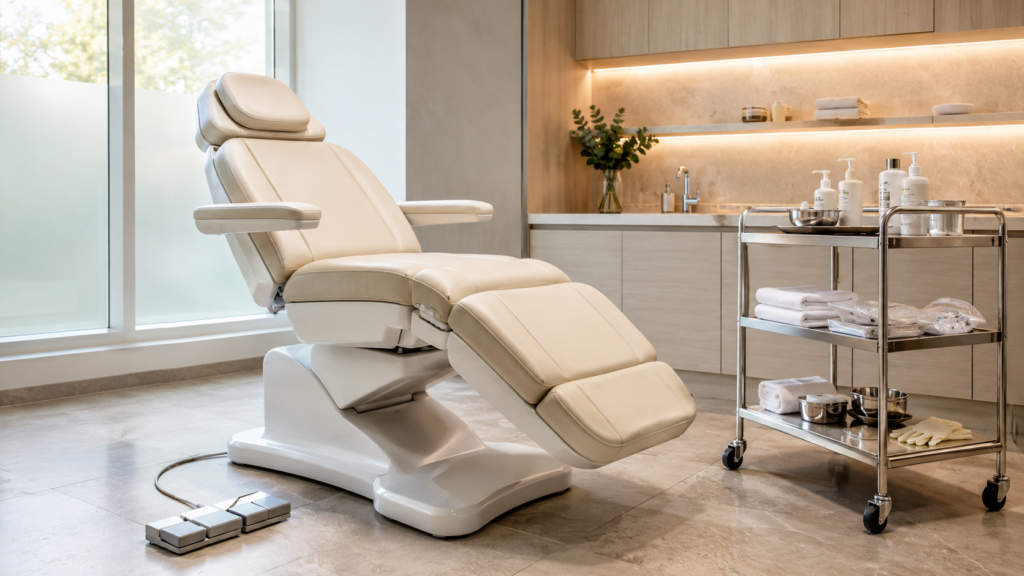
Selecting suitable Treatment chairs is an important decision for medical spas, aesthetic clinics, salons, dermatology practices, wellness centers, and outpatient facilities. The chair influences client comfort, practitioner posture, treatment efficiency, room organization, and the overall impression created by the business. Therefore, choosing one based only on appearance or price can result in poor ergonomics, difficult cleaning, limited positioning, and unnecessary replacement costs.
Professional treatment environments require furniture that can support repeated appointments while remaining stable, comfortable, and easy to maintain. However, the appropriate chair for facial treatments may not provide the positioning required for injectables, laser procedures, body treatments, or clinical examinations. Owners must evaluate their service menu, room dimensions, client needs, staff workflow, and cleaning procedures before purchasing.
This guide explains the main types of treatment chairs, their adjustment systems, practical features, upholstery options, safety considerations, and maintenance requirements. It also provides a structured process for comparing models without relying on unsupported marketing claims.
What Are Treatment Chairs?
Treatment chairs are adjustable pieces of professional furniture designed to position clients or patients during aesthetic, wellness, beauty, and selected outpatient procedures. Depending on their construction, they may function as upright chairs, reclined procedure seats, or nearly flat treatment beds.
These chairs are commonly found in:
- Medical spas
- Aesthetic clinics
- Facial treatment rooms
- Dermatology practices
- Laser treatment centers
- Wellness facilities
- Cosmetic consultation rooms
- Waxing and lash studios
- Tattoo and permanent makeup studios
- Selected outpatient clinics
Professional models generally provide more positioning flexibility than ordinary salon seating. They may include an adjustable backrest, leg section, headrest, armrests, height mechanism, rotating base, facial opening, foot controls, or programmable positions.
The term “treatment chair” covers several equipment categories. A buyer may encounter products described as medical spa chairs, procedure chairs, facial beds, esthetician chairs, electric spa beds, hydraulic facial chairs, or exam chairs. Although these terms can overlap, each model should be assessed according to its actual specifications rather than its marketing name.
Why the Right Treatment Chair Matters
A treatment chair is used throughout the working day, so small design limitations can create repeated inconvenience. If a chair cannot reach an appropriate height, practitioners may bend, stretch, or twist during every appointment. Over time, poor working positions can contribute to fatigue and discomfort.
Client experience is equally important. A person may remain seated or reclined for an extended period during a facial, injectable consultation, laser session, or cosmetic procedure. Insufficient cushioning, an awkward head position, unstable arm support, or an uncomfortable leg angle can affect the perceived quality of the service.
The right chair can support:
- More comfortable client positioning
- Better access to treatment areas
- Improved practitioner posture
- Faster transitions between services
- Easier cleaning between appointments
- More efficient use of room space
- A professional interior appearance
- Consistent treatment workflows
However, no chair is automatically suitable for every clinical or cosmetic procedure. The facility remains responsible for confirming that its furniture meets applicable licensing, accessibility, sanitation, and safety requirements.
Main Types of Treatment Chairs
Understanding the available categories helps buyers create a more focused shortlist.
Electric Treatment Chairs
Electric treatment chairs use powered motors to control one or more chair movements. Depending on the model, these movements may include height, backrest angle, leg-rest position, and full-chair tilt.
Controls may be operated through a handheld remote, buttons mounted on the chair, or foot pedals. Foot operation can be particularly useful when a practitioner needs to reposition a client without repeatedly reaching for a hand control.
Electric models are often selected for busy medical spas and aesthetic clinics because they allow controlled positioning with less physical effort. They may also include memory settings, reset functions, rotating bases, and independent adjustment sections.
Their advantages can include:
- Smooth powered adjustments
- Precise positioning
- Reduced manual handling
- Convenient height changes
- Support for multiple treatment types
- Optional hands-free controls
Potential disadvantages include a higher purchase price, dependence on an electrical supply, greater chair weight, and additional components that may eventually require maintenance.
Hydraulic Treatment Chairs
Hydraulic chairs use a pump mechanism to adjust the working height. Other sections, such as the backrest and leg rest, may be adjusted manually.
These chairs are often more affordable than fully electric alternatives. They can be appropriate for facials, waxing, lash services, eyebrow treatments, and other appointments that do not require frequent position changes.
Hydraulic models may also suit small studios because they often have simpler bases and fewer electrical components. Nevertheless, practitioners should confirm that manual adjustments can be made safely and conveniently while the chair is occupied.
Manual Facial Chairs
Manual facial chairs usually rely on mechanical levers or physical adjustment. They are commonly used in entry-level beauty rooms, training facilities, or businesses with a limited service menu.
Their simple construction may reduce the initial cost. However, repeated manual adjustments can interrupt workflow, especially when one room handles several appointment types.
A manual model should still provide a stable frame, secure locking positions, appropriate cushioning, and an upholstery surface suitable for professional cleaning.
Medical Procedure and Exam Chairs
Procedure and exam chairs are designed for environments that require controlled positioning, stable construction, and dependable access to the patient. They may offer a wider seat, higher weight capacity, low entry position, locking rotation, powered tilt, or accessory mounting points.
Not every chair marketed for a spa is appropriate for clinical use. Medical facilities should assess the manufacturer’s intended use, technical documentation, load rating, cleaning guidance, electrical information, and compatibility with required procedures.
Treatment Beds and Multi-Purpose Chairs
Some models can move from an upright seated position to a nearly horizontal bed configuration. These designs may support facials, massage-related services, body treatments, consultations, and selected aesthetic procedures.
A multi-purpose chair can improve room flexibility, but versatility should not replace suitability. A model that performs several functions reasonably well may still lack a specialist feature needed for a particular service.
Electric Versus Hydraulic Adjustment
Choosing between electric and hydraulic treatment chairs is one of the most important purchasing decisions.
An electric chair is usually preferable when practitioners reposition clients frequently. Powered movement can save time during back-to-back appointments and make small adjustments easier. It may also allow practitioners of different heights to establish a more comfortable working position.
A hydraulic chair may be sufficient when the client remains in one position for most of the service. It can provide dependable height adjustment without the expense of several motors.
The comparison should consider:
- Number of daily appointments
- Frequency of chair adjustments
- Type and duration of procedures
- Need for hands-free controls
- Available electrical outlets
- Room layout
- Maintenance capacity
- Purchase budget
- Expected service life
A lower-priced chair is not necessarily less valuable, and a motorized model is not automatically better. The best option is the one that supports the actual daily workflow without adding unnecessary complexity.
Understanding Motor Configurations
Motor count is commonly used to describe electric treatment chairs. However, buyers should confirm which movement each motor controls because configurations may differ.
Two-Motor Chairs
A two-motor model may control height and backrest angle. The leg section or tilt may require manual adjustment. This configuration can support basic facial and beauty services where extensive positioning is unnecessary.
Three-Motor Chairs
Three-motor chairs commonly provide powered adjustment of height, backrest, and leg rest. This arrangement offers greater flexibility for aesthetic services and can help practitioners change the client’s position without manual lifting.
Four-Motor Chairs
Four-motor treatment chairs often add independent tilt to the height, backrest, and leg-rest functions. Tilt can help create a wider range of working angles, although the exact motion and available positions depend on the model.
Four motors may be useful in medical spas, procedure rooms, and high-volume clinics. Still, buyers should not rely on motor count alone. Adjustment range, movement speed, noise, stability, control placement, and warranty coverage are equally important.
Essential Features to Compare
Product photographs rarely reveal everything that matters in daily use. A thorough comparison should focus on measurable specifications and practical details.
Height Range
The chair should lower enough for safe client entry and rise high enough for comfortable practitioner access. A broad adjustment range is particularly useful when several staff members use the same room.
A low starting height may make transfers easier for some clients, but facilities should verify applicable accessibility requirements rather than assuming a specific measurement is compliant.
Backrest and Leg-Rest Adjustment
An adjustable backrest supports upright consultations, semi-reclined treatments, and flatter working positions. Meanwhile, an independent leg rest can improve comfort and help adapt the chair to different procedures.
Check whether these sections are powered or manual and whether they can be adjusted while the chair is occupied.
Tilt and Positioning
Full-chair tilt changes the angle of the entire seating surface. Some models include a head-down position commonly called Trendelenburg positioning. Buyers should confirm the degree of tilt, intended use, and control method.
A positioning feature should only be used when appropriate for the procedure and consistent with professional protocols.
Rotation
Rotating treatment chairs can help practitioners reach different sides of the client without moving equipment or walking around a crowded room. However, the rotation mechanism should lock securely when movement is not required.
Buyers should check the rotation range and the amount of surrounding clearance needed. A chair that rotates widely may require more floor space than its static dimensions suggest.
Weight Capacity
Every professional chair should have a clearly published load rating. The stated capacity should be supplied by the manufacturer, not estimated from the chair’s appearance.
Choose a model that can safely support the facility’s expected client population. A higher capacity may also require a wider seat and reinforced frame, so all three specifications should be reviewed together.
Headrest Design
Adjustable or extendable headrests can accommodate clients of different heights. Some chairs include a facial opening for prone services, while others use a removable cushion.
The headrest should remain stable during treatment. Practitioners should also evaluate whether its shape permits accurate positioning for facial, scalp, neck, or aesthetic work.
Armrests
Armrests may be fixed, removable, reversible, or able to move with the backrest. Removable designs can improve side access, while synchronized armrests may provide better support during recline.
However, armrests should not shift unexpectedly when a client enters, exits, or changes position.
Controls
Control placement affects workflow. Hand remotes are convenient but must be stored where they will not fall or interfere with equipment. Integrated buttons reduce loose accessories, while foot pedals support hands-free adjustment.
Controls should be easy to identify without being exposed to accidental activation. Memory presets and one-touch reset functions may be valuable in high-volume rooms.
Comfort and Ergonomics
Comfort is not determined by cushioning thickness alone. A very soft chair may feel pleasant initially but provide inadequate support during longer appointments. In contrast, overly firm padding can create pressure points.
Evaluate:
- Seat width
- Cushion density
- Back and lumbar support
- Head and neck positioning
- Arm placement
- Leg support
- Seam location
- Upholstery temperature
- Stability during movement
Practitioner ergonomics also deserve close attention. The chair should let staff work with relaxed shoulders, a neutral wrist position, and limited forward bending. Its base should not prevent a stool from moving close enough to the client.
A chair should be tested in the positions used most often. If an in-person demonstration is unavailable, review the complete measurements and compare them with the practitioner’s stool height, equipment trolley, and expected working distance.
Upholstery and Infection-Control Considerations
Treatment chairs are cleaned repeatedly, so upholstery must tolerate the facility’s approved cleaning routine. Common materials include polyurethane upholstery, medical-grade vinyl, and synthetic leather.
A suitable surface should be:
- Non-absorbent
- Smooth enough to wipe
- Resistant to cracking
- Appropriately durable
- Compatible with approved cleaning products
- Free from unnecessary gaps that trap residue
Buyers should obtain the manufacturer’s care instructions before using disinfectants. A cleaning chemical can damage or discolor upholstery even when it is suitable for another surface.
Stitching, seams, facial openings, control buttons, armrest joints, and moving sections require careful attention because debris can collect in these areas. Removable protective covers or disposable barriers may support the cleaning process, but they do not replace required surface disinfection.
Facilities should follow the infection-control rules relevant to their services and location. A product described as easy to clean is not automatically certified for every medical environment.
Matching Treatment Chairs to Services
Different services create different positioning and equipment needs.
Medical Spas and Injectable Treatments
Medical spa treatment chairs often require powered height adjustment, stable back support, accessible armrests, controlled tilt, and easy practitioner access from several angles.
Foot controls can reduce the need to touch a handheld remote during a procedure. However, the chair’s features must be assessed alongside the practice’s clinical protocols.
Facial and Skincare Services
Facial chairs should support comfortable recline, accurate head positioning, and access to the face, neck, and shoulders. A facial opening may increase versatility when the model is also used for selected body services.
For lower-volume studios, a hydraulic model may provide sufficient adjustment. High-volume facilities may prefer electric controls to simplify transitions.
Laser and Light-Based Services
Laser treatment rooms may benefit from adjustable height, removable armrests, a stable base, and upholstery that can be cleaned efficiently. Buyers should also consider where the laser system, cooling equipment, protective accessories, and practitioner stool will be positioned.
Waxing and Body Treatments
These services may require a flatter configuration, strong leg support, and access from both sides. Check that the chair’s joints do not create uncomfortable gaps when it is placed in a bed-like position.
Dermatology and Outpatient Procedures
Clinical settings may require specific load ratings, low-entry positions, accessory compatibility, electrical standards, and sanitation features. The practice should confirm that the chair is appropriate for the intended procedure rather than relying solely on its appearance.
Measuring the Treatment Room
A chair that fits the floor plan while upright may become too large when fully reclined or rotated. Measure the usable room before ordering.
Record:
- Overall room length and width
- Doorway width
- Corridor width
- Elevator dimensions
- Chair dimensions when upright
- Chair dimensions when fully extended
- Base footprint
- Rotation clearance
- Distance from walls
- Space for practitioner movement
- Location of outlets
- Space for carts, stools, and devices
Also consider delivery access. Large treatment chairs may arrive assembled or in substantial packaging. Confirm whether the equipment can pass through the entrance, hallways, stairwells, and treatment-room door.
A scale drawing can reveal conflicts before purchase. Mark the chair’s maximum footprint and then add the working area needed by the practitioner.
Durability, Maintenance, and Warranty
Professional furniture should be evaluated as a long-term operational investment. A chair used for several appointments each day experiences repeated movement, cleaning, loading, and contact with equipment.
Before purchasing, ask about:
- Frame materials
- Base construction
- Motor specifications
- Hydraulic components
- Replacement controls
- Upholstery availability
- Service requirements
- Spare-part availability
- Warranty duration
- Warranty exclusions
- Labor coverage
- Shipping costs for replacement parts
A warranty may cover the frame differently from motors, electronics, upholstery, or accessories. Buyers should read the actual terms instead of assuming the entire chair has identical coverage.
Routine inspections can help identify loose hardware, damaged cables, unusual motor sounds, hydraulic leakage, worn upholstery, or unstable armrests. Stop using equipment that shows a possible safety problem until it has been assessed.
Budgeting for Treatment Chairs
The initial purchase price is only one part of the budget. Additional costs may include shipping, lift-gate service, inside delivery, assembly, installation, protective covers, accessories, replacement parts, and future repairs.
Businesses should consider the total cost of ownership:
- Purchase price
- Delivery and setup
- Expected daily usage
- Maintenance
- Cleaning materials
- Energy consumption
- Replacement components
- Warranty support
- Anticipated service life
A basic chair may be cost-effective for a low-volume room with simple services. Conversely, a busier practice may benefit from faster powered adjustments, memory controls, and a durable frame because these features support repeated daily use.
Avoid purchasing more functionality than the service menu requires. At the same time, selecting a model with no room for growth may lead to another equipment purchase when new treatments are introduced.
Common Purchasing Mistakes
Choosing by Appearance Alone
A chair can complement the interior while still offering poor access, limited adjustment, or unsuitable upholstery. Design should be considered after essential operational requirements have been confirmed.
Ignoring Maximum Dimensions
Always examine the chair in its fully reclined, extended, and rotated positions. Static product dimensions may not represent its actual working footprint.
Assuming Every Chair Is Medical Grade
Terms such as professional, clinical, or medical-style do not automatically confirm compliance with a facility’s requirements. Request documentation and verify suitability for the intended use.
Overlooking Staff Ergonomics
A comfortable client chair can still create poor working posture for practitioners. Evaluate both sides of the treatment experience.
Failing to Check Cleaning Compatibility
Using the wrong chemical can damage upholstery and potentially affect warranty coverage. Obtain approved cleaning instructions from the supplier or manufacturer.
Forgetting Delivery Access
Heavy equipment can be difficult to move through narrow doors, stairs, and corridors. Measure the complete delivery route before placing the order.
Selecting an Unclear Weight Capacity
Do not estimate capacity based on size or construction. Use a published manufacturer rating and follow all usage instructions.
A Practical Buying Checklist
Before selecting treatment chairs, confirm the following:
- The chair is suitable for the intended services.
- Its adjustment system matches the daily workflow.
- The height range supports practitioners and clients.
- The published weight capacity is appropriate.
- The seat width provides suitable support.
- The chair fits when fully extended and rotated.
- The delivery route can accommodate the packaged equipment.
- Upholstery is compatible with the required cleaning products.
- Controls are accessible and protected from accidental use.
- The base remains stable in working positions.
- Armrests and headrests adjust as needed.
- Electrical requirements match the facility.
- Replacement parts are available.
- Warranty terms are clearly documented.
- Delivery, assembly, and installation costs are understood.
- Applicable safety and accessibility requirements have been checked.
This structured comparison makes it easier to distinguish useful features from optional upgrades.
Frequently Asked Questions
What is the difference between treatment chairs and regular salon chairs?
Treatment chairs are designed for aesthetic, spa, or clinical procedures and generally offer more positioning options. Regular salon chairs are primarily intended for hairstyling services and may not provide adjustable leg rests, full recline, powered tilt, or a facial opening.
Are electric treatment chairs better than hydraulic models?
Electric models provide powered, precise adjustments and may improve workflow in busy treatment rooms. Hydraulic chairs cost less and can be suitable when frequent repositioning is unnecessary. The better choice depends on the services, appointment volume, budget, and room setup.
How many motors should a treatment chair have?
Two motors may cover basic height and backrest adjustment. Three motors often add powered leg positioning, while four motors may provide independent tilt. Buyers should confirm the exact function of each motor because configurations can vary.
What weight capacity should I choose?
Choose a chair with a manufacturer-published capacity that safely supports the expected client population. Seat width, frame stability, and accessibility should be considered alongside the load rating.
Can one chair be used for facials and medical spa procedures?
Some multi-purpose chairs support both service types. However, the facility should verify that the adjustment range, stability, upholstery, controls, and manufacturer’s intended use are appropriate for every planned procedure.
How should treatment chairs be cleaned?
Follow the manufacturer’s cleaning and care instructions together with the facility’s infection-control procedures. Use compatible products, observe required contact times, and pay attention to seams, controls, facial openings, armrests, and moving joints.
Do treatment chairs require professional installation?
Requirements depend on the model. Some chairs arrive substantially assembled, while others require installation or setup. Heavy electric models may also need specialist handling. Confirm assembly, electrical, and delivery requirements before ordering.
What measurements should be checked before purchase?
Check upright and extended dimensions, base footprint, minimum and maximum height, seat width, headrest extension, rotation clearance, doorway width, corridor access, and available working space around the chair.
Are memory controls necessary?
Memory controls are not essential, but they can improve efficiency in high-volume practices by returning the chair to commonly used positions. Their value depends on appointment frequency and the number of position changes required.
How long should professional treatment chairs last?
Service life depends on construction quality, usage frequency, maintenance, cleaning methods, load conditions, and the availability of replacement parts. No universal lifespan applies to every model, so warranty and support arrangements should be reviewed carefully.
Conclusion
Treatment chairs play a central role in client comfort, practitioner ergonomics, hygiene routines, and treatment-room efficiency. The best model is not necessarily the most expensive or technologically advanced; it is the chair that matches the practice’s services, appointment volume, available space, and operational standards. Buyers should compare adjustment systems, motor functions, height range, weight capacity, upholstery, controls, rotation, maintenance requirements, and warranty terms before making a decision. Accurate room measurements and a clear understanding of delivery access can also prevent costly installation problems. By focusing on documented specifications and real workflow needs, clinics, medical spas, and salons can choose treatment chairs that support safe, professional, and consistent service over the long term.
Pingback: Wigs for Black Women: 8 Best Secrets of Glueless V Part Wigs