
A two-passenger electric tricycle combines the three-wheel layout of an adult trike with electric motor assistance and seating designed to accommodate a rider plus another passenger, or...
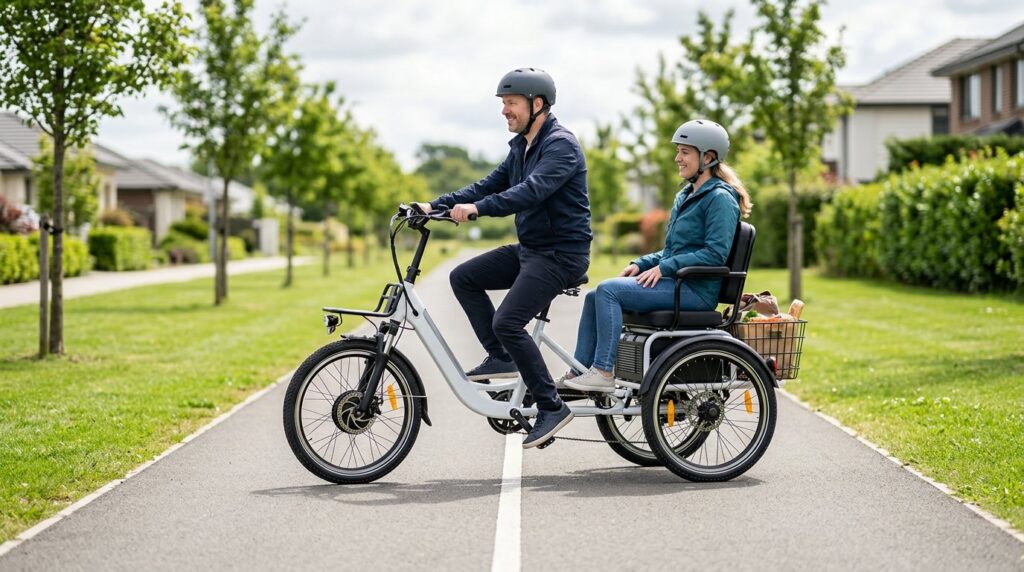
A two-passenger electric tricycle combines the three-wheel layout of an adult trike with electric motor assistance and seating designed to accommodate a rider plus another passenger, or two occupants where the vehicle is specifically engineered and legally approved for that use. These electric tricycles can be practical for neighborhood journeys, private properties, campuses, leisure riding and some everyday transportation needs. However, passenger capacity, road legality, licensing, motor power classifications and safety requirements vary significantly between models and jurisdictions. Buyers should therefore examine the vehicle’s rated capacity and local regulations as carefully as its battery, range, motor and comfort features.
What Is a Two-Passenger Electric Tricycle?
A two-passenger electric tricycle is an electrically assisted three-wheel vehicle designed and rated by its manufacturer to carry two people.
The precise configuration varies.
Some products place the primary rider in front with a passenger seat behind. Other designs position passengers differently or incorporate a wider seating arrangement. There are also larger enclosed electric three-wheel vehicles that resemble compact mobility vehicles more than conventional bicycles.
The three-wheel architecture distinguishes an electric trike from a standard two-wheel electric bicycle. It can provide stationary stability and remove the need for the rider to balance the vehicle on two wheels when stopped.
That does not mean a tricycle cannot overturn. Three-wheel vehicles have distinct cornering dynamics, and inappropriate speed or weight distribution can reduce stability.
How Does a Two-Passenger Electric Tricycle Work?
Most electric tricycles combine a rechargeable battery, electric motor, motor controller and rider controls.
Depending on the model and local classification, electric assistance can be activated through pedal assistance, a throttle, or both.
The battery stores electrical energy, while the controller regulates delivery to the motor. Motors may be located in a wheel hub or connected through another drive arrangement.
Pedal Assist on a Two-Passenger Electric Tricycle
Pedal assistance detects rider input and supplies motor support according to the selected assistance level.
Throttle Operation
Some trikes include a throttle that can power the vehicle without simultaneous pedaling. Throttle legality and permitted power levels vary by jurisdiction, so the feature should not be assumed road legal everywhere.
9 Amazing Benefits of a Two-Passenger Electric Tricycle
The advantages of an electric passenger trike depend on the user’s needs, physical abilities, terrain and the model’s design.
1. Two-Passenger Electric Tricycle Seating Enables Shared Trips
The defining advantage is the ability to transport another person when the vehicle has been engineered for passenger use.
This can make a trike useful for couples, caregivers and families undertaking appropriate short distance journeys.
Passenger seats should never be improvised.
A rack that looks large enough to sit on is not necessarily designed for human loads. Use only manufacturer approved seating, foot supports, restraints where specified and other passenger equipment.
2. Three Wheels Provide Stationary Stability
A conventional bicycle requires the rider to maintain lateral balance, particularly at very low speeds and when stopping.
A tricycle remains supported by three contact points while stationary on suitable level ground.
This can make starting and stopping more convenient for some riders.
However, riding dynamics are different from a bicycle. Riders should practice turns, braking and maneuvering in a controlled environment before carrying a passenger.
3. Electric Assistance Reduces Required Pedaling Effort
Motor support can make acceleration and climbing more manageable.
This becomes particularly useful when the combined mass of the trike, two occupants and cargo is substantial.
Electric assistance does not eliminate physical limitations.
A heavily loaded tricycle can still slow considerably on steep hills, and motor output, gearing, battery condition and controller limits influence climbing ability.
4. Passenger Trikes Can Include Useful Cargo Space
Some two-person models incorporate baskets, rear storage areas or other cargo solutions.
Storage can be convenient for groceries, personal belongings, recreational equipment and small everyday loads.
Cargo Capacity of a Two-Passenger Electric Tricycle
Cargo should remain within the manufacturer’s stated limits.
Passenger and Cargo Weight Matter Together
Maximum payload commonly includes occupants plus luggage rather than providing separate unlimited capacities. Confirm exactly how the manufacturer defines payload before loading the vehicle.
5. Electric Tricycles Produce No Tailpipe Emissions During Use
A battery electric trike has no combustion engine and therefore produces no exhaust emissions at the point of operation.
Its total environmental impact still depends on factors such as electricity generation, battery production, manufacturing, lifetime use and end-of-life handling.
For short journeys that would otherwise use a larger combustion vehicle, an electric trike may provide a lower-energy transportation option, depending on circumstances.
6. Lower-Speed Mobility Can Suit Local Trips
Electric trikes are often used for relatively short journeys rather than high-speed transportation.
Neighborhood roads, approved cycling infrastructure, resorts, campuses and private sites can be suitable environments depending on local regulations.
A lower design speed can support relaxed travel, but safe operation still requires attention to road users, surfaces, visibility and intersections.
7. Two-Passenger Electric Tricycle Designs Can Improve Comfort
Passenger-oriented models may provide padded seating, backrests, step-through frames, suspension or other comfort features.
These characteristics can make the experience very different from riding a conventional bicycle saddle.
Comfort is highly individual.
Seat dimensions, posture, suspension, tire pressure, vibration and journey duration all influence how comfortable a trike feels.
8. Charging Can Be Convenient for Daily Use
Many electric trikes can be charged from an ordinary electrical supply using the manufacturer’s compatible charger.
Charging arrangements differ according to battery design.
Some batteries can be removed and charged separately, while others are integrated into the vehicle.
Always follow manufacturer charging instructions and use an approved compatible charger.
9. A Two-Passenger Electric Tricycle Can Support Transport Flexibility
For suitable users, an electric trike can occupy the space between walking, cycling and using a larger motor vehicle.
It may serve practical local transportation without requiring the physical balancing demands of a two-wheel bike.
Whether it can replace a car depends on weather, infrastructure, distance, cargo needs, passenger needs and applicable road laws.
Types of Two-Passenger Electric Tricycle Designs
There is no universal passenger trike configuration.
Understanding the principal designs helps buyers choose equipment appropriate to their intended journeys.
Rider With Rear Passenger Seat
One common design positions the rider at the front and provides a dedicated second seat toward the rear.
The passenger seat may include a backrest, footrests and grab points.
Weight distribution requires careful engineering because a passenger’s mass can significantly influence steering and braking behavior.
Side-by-Side Electric Tricycle
Some three-wheel vehicles position occupants next to one another.
These vehicles are generally wider and may have completely different handling characteristics from bicycle-style trikes.
Enclosed Electric Tricycles
Larger models can incorporate roofs, windshields, doors or partial weather protection.
Classification Can Change With Vehicle Design
An enclosed three-wheel electric vehicle may legally fall into a motorcycle, moped, low-speed vehicle or another category rather than an electric bicycle category. Verify local rules before purchasing.
Two-Passenger Electric Tricycle Motor Options
Motor specifications influence acceleration, climbing and the vehicle’s ability to manage heavier loads.
Hub motors are widely used because of their relatively straightforward design.
Mid-drive systems can take advantage of drivetrain gearing but introduce different cost and maintenance considerations.
Motor Power
Power ratings are commonly expressed in watts.
A higher advertised number does not automatically mean a better trike.
Motor type, controller settings, gearing, wheel diameter, system efficiency, terrain and total load all influence real-world performance.
Motor Power and Legal Limits
Many jurisdictions limit motor power or assisted speed for vehicles to qualify as electric bicycles.
More Power Can Change Legal Classification
A high-powered trike might require registration, licensing, insurance or different operating locations. Regulations should be checked before selecting motor size.
Battery Options for a Two-Passenger Electric Tricycle
Lithium-ion batteries are common in modern electric mobility products because they offer useful energy storage relative to their weight.
Battery specifications often include voltage and amp-hour capacity.
Energy capacity is more meaningfully compared in watt-hours.
Watt-hours can be estimated by multiplying nominal voltage by amp-hours when specifications are provided consistently.
How Battery Capacity Affects Range
Greater energy capacity can increase potential range, but there is no direct universal mileage figure.
Vehicle efficiency varies substantially.
Factors Affecting Electric Tricycle Range
Range can be influenced by:
• Combined rider and passenger weight
• Cargo weight
• Assistance level
• Throttle use
• Speed
• Hills
• Wind
• Temperature
• Tire pressure
• Surface conditions
• Starting and stopping frequency
• Battery age and condition
• Motor and drivetrain efficiency
Manufacturer range claims should therefore be understood as estimates under particular test conditions rather than guaranteed everyday results.
How Far Can a Two-Passenger Electric Tricycle Travel?
There is no single correct range for all models.
Some trikes are optimized for relatively short local journeys, while models with larger batteries can travel considerably farther under suitable conditions.
Carrying two adults usually increases energy demand compared with a single lighter rider.
Terrain can have an even larger influence when steep hills are involved.
Estimating Your Required Range
Calculate the length of a typical round trip and include an appropriate reserve.
Avoid selecting a vehicle whose advertised maximum range only narrowly covers your routine journey.
Battery Degradation Over Time
Rechargeable batteries gradually lose usable capacity as they age and accumulate charge cycles.
Plan for Long-Term Range Needs
A battery that barely meets requirements when new may become inconvenient as its capacity decreases. Ask about replacement battery price and future availability before buying.
Speed and Performance
Electric tricycle speed depends on vehicle design, motor control and applicable legal restrictions.
Faster does not automatically mean better.
Trikes carry cornering loads differently from two-wheel bicycles, and higher speed can increase the consequences of mistakes.
Cornering a Two-Passenger Electric Tricycle
Riders should slow before turns and become familiar with how passenger weight affects handling.
Sudden turns at inappropriate speeds can destabilize a trike.
Practice Before Carrying a Passenger
Begin in a quiet, open area.
Learn Braking and Turning Characteristics
Practice smooth acceleration, controlled braking, wide and tight turns, and maneuvering at low speed before introducing an additional occupant.
Brakes for a Two-Passenger Electric Tricycle
Braking performance is particularly important because passenger trikes can carry substantial combined weight.
Disc brakes are common on many electric trikes, although exact braking systems differ.
Buyers should evaluate whether the braking system is appropriately designed for the vehicle’s maximum rated mass and intended terrain.
Parking Brakes
A parking brake or locking mechanism can help prevent movement while stopped.
This can be valuable when a passenger is getting on or off.
Brake Maintenance
Brake pads, rotors, cables and hydraulic components can wear or require adjustment depending on the system.
Never Ignore Reduced Braking Performance
If braking becomes inconsistent, unusually noisy or less effective, stop using the vehicle until it has been inspected and repaired appropriately.
Safety Features to Look For
Safety should influence purchasing at least as much as range and speed.
Useful equipment can include effective brakes, front and rear lighting, reflectors, mirrors, a horn or bell, reliable tires and appropriately designed passenger supports.
Local laws may impose additional equipment requirements.
Passenger Safety
The second occupant needs a proper seat and secure places for feet.
Loose clothing should remain clear of wheels, chains and other moving parts.
Helmets and Protective Equipment
Helmet laws differ between jurisdictions.
Follow Local Requirements
Use protective equipment appropriate to the vehicle and applicable law. Manufacturer recommendations should also be followed.
Weight Capacity and Payload
Payload capacity is one of the most important numbers for a two-person trike.
Add the rider, passenger and expected cargo to determine the normal operating load.
The total must remain within the manufacturer’s rated limits.
Why Payload Limits Matter
Excessive weight can influence acceleration, braking distance, steering, tires, wheels, frame loading and range.
Check Per-Seat Limits
The overall payload rating might not be the only restriction.
Confirm Passenger Seat Capacity
Ask for documented limits for the frame, individual seats and cargo areas where applicable. Avoid relying solely on an online seller’s generic description.
Comfort and Accessibility
A step-through frame can make mounting easier because the rider does not need to lift a leg over a high top tube.
Passenger access should also be considered.
A stable parking system and conveniently placed foot supports can make boarding more manageable.
Seat Design
Wide seats and backrests can provide additional support.
However, an upright position may not be comfortable for every rider.
Suspension
Suspension can help absorb some surface irregularities.
Tires Also Affect Ride Quality
Tire volume and inflation pressure influence comfort and handling. Always remain within manufacturer specified tire pressure limits.
Two-Passenger Electric Tricycle Versus a Standard E-Bike
An electric bicycle is generally narrower, lighter and more agile.
A passenger electric trike offers greater stationary stability and may provide a more substantial passenger arrangement.
The trike’s additional width needs consideration.
Storage areas, gates, pathways, ramps and cycle infrastructure may be too narrow for some models.
Transporting the vehicle by car can also be more difficult because ordinary bicycle racks may not support its dimensions or weight.
Two-Passenger Electric Tricycle Versus Mobility Scooter
Electric trikes and mobility scooters serve overlapping but distinct needs.
Many electric trikes retain bicycle-style steering and, on relevant models, pedaling.
Mobility scooters are generally specifically designed around powered personal mobility and accessibility.
A person with significant mobility limitations should choose equipment based on individual physical capabilities and professional advice where appropriate rather than assuming a trike is an equivalent medical mobility solution.
Are Two-Passenger Electric Tricycles Street Legal?
Street legality depends on location and vehicle specification.
Rules can consider motor power, maximum assisted speed, throttle functionality, pedals, vehicle dimensions, seating capacity and other construction details.
Adding a passenger can also be regulated separately.
Check Local Electric Tricycle Laws
Consult the relevant transport or motor vehicle authority where the trike will actually be operated.
Do this before purchasing.
Bike Lane Rules
Even when an electric tricycle can legally use public roads, that does not automatically mean it can use every bicycle lane or shared path.
Passenger Rules May Differ
Some jurisdictions impose specific rules for carrying passengers on bicycles or electric cycles. A second seat alone does not establish legal passenger eligibility.
Charging a Two-Passenger Electric Tricycle
Use only charging equipment specified as compatible by the manufacturer.
Charge in a suitable environment away from conditions prohibited by the battery or charger instructions.
Lithium-ion batteries require careful handling because damaged, defective or improperly charged packs can create fire hazards.
Electric Tricycle Battery Safety
Do not charge a battery showing swelling, impact damage, unusual overheating, leakage or other signs of failure.
Seek manufacturer or qualified service guidance.
Battery Certification
Buyers can ask what safety standards and certifications apply to the electrical system, battery and charger in their country.
Avoid Unverified Replacement Batteries
An inexpensive incompatible pack can create performance and safety problems. Use manufacturer approved or appropriately verified replacements.
Maintenance Requirements
Electric tricycles combine bicycle components with electrical systems.
Routine checks can include tire condition and pressure, brake operation, wheel security, drivetrain condition, lights and visible electrical connections.
Three wheels mean there are additional tires and wheel components to maintain compared with a conventional bicycle.
Battery Maintenance
Follow the battery manufacturer’s recommendations for charging and storage.
Extreme temperatures can affect lithium-ion battery performance and longevity.
Long-Term Storage
Battery storage charge recommendations differ between manufacturers.
Follow the Official Manual
Do not depend on a universal charging percentage found online when the manufacturer provides model-specific instructions.
Weather and Water Resistance
An electric trike intended for normal outdoor transport should have an electrical system designed for expected environmental exposure.
However, water resistance does not mean waterproof under all conditions.
Avoid deep water, flooding and pressure washing unless the manufacturer explicitly specifies otherwise.
After exposure to severe weather, follow recommended inspection and drying procedures.
Cost of a Two-Passenger Electric Tricycle
Pricing varies according to motor, battery capacity, frame construction, braking system, passenger equipment, suspension, electronics, brand support and shipping.
Larger passenger-oriented trikes may cost more than basic single-rider electric tricycles.
Purchase price is only part of ownership cost.
Consider eventual battery replacement, tires, brake components, servicing, accessories and insurance or registration where applicable.
How to Choose the Best Two-Passenger Electric Tricycle
Start with passenger capacity and legal classification.
Confirm in writing that the trike is designed by its manufacturer for the number and weight of occupants you intend to carry.
Next, assess terrain and range.
Hilly routes with two adults require different motor, battery and braking considerations from flat recreational paths.
Two-Passenger Electric Tricycle Buying Checklist
Before buying, verify:
• Manufacturer rated passenger capacity
• Maximum total payload
• Individual seat limits where specified
• Battery capacity in watt-hours
• Motor type and rated power
• Estimated range and test conditions
• Braking system
• Parking brake functionality
• Lights and reflectors
• Passenger footrests and supports
• Vehicle width and storage dimensions
• Battery and electrical safety certifications
• Replacement battery availability
• Spare parts availability
• Warranty coverage
• Local road and pathway legality
A test ride can be valuable where available, particularly because three-wheel handling differs from conventional cycling.
Where to Use an Electric Passenger Trike
Potential settings include private properties, residential communities, large campuses, resorts and public transportation routes where permitted.
Actual suitability depends on infrastructure.
Steep gradients, narrow paths, high-speed traffic, poor surfaces or inadequate crossings can make some routes inappropriate even when the vehicle itself is legally permitted.
Route planning should therefore form part of the purchase decision.
Frequently Asked Questions
What is a two-passenger electric tricycle?
A two-passenger electric tricycle is a three-wheel electric vehicle specifically designed and rated to carry two occupants, commonly a rider and one passenger.
Can two adults ride an electric tricycle together?
Yes, but only if the manufacturer rates the specific model for two adults and their combined weight remains within passenger and total payload limits.
How far can a two-passenger electric tricycle travel?
Range varies by battery capacity, total load, speed, terrain, weather and assistance level. Manufacturer figures should be treated as estimates under stated testing conditions.
Is a two-passenger electric tricycle safe?
A properly designed trike can provide practical transportation, but safe use requires suitable brakes, correct loading, responsible cornering, maintenance and compliance with manufacturer instructions.
Is a two-passenger electric tricycle street legal?
Legal status depends on motor power, speed, throttle configuration, passenger rules and local vehicle classifications. Check with the relevant transport authority before purchase.
How long does an electric tricycle battery last?
Battery lifespan varies with cell quality, charging behavior, temperature, storage, use and age. Ask about warranty terms and replacement battery availability when comparing models.
Conclusion
A two-passenger electric tricycle can provide comfortable, practical electric mobility for shared local journeys when it is genuinely engineered for two occupants. Battery capacity, payload, braking, passenger seating, motor performance and three-wheel handling should all be evaluated before purchase. Buyers also need to verify local laws because passenger rules and electric vehicle classifications vary between jurisdictions. Choosing a supported model with documented specifications, appropriate safety features and available replacement parts can make long-term ownership considerably more practical.