
Spending hours at a desk, changing activity levels, lifting, repetitive movements, or muscle strain can sometimes contribute to discomfort around the upper and mid back....
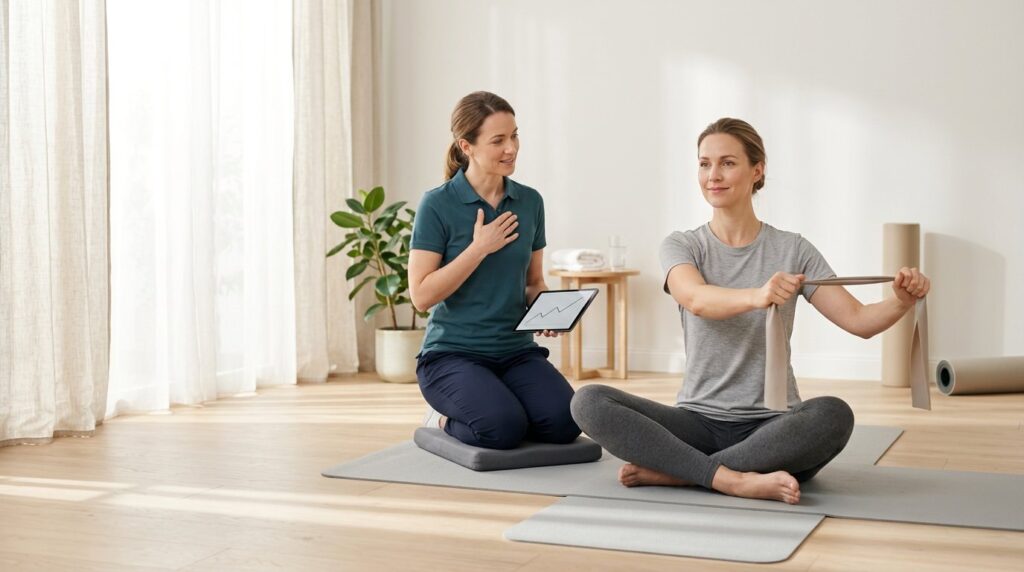
Spending hours at a desk, changing activity levels, lifting, repetitive movements, or muscle strain can sometimes contribute to discomfort around the upper and mid back. For uncomplicated muscular discomfort, appropriately selected upper back pain relief exercises may help maintain movement, reduce stiffness, and improve strength or mobility over time. However, upper back pain has many possible causes, and exercise is not appropriate for every situation. Severe pain, significant trauma, chest pain, breathing difficulty, neurological symptoms, fever, or other concerning signs require medical assessment rather than relying on an exercise routine.
The upper back includes the thoracic spine, ribs, shoulder blades, muscles, joints, and other tissues that work together during everyday movement. Symptoms in this area can also occasionally originate from structures outside the back itself.
For that reason, the goal of a general exercise program should not be to diagnose or “fix” an assumed structural problem. It should provide gentle movement options that an otherwise healthy adult can consider when symptoms are mild and there are no warning signs.
What Are Upper Back Pain Relief Exercises?
Upper back exercises can include gentle mobility movements, stretches, postural variations, and strengthening exercises involving the thoracic spine, shoulders, and surrounding muscles.
Different exercises serve different purposes.
A thoracic rotation exercise emphasizes controlled movement through the upper trunk. A chest stretch targets tissues across the front of the shoulders and chest. Rowing movements strengthen several muscles around the shoulder blades and upper back.
No single exercise is universally best.
The appropriate choice depends on the cause of symptoms, current mobility, injury history, health conditions, and how a person’s body responds to movement.
When Can Upper Back Pain Relief Exercises Be Helpful?
Gentle activity can be appropriate for many cases of non specific back discomfort, particularly when prolonged inactivity or sustained positions contribute to stiffness.
Movement may also help someone gradually return to normal activity after a mild muscular strain.
Exercise should remain tolerable.
A mild sensation of stretching or muscular effort is different from sharp, severe, radiating, or rapidly worsening pain. If an exercise clearly aggravates symptoms, stop and reassess rather than trying to force through it.
Who Should Avoid Upper Back Pain Relief Exercises Without Medical Advice?
Seek individualized advice before beginning a generic routine if pain followed significant trauma, surgery, a known fracture, or another diagnosed spinal condition.
Additional caution is appropriate for people with osteoporosis, cancer, inflammatory conditions, serious cardiovascular or respiratory disease, or other medical issues that could affect exercise safety.
Pregnancy and recent childbirth may also change exercise considerations.
When unsure, a doctor, physiotherapist, or another appropriately qualified professional can help determine whether exercise is suitable.
7 Upper Back Pain Relief Exercises to Try Gently
The following exercises are general movement options rather than treatment prescriptions. Begin gently, stay within a comfortable range, and stop if symptoms meaningfully worsen.
1. Upper Back Pain Relief Exercises With Seated Thoracic Rotation
Sit upright in a stable chair with both feet supported.
Cross your arms comfortably over your chest or place your hands lightly on your shoulders. Keeping your hips generally facing forward, slowly rotate your upper trunk toward one side.
Move only as far as feels comfortable.
Return to the center and repeat toward the opposite side.
The movement should be controlled rather than bounced or forced. Breathe normally and allow the rotation to come from the torso instead of aggressively pulling yourself around with the arms.
A few gentle repetitions on each side can be used as an initial mobility drill.
2. Upper Back Pain Relief Exercises With a Chair Extension
Sit on a stable chair whose back reaches approximately the region you want to mobilize without creating uncomfortable pressure.
Place your hands behind your head or across your chest.
Gently allow your upper back to extend over the chair while keeping the movement controlled. Avoid aggressively arching the lower back or forcing the neck backward.
Return to a neutral seated position.
This movement may not be appropriate for everyone, including some people with osteoporosis or particular spinal conditions. Seek professional advice if those considerations apply.
3. Upper Back Pain Relief Exercises With Cat Cow Movement
Begin on hands and knees on a comfortable surface if this position is appropriate for you.
Place the hands approximately under the shoulders and knees under the hips.
Slowly round the spine in a comfortable range, allowing the head to follow naturally. Then reverse the movement by gently moving the chest forward and allowing the spine to extend without forcing the neck or lower back.
Move smoothly between positions.
The purpose is controlled spinal movement, not achieving the largest possible range.
4. Upper Back Pain Relief Exercises With a Doorway Chest Stretch
Stand beside an open doorway.
Position the forearm against the doorframe at a comfortable height and gently turn the body away until a mild stretch is felt across the chest or front of the shoulder.
Do not force the arm far behind the body.
Hold comfortably while breathing normally, then release and repeat on the other side.
People with shoulder injuries, instability, or pain may need a modified position or a different exercise.
5. Upper Back Pain Relief Exercises Using Shoulder Blade Squeezes
Sit or stand comfortably with the shoulders relaxed.
Gently draw the shoulder blades toward each other without aggressively lifting the shoulders or forcing the chest forward.
Hold briefly, then relax completely.
The movement should remain subtle.
Rather than trying to maintain the squeezed position all day, use it as a controlled exercise. Normal posture requires movement and variation, not continuously holding the body in one rigid “correct” position.
6. Upper Back Pain Relief Exercises With Resistance Band Rows
Secure a resistance band to an appropriate stable anchor at roughly chest level.
Hold each end and step back until there is light tension. Keeping the trunk controlled, pull the elbows backward while allowing the shoulder blades to move naturally.
Slowly return to the starting position.
Start with manageable resistance.
The anchor must be secure because a slipping resistance band can cause injury. Inspect bands for damage before use and keep them away from the face during loaded exercises.
7. Upper Back Pain Relief Exercises With Wall Slides
Stand with your back near a wall in a comfortable position.
Place the arms against or near the wall according to available shoulder mobility. Slowly slide them upward while maintaining a comfortable range, then return.
Do not force the arms to remain flat against the wall if doing so causes pain or requires excessive arching.
This exercise combines shoulder movement with upper back control.
If shoulder symptoms dominate, professional assessment may be more useful than assuming the pain comes exclusively from the thoracic spine.
How Often Should You Do Upper Back Pain Relief Exercises?
There is no universal frequency suitable for every condition.
Gentle mobility exercises may be performed more frequently than demanding strengthening exercises, but appropriate volume depends on the individual, symptoms, exercise intensity, and broader activity level.
Start conservatively.
Pay attention to how you feel during exercise and afterward rather than judging the routine only in the moment.
Upper Back Pain Relief Exercises and the Pain Response
Some people can exercise safely with mild discomfort, while others need a different approach depending on their diagnosis.
A general rule is not to push through sharp, severe, unfamiliar, or escalating pain.
Symptoms that spread into the arm, produce weakness or numbness, or accompany chest pain or breathing difficulty deserve particular attention.
If mild symptoms consistently become worse after exercising or remain elevated, reduce the activity and seek professional advice if the pattern continues.
Progressing Upper Back Pain Relief Exercises Safely
Progress should be gradual.
For strengthening exercises, progression might involve additional repetitions or modestly increased resistance. For mobility work, improved control can be more useful than forcing greater range.
Change one variable at a time when possible.
This makes it easier to understand how your body responds and reduces the temptation to advance volume, resistance, and range simultaneously.
Upper Back Pain Relief Exercises for Desk Workers
Desk work does not automatically damage the spine, but remaining in one position for long periods can feel uncomfortable for some people.
The solution is not necessarily finding one perfect posture.
Regularly changing position can be more practical than attempting to sit rigidly upright throughout the entire working day.
Seated Upper Back Pain Relief Exercises at Work
Simple seated rotation, gentle shoulder movement, and standing or walking breaks can introduce variation without special equipment.
Set reminders if you routinely lose track of time.
The ideal break frequency depends on the person and work demands, so there is no need to interrupt concentration every few minutes.
Instead, avoid remaining completely static for unnecessarily long periods when movement is available.
Upper Back Pain Relief Exercises and Workstation Setup
Exercise cannot compensate for every workstation problem.
Position frequently used equipment so you do not repeatedly strain to reach it. Adjust the chair, screen, keyboard, and pointing device to support comfortable working positions.
People using laptops for long periods may benefit from an external keyboard or other adjustments depending on their setup.
Ergonomics should support variation and comfort rather than enforce one fixed posture.
Upper Back Pain Relief Exercises During Movement Breaks
A movement break can be simple.
Stand, walk briefly, move the shoulders, rotate gently through the trunk, or perform a comfortable chest stretch.
These breaks do not need to become full workouts.
The goal is to interrupt sustained positioning and give the body a different movement demand.
Upper Back Pain Relief Exercises for Posture
Posture is often blamed for upper back pain, but the relationship between posture and pain is more complex than the idea that one “bad” position directly causes symptoms.
People vary naturally in how they sit and stand.
Comfortable posture can also change throughout the day.
Do Upper Back Pain Relief Exercises Fix Poor Posture?
Exercises can improve strength, movement capacity, and awareness, but they should not be marketed as permanently correcting one universally defective posture.
A more useful goal is developing options.
Being comfortable in several positions and moving between them may be more realistic than maintaining an idealized upright posture continuously.
If a specific posture consistently triggers symptoms, a physiotherapist can help explore modifications and other contributing factors.
Strength Based Upper Back Pain Relief Exercises
Rows, appropriate pulling movements, and exercises involving the shoulder blades can strengthen upper back musculature.
Strength development normally requires progressive resistance over time rather than simply repeating very easy movements indefinitely.
Technique and load should match the individual.
If you are new to resistance training, start with light resistance and focus on controlled movement before increasing difficulty.
Upper Back Pain Relief Exercises Without Equipment
Equipment is optional for basic mobility.
Seated rotation, cat cow movement, gentle arm movements, and certain chest stretches can all be performed without specialized products.
This makes short routines easier to fit into normal life.
Creating a Simple Upper Back Pain Relief Exercises Routine
A basic session could combine one gentle spinal mobility exercise, one shoulder or chest mobility movement, and one light strengthening exercise.
Keep the routine manageable.
Consistency is usually more realistic when a program does not contain twenty exercises with overlapping purposes.
If a particular movement does not suit you, it does not need to remain in the program simply because it appears on a generic list.
Breathing During Upper Back Pain Relief Exercises
Normal, relaxed breathing is appropriate for most gentle mobility exercises.
Avoid unnecessarily holding your breath.
Some people enjoy combining gentle thoracic movement with slow breathing because the ribs and thoracic region move during respiration.
Breathing exercises should not be used to dismiss unexplained breathlessness, chest pain, or other respiratory symptoms. Those symptoms may require medical assessment.
Upper Back Pain Relief Exercises With a Foam Roller
Foam rollers are commonly used for self massage and mobility work.
Some people find thoracic extension over a roller comfortable, but it is not essential for recovery.
It should also be used carefully.
Foam Roller Upper Back Pain Relief Exercises
If appropriate for you, place a foam roller across the upper back while lying on a safe surface and support the head appropriately.
Use small, controlled movements rather than aggressively rolling the neck or lower back.
For extension work, move gently over the roller without forcing the spine.
People with osteoporosis, fractures, significant spinal conditions, or recent injuries should obtain professional guidance before using forceful spinal extension techniques.
Upper Back Pain Relief Exercises and Strength Training
A painful episode does not necessarily mean all exercise needs to stop permanently.
Depending on the cause, gradual return to normal strengthening can be part of recovery.
The appropriate progression varies.
Resistance Upper Back Pain Relief Exercises
Rows are one accessible option, but other movements may be useful depending on the individual.
Exercises for the shoulders, trunk, and pulling muscles can contribute to general physical capacity.
Strength training should not be justified with claims that one weak muscle is definitely causing pain without proper assessment.
Pain is multifactorial, and strength is only one potentially relevant component.
When to Increase Upper Back Pain Relief Exercises Resistance
Increase resistance when the current exercise is well controlled and comfortably manageable, provided doing so is appropriate for your condition and goals.
Make small changes.
You do not need to reach muscular failure during rehabilitation style activity unless a qualified professional has programmed training that way.
If additional resistance repeatedly increases symptoms, return to a manageable level and reconsider progression.
When Upper Back Pain Relief Exercises Are Not Enough
Persistent pain deserves appropriate attention, especially when it is worsening, unexplained, or substantially affecting daily activities.
Upper back symptoms can occasionally relate to conditions that require medical investigation rather than musculoskeletal exercise alone.
Do not use exercise to delay urgent assessment.
Warning Signs Before Trying Upper Back Pain Relief Exercises
Seek urgent medical care for upper back pain accompanied by symptoms such as:
• Chest pressure or significant chest pain
• Sudden or severe shortness of breath
• Fainting or severe unexplained dizziness
• New significant weakness or numbness
• Loss of bladder or bowel control
• Severe pain after major trauma
• Symptoms suggesting a serious allergic or medical emergency
Other situations, including fever, unexplained weight loss, a history of cancer, persistent night pain, significant osteoporosis, or progressively worsening symptoms, can warrant timely medical evaluation.
The significance of symptoms depends on individual circumstances.
Upper Back Pain Relief Exercises After Injury
After a minor muscular strain, gentle movement may sometimes be reasonable as symptoms settle.
Significant collisions, falls, sports trauma, or direct blows require greater caution.
If you cannot move normally, have severe pain, experience neurological symptoms, or suspect a fracture, seek medical assessment.
Do not repeatedly stretch or manipulate an injured area in an attempt to “put it back into place.”
Lifestyle Factors Alongside Upper Back Pain Relief Exercises
Exercise is one part of overall musculoskeletal health.
Sleep, physical activity, workload, stress, recovery, and general health can influence how someone experiences pain.
These factors should be considered without suggesting that pain is imaginary or caused by one lifestyle habit.
Walking and Upper Back Pain Relief Exercises
Walking is an accessible form of general activity for many people.
If comfortable, short walks can help maintain normal movement during an episode of uncomplicated back discomfort.
Start at a tolerable duration and increase gradually.
Walking is not a substitute for medical assessment when warning signs are present, and people with health limitations should follow relevant professional advice.
Sleep and Upper Back Pain Relief Exercises
There is no single sleeping position proven to be ideal for everyone with upper back pain.
Choose a position that is reasonably comfortable.
A supportive pillow and mattress may influence comfort, but expensive orthopedic products are not automatically necessary.
Persistent sleep disruption because of pain is worth discussing with a healthcare professional, particularly when symptoms are severe or worsening.
Mistakes to Avoid With Upper Back Pain Relief Exercises
More exercise is not necessarily better.
Aggressively stretching into pain, repeatedly manipulating the spine, or progressing resistance too quickly can aggravate symptoms.
Avoid treating social media demonstrations as individualized medical prescriptions.
Upper Back Pain Relief Exercises Should Not Be a Test of Flexibility
Mobility varies between individuals because of anatomy, training background, age, and numerous other factors.
You do not need extreme thoracic rotation or extension to have a healthy back.
Focus on comfortable, useful movement rather than comparing your range with someone in a video.
Progress can mean less discomfort or better control without any dramatic increase in flexibility.
Keep Upper Back Pain Relief Exercises Simple
A short routine performed consistently can be easier to evaluate than a long sequence of movements.
Start with a few tolerable exercises.
If symptoms improve, gradually return to broader normal activity. If they worsen or fail to improve as expected, professional assessment can help determine the next step.
Exercises should support daily function rather than become a source of anxiety about moving “correctly.”
Frequently Asked Questions
What are the best upper back pain relief exercises?
There is no universal best exercise. Gentle thoracic rotation, cat cow movement, chest stretching, wall slides and light rows may suit uncomplicated muscular discomfort.
How often should I perform upper back pain relief exercises?
Frequency depends on symptoms and exercise intensity. Gentle mobility can often be performed regularly, while strengthening generally needs appropriate recovery between sessions.
Can upper back pain relief exercises help desk related stiffness?
Gentle movement and strengthening may help some people. Regular position changes and an appropriately arranged workstation can also reduce discomfort from prolonged sitting.
Can I do upper back pain relief exercises if movement hurts?
Do not force severe, sharp or worsening pain. Stop the aggravating exercise and seek professional advice if symptoms are significant, persistent or accompanied by warning signs.
Do upper back pain relief exercises require equipment?
No. Several mobility exercises can be performed with only a chair, wall or floor space. Resistance bands and foam rollers are optional tools.
When should I avoid upper back pain relief exercises?
Avoid self treatment and seek medical assessment for significant trauma, chest pain, breathing difficulty, neurological symptoms, suspected fracture or other concerning symptoms.
Conclusion
Upper back pain relief exercises can provide gentle movement, mobility, and strengthening options for some people experiencing uncomplicated upper back stiffness or muscular discomfort. The safest approach is to begin gradually, use comfortable ranges, and avoid forcing painful movements or pursuing extreme flexibility. Regular movement and sensible workstation adjustments may complement exercise when prolonged sitting contributes to symptoms. Severe, persistent, traumatic, or medically concerning upper back pain should be evaluated by an appropriate healthcare professional rather than managed through generic exercises alone.