
A leaking roof in the middle of a storm forces a decision before most homeowners feel ready to make one. The first question a contractor...
A leaking roof in the middle of a storm forces a decision before most homeowners feel ready to make one. The first question a contractor asks is not “how fast can we start?” It is: “What does this roof actually need?”
Emergency repair and full replacement are not interchangeable responses. Each serves a specific damage profile, roof age, and remaining service-life window. Choosing the wrong one costs more in the end, either through repeated patchwork on a roof that cannot hold repairs, or through an unnecessary full tear-off on a structure that had years of serviceable life remaining.
For homeowners dealing with emergency roof repair Urbandale, understanding the difference between immediate repairs and full roof replacement is essential. This article walks through the conditions that determine which path is correct, so homeowners can follow the contractor’s reasoning rather than simply accept a recommendation they cannot evaluate.
What Emergency Roof Repair Actually Covers
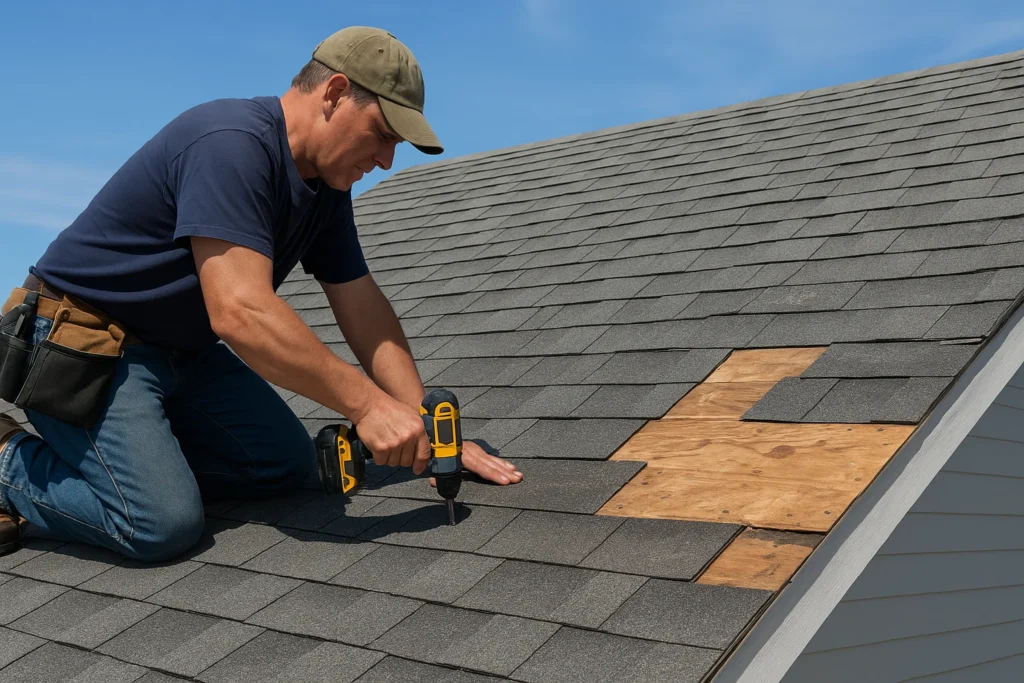
Emergency roof repair addresses a defined breach in the roof system. The crew locates the failure point, stops active water entry, and seals or replaces the damaged component. Common repair targets include:
- Displaced, cracked, or missing shingles over a small field section
- Failed flashing at chimneys, skylights, valleys, or pipe boots
- Punctures from fallen branches or hail strikes on an otherwise intact field
- Lifted ridge cap after high-wind events
A well-executed repair stops water entry at the source and restores weather resistance to the damaged zone. It does not address the condition of the surrounding field. If the deck and shingles outside the repair zone are structurally sound and within their rated service life, the repair holds and extends the roof’s functional timeline without requiring full replacement.
When a Repair Is Enough
Three conditions support emergency repair as the complete solution:
1. The roof is mid-life. Asphalt shingle systems carry a rated service life that varies by product grade and climate exposure. A roof that sits at or under roughly half that life cycle, with no prior significant damage, is a strong candidate for repair. The surrounding field retains its protective capacity, and the repair integrates into a system that will continue to perform.
2. The damage is isolated. When a storm rips three sections of shingles off a roof that is otherwise flat, sealed, and correctly flashed, those three sections represent the problem. Replacing the entire roof in response to localized storm damage does not add protection; it replaces materials that still function correctly.
3. The deck is dry and intact. Once a contractor removes the damaged shingles, the decking beneath tells the structural story. A dry, solid deck with no soft spots, delamination, or rot indicates the water did not penetrate long enough to compromise the substrate. Repair over a sound deck is structurally reliable.
When Full Replacement Is the Right Call
Repair becomes the wrong answer when the damage is a symptom rather than the whole problem. Specific conditions that shift the decision toward full replacement:
Age and widespread granule loss. Asphalt shingles shed granules as they age. Heavy granule loss across the full field indicates the shingle’s protective layer has worn through on a system-wide basis. Patching one section of a roof where the remaining field is at the same stage of wear means the next repair call comes within one to two storm seasons.
Deck deterioration. Soft decking, water-stained sheathing, or visible rot beneath removed shingles means water has been entering the structure longer than the visible leak indicated. Replacement addresses the deck and the covering in a single scope of work. Repair leaves the compromised substrate in place.
Multiple prior repairs. A roof that has received repairs in several locations over consecutive seasons is signaling a field-wide failure pattern. Each new storm finds the next weak point. At that stage, repair work addresses individual symptoms of an aging system rather than extending the roof’s service life in any meaningful way.
Insurance scope. When an adjuster documents storm damage across a defined percentage of the roof field, the insurance scope often covers full replacement rather than targeted repair. A contractor who reads the damage scope and the adjuster’s report together can tell the homeowner exactly what the claim supports before work begins.
How the Assessment Should Work
A contractor who arrives on an emergency call should inspect the full roof field, not just the visible breach point. The inspection checks shingle condition beyond the damaged zone, flashing integrity at every penetration, decking condition in the opened area, and attic evidence of prior water entry.
The written assessment that follows should state: the breach location and cause, the repair scope required to stop active water entry, the condition of the surrounding field, and a clear recommendation on whether repair or replacement serves the homeowner’s interests given the roof’s age and damage profile.
Homeowners who receive both options in writing, with the contractor’s reasoning for each, are in a position to make a decision rather than simply approve one. That transparency is the standard a qualified emergency roofing contractor should meet on every call.
A Note on Contractor Selection
The quality of an emergency roof repair or a replacement decision depends entirely on the accuracy of the initial inspection. A contractor who rushes the assessment to close a repair job, or who recommends full replacement without documenting why repair is insufficient, is not serving the homeowner’s interests.
For homeowners in Urbandale and across the Des Moines metro, Apple Roofing conducts full-field inspections on every emergency call, delivers a written damage assessment before any work begins, and states clearly whether repair or replacement is the correct path for the specific roof condition and age. The goal is an accurate diagnosis, not a predetermined answer.
View Your Professional Roofing Services in Urbandale in a full screen map
Media Contact:
Company Name: Apple Roofing
Phone: (515) 851-4392
Address: 3934 NW Urbandale Dr
City: Urbandale
State: IA
ZIP Code: 50322
Country: United States
Website: https://appleroof.com/urbandale-ia/
Social Media:
https://www.facebook.com/appleroofing
https://www.linkedin.com/company/apple-roofing-llc
https://www.youtube.com/channel/UCMNRXjzM6GKfNh7hX8rRRfQ
https://www.instagram.com/appleroofing