
If you sell on Shopify, Amazon, or Etsy, you've probably had this experience: you hand your accounts to a traditional accountant, and they ask questions...
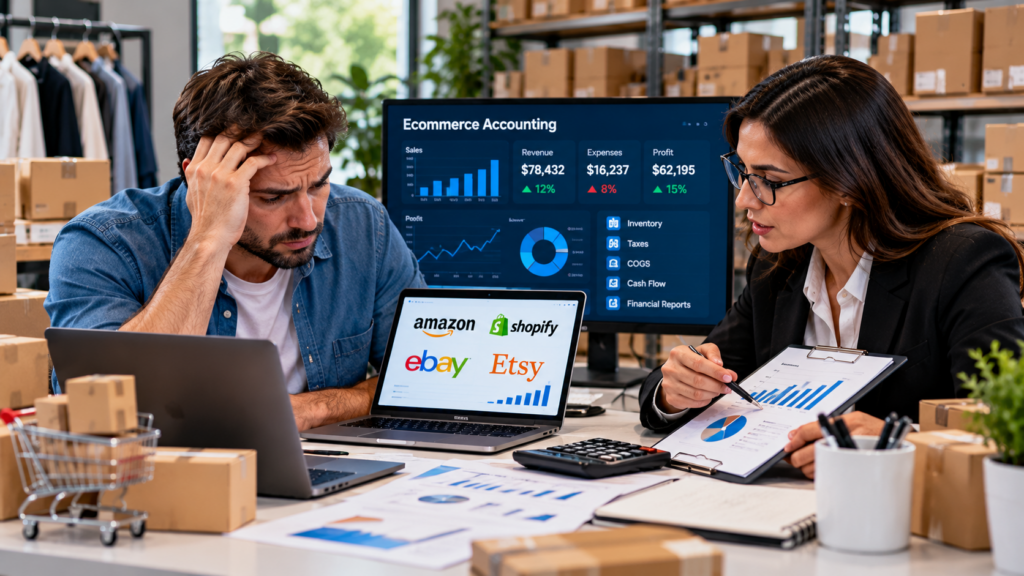
If you sell on Shopify, Amazon, or Etsy, you’ve probably had this experience: you hand your accounts to a traditional accountant, and they ask questions that make it clear they don’t quite understand your business. Why does your bank balance not match your sales? What’s a “settlement report”? Why do you have inventory sitting in three different countries?
This disconnect isn’t your accountant’s fault, and it isn’t a reflection of their skill. It’s simply that ecommerce businesses operate on a financial model that most general practice accountants were never trained for. Standard high-street accounting was built around straightforward transactions: an invoice goes out, a payment comes in, VAT is charged at the point of sale. Online selling doesn’t work that way.
This is why a growing number of UK sellers are switching to dedicated ecommerce accountants — professionals who understand platform fees, multi-currency sales, marketplace VAT rules, and inventory across warehouses. Below, we’ll break down exactly why generic accounting falls short, and what to look for instead.
The Unique Financial Challenges of Ecommerce Businesses
Ecommerce businesses generate financial data that doesn’t look anything like a typical retail or service business. A few examples:
- Marketplace payouts instead of direct payments. Amazon, Etsy, and even Shopify Payments don’t pay you per sale — they pay in batched settlements after deducting fees, refunds, and reserves. One “payment” in your bank account might represent hundreds of individual transactions.
- Multi-currency sales. Selling into the US, EU, or Australia means dealing with foreign currency conversion, exchange rate gains and losses, and separate bank or payment accounts.
- Inventory spread across locations. Stock held in Amazon FBA warehouses, 3PL centres, or overseas fulfilment hubs complicates stock valuation and cost of goods sold (COGS) calculations.
- High transaction volume, low average order value. A seller might process thousands of small transactions a month — something general ledger systems built for B2B invoicing simply aren’t optimised for.
None of this is impossible for a traditional accountant to learn. But without direct experience, it’s easy to misclassify income, miss deductible fees, or misreport VAT — all of which can lead to costly corrections down the line.
Why Standard Bookkeeping Falls Short for Online Sellers
Most bookkeeping approaches are built around one core assumption: that gross revenue equals what lands in your bank account. For ecommerce sellers, that assumption breaks down almost immediately.
Take a typical Amazon payout. It might reflect two weeks of sales, minus referral fees, FBA fulfilment fees, storage charges, advertising spend, and refunds — all rolled into a single lump sum. If a bookkeeper simply records that payout as “sales income,” they’ve missed the actual sales figure, the expenses that should be itemised separately, and any VAT implications tied to those fees.
This matters for three reasons:
- Tax accuracy. Recording net payouts instead of gross sales can understate your revenue and misrepresent your actual profit margins.
- VAT compliance. Marketplace fees often carry VAT that can be reclaimed — missed if fees aren’t broken out individually.
- Business decisions. If you can’t see true product-level profitability once fees and returns are accounted for, you can’t make informed pricing or inventory decisions.
This is where proper ecommerce bookkeeping — built around integrations with platforms like A2X, Link My Books, or similar tools — becomes essential rather than optional.
Key Skills an Ecommerce Accountant Should Have
Not every accountant who says they “work with online businesses” has the specific expertise ecommerce sellers need. Look for someone who genuinely understands:
- Platform-specific reporting — how to read and reconcile Amazon Seller Central, Shopify, and Etsy payout reports
- Marketplace VAT rules — including deemed supplier legislation, where platforms like Amazon and Etsy collect VAT on certain sales on your behalf
- Inventory and COGS accounting — accurately valuing stock across multiple warehouses and calculating true product costs
- Multi-currency and international tax exposure — understanding when selling abroad creates foreign tax registration obligations
- Software integrations — familiarity with ecommerce accounting tools that automatically sync sales data into Xero or QuickBooks, rather than manual data entry
A specialist Shopify accountant or Amazon-focused accountant will typically have hands-on experience with these systems already, rather than learning them on your dime.
Signs You’ve Outgrown Your Current Accountant
It’s not always obvious when your accountant isn’t the right fit — until something goes wrong. Common warning signs include:
- Your VAT returns consistently need correcting or feel like guesswork
- Your accountant doesn’t ask about marketplace fees, FBA reimbursements, or advertising spend
- You’re manually explaining basic ecommerce concepts (like “settlement periods”) during every meeting
- Your management accounts don’t reflect true profitability per platform or product
- You’ve expanded into new markets (EU, US) and haven’t discussed the tax implications
- Bookkeeping is done manually rather than through automated platform integrations
If two or more of these sound familiar, it may be time to consider online seller accounting support built specifically for your business model.
What to Look for When Switching to an Ecommerce Specialist
When evaluating a new accountant, ask direct questions:
- Do you currently work with other Amazon, Shopify, or Etsy sellers?
- Which ecommerce accounting software do you use or recommend?
- How do you handle marketplace VAT and deemed supplier rules?
- Can you help with inventory valuation across multiple fulfilment locations?
- Do you offer proactive tax planning, or just annual compliance?
A specialist will answer these easily and often ask you similarly detailed questions about your sales channels, product margins, and growth plans — a good sign they’re thinking beyond basic compliance.
Final Thoughts
Ecommerce accounting isn’t just “regular accounting with more spreadsheets.” It requires genuine familiarity with how marketplaces operate, how VAT applies across borders, and how to translate messy platform data into accurate, usable financial insight. Sticking with a generalist might work while your business is small — but as you scale across platforms and markets, the gaps become expensive.
If your current accountant doesn’t speak the language of settlement reports, FBA fees, or marketplace VAT, it may be time for a change. Book a free consultation with an ecommerce accounting specialist today and find out what you might be missing.