
Industrial valves manufacturers are moving actuated ball valves beyond basic remote opening and closing. Modern valve packages can combine reliable mechanical designs with intelligent electric or...
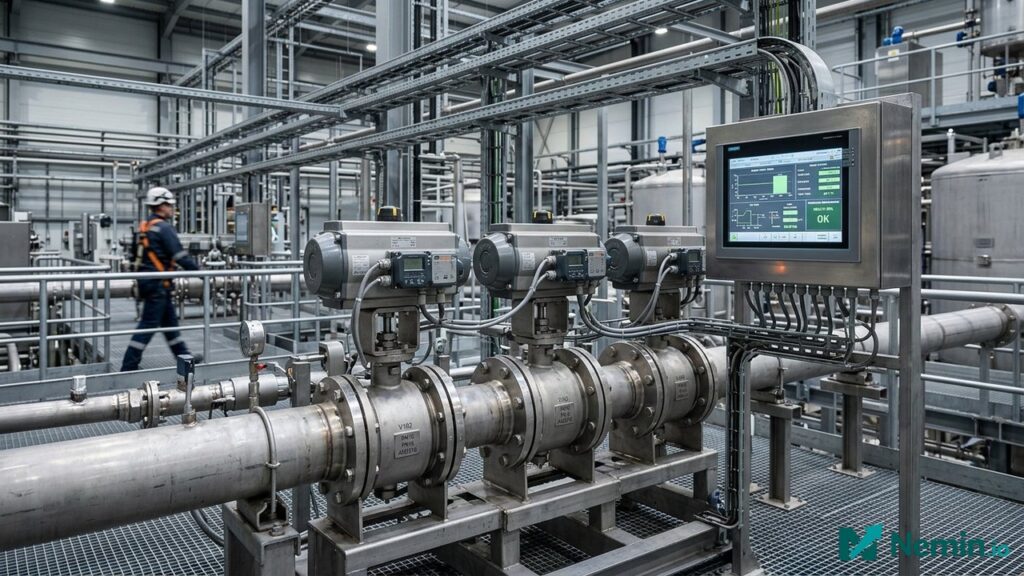
Industrial valves manufacturers are moving actuated ball valves beyond basic remote opening and closing. Modern valve packages can combine reliable mechanical designs with intelligent electric or pneumatic actuators, digital positioners, sensors, diagnostic capabilities and industrial communication systems. Together, these technologies give operators greater visibility into how a valve is performing and whether its operating behavior is changing.
For industrial valves manufacturers, smarter automation is not simply about adding electronics to a valve. The real objective is to match the valve, actuator, controls, feedback devices and communication architecture to actual process conditions. Done correctly, this approach can improve control, simplify troubleshooting, support maintenance decisions and make automated valve assets easier to manage throughout their operating life.
Why Industrial Valves Manufacturers Are Rethinking Ball Valve Automation
A conventional automated ball valve has a straightforward job. A control signal tells an actuator to rotate the valve stem, typically through a quarter turn, to open or close the flow path. Limit switches or similar devices may then confirm that the valve has reached the requested endpoint.
That approach remains suitable for many applications. However, industrial valves manufacturers now have access to technologies that can provide considerably more information about the valve and actuator.
Depending on equipment design, an intelligent automated valve package may provide information about:
- Valve or actuator position
- Opening and closing time
- Number of operating cycles
- Command and response status
- Actuator alarms
- Motor or drive behavior
- Instrument air conditions
- Temperature
- Position deviation
- Communication status
- Selected diagnostic events
These capabilities matter because an open or closed signal says relatively little about the condition of the equipment. Industrial valves manufacturers can use richer feedback to help plant teams understand whether a valve is operating normally or whether its behavior deserves investigation.
Automation does not make fundamental engineering requirements less important. Valve sizing, process compatibility, actuator sizing, pressure and temperature ratings, sealing materials and applicable standards remain essential.
How Industrial Valves Manufacturers Build Smarter Actuated Ball Valves
Actuated ball valves should be considered complete assemblies rather than a collection of independent components. Industrial valves manufacturers must ensure that the mechanical valve and automation package work correctly together under specified operating conditions.
The ball valve provides the flow path and shutoff mechanism. The actuator converts pneumatic, electrical or hydraulic energy into rotational movement. Controls determine when and how that movement occurs, while feedback devices report the resulting status.
Core Components Industrial Valves Manufacturers Integrate
A typical automated ball valve system can contain a combination of the following components:
- Ball valve body and closure element
- Valve stem and seals
- Pneumatic, electric or hydraulic actuator
- Valve-to-actuator mounting hardware
- Coupling or drive adapter
- Limit switches
- Position sensors
- Solenoid valves
- Positioners
- Air preparation equipment
- Local control interfaces
- Communication modules
- Diagnostic electronics
Not every application requires every component. Industrial valves manufacturers generally need to balance functional requirements with reliability, maintainability and overall system complexity.
Why the Mechanical Ball Valve Still Matters
Automation technology attracts considerable attention, but the underlying valve remains fundamental. Industrial valves manufacturers cannot compensate for incorrect mechanical selection merely by installing a smarter actuator.
Ball valves are available in several configurations. Floating-ball valves and trunnion-mounted ball valves are common examples, while valve bodies can use one-piece, two-piece, three-piece or other constructions according to design and application.
Full-bore and reduced-bore configurations also serve different flow requirements. Seat, seal and body materials must be selected for the actual process medium, temperature and pressure.
What Industrial Valves Manufacturers Need to Know Before Automation
Important application information includes:
- Fluid composition
- Minimum and maximum operating temperature
- Design temperature
- Normal and maximum pressure
- Differential pressure across the valve
- Required flow capacity
- Valve size
- Pipe connection and applicable standard
- Required opening and closing time
- Expected cycle frequency
- Required fail position
- Available electrical power
- Available instrument air
- Environmental conditions
- Hazardous-area classification where relevant
- Materials compatibility
- Leakage or shutoff requirements
- Applicable industry codes and standards
Accurate data allows industrial valves manufacturers to select a valve and actuator package around real operating conditions rather than assumptions.
7 Automation Advances Industrial Valves Manufacturers Are Using
Automation innovation is occurring across actuators, sensing, communications and analytics. The following seven developments are particularly relevant to modern actuated ball valves.
1. Industrial Valves Manufacturers Are Advancing Electric Actuation
Electric actuators have developed from relatively simple motor-and-gear assemblies into sophisticated automation devices. Modern designs may incorporate electronic controls, position sensing, protection functions, local interfaces, configurable operating parameters and digital communications.
An intelligent electric actuator can receive a command, operate the valve and provide detailed information about its status. Some designs can also store operational or diagnostic information for later analysis.
For industrial valves manufacturers, electric actuation can be attractive where electrical power is readily available and installing or maintaining a compressed-air network is undesirable.
Electric actuators can also work effectively where controlled positioning is required. Their suitability still depends on the application.
Selection considerations include:
- Required output torque
- Operating speed
- Motor duty and cycling frequency
- Electrical supply
- Ambient temperature
- Ingress protection
- Hazardous-area requirements
- Control interface
- Required fail behavior
A key engineering point is that an electric actuator does not inherently guarantee a particular fail position following loss of electrical power. If an application requires defined emergency positioning, industrial valves manufacturers need an actuator and system architecture specifically designed to achieve it.
2. Smarter Pneumatic Actuators Improve Established Technology
Pneumatic actuators remain an important option for quarter-turn ball valves. Their fundamental operating principle is mature, but instrumentation and control around pneumatic actuation have become significantly more capable.
Industrial valves manufacturers can combine pneumatic actuators with smart positioners, valve-control monitors, solenoid valves, pressure sensing and industrial network interfaces.
Common pneumatic actuator designs include rack-and-pinion and scotch-yoke mechanisms. Each has characteristics that may suit different torque requirements and valve applications.
Spring-return designs use stored spring energy to drive an actuator toward a predetermined position when motive air is removed under defined conditions. This can be valuable when a process requires a specified fail-open or fail-closed action.
Double-acting systems use air pressure to move the actuator in both directions. Industrial valves manufacturers therefore need to determine how the valve should behave during loss of air, electrical control or other utilities.
3. Industrial Valves Manufacturers Use Better Position Feedback
Traditional endpoint switches can report that a valve has reached the open or closed position. Continuous position measurement provides a more detailed picture.
With appropriate sensing, an automation system can determine where the actuator or valve stem is during its travel. Industrial valves manufacturers can use this information in both modulating and on-off applications.
Consider an automated valve that normally closes within a consistent period and reaches its expected endpoint. If subsequent operations show slower travel or incomplete positioning, additional feedback could alert operators to investigate.
Potential causes might include:
- Changes in process conditions
- Reduced pneumatic supply
- Increasing mechanical resistance
- Actuator problems
- Control-system problems
- Sensor or calibration issues
Position information needs correct interpretation. Industrial valves manufacturers should not present stem-position feedback as direct proof that a valve has achieved leak-tight isolation. Establishing actual sealing performance may require separate testing or process measurements.
4. Digital Positioners Add Precise Control and Diagnostics
Positioners compare a requested valve position with actual measured position and adjust actuator input accordingly. Digital positioners expand this basic function by adding electronic configuration, diagnostic information and communication capabilities.
Industrial valves manufacturers can integrate these devices where an application requires modulating service or enhanced actuator monitoring.
Ball valves are widely associated with isolation service, but appropriately engineered rotary valve arrangements can be used for flow control. Doing so requires more than simply adding a positioner.
Industrial valves manufacturers must consider valve flow characteristics, required rangeability, pressure drop, process conditions, noise, velocity, cavitation or flashing where relevant, and the possibility of seat or trim erosion.
For control applications, the complete valve geometry and process behavior are therefore central to successful automation.
5. Industrial Communication Makes Valves More Visible
Another significant development is the ability to connect field devices to wider industrial control and asset-management systems.
Industrial valves manufacturers can offer products compatible with different communication architectures depending on equipment and customer requirements. These can include traditional discrete signals, analog signals, industrial field networks and Ethernet-based technologies.
Digital communications may allow a device to share more information than simple hardwired open and closed indications.
The information can potentially be consumed by:
- Programmable logic controllers
- Distributed control systems
- Asset-management platforms
- Operator interfaces
- Maintenance applications
- Supervisory systems
- Approved industrial analytics platforms
Industrial valves manufacturers should still prioritize robust architecture over maximum connectivity. A valve does not become more reliable simply because it produces more data.
6. Condition Monitoring Reveals Changes in Valve Behavior
Condition monitoring is one of the most practical applications of intelligent automation. Instead of waiting for an obvious failure, plant teams can monitor relevant operating parameters for meaningful changes.
Industrial valves manufacturers may enable monitoring through actuator electronics, positioners or dedicated sensors.
Potential measurements vary by device and can include cycle count, travel time, position response, air pressure, motor characteristics and temperature.
The value usually comes from trends rather than a single reading.
If an actuator’s travel time gradually increases, for example, the change can prompt investigation. It does not automatically reveal the root cause. The problem could involve the actuator, valve, energy supply, controls or process.
This distinction is important. Industrial valves manufacturers should treat diagnostic data as evidence to support troubleshooting rather than an infallible diagnosis.
7. Industrial Valves Manufacturers Enable Condition-Based Maintenance
Traditional preventive maintenance uses predetermined schedules. The method is straightforward but may result in servicing equipment regardless of its actual operating history.
Condition-based maintenance uses information about asset performance to help determine when inspection or intervention may be appropriate. Predictive approaches can incorporate historical patterns and analytical models to estimate future deterioration.
Industrial valves manufacturers can support these maintenance strategies by making relevant operating data accessible.
A high-cycle valve and a rarely operated isolation valve may experience very different conditions even if they were commissioned on the same date. Actual operating records therefore add useful context.
Predictive maintenance nevertheless has limitations. Its effectiveness depends on sensor quality, relevant measurements, sound analysis and sufficient historical data.
Data Industrial Valves Manufacturers Can Use for Smarter Decisions
More data is useful only when it helps answer a relevant operational question. Industrial valves manufacturers and plant operators should first identify important failure modes and then determine which measurements can provide meaningful indicators.
A structured view of common parameters helps illustrate the difference.
| Monitored parameter | Potential operational insight | Important limitation |
|---|---|---|
| Valve position | Shows measured position or travel | Does not prove seat sealing |
| Travel time | Identifies changes in operating speed | Many conditions can change travel time |
| Cycle count | Records operating frequency | Cycle count alone does not establish condition |
| Air pressure | Helps evaluate pneumatic supply | Requires correctly located sensing |
| Motor current | Can show changes in electric actuator loading | Meaning depends on actuator design and operating conditions |
| Temperature | Identifies selected thermal conditions | Value depends strongly on sensor location |
| Position deviation | Compares requested and measured position | Requires suitable calibration and configuration |
| Diagnostic alarms | Highlights predefined abnormal conditions | Alarm meaning is device specific |
Industrial valves manufacturers can make these parameters easier to obtain, but plant teams need contextual knowledge to turn measurements into maintenance decisions.
How Industrial Valves Manufacturers Improve Process Efficiency
Efficiency in valve automation is often misunderstood as energy efficiency alone. Energy matters, but operational efficiency also includes process consistency, labor utilization, troubleshooting time and maintenance planning.
Industrial valves manufacturers can contribute to these goals through well-designed automation.
Remote operation reduces the need for operators to travel to certain field valves solely to change position. Position feedback can indicate whether a requested movement occurred. Diagnostic information can help maintenance personnel determine which equipment requires closer inspection.
The benefits become especially relevant across facilities containing hundreds or thousands of automated assets.
Better Repeatability Through Automated Operation
Automation can improve repeatability because a correctly configured system performs a defined sequence consistently. That capability can be valuable in batch processes, manufacturing, chemical processing, water systems and many other industries.
For modulating applications, industrial valves manufacturers can combine suitable rotary valve designs with appropriate actuation and positioning technology to support process control.
For on-off applications, repeatable actuation and endpoint feedback provide useful operational confirmation.
Automation performance should always be evaluated as part of the complete process system rather than as an isolated valve characteristic.
Reducing Avoidable Field Intervention
Some industrial valves operate in remote, elevated, enclosed or otherwise difficult-to-access locations. Remote operation and diagnostics can reduce the number of routine visits required simply to confirm equipment status.
Industrial valves manufacturers can provide remote visibility, but facilities must decide which functions are appropriate for remote access.
Physical inspection remains necessary for many maintenance tasks. External leakage, corrosion, damaged wiring, loose mechanical components and local environmental problems may not be fully identifiable from digital data alone.
Industrial Valves Manufacturers and Predictive Maintenance
Predictive maintenance is often promoted as a major benefit of industrial digitalization. Its practical value depends on the quality and relevance of the information being analyzed.
For industrial valves manufacturers, a sensible starting point is establishing baseline behavior.
A newly commissioned and correctly functioning automated ball valve can provide reference information such as normal travel time, position response and actuator behavior. Future observations can then be compared with that baseline.
Why Baselines Matter for Industrial Valves Manufacturers
Two automated valves of similar size may behave differently because they operate under different process conditions. A universal alarm threshold can therefore be less informative than expected behavior for a specific asset or service.
Historical trends can help show gradual changes.
Industrial valves manufacturers can facilitate this process by providing reliable sensing, appropriate diagnostics and clear documentation explaining what the measured parameters represent.
Plant operators remain responsible for integrating that information with process context and maintenance history.
From Valve Data to Maintenance Action
Useful condition-based maintenance generally follows a logical sequence:
- Collect relevant measurements
- Verify data quality
- Establish normal operating behavior
- Identify meaningful deviations
- Compare changes with process conditions
- Review maintenance and operating history
- Investigate probable causes
- Inspect equipment when justified
- Record findings and corrective work
- Refine monitoring criteria using verified results
Industrial valves manufacturers can support several stages, but successful maintenance programs also depend on operations, reliability, instrumentation and maintenance personnel.
Industrial Valves Manufacturers Must Engineer Actuator Sizing Correctly
No automation package can perform reliably when an actuator lacks sufficient output to operate the valve under specified conditions.
Required valve torque is not necessarily a single fixed value. It can vary with valve construction, differential pressure, seat materials, temperature, service medium and operating condition.
Industrial valves manufacturers typically need relevant application data before selecting actuator size.
Simply matching a nominal actuator torque figure to an assumed valve torque can overlook important variables. Appropriate engineering margins and manufacturer selection procedures should be used.
Oversizing Is Not Automatically Better
Selecting the largest available actuator is not necessarily a good solution either.
Excessive actuator output can place unnecessary loads on stems, mounting components or internal valve parts if the assembly is not designed accordingly. Industrial valves manufacturers should verify maximum allowable stem torque and other mechanical limits where relevant.
The objective is a properly engineered package rather than maximum actuator force.
Cybersecurity Changes How Industrial Valves Manufacturers Approach Connectivity
As actuators and valve-control devices become more connected, they become part of the operational technology environment. That introduces cybersecurity requirements alongside conventional mechanical and electrical engineering.
Industrial valves manufacturers can design products with security capabilities, but industrial cybersecurity requires a system-level approach.
Areas that may require attention include:
- Device authentication
- User access control
- Network segmentation
- Secure configuration
- Firmware management
- Remote-access policies
- Logging and monitoring
- Configuration backups
- Change management
- Vulnerability-management processes
A connected valve should not expose unnecessary interfaces merely because connectivity is technically possible.
Industrial Valves Manufacturers Need Secure Integration
Plants need to determine which systems can monitor a valve, which systems are authorized to command it and what happens when communications become unavailable.
Industrial valves manufacturers can provide equipment capabilities and documentation, while system integrators and asset owners establish the wider control and network architecture.
Cybersecurity requirements also evolve during an asset’s operating life. Lifecycle support should therefore be considered during equipment selection rather than after commissioning.
Functional Safety and Industrial Valves Manufacturers
Some automated ball valves perform functions associated with process safety. These applications require different engineering considerations from ordinary automation.
A commercially available automated valve is not automatically suitable for a safety instrumented function simply because it can fail closed or fail open.
Industrial valves manufacturers supporting functional-safety applications may need to provide relevant reliability information, documentation and equipment designed or assessed for applicable requirements.
Standards such as IEC 61508 and IEC 61511 can be relevant depending on the equipment, system and application.
Fail Open and Fail Closed Requirements
Fail position describes the intended response to a defined failure condition. Whether a valve should fail open, fail closed or behave another specified way depends on process hazards.
Industrial valves manufacturers cannot safely determine the correct fail position from valve type alone.
A process hazard assessment must establish the required behavior.
Spring-return pneumatic actuators are commonly used where stored mechanical energy is appropriate for driving a valve toward a specified position after loss of air. Other actuator technologies and architectures may use different methods.
The entire final element matters, including the valve, actuator, solenoid, accessories and energy supplies.
How Industrial Valves Manufacturers Handle Edge Intelligence
Centralized automation is not the only way to process valve information. Edge technology allows selected processing to occur near the field device.
Instead of continuously sending every raw measurement to a distant system, an intelligent local device can potentially evaluate selected data and communicate relevant status or alarms.
For industrial valves manufacturers, edge capabilities create opportunities for more distributed diagnostics.
Potential advantages can include reduced communications traffic, local data processing and faster identification of predefined conditions.
The appropriateness of edge processing depends on architecture, criticality, cybersecurity and reliability requirements.
Local Intelligence Does Not Replace Plant Controls
Industrial valves manufacturers must distinguish between equipment diagnostics and process-control authority.
A local device detecting an unusual travel profile is different from allowing an autonomous system to modify a safety-critical process action.
Control authority should be deliberately engineered, documented and validated according to the application’s requirements.
Industrial Valves Manufacturers and Artificial Intelligence
Artificial intelligence is increasingly discussed in industrial maintenance and asset management. For automated valves, its most realistic near-term contribution is often analysis rather than autonomous control.
Machine-learning systems can potentially identify patterns across large equipment datasets that would be difficult to examine manually. Industrial valves manufacturers may eventually use such capabilities to support anomaly detection, fleet analysis and maintenance prioritization.
AI output remains dependent on the quality of its inputs.
If sensing is inaccurate, records are inconsistent or operating conditions are missing, a sophisticated model can still produce unreliable conclusions.
AI Can Support Industrial Valves Manufacturers Without Replacing Engineering
Valve behavior involves mechanical, electrical and process variables. A change detected by an algorithm often requires domain expertise to interpret correctly.
For example, an unusual actuator signature might originate from mechanical friction, changing differential pressure, instrument-air problems, electrical conditions or another factor.
Industrial valves manufacturers can therefore gain more from AI when it supports engineering investigation rather than attempting to eliminate engineering judgment.
Digital Twins for Industrial Valves Manufacturers
Digital twins can provide another approach to organizing and analyzing valve information. The term covers a broad range of technologies, from connected asset representations to complex dynamic models.
A useful digital representation might combine:
- Valve specifications
- Actuator specifications
- Serial and asset information
- Configuration settings
- Operating history
- Maintenance records
- Diagnostic events
- Selected process conditions
Industrial valves manufacturers can improve lifecycle support when accurate digital information remains associated with an asset from specification through operation and maintenance.
However, a database containing equipment records is not equivalent to a physics-based simulation. Organizations should define what they actually require before investing in digital-twin technology.
Choosing Between Electric, Pneumatic and Hydraulic Automation
Industrial valves manufacturers generally have several actuator technologies available. The best choice depends on the process and facility infrastructure.
| Actuator type | Main energy source | Common advantage | Important selection factor |
|---|---|---|---|
| Electric | Electrical power | Digital integration and controlled positioning | Duty cycle, power, speed and environment |
| Pneumatic | Compressed air | Fast operation and practical spring-return designs | Air quality, pressure and availability |
| Hydraulic | Hydraulic pressure | High output capability | Hydraulic supply and system complexity |
There is no universally superior actuator.
Industrial valves manufacturers should select technology using required torque, stroke time, duty cycle, fail action, available utilities, environmental conditions, controls and lifecycle requirements.
Industrial Valves Manufacturers Must Consider Interoperability
An automated valve can remain in service for many years. The control technology surrounding it may change several times during that period.
Interoperability and lifecycle support therefore deserve attention.
Industrial valves manufacturers should consider compatibility with existing plant control infrastructure and the long-term availability of configuration tools, replacement modules and documentation.
Facilities should evaluate:
- Supported communications
- Configuration procedures
- Replacement-part availability
- Firmware support policies
- Diagnostic accessibility
- Documentation quality
- Technician training needs
- Integration requirements
- Upgrade pathways
Technology that is impressive at commissioning but difficult to support later can create avoidable lifecycle problems.
Where Industrial Valves Manufacturers Apply Smart Ball Valve Automation
Automated ball valves operate across numerous industries, but requirements vary considerably between applications.
In water and wastewater systems, industrial valves manufacturers may need to emphasize dependable remote operation, corrosion resistance and compatibility with existing control systems.
Chemical applications require close attention to fluid compatibility, sealing materials, operating temperature and hazardous-area requirements where applicable.
Oil and gas installations can involve demanding pressure conditions, environmental exposure and industry-specific standards. Power facilities may prioritize high reliability and integration with established plant automation.
Food, beverage and pharmaceutical applications can introduce hygienic design, material, cleanability and documentation requirements.
Industrial valves manufacturers should therefore avoid treating smart automation as a standardized package that fits every industry.
Application Requirements Should Lead Technology Selection
The purpose of automation should be clear before devices are selected.
A valve operated twice a year in a noncritical location may not justify the same diagnostic package as a frequently cycling process valve whose failure can interrupt production.
Industrial valves manufacturers can provide multiple levels of automation based on actual asset criticality.
This approach also prevents plants from collecting large quantities of data without a practical plan for using it.
Common Automation Mistakes Industrial Valves Manufacturers Can Help Prevent
Smarter technology does not guarantee a smarter installation. Specification and integration mistakes can undermine otherwise capable equipment.
One common mistake is selecting an actuator before establishing the valve’s actual torque requirements. Another is specifying communications without confirming compatibility with the plant architecture.
Other issues can include inadequate environmental protection, poorly defined fail behavior, unsuitable materials, insufficient electrical or pneumatic supply and unclear diagnostic requirements.
Industrial valves manufacturers can reduce these risks by obtaining complete application information before final selection.
Avoiding Automation for Automation’s Sake
Adding every available sensor and digital feature can increase complexity without creating proportional value.
Industrial valves manufacturers should connect automation choices to clear operational questions.
Does the plant need continuous position information? Will cycle count affect maintenance decisions? Is remote configuration necessary? Can the maintenance team use advanced diagnostics? Does the facility have infrastructure to support the selected communications?
If the answer is no, a simpler configuration may be more appropriate.
A Practical Automation Strategy for Industrial Valves Manufacturers and Plants
Modernization does not have to involve replacing every automated ball valve at once. Plants can begin by identifying assets where additional visibility would provide the greatest operational value.
Industrial valves manufacturers can assist by evaluating existing applications, identifying compatible automation options and establishing appropriate specifications for replacement or upgraded equipment.
A practical program can follow these stages:
- Create an inventory of automated valves
- Identify critical assets and recurring problems
- Review available valve and actuator information
- Establish the operational question that monitoring should answer
- Determine which measurements are actually needed
- Verify controls and communication compatibility
- Select a limited group for initial implementation
- Establish baseline performance
- Train relevant operations and maintenance teams
- Evaluate results before expanding the program
This approach gives industrial valves manufacturers and plant owners a clearer basis for evaluating whether automation improvements are delivering useful results.
The Future for Industrial Valves Manufacturers
The direction of industrial automation suggests that valve systems will become increasingly observable and easier to integrate with broader asset-management strategies.
Industrial valves manufacturers are likely to continue developing actuators and accessories that provide richer diagnostics, easier configuration and better access to operational information. Sensor technology and edge processing can further improve equipment visibility.
At the same time, mechanical engineering will remain central.
The physical ball, seats, stem, seals, body, actuator mechanism and mounting arrangement ultimately have to withstand real process conditions. No software layer changes that requirement.
Smarter Does Not Mean More Complicated
The best automation design is not necessarily the one with the greatest number of features.
For industrial valves manufacturers, a genuinely smart valve package is one whose capabilities correspond closely to its application. A simple automated isolation valve can be smart when it provides exactly the feedback and fail behavior the process requires.
A critical modulating valve may justify advanced positioning, diagnostics and communication.
Good engineering determines the difference.
What Buyers Should Ask Industrial Valves Manufacturers
Procurement decisions should account for the complete automated assembly rather than valve price alone. Buyers should provide accurate process information and ask suppliers how the selected components have been matched.
Questions worth addressing include:
- What valve design is appropriate for the service?
- How was required actuator torque determined?
- What actuator sizing margin is being applied?
- What are the applicable mechanical limits?
- Which seat and seal materials are proposed?
- Which feedback signals are available?
- What happens after loss of motive power?
- Which communications are supported?
- Which diagnostic parameters are measured directly?
- What environmental protection is provided?
- What maintenance does the actuator require?
- How are replacement components supported?
- Which relevant standards apply?
- What commissioning procedures are recommended?
Well-informed industrial valves manufacturers should also identify where additional process information is required rather than making unsupported assumptions.
Why Industrial Valves Manufacturers Still Depend on Sound Engineering
Automation advancements can substantially expand the information available from actuated ball valves. They cannot eliminate the fundamentals that determine whether a valve is suitable for service.
Industrial valves manufacturers need to begin with mechanical compatibility, pressure and temperature limits, flow requirements, process chemistry, actuator torque and environmental conditions.
Only then should sensors, networks and analytics be layered onto the application.
This sequence matters because data is most useful when it comes from equipment that was properly engineered in the first place.
When mechanical engineering and digital automation are treated as complementary disciplines, industrial valves manufacturers can build systems that are easier to operate, monitor and maintain without sacrificing fundamental reliability.
FAQ’s
How are industrial valves manufacturers improving actuated ball valves?
Industrial valves manufacturers are integrating intelligent actuators, position feedback, diagnostics, digital communications and condition monitoring to provide better control and visibility.
Which actuator technology do industrial valves manufacturers prefer?
Industrial valves manufacturers use electric, pneumatic and hydraulic actuation depending on torque, speed, utilities, fail action, environmental conditions and control requirements.
Can industrial valves manufacturers support predictive maintenance?
Yes. Industrial valves manufacturers can provide sensors and diagnostic information that support condition-based and predictive maintenance when combined with reliable data and suitable analysis.
How do industrial valves manufacturers make automated valves more efficient?
Industrial valves manufacturers can improve operational efficiency through appropriate sizing, remote operation, repeatable positioning, useful diagnostics and better maintenance information.
Do industrial valves manufacturers use AI with actuated ball valves?
Some industrial valve applications can use AI-based analytics for anomaly detection and maintenance support, although AI does not replace correct valve engineering or properly designed safety systems.
What should buyers check when selecting industrial valves manufacturers?
Buyers should assess engineering capability, applicable standards, material selection, actuator sizing, controls, documentation, testing, lifecycle support and suitability for the actual process conditions.
Conclusion
Industrial valves manufacturers are turning actuated ball valves into more observable industrial assets through intelligent electric and pneumatic actuation, position feedback, digital communications, diagnostics and condition monitoring. These capabilities can support more consistent operation, faster troubleshooting and better-informed maintenance when they are matched to a genuine process requirement.
The strongest results still begin with engineering fundamentals. Industrial valves manufacturers must correctly select the valve, materials, actuator, controls and fail behavior before advanced analytics can add meaningful value. As connectivity, edge processing and AI-assisted analysis evolve, the smartest actuated ball valve will remain the one that combines useful automation with dependable mechanical design and appropriate lifecycle support.