
Bulk cosmetic packaging turns an initial oil bottle idea into a physical package that must protect the formula, communicate a brand identity, function reliably and withstand...
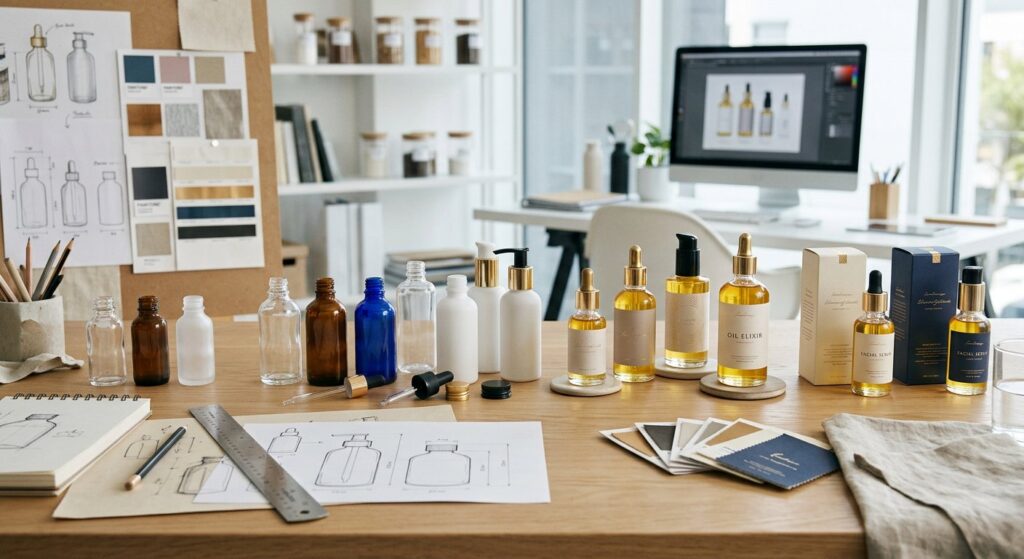
Bulk cosmetic packaging turns an initial oil bottle idea into a physical package that must protect the formula, communicate a brand identity, function reliably and withstand manufacturing and distribution. What begins as a sketch can eventually involve bottle geometry, material selection, closures, dispensing systems, decoration, compatibility testing, filling-line requirements, shipping considerations and regulatory labeling.
For brands purchasing Bulk cosmetic packaging, successful oil bottle development depends on much more than visual appeal. Designers, packaging suppliers, manufacturers, formulators and filling partners need to coordinate early so that creative decisions remain practical at production scale. Understanding this journey from concept to shelf can help beauty businesses create packaging that is attractive, functional and appropriate for the product inside.
Why Bulk Cosmetic Packaging Begins With the Product
Packaging designers may start with mood boards and sketches, but a commercial oil bottle has a functional job before it has an aesthetic one. The package needs to contain the formulation reliably throughout its intended lifecycle.
That makes the oil itself one of the first design inputs.
A facial oil, hair oil, body oil, massage oil and cleansing oil can have different viscosities, ingredients, usage patterns and dispensing requirements. These variables influence what type of Bulk cosmetic packaging may be appropriate.
The development team should understand factors such as:
- Formula composition
- Product viscosity
- Intended dose
- Frequency of use
- Expected product life
- Sensitivity to light or oxygen where relevant
- Bottle capacity
- Target market
- Consumer environment
- Filling process
- Distribution conditions
- Required labeling information
Packaging should not be selected on appearance alone. The formula and package need to work as a system.
Defining the Brief for Bulk Cosmetic Packaging
A clear design brief gives creative and engineering teams a common starting point. It should explain what the product is, who will use it, how it should be positioned and what practical restrictions apply.
A useful Bulk cosmetic packaging brief typically covers the desired capacity, general bottle form, material preferences, dispensing mechanism, decoration, price target and expected production quantities.
It should also identify features that are essential rather than merely desirable.
For example, a brand may require a 30 ml glass bottle with controlled dispensing but remain flexible about whether decoration is achieved through a pressure-sensitive label or direct printing.
That flexibility can become useful when designers begin evaluating cost and manufacturing feasibility.
Translating Brand Identity Into Bottle Design
Oil packaging often operates as a small three-dimensional representation of the wider brand.
A minimalist skincare company may prefer simple geometry and restrained decoration. A premium botanical brand might explore tinted glass, textured finishes or natural visual cues. A salon-focused hair oil may prioritize easy dispensing and durability.
Bulk cosmetic packaging therefore needs to connect visual design with the intended customer experience.
Color, shape, closure proportions, typography, decoration and secondary packaging should feel deliberate rather than assembled independently.
7 Creative Stages Behind Bulk Cosmetic Packaging for Oil Bottles
Moving from an idea to a production-ready bottle is usually an iterative process. Exact workflows differ between suppliers and projects, but seven stages illustrate the major decisions involved.
1. Bulk Cosmetic Packaging Starts With Concept Development
The concept phase is where broad creative ideas are explored before significant production commitments are made.
Designers may build mood boards, analyze the intended market position, examine existing package formats and sketch potential bottle silhouettes. This stage helps establish a visual language for the product.
The goal is not necessarily to create a final design immediately.
Instead, a team developing Bulk cosmetic packaging can explore different directions and identify which ones best balance brand identity with practical requirements.
Concept questions might include:
- Should the bottle appear clinical, botanical, luxurious or accessible?
- Should the container be transparent, opaque or tinted?
- Is a round, square or custom silhouette appropriate?
- How should the consumer dispense the oil?
- What should consumers notice first?
- Does the bottle need secondary packaging?
- How will required information fit on the available surfaces?
A striking design that leaves inadequate room for essential information may require significant revision later.
Stock or Custom Bulk Cosmetic Packaging
One early decision is whether to begin with an existing stock bottle or create custom tooling.
Stock Bulk cosmetic packaging generally uses existing container designs and can offer a more straightforward development path because the basic package already exists. Brands can differentiate it using colors, closures, labels, printing, coatings and secondary packaging.
Custom packaging provides greater freedom over bottle geometry and proprietary details but usually involves additional engineering, tooling, validation, minimum production considerations and development time.
Neither approach is inherently superior.
An emerging beauty brand may achieve a highly distinctive result using a thoughtfully decorated stock bottle. A high-volume product with a strong commercial reason for proprietary geometry may justify custom development.
2. Selecting Materials for Bulk Cosmetic Packaging
Material selection affects appearance, weight, durability, compatibility, manufacturing, transportation and end-of-life considerations.
Common options for oil bottles include glass and several types of plastic, although appropriate choices depend on the formulation and application.
Glass is frequently selected for oils because it can provide a premium feel and useful chemical resistance for many formulations. It is available in clear and colored formats, including amber glass commonly associated with products where reduced light exposure is desirable.
Glass also introduces considerations such as weight and breakage.
Plastic Bulk cosmetic packaging can offer lower weight and impact resistance. Different polymers provide different mechanical, barrier and chemical properties, so the specific resin matters.
Packaging professionals should avoid assuming that all plastics behave identically.
Understanding Common Bottle Material Options
The following comparison provides general design considerations rather than universal compatibility rules.
| Material option | Common packaging characteristic | Design consideration |
|---|---|---|
| Glass | Rigid with a premium tactile feel | Weight and breakage need consideration |
| Amber glass | Colored glass that reduces some light transmission | Color affects product visibility |
| PET | Clear, lightweight thermoplastic commonly used in packaging | Compatibility must be verified with the formula |
| HDPE | Durable plastic often used where opacity and toughness are useful | Visual appearance differs from glass or clear PET |
| PP | Frequently used in closures and selected containers | Suitability depends on component and formulation |
Bulk cosmetic packaging should undergo appropriate compatibility evaluation with the actual product rather than relying solely on generic material descriptions.
3. Designing the Dispensing System
The bottle is only part of the consumer experience. For oil products, the dispensing component can strongly influence convenience, dosage and cleanliness.
Bulk cosmetic packaging suppliers may offer droppers, pumps, treatment pumps, reducers, screw caps and other closures depending on the bottle neck and application.
A facial oil may benefit from controlled dispensing. A larger body or massage oil may require a pump that delivers an appropriate amount efficiently.
The intended formula viscosity is relevant because dispensing components are not equally suited to every liquid.
Droppers in Bulk Cosmetic Packaging
Droppers are strongly associated with facial oils and concentrated skincare formats. A typical assembly may include a bulb, collar and pipette.
The overall design needs to fit the bottle finish correctly.
Aesthetic details can include collar materials, surface finish, pipette appearance and bulb color. However, functionality should remain the priority.
The package should be evaluated for dispensing behavior, sealing and formula compatibility under intended conditions.
Pumps and Reducers for Oil Bottles
Pumps offer another way to control product delivery. Different pumps are designed around different product characteristics and dose requirements.
Orifice reducers provide a simpler option. Instead of mechanically pumping the formula, the insert restricts the bottle opening to help control pouring or drop formation.
When evaluating Bulk cosmetic packaging, brands should test how real users interact with the complete bottle rather than judging the closure only from a component specification.
4. Developing the Visual Identity
Once the container and dispensing architecture become clearer, designers can refine the visible brand experience.
Decoration can dramatically change otherwise identical Bulk cosmetic packaging.
A basic stock bottle can appear completely different after color coating, printing, labeling and pairing with a carefully selected closure.
Common decoration methods can include:
- Pressure-sensitive labels
- Screen printing
- Selected forms of digital printing
- Coatings
- Frosted effects
- Metallized decorative elements
- Hot stamping
- Sleeves where appropriate
- Decorated caps or collars
- Secondary cartons
Availability depends on bottle material, shape, supplier capability and production quantity.
Color as Part of Bulk Cosmetic Packaging Design
Color carries substantial visual weight in beauty packaging.
Dark colors can create an understated premium appearance, while transparent packaging can reveal the formula itself. Soft neutral palettes are common in minimalist design, while stronger colors can improve shelf distinction.
Color selection also needs practical control.
When matching branded colors across a bottle, closure, label and carton, differences in substrate and production processes can produce visible variation. Packaging teams should therefore review physical samples under appropriate lighting.
Typography and Label Hierarchy
An oil bottle usually has limited printable space. Designers need to determine how brand name, product identity, quantity and other required information are arranged without making the package visually crowded.
Bulk cosmetic packaging works best when graphic hierarchy supports both branding and readability.
Regulatory requirements depend on the product category and market where it is sold. Brands should confirm applicable cosmetic labeling requirements for each jurisdiction rather than relying on a generic global layout.
Why Prototyping Matters in Bulk Cosmetic Packaging
Digital renderings are valuable for exploring ideas, but they cannot reveal every physical issue.
A label that appears perfectly positioned on screen may behave differently around a curved bottle. A closure that looks proportionally elegant in a rendering may feel oversized when held in the hand.
Physical prototypes allow a Bulk cosmetic packaging design to be judged as an object.
Teams can assess:
- Bottle proportions
- Closure fit
- Visual balance
- Label placement
- Print scale
- Color appearance
- Ergonomics
- Stability
- Dispensing behavior
- Overall brand impression
Different prototype methods provide different levels of fidelity. An early model may primarily demonstrate shape, while later samples should more closely represent production components and decoration.
Bulk Cosmetic Packaging Samples Before Production
Samples are particularly important when using stock components from several sources.
A bottle may technically have a certain neck specification, but the complete closure system still needs to be verified for the actual application. Component dimensions, liners, gaskets, wipers and other details can influence final performance.
Bulk cosmetic packaging should therefore be evaluated as an assembled system whenever possible.
This is also the stage where the filling partner should become involved if it has not already participated.
Compatibility Testing for Bulk Cosmetic Packaging
One of the most important differences between decorative packaging and functional cosmetic packaging is product compatibility.
Cosmetic oils can contain complex mixtures of carrier oils, fragrances, essential oils, active ingredients and other substances. These can interact differently with packaging materials.
A package that performs well with one formula should not automatically be assumed to perform identically with another.
Bulk cosmetic packaging compatibility assessment can examine the container, closure, seals, liners, dip tubes, bulbs, decoration and any other materials likely to encounter the product.
What Compatibility Evaluation Can Examine
Depending on the product and test protocol, evaluation may look for:
- Leakage
- Swelling
- Softening
- Cracking
- Discoloration
- Material distortion
- Changes in closure performance
- Changes in dispensing behavior
- Decoration deterioration
- Product appearance changes
- Unexpected interactions between formula and components
Test conditions and duration should be established by qualified packaging and formulation professionals based on the actual product and market requirements.
Bulk cosmetic packaging suppliers can provide material and component information, but the brand or responsible product organization should ensure that the finished package is appropriately assessed.
Why the Closure Needs Testing Too
Brands sometimes concentrate on bottle material while overlooking the closure.
However, the closure assembly may contain several materials. A dropper, for example, is not simply glass. Its bulb, collar, pipette and sealing components can have distinct material properties.
Pumps are even more complex.
Therefore, Bulk cosmetic packaging compatibility work should consider every relevant product-contact component rather than evaluating only the bottle body.
Engineering Bulk Cosmetic Packaging for Production
A beautiful prototype is not yet a commercial package.
The design must be produced consistently, decorated efficiently, filled correctly, closed properly, packed for distribution and transported to its destination.
This is where design intent meets manufacturing reality.
Bulk cosmetic packaging projects benefit when production constraints are considered during early design rather than immediately before launch.
Neck Finishes and Component Compatibility
The bottle neck or finish is a critical interface. Closures need to match the relevant dimensions and specifications.
Simply selecting two components that appear similar is not sufficient.
Bulk cosmetic packaging suppliers should confirm appropriate component compatibility, and finished assemblies should be evaluated under the conditions relevant to their intended use.
Custom decorative details also must not interfere with function.
A coating around critical fit surfaces, for example, may create problems if dimensional effects were not considered during process development.
Filling-Line Requirements
Packaging should be compatible with the selected filling operation.
Factors that can influence line performance include bottle geometry, stability, opening size, closure style, fill volume, product viscosity, labeling method and production speed.
A uniquely shaped container might look excellent but require specialized handling.
For this reason, brands buying Bulk cosmetic packaging should consult their contract manufacturer or filling facility before freezing the final specification.
Early collaboration can prevent expensive modifications later.
Bulk Cosmetic Packaging and Production Quantity
Production volume influences design choices throughout a project.
Custom molds, specialized decoration and unique components can have practical minimum quantities, setup requirements and lead times. Exact quantities differ substantially among suppliers, manufacturing processes and regions.
A brand should therefore avoid assuming that every design is equally practical at every volume.
Stock Bulk cosmetic packaging can provide useful flexibility because tooling costs for the core bottle may already be absorbed by the standard product.
Customization can then occur through decoration and component selection.
Planning for Scale
A package selected for an initial launch should ideally have a realistic scaling path.
Questions to consider include:
- Can the supplier support larger future quantities?
- Are components regularly available?
- Could decoration become a production bottleneck?
- Are multiple components dependent on separate suppliers?
- What are typical replenishment lead times?
- Is custom tooling required?
- How will revisions be controlled?
- Are replacement components available?
Bulk cosmetic packaging procurement is partly a design activity and partly a supply-chain activity.
Ignoring the second part can put product availability at risk.
Sustainable Thinking in Bulk Cosmetic Packaging
Sustainability has become an important packaging consideration, but simple environmental claims can be misleading.
The environmental impact of packaging depends on multiple factors, including material quantity, manufacturing, transportation, product protection, reuse where applicable and actual recovery infrastructure.
Bulk cosmetic packaging teams should focus on specific, supportable improvements rather than vague claims.
Potential strategies can include:
- Reducing unnecessary material
- Lightweighting where technically appropriate
- Avoiding unnecessary secondary components
- Considering recycled content where suitable and permitted
- Designing components with end-of-life considerations in mind
- Reducing excessive package dimensions
- Improving shipping efficiency
- Providing accurate disposal guidance where appropriate
The best option varies by product and market.
Is Glass Always the Sustainable Choice
Glass has valuable attributes, including established recycling streams in many locations, but calling it universally more sustainable than plastic oversimplifies the issue.
Glass is heavier than many plastic alternatives and can require more protective shipping material because of breakage risk.
Plastic can be significantly lighter, but polymer type, format, local collection and recycling infrastructure influence end-of-life outcomes.
Bulk cosmetic packaging sustainability decisions are therefore better supported by product-specific analysis than assumptions based solely on material category.
Quality Control in Bulk Cosmetic Packaging
Production consistency matters because thousands of packages need to perform similarly to approved samples.
Quality requirements should be established before large-scale production begins.
Depending on the package, inspection criteria can include dimensions, visual defects, decoration quality, color, closure performance and other agreed characteristics.
Bulk cosmetic packaging projects should also have clear approved references.
Physical standards, signed samples or well-defined specifications can help suppliers and customers evaluate whether production output matches expectations.
Managing Cosmetic Appearance
Beauty products face particularly demanding visual expectations.
Minor visual variations that have little functional impact can still affect perceived quality. Decoration registration, scratches, color consistency and surface imperfections may therefore matter commercially.
However, manufacturing processes have tolerances.
Brands and Bulk cosmetic packaging suppliers should agree on realistic acceptance criteria instead of relying on subjective expectations that have never been documented.
Shipping Bulk Cosmetic Packaging Safely
The package needs to survive more than a controlled photography studio.
Before reaching consumers, bottles can encounter warehouse handling, vibration, temperature changes, stacking and transportation.
Shipping design is especially relevant for glass oil bottles.
Bulk cosmetic packaging must be packed to reduce damage during transportation, and finished consumer products may need appropriate distribution testing based on their sales and logistics channels.
Secondary and tertiary packaging can play important protective roles.
An attractive bottle that frequently arrives damaged is not a successful packaging design.
Ecommerce Changes Packaging Priorities
Retail shelves and ecommerce networks present different challenges.
A retail product may be shipped in larger protected cases before being placed individually on shelves. Ecommerce orders can subject individual units to parcel-distribution conditions.
Bulk cosmetic packaging intended for online-first brands should therefore be considered alongside its shipping configuration.
Package dimensions can also influence the amount of protective material and shipping space required.
How Bulk Cosmetic Packaging Reaches the Shelf
Once the design has been developed, tested and approved, production coordination begins.
The exact sequence depends on the supply arrangement. Bottles may be manufactured, decorated, inspected and shipped to a filling facility, while closures arrive separately or as part of an assembled packaging program.
The filler then handles product filling and closure application according to its validated process.
Labels or secondary packaging may be applied at different points depending on production design.
For Bulk cosmetic packaging, coordination between component suppliers and the filler is crucial because a delay in one item can prevent finished-product assembly.
From Approved Sample to Production Run
The approved sample becomes a reference for manufacturing.
Production specifications should clearly identify component versions, colors, artwork, finishes and other important details.
Version control matters.
A small artwork revision or closure change can create confusion if suppliers, designers and fillers are working from different files.
Bulk cosmetic packaging programs become easier to manage when specifications are documented and approvals are traceable.
Building Shelf Impact With Bulk Cosmetic Packaging
Shelf impact is often treated as a graphic-design problem. In reality, consumers perceive the complete physical package.
Bottle silhouette, material, color, closure, label, carton and product appearance all contribute.
A strong Bulk cosmetic packaging design does not necessarily need to be visually loud. Distinctiveness can come from consistency and proportion rather than excessive decoration.
Premium packaging, for example, often benefits from restrained use of design elements.
Designing for the Hand as Well as the Eye
Consumers do not only view oil bottles. They pick them up, open them, dispense the product and store them.
This makes ergonomics part of the creative process.
A bottle should be comfortable enough to grip for its intended use. The closure should provide an appropriate interaction. The dispenser should deliver the formula in a way that corresponds with expected usage.
Bulk cosmetic packaging therefore involves industrial design as well as visual branding.
Common Bulk Cosmetic Packaging Design Mistakes
Many development problems originate from decisions made too early without enough technical information.
Choosing a bottle based only on a rendering can create compatibility or filling issues later. Designing graphics before confirming the decoration area may force artwork changes.
Ordering components without testing the complete assembly can introduce additional risk.
Other common problems include:
- Selecting appearance before confirming formula compatibility
- Ignoring closure materials
- Finalizing artwork before establishing printable dimensions
- Overcomplicating a package with unnecessary components
- Failing to involve the filler early
- Assuming prototype colors will exactly represent production
- Underestimating procurement lead times
- Neglecting shipping requirements
- Failing to establish quality criteria
- Treating sustainability claims as purely marketing language
Experienced Bulk cosmetic packaging development aims to discover these issues before full production rather than after inventory has been manufactured.
Bulk Cosmetic Packaging for Emerging Beauty Brands
Smaller and emerging brands often need to balance differentiation with budget and manageable order quantities.
A completely custom bottle is not the only route to distinctive packaging.
Stock Bulk cosmetic packaging combined with carefully selected decoration can create a recognizable identity without developing every physical component from the beginning.
A brand might differentiate a standard bottle through:
- Custom label artwork
- Carefully selected glass color
- Branded screen printing
- Coordinated closure colors
- A distinctive carton
- Consistent typography
- Thoughtful tactile finishes
The objective should be cohesive design rather than novelty for its own sake.
When Custom Packaging Makes Sense
Custom Bulk cosmetic packaging becomes more compelling when a proprietary shape or function creates meaningful commercial value and production volume can support development requirements.
A custom bottle can reinforce brand recognition, but it introduces additional considerations involving engineering, tooling, samples, validation and inventory.
Brands should assess total lifecycle cost rather than looking only at the quoted unit cost.
Choosing a Bulk Cosmetic Packaging Supplier
Supplier selection can strongly affect the transition from design to production.
A capable supplier should be able to explain its components accurately, provide technical specifications where appropriate and communicate realistic production constraints.
When comparing Bulk cosmetic packaging partners, brands can evaluate:
- Material and component range
- Stock and custom capabilities
- Decoration options
- Quality-management processes
- Sampling procedures
- Technical documentation
- Manufacturing locations
- Production lead times
- Minimum order requirements
- Communication quality
- Traceability
- Support for compatibility evaluation
- Scalability
Price matters, but a lower component price can lose its advantage if quality inconsistencies or supply interruptions create downstream costs.
How Bulk Cosmetic Packaging Supports Brand Consistency
Successful beauty brands often expand from one hero product into wider families.
A packaging system can make that expansion easier.
For example, a brand might use related bottle shapes across facial oils while differentiating formulations with label color, glass tint or decorative details.
Bulk cosmetic packaging can support this architecture by providing component families across multiple capacities.
Consistency helps consumers recognize related products while allowing enough variation to distinguish individual formulas.
Designing a Packaging Family
Packaging architecture should be considered early when future expansion is likely.
A brand launching a single 30 ml oil today might later introduce larger oils, serums or complementary products.
Choosing Bulk cosmetic packaging with coordinated size and closure options can make future launches visually easier to integrate.
The brand does not need to predict every future product. It simply benefits from considering whether its initial packaging design is flexible enough to grow.
The Future of Bulk Cosmetic Packaging for Oil Bottles
Oil bottle design continues to evolve as brands seek stronger differentiation, improved functionality, better material choices and more efficient production.
Digital design tools can accelerate early visualization and artwork development. Manufacturing improvements can broaden decoration possibilities, while better data management can improve specification control and supplier collaboration.
Bulk cosmetic packaging is also increasingly evaluated through its entire lifecycle rather than its appearance at launch.
Brands are paying closer attention to transportation, material use, consumer experience and end-of-life considerations.
However, new technology does not eliminate the need for physical testing.
An oil bottle remains a physical system containing a real formulation. Material interactions, dimensional fit, dispensing performance and distribution durability must be evaluated in the real world.
A Practical Bulk Cosmetic Packaging Development Workflow
A structured workflow can reduce expensive late-stage changes.
While each company may use a different development model, a typical Bulk cosmetic packaging project can proceed through interconnected stages.
| Development stage | Primary objective | Typical output |
|---|---|---|
| Product definition | Understand formula and user requirements | Packaging brief |
| Concept design | Explore bottle and brand direction | Sketches and visual concepts |
| Component selection | Identify bottle and dispensing system | Preliminary specification |
| Decoration design | Build visual identity | Artwork and finish concepts |
| Prototyping | Evaluate physical appearance and interaction | Samples |
| Compatibility work | Assess package and formula interaction | Test observations and documentation |
| Production engineering | Confirm filling and manufacturing feasibility | Production-ready specification |
| Quality approval | Define acceptable production output | Approved references |
| Manufacturing | Produce commercial components | Bulk packaging inventory |
| Filling and packing | Create finished saleable product | Shelf-ready units |
This process illustrates why Bulk cosmetic packaging should not be treated as a last-minute branding purchase.
The earlier packaging decisions are integrated with formulation, manufacturing and marketing, the easier it is to identify conflicts before commercial production.
What Makes Bulk Cosmetic Packaging Successful
Successful packaging solves several problems simultaneously.
It contains and protects the formula. It communicates the brand. It dispenses the product appropriately. It can be manufactured at the necessary volume. It works with filling operations and distribution. It also needs to meet applicable market requirements.
Bulk cosmetic packaging should therefore be judged against a complete specification rather than beauty alone.
A visually impressive bottle that leaks is unsuccessful. A technically excellent bottle that does not communicate the intended market position may also be commercially weak.
The creative challenge is finding the point where function and identity reinforce one another.
Bulk Cosmetic Packaging Is a Collaborative Process
Oil bottle development rarely belongs to one discipline.
Graphic designers understand visual communication. Industrial designers consider form and interaction. Packaging engineers focus on materials, fit and manufacturing. Formulators understand the product. Fillers understand production equipment and process requirements.
Suppliers understand the capabilities and limitations of their Bulk cosmetic packaging components.
Bringing those perspectives together early can reduce the need to correct avoidable problems later.
FAQ’s
What is Bulk cosmetic packaging for oil bottles?
Bulk cosmetic packaging refers to cosmetic containers and related components sourced in production quantities, including oil bottles, droppers, pumps, caps and other packaging elements.
Which materials are best for Bulk cosmetic packaging?
There is no universally best material. Glass, PET, HDPE and other materials can be suitable depending on formula compatibility, appearance, function, manufacturing and distribution requirements.
Can Bulk cosmetic packaging be customized?
Yes. Bulk cosmetic packaging can often be customized through labels, printing, coatings, colors, closures and secondary cartons, while fully custom bottles may require dedicated tooling.
Should Bulk cosmetic packaging be tested with cosmetic oils?
Yes. The complete Bulk cosmetic packaging system should be appropriately evaluated with the actual formulation because oils and other ingredients may interact differently with packaging materials.
Is stock Bulk cosmetic packaging suitable for premium brands?
Yes. Carefully selected stock Bulk cosmetic packaging can achieve a premium presentation through coordinated bottles, closures, decoration, typography and secondary packaging.
How should brands choose Bulk cosmetic packaging suppliers?
Brands should evaluate Bulk cosmetic packaging suppliers based on product quality, technical support, material information, decoration capabilities, minimum quantities, lead times, scalability and reliable communication.
Conclusion
Bulk cosmetic packaging turns the creative vision for an oil bottle into a package capable of functioning throughout production, distribution and consumer use. The strongest projects coordinate bottle shape, materials, dispensing systems, decoration and brand identity while accounting for compatibility, filling, quality and logistics from the early development stages.
For brands developing oils, Bulk cosmetic packaging is most effective when creativity and technical decision-making progress together. A shelf-ready bottle is not simply the result of an attractive sketch. It is the result of coordinated design, careful component selection, appropriate testing and disciplined production planning that allow the original concept to survive the journey from the designer’s workspace to the consumer’s hand.