
Packaging equipment is the machinery that turns a finished product into a shippable, sellable, shelf-ready package, and it is almost always the last stage of...
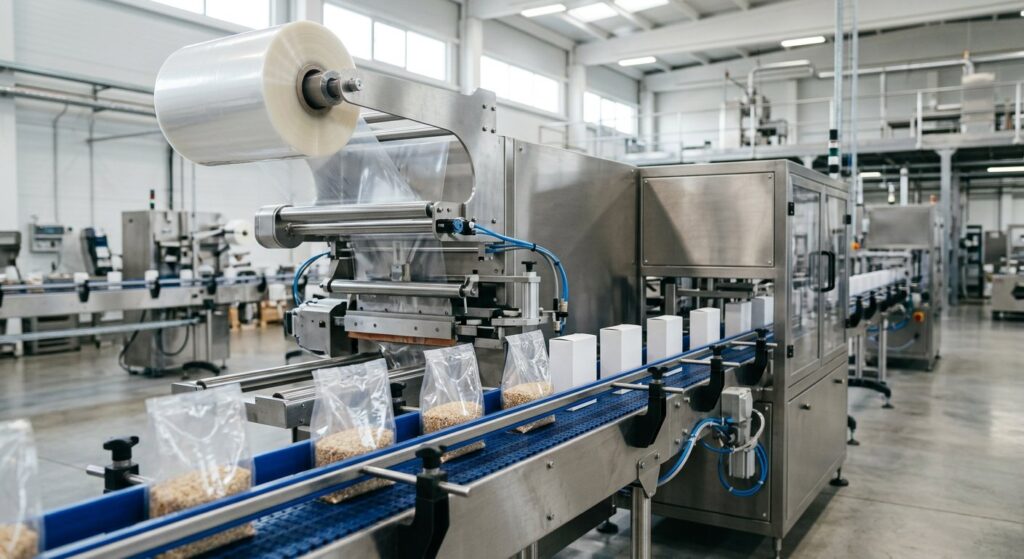
Packaging equipment is the machinery that turns a finished product into a shippable, sellable, shelf-ready package, and it is almost always the last stage of the production cycle, which means it inherits every upstream problem and amplifies every downstream cost. When packaging works, nobody inside the factory notices it; when it underperforms, the entire plant feels it, in labor bills for manual packing, in film and material waste, in inconsistent seals that generate returns, and in a line that can only ship as fast as its slowest station. That is why manufacturers across food, pharmaceuticals, cosmetics, chemicals, and consumer goods treat packaging automation as one of the highest-leverage investments on the floor, with modern machines running from a few dozen to well over a thousand packs per minute. This guide explains what packaging equipment actually encompasses, breaks down the nine machine families that do the work, and walks through the selection factors, product, format, speed, automation level, integration, and support, that separate a smart purchase from an expensive one, ending with a comparison table and the questions buyers ask most before committing.
Key Takeaways
- Packaging equipment is the final stage of production, responsible for forming, filling, sealing, wrapping, cartoning, and palletizing products at speed.
- The nine core machine families span primary packaging, VFFS, HFFS flow wrappers, blister, and filling, through secondary and end-of-line systems, cartoning, case packing, wrapping, and palletizing.
- Machine choice starts with the product, liquids, powders, granules, and solids each demand different filling and sealing technologies, and the packaging format decides the rest.
- Automation level should match production volume: semi-automatic machines suit short or variable runs, while fully automatic lines pay for themselves at scale.
- Integration with existing conveyors, coders, and inspection systems, plus supplier training and after-sales support, determines whether the line performs as promised.
What Is Packaging Equipment?
Packaging equipment is the broad category of machinery that handles any stage of enclosing a product for distribution, storage, sale, and use: forming the package, filling it with a measured dose, sealing it, printing codes and labels on it, grouping it into cartons and cases, and stacking it onto pallets. Modern systems handle products in rigid, semi-rigid, and flexible formats, and many also handle unpackaged items directly, from metal castings to bulk goods, making the packaging stage a genuine production function rather than an afterthought. Machines range from compact semi-automatic units where an operator loads each product, to fully automatic lines that run unattended from infeed to wrapped pallet, with speeds spanning roughly 10 to 1,200 packs per minute depending on the machine type and application. Because the packaging stage sits at the end of the line, its reliability defines the reliability the customer sees, dented cartons and loose seals are the only part of your process the market ever inspects.
Primary, Secondary, and End-of-Line
The industry divides the work into three tiers, and understanding them makes every purchase conversation easier. Primary packaging touches the product itself: the blister that holds a tablet, the pouch that holds coffee, the flow wrap around a candy bar. Secondary packaging groups primary packages for handling: the carton around a dozen tubes, the case around two dozen pouches. End-of-line packaging prepares shipments: case erecting and sealing, stretch wrapping, strapping, and palletizing. A single supplier who covers all three tiers can design a coherent line; a supplier who covers one tier well should at least speak fluently about the other two, because the interfaces between tiers are where lines jam.
9 Powerful Machines That Do the Work
1. Vertical Form-Fill-Seal Machines
VFFS machines are the volume kings of flexible packaging: they pull film from a roll, form it into a bag vertically around a filling tube, dose the product in, and seal it, all in one continuous motion. They excel with flowable products, snacks, rice, powders, granules, and frozen goods, and swapping the dosing system, an auger filler for powders, a multi-head weigher for granules, a liquid pump for sauces, lets the same frame handle a whole portfolio. Typical outputs run from 20 to 120 bags per minute, and because their consumable is rollstock film rather than pre-made pouches, their long-term material cost is the lowest in flexible packaging. For high-volume dry and flowable products, VFFS is usually the first machine a line is designed around. One detail separates a good purchase from a regret: the dosing system, not the forming tube, determines weight accuracy, and giveaway is money measured in tons per year.
2. Horizontal Flow Wrappers
HFFS flow wrappers take a product, feed it into a film web horizontally, and crimp-seal it into a pillow pack at extraordinary speed, routinely hundreds of packs per minute for items like biscuits, bars, bakery goods, and single-serve products. The motion suits products that are stable lying down, and the pillow pack is cheap, fast, and attractive on shelf. Flow wrappers are also the natural home of modified atmosphere flushing for freshness-critical foods, where the film seal traps a protective gas mix around the product. When speed per pack is the binding constraint on a line’s output, the flow wrapper is usually where the race is won. Buyers comparing wrappers should look past peak speed to real efficiency, because a wrapper rated for 300 packs per minute that jams for a tenth of every shift loses to a stable 250.
3. Premade Pouch Packaging Machines
Premade pouch machines open, check, fill, and seal pre-formed bags, stand-up pouches, and doypacks, and they exist because the market pays for packaging that rollstock machines cannot make: zipper closures, spouts, shaped silhouettes, and premium shelf presence. The mechanical sequence, pick, open, verify, fill, seal, is necessarily slower than continuous FFS, typically up to about 80 packs per minute, and the pouch material costs more per unit than film. Brands choose them anyway when positioning justifies it, because in crowded categories the package is the first advertisement the shopper sees. The trade between VFFS economics and pouch presentation is one of the clearest strategic decisions in packaging.
4. Blister Packing Machines
Blister packers form a plastic cavity, load the product, and seal it against a backing of foil or card, and they dominate pharmaceuticals plus sizable shares of food, hardware, and consumer goods. The format’s virtues are protection and compliance: each dose is individually sealed, tamper-evident, and printed with batch information, which is why regulators trust blisters for medicines. Machines range from compact laboratory units to high-speed lines producing thousands of blisters per minute, with forming, filling, sealing, and die-cutting integrated in one pass. Wherever unit-dose protection and visible product meet, blister equipment is the answer the industry standardized on.
5. Cartoning Machines
Cartoning machines erect folded cartons, load product or a primary package into them, and close them, tucking or gluing the flaps, at speeds from dozens to several hundred cartons per minute. They are the bridge between primary packaging and retail shelf: the blister goes into the carton, the sachet goes into the sleeve, the tube goes into the box, and the carton carries the branding the regulations require. Horizontal cartoners suit products loaded end-on, vertical cartoners suit dropping products like sachets or vials from above, and both integrate coding for batch and expiry data. Food, medicine, and cosmetics are their heartland industries.
6. Case Packing Machines
Case packers collect finished primary packages and load them into corrugated shipping cases, and they come in mechanical personalities to match the product: drop packers for sturdy goods, wrap-around packers for tight bundles, and robotic pick-and-place cells that handle delicate cartons and flexible pouches with vacuum fingers. Upstream of them, case erectors form flat blanks into boxes, and downstream, case sealers close and tape the flaps, together automating the entire corrugated journey. This is the tier where labor savings are most direct, because manual case packing is heavy, repetitive work that is hard to staff and easy to injure. A well-specified case pack line reliably pays back in labor, consistency, and damage reduction. Robotics have widened the choice further, since a single robotic cell can switch between formats with a recipe change, something mechanical packers accomplish more slowly.
7. Shrink Wrapping and Overwrapping
Shrink systems wrap products or bundles in loose film, then pass them through a heat tunnel where the film shrinks into a tight, protective skin, ideal for multipacks, bottled water bundles, and unitizing irregular shapes. Overwrapping machines take the more elegant path, folding film tightly around a box and heat-sealing it, producing the crisp, gift-store wrap familiar from cosmetics, pharmaceuticals, and premium confectionery. Both families protect against dust, moisture, and tampering while bundling units for distribution. They are also among the most cost-effective automations for mid-size producers, because the machinery is simple and the material is among the cheapest in the plant.
8. Labeling, Coding, and Inspection Systems
No package ships without its data, and this equipment tier applies it: pressure-sensitive labelers for front, back, and wrap-around labels; print-and-apply systems for pallet and case labels; thermal and inkjet coders for batch numbers, dates, and barcodes. Modern lines pair them with inspection devices, checkweighers, metal detectors, vision systems, that verify label presence, code quality, fill weight, and contaminant-free product before anything reaches a case. Regulatory industries treat this tier as mandatory rather than optional, and retailers increasingly do too, since a scannable, compliant package is the ticket to the shelf. The machines are smaller and cheaper than the rest of the line, and they prevent errors that cost more than everything else combined.
9. Palletizing and Complete Packaging Lines
At the end of the line, palletizers stack cases into stable shipping patterns: conventional high-speed palletizers excel on dedicated single-product lines, while robotic palletizers handle multiple case sizes and complex patterns on the same cell. Beyond individual machines lies the complete packaging line, where conveying, accumulation buffering, filling, packing, coding, and palletizing are engineered as one synchronized system, and accumulation zones absorb the micro-stoppages that would otherwise cascade into full-line halts. This is where supplier capability matters most, because a line is a system, not a catalog. JOCHAMP, a packaging machinery manufacturer with more than 20 years of experience, 15-plus mechanical engineers, and over 50 cooperating machinery factories, builds exactly this kind of tailored Packaging Equipment, carton packing machines, FFS machines, blister packers, wrapping machines, and integrated packaging production lines, certified under ISO 9001 and SGS with a two-year quality assurance, PLC-based controls, food-grade material options, and speeds from 10 to 1,200 packs per minute depending on model. For a manufacturer evaluating a line rather than a machine, a supplier of that profile, engineering depth, customization, certification, and support, is precisely the shortlist.
Packaging Equipment at a Glance
| Machine Family | Tier | Typical Products | Typical Speed | Signature Strength |
|---|---|---|---|---|
| VFFS | Primary | Snacks, powders, granules, frozen | 20-120 packs/min | Lowest material cost at volume |
| Flow wrapper (HFFS) | Primary | Bars, biscuits, bakery, confectionery | Up to 500+ packs/min | Highest speed per pack |
| Premade pouch | Primary | Premium snacks, coffee, pet food | Up to ~80 packs/min | Premium formats, zippers, spouts |
| Blister | Primary | Pharma, hardware, unit doses | High volume | Dose protection, compliance |
| Cartoner | Secondary | Blisters, tubes, sachets, cosmetics | 30-300+ cartons/min | Retail-ready branding |
| Case packer | Secondary | Grouped primary packages | Line-matched | Direct labor savings |
| Shrink/overwrap | Secondary-End | Multipacks, premium boxes | Line-matched | Protection and bundling |
| Label/coding/inspection | All tiers | Every package | Line-matched | Compliance and traceability |
| Palletizer/line | End-of-line | Cases, bundles | Line-matched | Shipping automation at scale |
Read the tier column before the speed column: matching the machine to the job matters more than any single number on a datasheet.
How to Choose the Right Packaging Equipment
Selection is a discipline, and the factors below carry most of the decision:
- Product characteristics: liquids, powders, granules, and solids demand different filling technologies; fragility, hygiene, and temperature sensitivity reshape the machine design around them.
- Packaging format: flexible film, pre-made pouches, cartons, and rigid containers each select their own machine family; decide the shelf presentation first, then the machine follows.
- Speed and capacity: size equipment to current output with headroom for growth, including shift patterns and seasonal peaks, because a line that runs at 100 percent today has no room for tomorrow’s order.
- Automation level: manual and semi-automatic machines win on flexibility and low capital for short or variable runs; fully automatic lines win decisively on labor cost, consistency, and throughput at scale.
- Changeover efficiency: multi-SKU facilities should demand tool-free adjustments, programmable recipes, and fast format changes, since changeover minutes are a hidden tax on every short run.
- Footprint and integration: measure the floor honestly, and evaluate how the machine connects to existing conveyors, coders, and upstream equipment; packaging machinery performs as part of a coordinated line, not in isolation.
- Support and training: PLC controls with intuitive interfaces, operator training, spare parts availability, and responsive after-sales service determine real-world uptime, especially for imported equipment.
Work through the list in order, because the earlier items eliminate more options than the later ones, and the final shortlist almost writes itself. Request a machine trial with your own product wherever possible, and treat the supplier’s application engineering, rather than the brochure, as the real product you are buying.
Frequently Asked Questions
What is packaging equipment?
It is the machinery that encloses products for distribution and sale, forming, filling, sealing, wrapping, labeling, cartoning, case packing, and palletizing, usually as the final stage of the production cycle.
How do I choose between semi-automatic and fully automatic machines?
Base it on volume and labor: semi-automatic machines suit small or highly variable production where flexibility matters, while fully automatic lines deliver lower unit costs, higher consistency, and minimal manual handling at sustained volume.
Which machine is best for powders and granules?
A VFFS machine with the right dosing system, an auger filler for powders or a multi-head weigher for granules, offers the best combination of speed, flexibility, and low material cost across flowable products.
What speed can packaging machines reach?
It depends on the family and application: modern systems run from around 10 to 1,200 packs per minute, with flow wrappers at the high end and premade pouch machines trading speed for premium formats.
Why does changeover time matter?
Every product or format switch stops the line, so facilities running many SKUs should prioritize tool-free adjustments and programmable recipes to reclaim uptime on every short run.
What support should I expect from a packaging machine supplier?
Expect operator training, documentation, PLC-based controls that simplify operation, spare parts availability, warranty terms such as two years, and responsive after-sales service, which for international buyers determines real uptime.
Conclusion
Packaging equipment decides, more quietly than any other investment, what your factory costs to run and what your customers think of your brand, because the last machine that touches the product is the one whose work everyone sees. The nine machine families above form a complete map of the territory, from the VFFS and flow wrappers that shape primary packages to the case packers, wrappers, coders, and palletizers that turn them into shipments, and the selection logic folds down to a handful of disciplined questions: what is the product, what is the format, what is the true volume, how much automation does the operation sustain, and who stands behind the steel. Manufacturers who answer those questions honestly end up with lines that run at their rated speed, change over without drama, and pay for themselves on a schedule; manufacturers who shortcut them donate their margin to spare parts and downtime. Specify the line around the product, buy from a supplier who engineers rather than assembles, and the packaging stage will do what great equipment always does, disappear into the rhythm of production.
Pingback: Roof Replacement: 7 Warning Signs That Destroy Your Home
Pingback: Practical Pump Evidence: 7 Critical Insights
Pingback: Housing Market in Hawaii: 7 Trends That Crush Investors