
A trading platform solution provides the technology businesses need to deliver electronic trading functionality through web, desktop, mobile, or connected financial systems. Depending on its scope, a...
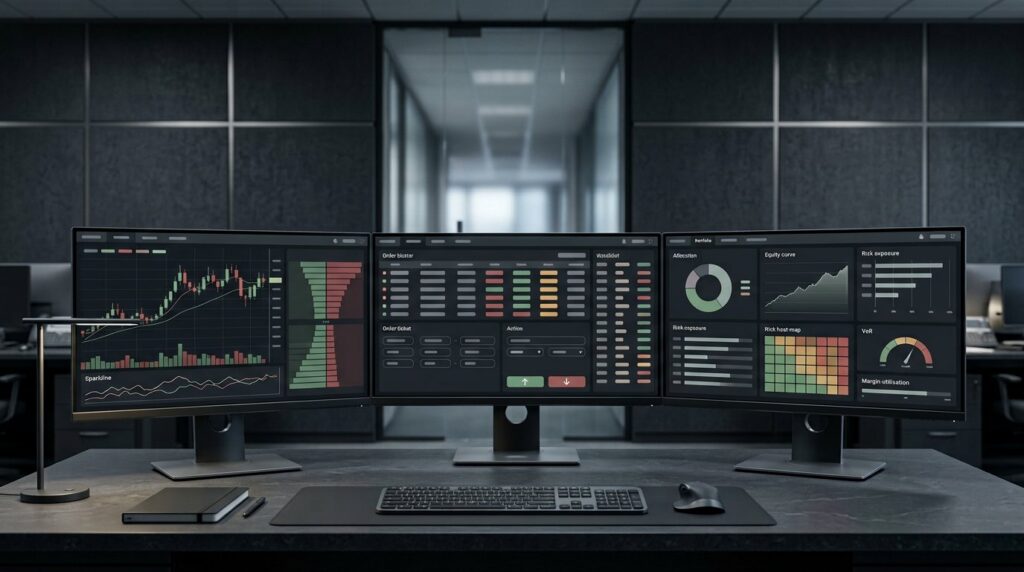
A trading platform solution provides the technology businesses need to deliver electronic trading functionality through web, desktop, mobile, or connected financial systems. Depending on its scope, a platform can combine market data, order entry, execution workflows, portfolio information, risk controls, reporting, administration, APIs, and integrations within one technology environment. Brokers, financial institutions, fintech companies, exchanges, and other market participants have different requirements, which makes platform selection a significant technology and operational decision. Security, reliability, regulatory obligations, scalability, asset coverage, usability, and total cost should all be assessed before an organization builds, buys, or licenses trading technology.
What Is a Trading Platform Solution?
A trading platform is a software environment that enables users or financial organizations to perform functions associated with trading financial instruments.
Its exact role depends on the business model.
A retail brokerage platform, for example, may provide customers with charts, watchlists, order tickets, portfolio information, alerts, account tools, and educational resources. Institutional systems may place greater emphasis on sophisticated order workflows, connectivity, execution management, permissions, data integration, and risk controls.
Some providers deliver complete white label platforms, while others supply modular components or APIs that businesses integrate into their own applications.
Importantly, software alone does not establish a regulated brokerage or financial service. Licensing, regulatory permissions, custody arrangements, market access, clearing, compliance, and other obligations depend on the activities performed and applicable jurisdictions.
9 Powerful Benefits of a Trading Platform Solution
The benefits depend on architecture and implementation, but a well designed system can centralize important parts of electronic trading operations.
1. Trading Platform Solution Infrastructure Centralizes Operations
Fragmented technology can force users and employees to move repeatedly among separate applications.
A unified platform can bring together relevant workflows such as account information, market data, order handling, trading interfaces, reporting, and administrative controls.
Centralization may reduce operational friction when systems are properly integrated.
It does not mean every function should be built into one monolithic application. Modern architecture often relies on specialized services connected through carefully designed APIs and messaging infrastructure.
2. Real Time Market Data Supports Trading Decisions
Current market information is fundamental to many trading applications.
Depending on the market and data licence, platforms may present bid and ask prices, last traded prices, market depth, historical data, charts, reference information, and news.
Market Data Within a Trading Platform Solution
Reliable market data architecture must manage incoming feeds, normalization, distribution, permissions, and display.
Market Data Licensing Matters
Exchange and vendor data may be subject to contractual restrictions, usage classifications, redistribution rules, and fees.
A platform provider should not assume that technical access automatically grants the legal right to redistribute market information to end users.
3. Order Management Supports Efficient Execution Workflows
An order management system can receive, validate, route, update, and record orders.
The exact process varies according to asset class and market structure.
Typical order types may include market, limit, and stop related instructions where supported by the venue and broker.
Businesses should clearly explain how orders operate because order types do not guarantee a particular execution price in all market conditions.
4. Multiple Asset Classes Can Be Supported
A modern platform may support equities, exchange traded funds, derivatives, foreign exchange, fixed income instruments, digital assets, or other products.
Asset coverage should never be evaluated by quantity alone.
Each market can involve different order models, trading hours, settlement practices, reference data, regulatory obligations, pricing conventions, and risk characteristics.
Supporting an additional asset class properly can therefore require significantly more than adding another price chart to the user interface.
5. APIs Enable Platform Integration
Application programming interfaces allow separate systems to exchange instructions and information in structured ways.
Trading APIs can connect front ends, market data services, order systems, customer relationship management tools, back office software, reporting systems, and other infrastructure.
API Based Trading Platform Solution Architecture
REST APIs are commonly used for request and response interactions, while WebSocket or similar streaming technologies may deliver rapidly changing information.
API Security Is Essential
Strong authentication, authorization, encryption, rate controls, monitoring, credential management, and secure software development practices are important.
APIs that permit financial transactions deserve particularly rigorous security controls because compromised credentials or authorization errors can cause substantial harm.
6. Scalability Supports Business Growth
A platform may begin with a modest customer base and later need to accommodate substantially more users, instruments, orders, messages, and data.
Scalable architecture is designed with this growth in mind.
Scaling involves more than adding servers. Databases, networking, market data distribution, queues, APIs, session management, monitoring, and external dependencies can all become bottlenecks.
Performance should therefore be tested under realistic loads.
7. Risk Controls Can Be Integrated Into Workflows
Depending on the business and asset class, a platform can incorporate controls relating to order size, available funds, positions, exposure, price thresholds, user permissions, and other defined conditions.
These mechanisms can help organizations enforce internal policies and applicable trading controls.
Risk controls should be designed by people who understand the relevant market and regulatory requirements.
They are not a substitute for broader governance, compliance, supervision, or human judgment.
8. White Label Technology Can Reduce Initial Development Requirements
A white label trading platform enables a business to deploy existing technology under an agreed branding and configuration model.
This can reduce the amount of proprietary software that must be developed from the beginning.
The tradeoff is dependence on an external technology provider.
Contract terms, customization limits, data access, integration capabilities, upgrade policies, service continuity, vendor lock in, and exit arrangements require careful evaluation.
9. Analytics Can Improve Operational Visibility
Trading systems produce substantial operational data.
Dashboards and reporting can help authorized teams monitor platform performance, order flows, user activity, system errors, risk indicators, and other relevant metrics.
Analytics can also help identify technical friction within user journeys.
Organizations should distinguish operational analytics from financial predictions. Historical activity does not provide certainty about future market outcomes.
Core Components of a Trading Platform Solution
The architecture of a trading product depends on what the platform is expected to accomplish.
A typical system can incorporate front end applications, backend services, databases, market connectivity, market data, order management, authentication, reporting, monitoring, and administrative functionality.
Trading User Interface
The user interface is the most visible part of the product.
A retail oriented interface may offer:
• Watchlists
• Charts
• Order tickets
• Account information
• Position views
• Transaction history
• Alerts
• Search functionality
• Relevant disclosures
Good design should emphasize clarity rather than displaying every possible feature simultaneously.
Financial interfaces deserve special attention because ambiguous controls can have meaningful consequences.
Backend Trading Infrastructure
Backend systems process business logic and communicate with external infrastructure.
Reliability Within a Trading Platform Solution
Critical components should be designed with failure scenarios in mind.
Resilience and Recovery
Organizations may need redundancy, backups, disaster recovery processes, incident response procedures, monitoring, and tested restoration plans appropriate to their risk profile.
Simply describing an application as cloud based does not automatically make it resilient.
Types of Trading Platform Solutions
The term trading platform covers several technology models.
Retail Trading Platforms
Retail platforms are designed primarily for individual customers.
Ease of use, mobile accessibility, account information, straightforward order entry, education, and transparent disclosures can be particularly important.
Products involving leverage or complex derivatives require careful risk communication.
Institutional Trading Platforms
Institutional tools can prioritize sophisticated execution workflows, high capacity market data, compliance functionality, reporting, permissions, and integration with existing systems.
Different institutional participants also have different needs, so there is no universal institutional platform configuration.
Proprietary Trading Platforms
Proprietary trading firms may build or purchase technology optimized around their own strategies, workflows, risk systems, and connectivity requirements.
Performance requirements can be highly specialized.
White Label Trading Platform Solution
White label products can provide preexisting front end and backend functionality while allowing agreed branding and configuration.
Custom Trading Platform Development
Custom development provides greater control but usually requires more engineering effort, testing, security management, maintenance, and ongoing product ownership.
Trading Platform Solution Architecture
Platform architecture should reflect expected workloads and operational risks.
Many modern financial applications use service based or microservice architecture, but this pattern is not automatically appropriate for every company.
Smaller systems can sometimes benefit from simpler architectures that are easier to operate.
Cloud Based Trading Platforms
Cloud infrastructure can provide flexible computing resources, managed services, automation, and geographic deployment options.
Financial organizations still remain responsible for appropriately managing security, resilience, data governance, vendor risks, and regulatory obligations.
A cloud provider secures parts of the underlying environment, while customers remain responsible for many aspects of their applications, identities, configurations, and data.
Microservices Architecture
Microservices separate functionality into independently managed services.
Potential benefits include service isolation, independent deployment, and targeted scaling.
Challenges of Distributed Trading Systems
Distributed architectures introduce additional operational complexity.
Observability Is Critical
Logging, metrics, distributed tracing, alerting, and incident management help engineering teams understand how services behave across complex environments.
Without adequate observability, diagnosing intermittent transaction problems can be difficult.
Security for a Trading Platform Solution
Security must be considered throughout the platform lifecycle.
Financial systems can be attractive targets for account takeover, credential theft, fraud, malicious automation, ransomware, denial of service attacks, and exploitation of application vulnerabilities.
Security controls should be based on risk assessment and recognized security practices.
Identity and Access Management
Authentication determines who a user is, while authorization determines what that user can access or perform.
Multifactor authentication can strengthen account security when implemented appropriately.
Privileged administrative accounts usually require even stricter safeguards.
Data Encryption
Sensitive information should be protected appropriately during transmission and storage.
Transport Layer Security is widely used to protect data transmitted across networks.
Key management is just as important as selecting encryption technology.
Secure Trading Platform Development
Security should be incorporated into design, coding, testing, deployment, and maintenance.
Vulnerability Management
Organizations should maintain processes for identifying, prioritizing, patching, and validating security vulnerabilities.
Independent penetration testing can complement internal security controls but should not be viewed as a one time guarantee of security.
Regulatory Compliance and Trading Platforms
Regulatory requirements depend heavily on jurisdiction, client type, financial instruments, and business activities.
Examples of potentially relevant obligations include customer identification, anti money laundering controls, sanctions screening, market conduct monitoring, transaction reporting, record keeping, privacy, cybersecurity, and consumer protection.
Not every obligation applies to every business.
Know Your Customer Workflows
Where required, KYC processes help regulated businesses establish and verify customer identities.
These workflows can involve identity documents, electronic verification, screening, record keeping, and additional checks based on risk.
Anti Money Laundering Controls
AML frameworks may involve customer due diligence, transaction monitoring, escalation processes, and regulatory reporting.
Compliance Cannot Be Solved by Software Alone
Technology can support compliance workflows, but regulated organizations remain responsible for their legal obligations. Qualified legal and compliance professionals should determine applicable requirements.
Trading Platform Solution Performance and Latency
Speed can be important in electronic trading, but performance requirements differ considerably.
An institutional electronic execution environment may care about extremely low latency, while a retail investing application may prioritize reliability, clarity, and consistent responsiveness.
The engineering goal should match the actual product.
Measuring Platform Latency
Teams can measure response times across different parts of an order lifecycle.
Metrics may cover client requests, internal processing, external routing, acknowledgements, and market data distribution.
Avoid Misleading Speed Claims
A platform should not advertise execution speeds that its own systems cannot substantiate.
Execution Depends on External Systems Too
Network conditions, brokers, venues, liquidity, order characteristics, and market conditions can affect execution independently of a platform’s user interface.
Mobile Trading Platform Solutions
Mobile trading has become an important access channel for many users.
A mobile application should prioritize clear navigation, secure authentication, stable data delivery, readable charts, order confirmation, and useful account information.
Screen limitations make interface design particularly important.
Trading Platform Solution for iOS and Android
Businesses can develop native applications or use cross platform technology.
Neither approach is inherently superior for every project.
The decision should account for performance, development resources, required device functionality, maintenance, accessibility, and long term product strategy.
Mobile Security
Mobile applications should use platform appropriate secure storage and follow current security guidance.
Do Not Store Sensitive Credentials Insecurely
Tokens, passwords, API secrets, and cryptographic material require careful handling. Sensitive information should not simply be embedded into application code where it can be extracted.
Market Data Integration
Accurate market data is central to a trading interface.
Data can originate from exchanges, brokers, specialized vendors, liquidity providers, and other approved sources.
Real Time Versus Delayed Data
Users need to know when displayed information is delayed.
Using old market data while presenting it as real time can lead to poor decisions and potential compliance concerns.
Corporate Actions and Reference Data
Prices alone are not sufficient for many markets.
Data Quality Controls
Symbol changes, splits, dividends, instrument expirations, identifiers, trading calendars, and other reference information may need to be handled correctly for accurate portfolio and market displays.
Risk Management Features
Risk controls vary by platform and regulatory context.
Possible functionality includes:
• Order validation
• Position limits
• Exposure limits
• Price reasonability checks
• Buying power verification
• User permissions
• Margin monitoring where applicable
• Administrative alerts
• Audit records
For leveraged products, risk management becomes particularly important because losses can develop quickly.
Automated controls should also be tested for failure scenarios.
Reporting and Analytics
Trading technology may require reporting for customers, internal teams, counterparties, or regulators.
Reports can include order history, transactions, account activity, holdings, fees, performance information, and operational records.
Accuracy is critical.
Audit Trails Within a Trading Platform Solution
Audit records help organizations investigate events and reconstruct important actions.
Timestamping and Record Integrity
Accurate timestamps and appropriate record retention can be essential for particular regulated activities.
Requirements Vary by Jurisdiction
Regulatory reporting specifications can differ significantly between countries and market structures. Businesses should obtain professional compliance guidance for the markets they serve.
Building Versus Buying a Trading Platform Solution
One of the most important technology decisions is whether to build software internally or license an existing product.
Building provides greater control over intellectual property, architecture, integrations, and roadmap.
It also transfers significant responsibility to the business for engineering, security, testing, operations, and maintenance.
Buying can accelerate deployment but introduces vendor dependency.
Evaluating a Trading Technology Vendor
Review the provider’s architecture, security program, service history, product roadmap, integration options, documentation, support capabilities, data handling, and contractual commitments.
Service Level Agreements
An SLA can define specific service expectations such as availability targets and support response commitments.
Understand SLA Exclusions
Businesses should understand how availability is calculated, which systems are covered, planned maintenance rules, exclusions, remedies, and incident notification processes.
Trading Platform Solution Costs
Costs vary dramatically according to complexity.
A simple interface connected to existing brokerage infrastructure is fundamentally different from building an end to end multi asset trading ecosystem.
Potential costs include software licensing, development, infrastructure, market data, integrations, cybersecurity, compliance tooling, testing, support, maintenance, and third party connectivity.
White label systems may involve setup fees, monthly fees, transaction charges, user based pricing, or revenue sharing arrangements.
Total cost of ownership is usually more informative than the initial implementation price.
How to Select the Right Trading Platform Solution
Start by defining business requirements rather than requesting the longest available feature list.
Identify customer types, jurisdictions, asset classes, expected trading volumes, market data needs, integrations, security requirements, regulatory obligations, and growth expectations.
A structured proof of concept can then validate important functionality before a wider launch.
Questions to Ask a Trading Platform Provider
Important questions include:
• Which asset classes and markets are supported?
• What market connectivity is available?
• How is customer and transaction data protected?
• Which APIs and integration methods are provided?
• How is platform availability monitored?
• What disaster recovery processes exist?
• How are software changes tested?
• What customization is possible?
• Who owns customer and operational data?
• How can data be exported if the contract ends?
• What support is available during incidents?
• How is pricing calculated?
Vendor answers should be supported by meaningful documentation where appropriate.
AI in Trading Platform Solutions
Artificial intelligence can support areas such as customer service, anomaly detection, document processing, analytics, surveillance workflows, and user experience.
AI generated trading recommendations require greater caution.
Financial markets are uncertain, and historical patterns cannot guarantee future returns.
AI Powered Trading Tools
Where AI functionality influences financial decisions, firms should consider explainability, testing, monitoring, data quality, model risk, customer disclosures, and applicable regulations.
Avoid Guaranteed Trading Outcomes
No legitimate trading technology can guarantee profits or eliminate financial risk.
Responsible AI Integration
Human oversight, appropriate governance, security, validation, and ongoing monitoring should form part of material AI deployments within financial services.
Frequently Asked Questions
What is a trading platform solution?
A trading platform solution is technology that supports electronic trading functions such as market data, order entry, execution workflows, portfolios, risk controls, reporting, and integrations.
What features should a trading platform solution include?
Requirements vary, but common features include secure authentication, market data, order management, risk controls, reporting, APIs, monitoring, and administrative tools.
Is a white label trading platform better than custom development?
Neither is universally better. White label technology can accelerate deployment, while custom development provides greater control but requires substantially more engineering and maintenance.
How secure should a trading platform be?
Security should reflect the sensitivity and risk of financial operations, including strong authentication, encryption, access controls, monitoring, secure development, and incident response.
Can a trading platform guarantee profitable trades?
No. Trading involves financial risk, and software cannot guarantee profits or eliminate losses caused by market movements, liquidity, execution conditions, or user decisions.
How much does a trading platform solution cost?
Costs depend on asset classes, users, integrations, market data, customization, infrastructure, regulatory requirements and whether the system is built, licensed, or white labeled.
Conclusion
A trading platform solution can provide the technological foundation for secure market access, order workflows, data delivery, risk controls, analytics, and financial service integrations. Choosing the right solution requires careful evaluation of architecture, security, regulatory requirements, scalability, vendor reliability, and total cost of ownership. Organizations should prioritize dependable infrastructure and transparent functionality over exaggerated performance or profitability claims. With appropriate governance and professional compliance input, a well designed platform can support resilient and scalable trading operations