
Choosing the right trampolines for garden spaces requires balancing available lawn dimensions, jumper age ranges, structural build quality, and protective enclosure design. A well-matched backyard...
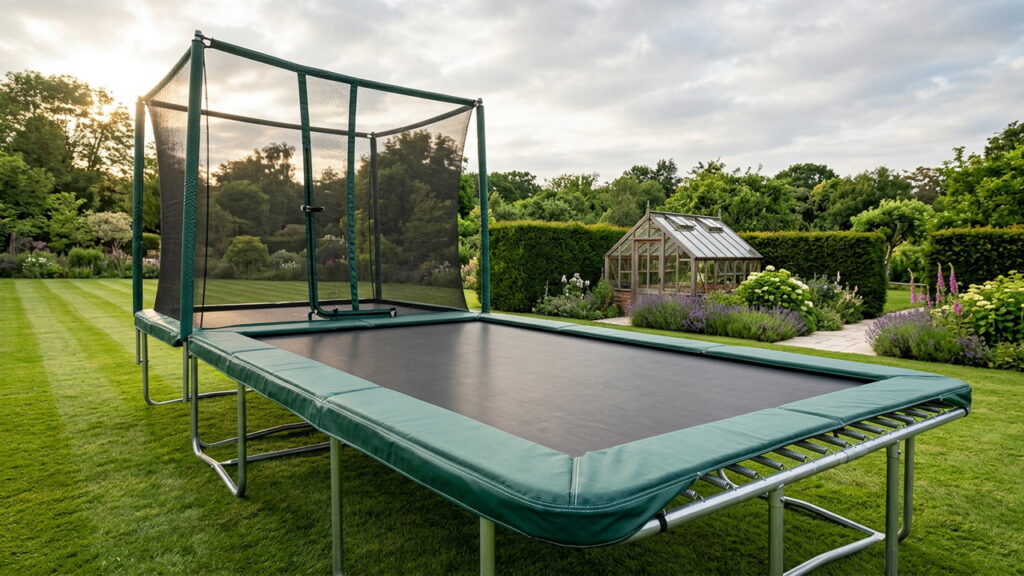
Choosing the right trampolines for garden spaces requires balancing available lawn dimensions, jumper age ranges, structural build quality, and protective enclosure design. A well-matched backyard rebounder turns unused outdoor space into an active recreation zone, provided the frame, springs, and safety net suit your specific property layout and household routines.
Not all trampolines for garden use are built to the same engineering or weatherproofing standards. This guide explains how to measure your outdoor clearance zone, compare round and rectangular frames, evaluate above-ground and in-ground installations, and inspect safety certifications before you buy.
Quick Buying Summary for Trampolines for Garden
Selecting reliable trampolines for garden setups starts with measuring the total footprint rather than looking only at the jumping mat diameter. Every unit needs a level surface, a dedicated safety perimeter free from hard obstacles, and sufficient overhead clearance from tree limbs or utility cables.
Once you confirm your available yard space, compare models by their frame steel treatment, enclosure net attachment method, single-user weight limit, and compliance with recognized domestic safety standards. Prioritizing structural thickness and UV-resistant materials ensures that trampolines for garden environments withstand year-round exposure to rain, frost, and sunlight.
Use this initial checklist before comparing specific models
- Measure your available lawn area and subtract the mandatory safety clearance zone around the entire frame perimeter.
- Decide between a traditional freestanding unit with an enclosure net and a flush in-ground installation that requires excavation.
- Match the frame shape and bounce response to the primary users, whether young children, teenagers, or adults.
- Confirm that the enclosure net attaches inside the spring pad or uses a springless design to keep feet away from metal coils.
- Check the manufacturer specifications for hot-dip galvanized steel, UV-stabilized polypropylene mats, and verified safety testing.
- Plan for wind anchoring kits, weather covers, and safe winter maintenance before completing your purchase.
How to Measure Your Yard for Trampolines for Garden
Accurate site measurement is the most important preparation step when shopping for trampolines for garden installation. Buyers often measure only the advertised frame width, overlooking the extra lateral space required to prevent jumpers from contacting fences, walls, or garden structures if they push against the safety net.
Start by staking out the proposed location on your lawn with a tape measure and string. When evaluating different trampolines for garden plots, always check both the outer frame dimensions and the manufacturer’s required clear zone around and above the equipment.
Calculating the Safe Perimeter Clearance Zone
Safety guidance for domestic trampolines for garden use typically calls for a clear buffer zone of at least 1.5 to 2.5 meters around the entire outer edge of the frame. This unobstructed border ensures that if a jumper falls against the flexible enclosure netting, the net can stretch outward without striking a brick wall, timber fence, garden shed, or patio edge.
To calculate the true space needed for trampolines for garden placement, add twice the recommended clearance distance to the frame diameter or width. For example, a 10-foot round frame measuring roughly 3 meters across requires a total clear lawn circle of about 6 to 7 meters in diameter when a 1.5-meter to 2-meter safety buffer is included on all sides.
Never squeeze large trampolines for garden use into narrow side yards where the net brushes against boundary panels or prickly hedges. Choosing a slightly smaller frame that preserves a generous safety perimeter is always safer than installing an oversized model with zero side clearance.
Evaluating Ground Surfaces and Overhead Obstacles
The surface beneath trampolines for garden setups must be firm, energy-absorbing, and level across the entire footprint. Natural grass, cushioned play bark, or purpose-made impact mulch provide a forgiving base, whereas concrete patios, tarmac driveways, and hard stone paving should never sit directly under a domestic rebounder.
Slope is another critical factor when siting trampolines for garden stability. Even a gentle gradient can cause the frame legs to bear uneven weight and subtly pull jumpers toward the lower side of the mat, so use a spirit level and adjust the turf or leg trenches as permitted by the manual rather than propping legs up on loose bricks.
Look straight up from your proposed installation spot to check for overhead hazards before finalizing the location. Domestic trampolines for garden recreation need at least 7 to 8 meters of vertical clearance from the ground to prevent jumpers from reaching overhanging tree branches, washing lines, pergolas, or overhead electrical and telecom wires.
Comparing Shapes of Trampolines for Garden
| Frame Shape | Bounce Characteristics | Best Garden Layout | Typical User Profile |
|---|---|---|---|
| Round | Even spring tension that naturally guides jumpers back toward the center | Open square lawns or central backyard play areas | Younger children, casual family play, and first-time buyers |
| Rectangular | Independent spring activation offering a higher, more uniform lift across the bed | Long, narrow gardens or spaces running alongside a lawn border | Older children, teenagers, gymnasts, and experienced jumpers |
| Oval | Elongated jumping zone combining gentle inward guidance with extra length | Medium-width yards that cannot fit a wide circle | Families wanting a longer bounce track without high-rebound corners |
| Square | Spacious diagonal jumping area with balanced corner-to-corner tension | Structured corner plots with full safety clearance on all four sides | Households seeking maximum mat area within a compact footprint |
Round Models for Everyday Family Jumping
Round frames remain the most widely sold trampolines for garden use because their circular geometry pulls every spring equally toward the middle of the mat. When a jumper lands slightly off-center, the uneven stretch naturally redirects them back toward the middle, which helps younger users stay away from the perimeter.
Because circular frames distribute structural loads evenly around a continuous ring, they often require lighter steel tubing than comparably sized cornered frames. This makes round trampolines for garden buyers an economical and straightforward option for general outdoor play and light exercise.
Keep in mind that a circular footprint consumes equal width and depth on your lawn. If you are comparing round trampolines for garden plots that are long and narrow, the width of the yard will limit the maximum diameter you can safely install.
Rectangular and Oval Designs for Narrow Lawns
Rectangular trampolines for garden installations mimic the geometry of gymnastic equipment by engaging springs at different rates depending on where the jumper lands. Because not all springs stretch at the exact same moment, the mat delivers a lively, consistent bounce across both the center and the ends of the bed.
To handle the concentrated stress at the four corners, rectangular trampolines for garden use require heavier-gauge steel frames and reinforced corner joints. That extra steel adds to the purchase price and total weight, but the straight edges fit much more neatly parallel to lawn boundaries than a wide circle.
Oval trampolines for garden spaces offer a practical middle ground between circular and rectangular engineering. Their curved ends eliminate sharp corner stress while elongating the jumping bed, giving children a longer active zone that fits comfortably into medium-width urban and suburban gardens.
Square Units for Corner Garden Layouts
Square trampolines for garden settings provide up to twenty percent more usable jumping surface than a round model of the same width. They fit neatly into squared-off landscaping designs while still requiring the full safety clearance zone between the frame and any adjacent fence or wall.
Above-Ground Versus In-Ground Trampolines for Garden
Beyond frame shape, you must decide whether the jumping mat will sit elevated on steel legs or flush with your lawn surface. Both above-ground and sunken trampolines for garden installations have specific site preparation, drainage, and safety requirements.
Traditional Freestanding Frames
Freestanding above-ground models are the most accessible trampolines for garden owners because they assemble directly on top of a level lawn without earthworks. Elevated frames typically stand between 60 and 95 centimeters off the ground, giving the jumping mat plenty of vertical room to flex downward under a jumper’s weight.
Because the mat sits high above the turf, freestanding trampolines for garden use should always include a full-height safety enclosure net and a stable access ladder for smaller children. They can also be repositioned across the lawn when mowing grass or moved to a new house if your family relocates.
The main trade-off with elevated trampolines for garden settings is visual impact. A tall black safety net and steel frame can dominate the view in a compact backyard, which leads some homeowners to explore sunken alternatives.
In-Ground and Flat-Ground Installations
In-ground trampolines for garden landscaping sit over a purpose-dug pit so that the frame rests level with or just a few centimeters above the surrounding grass. By lowering the mat to lawn height, these models blend seamlessly into garden views and remove the need to climb a ladder to enter the jumping area.
Never bury a standard above-ground frame in a hole, as ordinary frames lack retaining walls to hold back damp soil and have no venting system for trapped air. Purpose-built in-ground trampolines for garden installations include integrated retaining panels and vented safety pads or porous mats that allow air underneath the bed to escape during each bounce.
Even when the mat sits flush with the lawn, many families still fit a safety enclosure net to in-ground trampolines for garden use. A sunken bed reduces the drop height to the grass, but an enclosure net still prevents jumpers from landing awkwardly on the surrounding turf or rolling onto nearby garden borders.
Drainage and Soil Retention Planning
Installing sunken trampolines for garden plots requires checking your local water table and soil composition before digging. Heavy clay soil or high groundwater can turn an unlined pit into a waterlogged basin after heavy rain, which accelerates corrosion and ruins bounce performance.
Plan a gravel soakaway base at the bottom of the excavation or install a drainage pipe or sump pump if your garden holds standing water in winter. Consulting a qualified landscaper helps ensure that in-ground trampolines for garden installations remain dry, stable, and structurally sound over many seasons.
Frame, Spring, and Mat Engineering to Inspect
The lifespan and bounce feel of trampolines for garden use depend heavily on the metallurgy of the frame, the design of the suspension system, and the weave of the jumping mat. Reviewing technical specifications protects you from thin-walled frames that rust or warp after a single wet winter.
Galvanized Steel Frames and Joint Construction
Look for trampolines for garden durability that use hot-dip galvanized steel on both the inside and outside surfaces of the frame tubes. Hot-dip galvanization coats the steel in a thick protective layer of zinc, whereas cheaper electro-plated or paint-only finishes can flake off and allow internal rust to weaken the legs from the inside out.
Steel wall thickness is equally important when comparing trampolines for garden strength. Quality domestic frames generally use steel tubing with a wall thickness between 1.5 millimeters and 2.5 millimeters, with larger rectangular units requiring the thickest gauge to prevent frame flex during energetic bouncing.
Inspect how the top rail sections join to the vertical leg extensions on trampolines for garden frames. Welded T-sockets, press-fitted reinforced brackets, or heavy bolt-free interlocking joints provide much greater torsional rigidity than thin stamped metal couplings held together by a single light screw.
Coil Springs Versus Springless Tension Systems
Traditional trampolines for garden recreation use high-tensile galvanized steel coil springs to connect the jumping mat to the outer frame ring. Longer tapered springs—often measuring between 175 millimeters and 215 millimeters—stretch more progressively than short stubby springs, delivering a smoother, deeper bounce that is gentler on knees and ankles.
Springless trampolines for garden safety replace metal coils with flexible composite fiberglass rods positioned beneath the jumping surface or elastic webbing straps woven around the perimeter. Because there are no metal springs sitting level with the mat, springless designs eliminate pinch points and maximize usable jumping space inside the net.
Both systems perform well when engineered properly for trampolines for garden use. Coil-spring models are typically easier to repair individually if a single spring stretches over time, while composite-rod systems offer a sleek profile and remove hard metal edges from the immediate jumping periphery.
Understanding Single-User Weight Ratings
Every reputable manufacturer assigns a maximum single-user weight rating to its trampolines for garden models, along with a much higher static structural test load. The single-user weight limit indicates the heaviest individual who can jump hard in the center of the mat without bottoming out and touching the ground or over-stretching the springs.
When comparing trampolines for garden capacities, select a weight rating that comfortably exceeds the weight of the heaviest person in your household who will use the equipment. Even if a model has a high structural test rating, domestic safety rules strictly advise allowing only one person on the mat at a time to prevent mid-air collisions.
Safety Enclosures, Padding, and Standards
| Safety Component | Design Options to Compare | Primary Protective Benefit | What to Verify Before Buying |
|---|---|---|---|
| Enclosure Net Position | Inside-mounted net versus outside-mounted net | Inside nets separate the jumper completely from the springs and frame | Confirm net attaches directly to the mat edge inside the spring pad |
| Enclosure Poles | Curved or bowed poles versus straight padded poles | Curved poles hold the netting taut and away from the metal upright tubes | Check for thick closed-cell foam sleeves and weather-resistant PVC covers |
| Entry Doorway | Overlapping self-closing walk-through entry versus zippered door with clips | Overlapping entries cannot be left unzipped by forgetful jumpers | Inspect stitching strength and heavy-duty safety buckles on zippered doors |
| Frame and Spring Pad | Thick closed-cell EPE or PE foam encased in UV-treated PVC vinyl | Cushions accidental contact with the steel ring and spring hooks | Look for pad thickness of 20mm to 30mm and secure tie-down straps |
Inside-Mounted Versus Outside-Mounted Nets
Safety nets on trampolines for garden setups generally attach in one of two places. An inside-mounted net threads directly to the outer perimeter of the jumping mat, placing the metal springs and steel frame completely outside the netted jumping enclosure.
An outside-mounted net fastens around the outer rim of the steel frame, which leaves the padded springs inside the play space. While an outside net feels slightly roomier on compact trampolines for garden use, an inside-mounted net provides superior protection by preventing a jumper’s feet from sliding under the safety pad into the spring gap.
Also examine the entryway and pole structure when evaluating trampolines for garden enclosures. Overlapping L-shaped or tunnel entries close automatically behind the user, whereas zippered openings require active supervision to ensure children close the zip and fasten the safety clips before jumping.
Checking Safety Certifications and Padding Density
Always verify that trampolines for garden use carry independent certification to recognized domestic toy and equipment standards, such as EN 71-14 in the UK and Europe or ASTM F381 in the United States. These standards test structural stability, enclosure impact resistance, padding coverage, pinch-point elimination, and clear safety labeling.
Inspect the spring padding specifications closely even on inside-netted trampolines for garden models. High-grade pads use closed-cell polyethylene foam at least 20 to 30 millimeters thick wrapped in heavy-duty, UV-resistant PVC tarpaulin rather than thin woven plastic that splits and absorbs rainwater after one summer.
Check the jumping mat and enclosure net materials as well. The most durable trampolines for garden weather exposure use UV-stabilized polypropylene weave for the bed, with multiple rows of heavy perimeter stitching securing the V-rings against tearing.
Pros and Cons of Installing Trampolines for Garden
Weighing the practical benefits and ongoing responsibilities helps households decide whether backyard rebounding equipment fits their outdoor lifestyle. Review these advantages and trade-offs before ordering trampolines for garden installation.
Pros of trampolines for garden use
- Encourages children and adults to spend active time outdoors away from indoor screens.
- Supports cardiovascular fitness, balance, coordination, and core stability right at home.
- Provides years of repeatable backyard entertainment once properly assembled and anchored.
- Available in round, rectangular, oval, and in-ground configurations to fit diverse garden shapes.
- Modern inside-netted and springless designs significantly reduce contact with frames and springs.
Cons of trampolines for garden use
- Requires a substantial level footprint plus a mandatory 1.5-meter to 2.5-meter clear safety perimeter.
- Demands active adult supervision and strict enforcement of the single-jumper rule to prevent injuries.
- Freestanding frames and tall enclosure nets can visually dominate smaller backyards and shade grass beneath.
- High winds can lift or overturn unanchored above-ground units if storm tie-down kits are not installed.
- Fabrics, foam pads, and nets gradually degrade under UV light and frost, requiring periodic replacement parts.
Step-by-Step Assembly and Wind Anchoring Guide
Assembling trampolines for garden safety is a two-person job that requires patience, protective gloves, and adherence to the manufacturer’s sequence. Rushing the build or stretching springs in the wrong order can warp the frame or damage the mat rings.
- Clear and level the chosen lawn area, confirming that both the perimeter buffer zone and vertical overhead space meet safety requirements.
- Lay out all frame tubes, leg bases, springs, and enclosure parts on the grass and verify every component against the instruction manual parts list.
- Assemble the base legs and top rail ring firmly, ensuring all locking pins or bolts click or tighten completely into position.
- Attach the jumping mat on spring-based trampolines for garden setups using the quarter-point cross-tension method—hooking springs at the twelve, six, three, and nine o’clock positions first so tension stays balanced.
- Secure the protective spring padding tightly over the coils and frame ring using all elastic ties or straps so the pad cannot shift during use.
- Erect the enclosure poles and attach the safety net according to the manual, checking that the net sits taut with no gaps at the mat edge.
- Screw heavy-duty auger wind stakes deep into the soil around the frame legs and strap the main top rail down to prevent wind uplift during storms.
Year-Round Maintenance and Winter Weather Care
Regular inspection extends the working life of trampolines for garden environments and catches wear before it creates a safety hazard. At the start of each month during peak jumping season, check that wind anchor straps remain tight, frame joints sit flush, and no springs are over-stretched or missing hooks.
Keep the jumping mat clean by brushing away fallen leaves, twigs, and bird droppings with a soft broom and rinsing with plain lukewarm water. Never use harsh chemical detergents, bleach, or high-pressure washers on trampolines for garden mats, as strong chemicals and jet streams weaken UV coatings and fray stitching threads.
Before winter storms or freezing weather arrive, brush heavy snow off the jumping bed promptly so the weight does not permanently stretch the springs. If your household will not use the equipment during winter, dismantling the safety net, foam padding, and jumping mat for dry indoor storage is the best way to preserve trampolines for garden longevity.
Also establish clear house rules for everyone using trampolines for garden play. Enforce one jumper at a time, prohibit flips or somersaults that risk neck injuries, require bare feet or grippy socks instead of hard shoes, and keep pets and toys off the jumping bed.
FAQ’s
What size trampolines for garden spaces work best for families?
A 10-foot to 12-foot model suits most medium family gardens, provided you also have 1.5 to 2.5 meters of clear safety space around the entire frame. Always measure your open lawn and subtract the clearance zone before choosing a frame size.
Are round or rectangular trampolines for garden use safer for young children?
Round trampolines for garden play are often preferred for younger children because the circular spring arrangement naturally directs jumpers back toward the center. Rectangular models produce a stronger bounce across the whole bed and suit older kids or gymnasts.
Do trampolines for garden setups need to be anchored to the ground?
Yes, all freestanding trampolines for garden installations should be secured with corkscrew ground anchors and heavy-duty straps fastened over the main top frame rail. Anchoring prevents strong winds from lifting the unit or tipping it over during use.
How much clearance space is needed around trampolines for garden safety?
Most domestic safety standards and manufacturers recommend a clear buffer zone of at least 1.5 to 2.5 meters around the outer edge of the frame. You also need at least 7 to 8 meters of clear vertical space above the ground free from branches or wires.
Can trampolines for garden use stay outside during winter?
Hot-dip galvanized steel frames can remain outdoors all year if securely anchored, but removing the enclosure net, foam pad, and jumping mat for dry winter storage prevents frost and wind damage. Always brush accumulated snow off the mat rather than letting it sit.
What is the difference between in-ground and above-ground trampolines for garden plots?
Above-ground trampolines for garden use stand on elevated steel legs and require an access ladder and full enclosure net. In-ground models sit flush over an excavated pit with retaining walls and airflow vents, offering easy step-on access and a low visual profile.
Conclusion
Selecting the best trampolines for garden recreation comes down to accurate lawn measurement, thoughtful shape selection, and uncompromising safety details. By leaving a generous clear perimeter around the frame and choosing hot-dip galvanized steel paired with an inside-mounted safety net, you create a durable outdoor play space built for years of active enjoyment.
Before finalizing your order, verify compliance with recognized safety standards such as EN 71-14 or ASTM F381, plan for proper wind anchoring, and establish clear single-jumper supervision rules at home. With routine seasonal care and a well-matched design, trampolines for garden spaces deliver healthy outdoor fun and dependable long-term value for the whole household.