
When a project involves massive concrete structures, reinforced materials, difficult access, or complex demolition requirements, conventional methods may not always provide the precision and control...
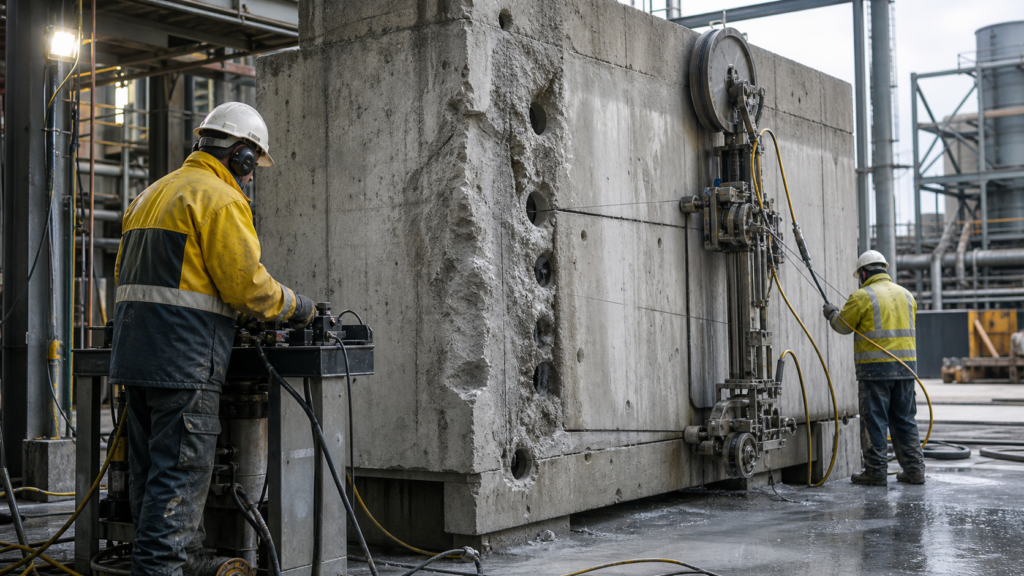
When a project involves massive concrete structures, reinforced materials, difficult access, or complex demolition requirements, conventional methods may not always provide the precision and control required. Bluegrass Bit specializes in advanced concrete cutting, diamond wire sawing, core drilling, robotic hammering, metal cutting, and decommissioning solutions for demanding industrial environments.
Specialized cutting is particularly important when a project requires controlled removal rather than unrestricted demolition. Industrial facilities, bridges, dams, power plants, offshore structures, and nuclear facilities can have unique structural and environmental requirements. These conditions demand careful planning, specialized equipment, experienced technicians, and an approach designed around the specific project.
Bluegrass Bit has operated since 1979 and focuses on specialized demolition and cutting work across heavy industrial, heavy civil, nuclear, offshore, and related sectors.
What Is Bluegrass Bit?
Bluegrass Bit is a specialized industrial contractor focused on precision cutting, demolition, and decommissioning.
Its services include:
- Diamond wire sawing
- Rail and frame sawing
- Underwater cutting
- Core drilling
- Metal cutting
- Robotic hammering
- Concrete shaving
- Decommissioning
- Specialized demolition
The company also describes capabilities involving custom equipment design, engineering support, and project-specific solutions.
Its work is designed primarily for large-scale and complex industrial projects rather than ordinary residential construction.
Understanding Specialized Concrete Cutting
Concrete cutting is an essential part of many construction, demolition, maintenance, and infrastructure projects.
The objective is often to remove a specific portion of concrete while preserving surrounding structures.
This can be necessary when creating openings, modifying foundations, removing structural sections, upgrading facilities, or dismantling existing infrastructure.
Specialized concrete cutting can provide a more controlled approach than conventional demolition when accuracy is important.
Diamond Wire Sawing
Diamond wire sawing is one of the primary technologies used by Bluegrass Bit.
The technique uses a continuous wire equipped with diamond cutting segments to cut through hard materials.
It can be particularly useful for large or heavily reinforced concrete structures.
Diamond wire sawing may be used for:
- Structural concrete removal
- Bridge modifications
- Dam work
- Industrial demolition
- Foundation modifications
- Nuclear projects
- Offshore structures
- Large concrete sections
The technique can also be adapted for different configurations and difficult working conditions.
Why Precision Cutting Matters
Precision is important when only a particular section of a structure needs to be removed.
A controlled cut can help reduce unnecessary disturbance to adjacent structures and equipment.
This can be valuable in facilities where other systems must remain protected or where demolition is part of a larger construction or upgrade project.
Precision also allows project teams to develop specific removal sequences rather than relying entirely on broad demolition methods.
Rail Sawing and Frame Sawing
Rail and frame saws provide another approach to specialized concrete cutting.
These systems can be useful when a project requires controlled cuts along defined paths.
Bluegrass Bit describes custom-designed diamond wire rail saws as part of its specialized cutting technology.
The appropriate equipment depends on the structure, dimensions, access, cutting requirements, and project schedule.
Core Drilling
Core drilling creates circular openings through concrete and other materials.
It can support a wide range of industrial and construction applications.
Common uses include:
- Utility penetrations
- Equipment installation
- Structural modifications
- Mechanical systems
- Electrical installations
- Infrastructure projects
- Industrial maintenance
Core drilling can also be combined with other cutting methods when a project requires multiple types of precision removal.
Large-Diameter Core Drilling
Large openings can present additional challenges.
The equipment needs to accommodate the required diameter and depth while maintaining stability during drilling.
Bluegrass Bit describes core drilling capabilities for large-diameter and deep applications, including work in difficult environments.
Project conditions determine the appropriate equipment and drilling method.
Underwater Concrete Cutting
Some structures require cutting below the waterline.
Underwater cutting can be used in projects involving:
- Dams
- Ports
- Marine structures
- Offshore facilities
- Subsea infrastructure
- Water intake structures
- Bridges
These environments create additional challenges involving visibility, access, water conditions, equipment handling, and communication.
Specialized underwater cutting equipment can help crews perform controlled work in these conditions.
ROV-Friendly Cutting
Remote-operated equipment can provide additional flexibility for certain underwater projects.
ROV-friendly saw systems can support work where direct access is difficult or where remote equipment provides operational advantages.
This type of technology can be particularly relevant to offshore and subsea projects.
The equipment must be selected based on the structure, water conditions, cutting requirements, and overall project plan.
Industrial Demolition
Industrial demolition can be significantly more complex than conventional building demolition.
Industrial facilities may contain:
- Reinforced concrete
- Structural steel
- Heavy machinery
- Process equipment
- Pipes
- Electrical systems
- Foundations
- Confined spaces
The demolition strategy therefore needs to account for the entire environment.
A specialized contractor can assess the structure and determine which cutting, drilling, or demolition methods are appropriate.
Decommissioning Services
Decommissioning involves taking a facility, structure, or system out of service and preparing it for removal, modification, or another final state.
This can involve multiple phases.
A project may include:
- Assessment
- Planning
- Equipment preparation
- Structural cutting
- Dismantling
- Material removal
- Waste handling
- Site restoration
Each project has different requirements.
Bluegrass Bit describes decommissioning as one of its core areas of specialized work.
Power Plant Demolition and Maintenance
Power plants require specialized approaches because they contain large structural components and complex systems.
Bluegrass Bit works with power-generation facilities involving nuclear, fossil-fuel, and hydroelectric operations.
Potential work can include:
- Concrete cutting
- Core drilling
- Metal cutting
- Foundation modifications
- Equipment access
- Structural removal
- Decommissioning
- Maintenance support
Work may take place during scheduled outages or larger facility modification projects.
Nuclear Industry Applications
Nuclear facilities require highly controlled work environments.
Concrete cutting and demolition projects may involve containment structures, foundations, walls, floors, access modifications, and other specialized components.
Bluegrass Bit identifies nuclear work as one of the industries it serves.
Projects in this sector require careful attention to site-specific procedures, training, safety requirements, and applicable regulations.
Heavy Civil Projects
Heavy civil infrastructure includes structures such as bridges, dams, highways, ports, and other major infrastructure.
These projects often involve massive quantities of concrete and steel.
Specialized cutting can support:
- Bridge pier removal
- Dam modifications
- Foundation changes
- Structural openings
- Concrete removal
- Infrastructure upgrades
Bluegrass Bit describes its heavy civil capabilities as including selective cutting and removal of large concrete and steel structures.
Offshore Demolition
Offshore structures create unique logistical and environmental challenges.
Projects may involve:
- Platforms
- Pipelines
- Subsea structures
- Piles
- Compressor bases
- Topside components
- Marine infrastructure
Cutting methods need to account for water conditions, access, equipment deployment, and environmental considerations.
Bluegrass Bit describes offshore decommissioning as an area where it provides specialized underwater cutting and related services.
Metal Cutting
Concrete is not the only material requiring specialized cutting.
Industrial projects may also involve large steel components, pipes, shafts, structural members, and other metal systems.
Metal cutting can support:
- Demolition
- Decommissioning
- Equipment removal
- Plant modifications
- Structural changes
- Offshore projects
The method depends on the metal type, dimensions, location, access, and required cutting sequence.
Robotic Hammering
Robotic demolition equipment can provide an alternative to conventional manually operated tools in certain environments.
Remote-operated equipment can be useful when work conditions make direct operator access difficult.
Bluegrass Bit lists robotic hammering among its specialized services.
The appropriate use of robotic equipment depends on the structure and the project’s safety and operational requirements.
Concrete Shaving
Concrete shaving involves removing controlled amounts of material from a concrete surface.
It may be useful when a surface needs to be modified without removing an entire structural section.
Applications can include:
- Surface preparation
- Structural modifications
- Level adjustments
- Repairs
- Industrial upgrades
The method should be selected according to the desired depth and surface requirements.
Custom Equipment Development
Complex projects sometimes require equipment that is not readily available in standard configurations.
Custom equipment can provide a way to address unusual:
- Dimensions
- Access limitations
- Cutting angles
- Structural conditions
- Environmental conditions
Bluegrass Bit describes its ability to design, build, and test its own saws and components.
This capability can help develop project-specific solutions for challenging cutting requirements.
Engineering Support
Engineering can play an important role in complex demolition and cutting work.
Before equipment reaches the job site, project teams may need to understand:
- Structural conditions
- Cutting locations
- Load considerations
- Equipment placement
- Removal sequence
- Access
- Environmental factors
Engineering support can help translate the project objective into a workable cutting plan.
Project-Specific Solutions
No two industrial demolition projects are exactly the same.
Even similar structures can have different:
- Dimensions
- Reinforcement
- Access
- Equipment
- Operating conditions
- Safety requirements
- Schedules
For this reason, specialized contractors often evaluate the project before determining the final cutting method.
A project-specific plan can be more effective than relying on a standard approach.
Safety in Industrial Cutting
Safety is a critical consideration for specialized cutting and demolition.
Projects can involve heavy materials, rotating equipment, water, elevated work areas, structural instability, electrical systems, and other hazards.
A comprehensive safety process may include:
- Site assessment
- Hazard analysis
- Equipment inspections
- Operator training
- Personal protective equipment
- Work-zone controls
- Communication procedures
- Emergency planning
Bluegrass Bit states that safety is an important part of its company culture and describes the use of job hazard analyses and ongoing training.
Experienced Technicians
Specialized equipment requires skilled operators.
Technicians need to understand how equipment behaves under different conditions and how to position and operate systems correctly.
Experience can be particularly valuable when unexpected conditions appear during a project.
A trained team can evaluate changes and coordinate with project management to determine the appropriate response.
Planning a Complex Cutting Project
Successful projects generally begin before the equipment arrives.
The planning process may include:
Site Assessment
Understanding the physical location and surrounding conditions.
Structural Review
Identifying the material, thickness, reinforcement, and structural configuration.
Equipment Selection
Determining which saws, drills, hammers, or other equipment are appropriate.
Cutting Sequence
Planning where and when each cut will occur.
Material Removal
Determining how cut sections will be supported, lifted, transported, and removed.
Safety Planning
Identifying hazards and establishing controls before work begins.
Benefits of Specialized Cutting
Specialized cutting can provide several practical advantages.
Precision
Cuts can be made according to defined project requirements.
Controlled Removal
Specific sections can be removed without relying entirely on broad demolition techniques.
Flexibility
Different cutting systems can be adapted to different environments.
Access
Specialized equipment can support work in difficult or restricted locations.
Reduced Disruption
Controlled cutting may help limit unnecessary impact on surrounding structures and operations.
Choosing a Specialized Contractor
Selecting a contractor for industrial cutting requires careful evaluation.
Consider the following factors.
Relevant Experience
Look for experience with projects similar to yours.
Equipment
Determine whether the contractor has suitable equipment for the required work.
Engineering Capability
Complex projects may benefit from engineering resources.
Safety Practices
Ask about training, certifications, hazard analysis, and site procedures.
Project Management
A dedicated project-management process helps coordinate multiple phases.
Technical Flexibility
The contractor should be able to adapt when project conditions change.
Questions to Ask Before Hiring
Before selecting a specialized cutting contractor, consider asking:
- What cutting methods do you specialize in?
- Can you work with reinforced concrete?
- Do you provide diamond wire sawing?
- Can you perform underwater cutting?
- Do you offer core drilling?
- Can you cut large steel components?
- What equipment will the project require?
- Can you develop custom equipment?
- Is engineering support available?
- How do you approach safety planning?
- How will cut sections be removed?
- What information do you need before preparing a project plan?
Clear answers can help determine whether the contractor is appropriate for the project.
Industries Served by Bluegrass Bit
Bluegrass Bit works across several specialized sectors.
These include:
- Nuclear
- Heavy civil
- Heavy industrial
- Offshore
- Heavy metal
- Marine
- Power plants
- Chemical facilities
- Steel mills
- Pulp and paper mills
- Ports
- Bridges
- Locks and dams
Each industry has different operational requirements, but they share a need for controlled and technically capable cutting and demolition.
Large-Scale Infrastructure Work
Infrastructure projects can involve massive structures that cannot simply be demolished using conventional methods.
A bridge pier, dam component, or foundation may need to be removed while adjacent structures remain intact.
Precision cutting can provide a controlled method for separating the required section.
This can support renovation, replacement, expansion, and maintenance projects.
Supporting Facility Upgrades
Cutting and demolition can also be necessary when an existing facility is being upgraded.
A project may require:
- Removing a foundation
- Creating an opening
- Modifying a wall
- Removing equipment supports
- Cutting steel
- Preparing an area for new equipment
The objective is not necessarily to demolish the facility.
Instead, specialized cutting can support the modification of an existing structure.
Dealing With Difficult Access
Restricted access is common in industrial environments.
Equipment may need to work around:
- Pipes
- Machinery
- Structural members
- Platforms
- Walls
- Narrow corridors
- Water
- Existing operations
Project-specific equipment and specialized cutting systems can help address these constraints.
Why Non-Explosive Methods Matter
Non-explosive demolition methods can be useful when a project requires greater control over material removal.
They may be appropriate where blasting is unsuitable because of nearby structures, operating equipment, environmental considerations, or project requirements.
Diamond wire sawing provides a controlled cutting approach for concrete and certain other materials.
Environmental Considerations
Industrial demolition can produce debris, dust, water, and other project-related materials.
A responsible project plan should consider how these materials will be controlled and handled.
Water-based cutting methods may also require management of resulting slurry or effluent.
Bluegrass Bit describes containment of effluents and environmental considerations as part of its approach to concrete cutting.
Project Scheduling
Large industrial projects often operate under demanding schedules.
A cutting contractor may need to coordinate with:
- General contractors
- Engineers
- Facility operators
- Maintenance teams
- Other subcontractors
- Project managers
Delays in one stage can affect other activities.
A well-developed cutting plan can help align field operations with the broader project schedule.
Bluegrass Bit and Complex Projects
Bluegrass Bit’s project portfolio includes work involving nuclear facilities, dams, bridges, offshore structures, industrial plants, and other challenging environments.
The company’s project approach focuses on analyzing structural, safety, and environmental considerations before developing a cutting strategy.
This project-specific approach is important because specialized demolition rarely follows a single standardized process.
What Makes Specialized Industrial Cutting Different?
Specialized industrial cutting combines several disciplines.
It may require:
- Engineering
- Equipment design
- Mechanical knowledge
- Structural understanding
- Skilled operation
- Project management
- Safety planning
- Material handling
The equipment is only one part of the solution.
Successful execution depends on coordinating all of these elements.
Preparing for a Bluegrass Bit Project
Organizations considering specialized cutting should gather as much project information as possible.
Useful information may include:
- Drawings
- Structural details
- Material specifications
- Dimensions
- Site photographs
- Access information
- Project schedule
- Cutting locations
- Removal requirements
- Environmental conditions
Providing accurate information can help the contractor develop a more suitable project approach.
When Specialized Cutting Is the Right Choice
Specialized cutting may be worth considering when a project involves:
- Large reinforced structures
- Precision removal
- Difficult access
- Underwater work
- Industrial demolition
- Decommissioning
- Structural modifications
- Sensitive environments
The final method should always be determined through a professional project assessment.
Conclusion
Bluegrass Bit focuses on specialized concrete and metal cutting, demolition, and decommissioning for complex industrial environments. Its capabilities include diamond wire sawing, rail and frame sawing, core drilling, underwater cutting, robotic hammering, metal cutting, concrete shaving, and project-specific equipment solutions. These services can support demanding projects across nuclear, heavy civil, heavy industrial, offshore, marine, power, and infrastructure applications. When a project requires controlled removal, difficult-access cutting, or specialized demolition, careful planning and experienced technical teams are essential. Evaluating the project’s structural requirements, access conditions, safety considerations, equipment needs, schedule, and removal strategy can help ensure that the selected approach fits the actual work.
FAQs
What services does Bluegrass Bit provide?
Bluegrass Bit provides specialized services including diamond wire sawing, rail and frame sawing, underwater cutting, core drilling, metal cutting, robotic hammering, concrete shaving, and decommissioning.
What is diamond wire sawing used for?
Diamond wire sawing is used to cut large or heavily reinforced concrete and other materials. It can be suitable for industrial demolition, infrastructure modifications, offshore work, and other projects requiring controlled cutting.
Does Bluegrass Bit perform underwater cutting?
Yes. Bluegrass Bit provides underwater and ROV-friendly cutting solutions for marine and offshore applications.
What industries does Bluegrass Bit serve?
Bluegrass Bit serves industries including nuclear, heavy civil, heavy industrial, offshore, marine, heavy metal, power generation, chemical facilities, steel mills, ports, bridges, and dams.
Does Bluegrass Bit provide core drilling?
Yes. Core drilling is among the company’s specialized concrete cutting services and can be used for creating precise circular openings in concrete and other materials.
What is industrial decommissioning?
Industrial decommissioning involves taking a facility, structure, or system out of service and preparing it for dismantling, removal, modification, or another final condition.
Why use specialized concrete cutting instead of conventional demolition?
Specialized cutting can provide greater control when only specific sections of a structure need to be removed. It can be useful when surrounding structures, equipment, or operations need to be protected.
Does Bluegrass Bit handle residential projects?
Bluegrass Bit focuses on large-scale, complex demolition and cutting projects in specialized industries rather than residential work.