
Cashmere beanies sit at the peak of winter headwear for reasons that are physical before they are fashionable: the fibre is finer than almost anything...
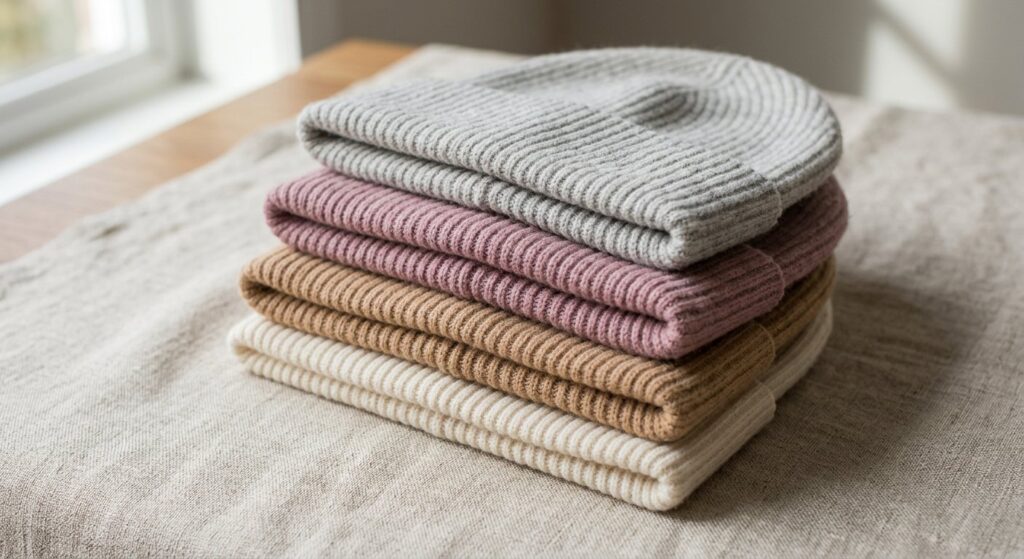
Cashmere beanies sit at the peak of winter headwear for reasons that are physical before they are fashionable: the fibre is finer than almost anything else you can put against your skin, warmer per gram than sheep’s wool, and soft enough to wear all day without a single itch. Yet the category confuses shoppers constantly, because prices swing wildly, quality labels are vague, and care advice online ranges from sensible to superstition. A great cashmere beanie is a fifteen-year purchase that softens with age, packs into a pocket, and completes every winter outfit from a wool coat to ski wear; a poor one pills in a month and sheds its halo by spring. The difference lies in fibre grade, construction, and how you look after it, all of which this guide explains. It covers what cashmere actually is, how to read quality like a buyer, the nine concrete advantages over wool, acrylic, and synthetic hats, a complete care routine, and when a cashmere beanie is genuinely worth it. By the end, you will know exactly what to look for and why the softest hat in the shop is often the smartest thing on the shelf.
Key Takeaways
- Cashmere fibres run roughly 14 to 19 microns, far finer than sheep’s wool at 25 to 40, which is why cashmere beanies never itch the way wool can.
- Grade A Mongolian cashmere, the finest and longest fibre, is the quality benchmark; suspiciously cheap “100% cashmere” usually means short Grade C fibre.
- Cashmere provides superior warmth-to-weight: hats that feel airy and light still trap serious heat.
- Proper care is simple: hand wash cool, dry flat, de-pill with a cashmere comb, store folded with cedar, and the hat improves with age.
- Look for stated fibre specs, two-ply yarn, trusted origin, and OEKO-TEX certification when comparing beanies.
What Are Cashmere Beanies?
Cashmere beanies are knitted hats made from the downy undercoat of cashmere goats, combed or shorn once a year and spun into yarn that is soft, light, and exceptionally insulating. The fibre comes primarily from the cold, high regions of Mongolia and Inner Asia, where goats survive winters far below freezing, and that survival mechanism is exactly what the fibre does for you: it traps air in thousands of fine, insulating pockets. Compared with sheep’s wool at 25 to 40 microns, cashmere fibres measure roughly 14 to 19 microns, which is why they bend against skin without triggering the prickly itch wool causes. A beanie, as opposed to a beret or a slouchy hat, is the close-fitting, cuffed classic of the family, the most versatile shape in knitwear because it suits every face, every coat, and every age.
Why Mongolian Cashmere Sets the Standard
The finest cashmere comes from goats raised in regions of extreme temperature variation, and Mongolia’s harsh climate produces fibre that is long, fine, and strong, the three measurements that define quality. Grade A cashmere runs about 14 to 15.5 microns in diameter with fibre lengths of 34 to 36 millimetres, specifications that yield yarn which resists pilling, holds its shape, and softens rather than degrades over years of wear. Shorter, coarser fibres, Grades B and C, are what make cheap cashmere feel silky in the shop and fuzzy in the wash, because short fibres work loose and tangle into pills. Heritage producers from the region, including GOBI Cashmere, which has worked with Mongolian fibre for decades, build entire collections on that Grade A foundation, with OEKO-TEX certified knits and rib constructions that keep their stretch season after season.
Cashmere, Wool, Acrylic: The Honest Comparison
Acrylic beanies cost little and offer almost nothing back: no real warmth per gram, no breathability, and a static-cling relationship with your hair. Wool beanies are warm but heavy when thick, itchy when coarse, and none of them fold into a pocket. Cashmere is the fibre that solves both columns at once, warmer than wool by weight and softer than acrylic by any measure, and the rest of this guide is the itemised case.
9 Powerful Reasons Cashmere Beanies Outperform Every Winter Hat
1. Unmatched Warmth Without the Weight
Cashmere’s insulating power comes from the fineness of the fibre: thousands of ultra-fine hairs trap still air far more efficiently than the same weight of coarser wool, which is why a light, airy-feeling beanie outperforms a thick, heavy one. On a freezing platform or a windy summit, the difference shows up as warmth without pressure, no heavy band across the forehead, no sweat-inducing bulk under a hood. That warmth-to-weight ratio is the same reason mountaineers pack cashmere, and it translates to city life as a hat you forget you are wearing until you notice you are perfectly warm. There is also a practical angle: a light cashmere knit sits comfortably under a helmet hood or a hooded shell, where a thick wool cap simply does not fit. For anyone who has abandoned hats because they feel like insulation for the entire head, cashmere is the correction.
2. Zero Itch, All Day Comfort
The itch in a wool hat is mechanical: coarse fibre ends are thick enough to press against skin and trigger the prickling response, and no amount of lining fully solves a fibre that is fundamentally scratchy. Cashmere fibres at 14 to 19 microns are finer than a human hair and bend freely against skin, which is why cashmere beanies can be worn directly against the forehead and ears without a single prickle. This matters most at the cuffs and edges, where wool hats concentrate their scratchiness, and for children whose skin tolerates coarse fibres least. People who believe they are “not hat people” are almost always people whose hats itched, and cashmere is the standard fix. Sensitive foreheads, eczema-prone skin, and children who pull off wool hats in tears all tend to forget their grievances the first week the fibre changes.
3. Breathable Temperature Regulation
Cashmere is a living fibre with natural breathability: it insulates against the cold while letting excess heat and moisture escape, so heads stay warm outdoors without becoming damp greenhouses indoors. That regulation is why a cashmere beanie survives the commute-to-office transition, the restaurant arrival, and the overheated train carriage without ever being stuffed into a bag. Acrylic and polyester hats trap moisture against the scalp and breed the post-hat frizz every winter wardrobe dreads, while cashmere wicks and releases it. Wearers also report the fibre’s natural odour resistance, several wears between washes with a simple overnight air-out, which makes daily-use hats genuinely practical rather than high-maintenance.
4. A Style That Finishes Every Outfit
Few accessories earn the styling range a good cashmere beanie does. In black, grey, navy, camel, or cream, it sharpens a wool coat and softens a puffer; in a rib knit it reads quietly luxurious; slouched, it reads effortlessly casual; cuffed, it reads precise. The fibre’s depth of colour, cashmere dyes richly and holds tone without the plasticky sheen of synthetics, is what makes the same beanie look at home with tailoring and with technical ski wear. Heritage producers offer the full palette, from classic neutrals through seasonal colours like aurora pink and lichen green, which means one hat can be the repeating signature through an entire winter wardrobe. Style guides keep proving the point each autumn, when fashion editors revive the beanie-with-wool-coat pairing and the high street follows. The style argument reduces to this: acrylic hats are worn, cashmere beanies are worn in.
5. They Pack Like a Pocket Handkerchief
A cashmere beanie crushes to the size of a fist, springs back with no crease, and weighs next to nothing, which quietly changes how you travel. It lives in a coat pocket, a handbag, or the top of a suitcase without a second thought, rides out being sat on in a carry-on, and emerges ready to wear. Every traveller knows the scenario: the hat you left behind because it was bulky, on the one day the weather turned. Wool hats hold their bulk and their creases; synthetics hold their static; cashmere alone packs down and performs. It is the hat equivalent of the cashmere travel wrap, one piece that earns its place in every bag. For commuters, weekenders, and anyone whose winter is one long luggage decision, this is the least glamorous and most loved advantage.
6. Kinder to Your Hair and Skin
Winter hats and good hair are usually enemies, and the culprit is friction: coarse fibres and synthetic static rough up the hair cuticle, producing the frizz halo and static flyaway that follow every acrylic beanie removal. Cashmere’s smooth, fine fibres glide against hair rather than scrapping with it, generating far less static and far less breakage at the hairline, and the soft hand feels gentle against sensitive skin and the ears, where hats spend their whole lives pressing. For anyone with curly or fragile hair in particular, the difference between a synthetic beanie and a cashmere one is the difference between restyling and simply walking on. It is a subtle advantage in the shop and an obvious one in the bathroom mirror.
7. A Genuine Gift That Never Misses
The cashmere beanie has solved gift-giving more times than any voucher, because it hits the rare combination of luxury, utility, and safe sizing. One size genuinely fits most faces in a well-cut beanie, the colour palette offers something for every taste, and the perceived value of cashmere arrives the moment it is touched, no explanation needed. The unboxing helps too, because heritage houses wrap these pieces the way gifts are meant to arrive, which is half the moment before the hat is even seen. Unlike scarves or gloves that demand size guesswork, or jumpers that demand style guesswork, a beanie in a classic shade is almost universally wearable, and the recipient wears it immediately, which is the emotional signature of a successful gift. Add the price spectrum from accessible rib knits to elevated pieces, and the category covers everyone from a first Christmas gift to a milestone birthday.
8. Durability That Improves With Age
Well-made cashmere does not wear out; it breaks in. Long Grade A fibres resist pilling and hold their structure, and with correct care, cool hand washing, flat drying, gentle de-pilling, a cashmere beanie grows softer and more personal over years, becoming the piece you reach for first precisely because it has moulded to your head and habits. The economics reinforce the sentiment: spread over a decade of winters, even a premium beanie costs less per wear than the disposable acrylic hats it replaces, most of which are binned within a season. There is a sustainability logic underneath the economics as well: one biodegradable natural-fibre piece replacing a chain of synthetic ones is the small, realistic version of a better wardrobe. The durability comes from buying quality in the first place, which is the next point, and from the simple care routine at the end of this guide, which takes less time than most people spend choosing a podcast.
9. Buy Well: How to Spot Quality Cashmere Beanies
Everything above depends on what you actually buy, so read the label like a buyer. Green flags: fibre specifications stated openly, microns and fibre length, two-ply or higher yarn, origin disclosed as Mongolian or Italian-spun, OEKO-TEX certification for chemical safety, care instructions included, and a weight that feels substantial rather than hollow. Red flags: suspiciously low prices for “100% cashmere,” no quality information at all, and a silky, slippery feel that short Grade C fibres produce. The stretch test helps in person: quality cashmere springs back from a gentle pull without losing shape, while loosely spun fibre stays slack. When you are ready to buy, the cashmere beanies in GOBI’s accessories collection are a useful benchmark of the category done right, Mongolian fibre, rib knits in more than a dozen colours, OEKO-TEX Standard 100 certification, and the kind of heritage production that has specialised in this exact fibre for decades, with beanies and hats at accessible prices alongside heavier-weight and slouchy styles. Compare anything you consider against that checklist, and the market sorts itself quickly.
Care Guide: Keep It Soft for a Decade
Cashmere care is simpler than its reputation, and consistency beats intensity:
| Step | What to Do | Never |
|---|---|---|
| Washing | Hand wash cool with wool detergent or baby shampoo every 5 to 7 wears | Hot water, regular detergent, fabric softener |
| Handling | Soak briefly, swirl gently, squeeze water out in a towel | Wringing, twisting, hard scrubbing |
| Drying | Lay flat on a towel, reshape, air dry away from heat | Hanging, tumble drying, radiator drying |
| De-pilling | A cashmere comb, light strokes in the direction of the knit | Shaving blades that cut the fibre |
| Storage | Folded in a drawer with cedar blocks | Hanging on hooks, plastic bags, damp cupboards |
Follow that routine and pilling fades after the first season, softness deepens with every wash, and the beanie becomes a long-term resident of the winter wardrobe rather than an annual purchase. One last habit worth stealing from knitwear collectors: give the hat a day of rest between wears, because fibre recovers its shape and freshness when it is not compressed daily, and a cedar block or two in the drawer quietly solves the moth question before it becomes a question.
Frequently Asked Questions
Are cashmere beanies worth the money?
Yes for daily winter use: superior warmth without weight, no itch, and a lifespan measured in years, which brings the cost per wear below the acrylic hats they replace.
Why is some cashmere itchy and some not?
Fibre fineness decides it: cashmere at 14 to 19 microns bends against skin without prickling, while coarse Grade C fibre or wool blends trigger the itch cheaper hats are known for.
How do I wash a cashmere beanie?
Hand wash in cool water with wool detergent or baby shampoo, swirl gently, roll in a towel to remove water, and dry flat on a towel, never hanging or machine drying.
Will a cashmere beanie pill?
Some pilling is natural friction behaviour in any cashmere, but long-fibre Grade A yarn pills far less, and a few passes with a cashmere comb keep the surface clean without harming the knit.
Can I wear a cashmere beanie in mild weather?
Yes, that is the fibre’s temperature regulation at work: it insulates in the cold and breathes when it is mild, which is why light cashmere beanies work through autumn and spring too.
What should I look for when buying?
Stated fibre specs, two-ply yarn, Mongolian or Italian-spun origin, OEKO-TEX certification, honest care instructions, and a price that makes sense, because “100% cashmere” at an implausible price usually means Grade C fibre.
Conclusion
Cashmere beanies outperform every alternative in the winter hat drawer for reasons that survive scrutiny: a fibre finer than wool at twice the warmth per gram, comfortable against the most sensitive skin, breathable from street to sitting room, packable enough to live in a coat pocket, and durable enough to soften through a decade of winters with nothing more than cool water and a comb. The nine advantages above are not luxury marketing; they are the material science of one of nature’s finest insulators applied to the most versatile hat shape ever knitted. Buy with the buyer’s checklist, microns, ply, origin, certification, and honest pricing, care for it with the simple routine that takes minutes, and the hat repays the attention every cold morning it is chosen first. Winter is long enough to deserve one genuinely excellent thing on your head, and few purchases deliver their promise as literally, and as softly, as this one.