
Cloud computing (AWS/Azure) explained simply means running software and storing data on remote servers over the internet instead of on your own computer or data...
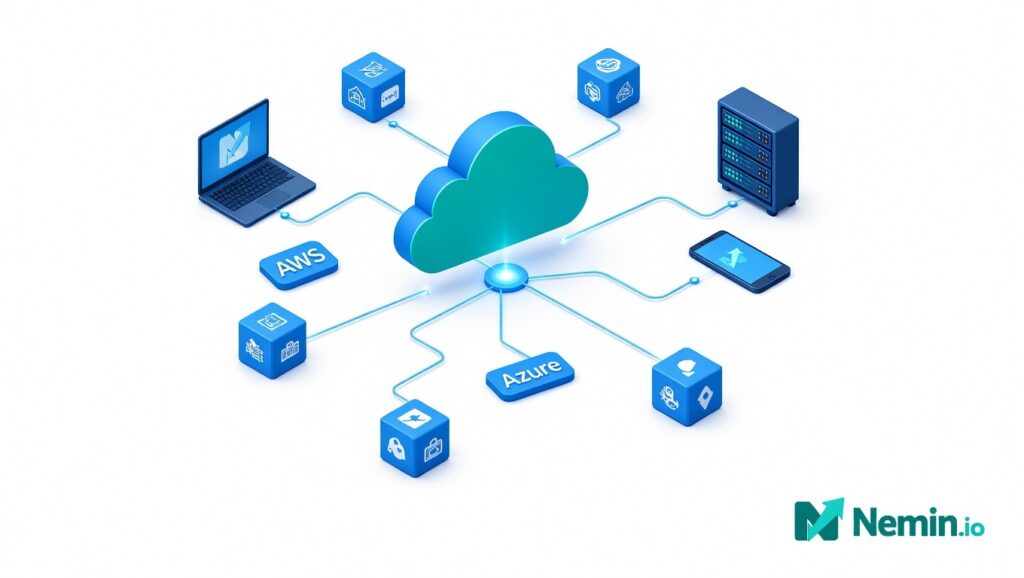
Cloud computing (AWS/Azure) explained simply means running software and storing data on remote servers over the internet instead of on your own computer or data center. Amazon Web Services (AWS) and Microsoft Azure are the two largest cloud platforms, together holding around half of the global market. The latest data shows global public cloud spending reached about 723 billion dollars in 2025, and it keeps growing at roughly 20 percent a year.

Every photo you back up, every movie you stream, every app that remembers your settings, and every business tool you log into is running on cloud computing. Cloud computing (AWS/Azure) explained in the simplest terms is the practice of using remote servers, managed by providers like Amazon and Microsoft, to store data and run applications over the internet. Instead of buying and maintaining your own computers and data centers, you rent exactly what you need and pay only for what you use.
This guide is cloud computing (AWS/Azure) explained in plain language, including what cloud computing (AWS/Azure) explained means, how AWS and Azure differ, real-time market data and statistics, the ten proven benefits of cloud computing (AWS/Azure) explained, cost calculations that show the business impact, and what cloud computing (AWS/Azure) explained means for consumers and businesses in the United States.
Cloud Computing (AWS/Azure) Explained: A Simple Definition
Cloud computing (AWS/Azure) explained simply is the delivery of computing services over the internet. Those services include servers, storage, databases, networking, software, analytics, and artificial intelligence, and you access them on demand from a cloud provider. AWS and Azure are the two biggest providers, and cloud computing (AWS/Azure) explained through those two platforms covers the majority of the market.
Cloud computing (AWS/Azure) explained through an analogy: think of electricity. Instead of every home building its own power plant, homes and businesses buy electricity from a shared grid and pay for what they use. Cloud computing works the same way. Instead of every company building its own data center, companies rent computing power and storage from AWS and Azure, scale up when demand grows, and scale down when it shrinks.
The same logic applies to individuals. When you store photos in the cloud, you are renting storage space on someone else’s servers, at the consumer level. When a business runs its website on AWS or its customer database on Azure, that is cloud computing (AWS/Azure) explained at the enterprise level. The principle is the same everywhere, which is on demand access to shared computing resources.
Cloud Computing (AWS/Azure) Explained: AWS vs Azure
To understand cloud (AWS/Azure) explained, it helps to see how the two giants compare. AWS launched in 2006 and effectively created the modern cloud market. Microsoft Azure launched in 2010 and used its strength in business software to grow fast. Together they control roughly half of global cloud infrastructure spending, at market scale.

AWS is the market leader with the widest catalog of services, more than 200 offerings covering compute, storage, databases, machine learning, and more. AWS is popular with startups, developers, and cloud native companies because of its breadth and maturity. Azure is the second largest and is growing fastest of the two, and it is deeply integrated with Microsoft tools like Windows Server, Office 365, Active Directory, and SQL Server, which makes it the natural choice for businesses already running Microsoft software.
The table below shows the key differences between the two platforms.
| Dimension | AWS | Microsoft Azure |
|---|---|---|
| Market share | About 28 to 31 percent | About 20 to 24 percent |
| Launch year | 2006 | 2010 |
| Service catalog | 200 plus services | 200 plus services |
| Global regions | 30 plus regions | 60 plus regions |
| Best for | Linux, containers, startups | Windows, .NET, enterprise |
| Free tier | 12 months plus always free | 12 months plus always free |
| Cost savings programs | Savings Plans up to 72 percent | Reservations up to 72 percent |
| Licensing advantage | Broad independent ecosystem | Hybrid Benefit saves up to 40 to 55 percent on Windows |
The choice between AWS and Azure depends on your environment. A startup building cloud native applications often starts with AWS, while a business running Windows Server and Microsoft 365 often saves money with Azure. The choice is not about picking a winner, it is about picking the right fit.
Real-Time Data and Statistics for Cloud Computing (AWS/Azure) Explained
Cloud (AWS/Azure) explained with real numbers shows an industry in rapid growth. Market researchers agree on the direction, even when their exact figures differ, and the numbers tell the story.
| Metric | Figure | Source |
|---|---|---|
| Global public cloud spending 2025 | About 723 billion dollars | Gartner |
| Public cloud growth 2025 | About 21.5 percent year over year | Gartner |
| Cloud infrastructure spend Q4 2025 | About 119 billion dollars in one quarter | Synergy Research |
| Big Three combined market share | About 63 to 68 percent | Synergy Research |
| Enterprise cloud adoption rate | About 94 percent | Flexera |
| Organizations using multiple clouds | About 92 percent | Industry research |
| Cloud budget wasted on average | About 32 to 35 percent | Flexera |
| Public cloud market projected 2029 | About 1.48 trillion dollars | Gartner |
North America is the largest cloud region, and the United States is the biggest single cloud market in the world, because AWS, Azure, and Google Cloud are all American companies with data centers across the country. For the USA, the story starts with one fact, which is that the United States leads the world in cloud adoption and spending.
How Cloud Computing (AWS/Azure) Explained Works
A working cloud deployment has several layers, and understanding them is essential.
At the bottom are data centers full of servers, storage drives, and networking equipment, owned and maintained by AWS and Azure. On top of that sits virtualization, which lets one physical server run many virtual machines, and that is what makes renting a small slice of a huge machine possible. Above that are the services you actually use, such as virtual machines for compute, object storage for files, databases for structured data, and AI services for machine learning.
Cloud computing (AWS/Azure) explained also involves three main service models. Infrastructure as a Service, or IaaS, gives you raw compute and storage, like AWS EC2 or Azure Virtual Machines. Platform as a Service, or PaaS, gives you a ready platform for building applications, like AWS Elastic Beanstalk or Azure App Service. Software as a Service, or SaaS, gives you finished applications you use in a browser, like Microsoft 365 or Netflix, in consumer form.
When a US business moves its website to AWS or its customer system to Azure, the provider handles the hardware, the networking, and the security of the physical data center, while the business manages its own applications and data. That division of responsibility defines everyday operation, and it is why companies of every size can use enterprise grade infrastructure without owning a data center.
The 10 Best Benefits of Cloud Computing (AWS/Azure)
These ten benefits explain why cloud explained has become the default for modern technology, and each one matters for consumers and businesses in the USA.
1. Pay Only for What You Use in Cloud Computing (AWS/Azure) Explained
The first benefit of cloud (AWS/Azure) explained is the pay as you go model. Instead of buying expensive servers that sit idle, you pay for the compute and storage you actually use. For a startup, that means starting with a tiny bill and growing it as the business grows, as a financial advantage.
2. Scale Up and Down Instantly With Cloud Computing (AWS/Azure) Explained
Cloud computing (AWS/Azure) explained lets you scale capacity in minutes. When a retailer’s website spikes during a sale, AWS and Azure add capacity automatically, and when demand drops, they scale back down. This elasticity is one of the most powerful benefits of cloud computing (AWS/Azure) explained, because it matches cost to real demand.
3. No Hardware to Buy or Maintain With Cloud Computing (AWS/Azure) Explained
With the cloud, there is no server to purchase, no rack to install, and no hardware to replace. AWS and Azure manage all the physical infrastructure, and the provider handles maintenance, cooling, power, and upgrades. That removes a huge burden from businesses, which is cloud computing (AWS/Azure) explained in terms of simplicity.
4. Access From Anywhere
Cloud computing (AWS/Azure) explained means your data and applications are available anywhere with an internet connection. Employees work from home, from the road, or from an office, and they all reach the same systems. For a distributed US workforce, this accessibility is cloud computing (AWS/Azure) explained in daily practice.
5. Built In Security and Compliance
AWS and Azure invest enormous resources in security, and both hold many compliance certifications. Cloud computing (AWS/Azure) explained with security in mind means encryption, identity controls, and monitoring are available from day one. For businesses in regulated industries like healthcare and finance, cloud computing (AWS/Azure) explained provides the controls they need.
6. Automatic Updates and Innovation
With cloud computing (AWS/Azure) explained, the provider keeps the platform updated, patched, and improved. AWS and Azure release new features constantly, and businesses get access automatically. That constant innovation is cloud computing (AWS/Azure) explained as a competitive advantage, because you benefit from upgrades without doing the work.
7. Disaster Recovery Without a Second Site
The cloud makes backup and recovery practical for every business. Data is replicated across multiple locations, and recovery tools restore systems quickly after an outage. A business using cloud computing (AWS/Azure) explained can survive a server failure or a natural disaster far better than one running everything on premises.
8. Advanced AI and Analytics
The fastest growing part of cloud computing (AWS/Azure) explained is artificial intelligence. AWS offers machine learning services like SageMaker and Bedrock, and Azure offers OpenAI services and advanced analytics. Businesses use these tools for predictions, chatbots, and data insights, which is cloud computing (AWS/Azure) explained at the frontier.
9. Collaboration Made Simple
The cloud powers the collaboration tools that US teams use daily. Documents, spreadsheets, and project files live in the cloud, so everyone edits the same version in real time. This shared working model is cloud computing (AWS/Azure) explained in the modern office.
10. Lower Total Cost Over Time
Finally, cloud computing (AWS/Azure) explained usually lowers the total cost of technology. Businesses avoid the upfront cost of data centers, the cost of idle capacity, and the cost of specialized staff to run hardware. When budgets are wasted, which research says is about a third of cloud spend on average, the fix is better cloud management, which is cloud computing (AWS/Azure) explained as a discipline.
Cloud Computing (AWS/Azure) Explained: Cost Calculations
Cloud computing (AWS/Azure) explained with numbers shows why the model saves money, and here are three realistic calculations for US businesses.
Calculation 1: Moving a Small Business Server to the Cloud
A small business running one on premises server pays for the hardware, the electricity, the cooling, the maintenance, and the occasional replacement. Over five years, that server might cost about 1,200 dollars per year in electricity, 500 dollars per year in maintenance and support, and 3,000 dollars to replace hardware every five years, which works out to roughly 1,700 dollars per year on average.
The same workload on AWS or Azure typically costs about 40 to 60 dollars per month for a small virtual machine, or roughly 600 dollars per year. Cloud computing (AWS/Azure) explained for this business means saving about 1,100 dollars per year, plus eliminating the risk of hardware failure and the time spent on maintenance.
| Cost Item | On Premises | Cloud (AWS/Azure) |
|---|---|---|
| Hardware replacement | About 600 dollars per year | Included |
| Electricity and cooling | About 1,200 dollars per year | Included |
| Maintenance and support | About 500 dollars per year | Included |
| Monthly service | Zero | About 600 dollars per year |
| Total per year | About 1,700 dollars | About 600 dollars |
Calculation 2: Reserved Capacity Savings
Cloud computing (AWS/Azure) explained with savings programs shows a second way to cut costs. Both AWS and Azure offer reserved pricing for workloads you know you will run, with savings of up to 72 percent compared with on demand pricing. A business spending 2,000 dollars per month on on demand compute can cut that to about 560 dollars per month with a three year reservation, saving about 17,000 dollars per year.
| Pricing Option | Monthly Cost | Yearly Cost |
|---|---|---|
| On demand | 2,000 dollars | 24,000 dollars |
| Reserved, 72 percent savings | 560 dollars | 6,720 dollars |
| Savings | 1,440 dollars | 17,280 dollars |
Calculation 3: The Cost of an Outage Without the Cloud
An on premises outage can cost a business thousands per hour, because recovery requires spare hardware, backup sites, and hours of work. Cloud computing (AWS/Azure) explained with built in redundancy recovers much faster, because data is replicated and virtual machines restart on healthy infrastructure. Avoiding even one multi hour outage per year often pays for the entire cloud bill, which is cloud computing (AWS/Azure) explained as risk protection.
These calculations are estimates, but the direction is consistent. Cloud computing (AWS/Azure) explained removes capital costs, matches spending to demand, and protects against expensive failures, which is why the model wins for most businesses.
Cloud Computing (AWS/Azure) Explained for US Consumers
For consumers in the United States, cloud computing (AWS/Azure) explained shows up in nearly every digital habit.

When your phone automatically backs up photos, that is cloud storage running on cloud computing (AWS/Azure) explained infrastructure. When you stream a movie and the picture quality adjusts to your connection, cloud services are scaling to serve you. When a banking app notifies you instantly about a payment, cloud computing (AWS/Azure) explained is processing that event in real time. When your smart speaker answers questions, cloud AI services are doing the thinking.
Cloud computing (AWS/Azure) explained also makes consumer life more convenient. Your files follow you across devices because they live in the cloud. Apps update automatically because updates are pushed from the cloud. Online shopping remembers your cart because the state lives in cloud databases. For US consumers, cloud computing (AWS/Azure) explained is the invisible engine behind modern digital life, and most people use it dozens of times a day without noticing.
Cloud Computing (AWS/Azure) Explained for US Businesses
For businesses in the United States, cloud computing (AWS/Azure) explained delivers advantages that touch every part of the company.

Startups use cloud computing (AWS/Azure) explained to launch with almost no capital, renting infrastructure for pennies and scaling only when revenue arrives. Small and mid size businesses use cloud computing (AWS/Azure) explained to run email, accounting, customer management, and ecommerce without an IT department. Large enterprises use cloud computing (AWS/Azure) explained at massive scale, running thousands of servers across multiple regions and using AI services to personalize products.
Cloud computing (AWS/Azure) explained also helps US businesses stay compliant. Healthcare providers use cloud services that meet HIPAA requirements, financial firms use controls that support regulatory audits, and retailers protect customer data with cloud security tools. Because AWS and Azure invest heavily in compliance, cloud computing (AWS/Azure) explained makes meeting regulations easier than building your own secure environment.
For US businesses, the strategic question is rarely whether to use cloud computing (AWS/Azure) explained, because about 94 percent of enterprises already do. The real questions are which provider to choose, how to control costs, and how to modernize faster, which is cloud computing (AWS/Azure) explained as a business roadmap.
Honest Challenges of Cloud Computing (AWS/Azure) Explained
Cloud computing (AWS/Azure) explained is powerful, but it is not perfect, and an honest guide must cover the trade offs.
Cost control is the biggest challenge. Research shows organizations waste about a third of their cloud budget on average, through idle resources, oversized instances, and unused services. Cloud computing (AWS/Azure) explained done well requires monitoring, budgeting tools, and discipline, because the pay as you go model only saves money when you manage it.
Vendor lock in is a second concern. Once a business builds deeply on AWS or Azure, moving to another provider is difficult, because services, configurations, and integrations are platform specific. Many organizations use cloud computing (AWS/Azure) explained with a multicloud strategy to keep options open, though that adds complexity.
Security responsibility is shared. AWS and Azure secure the cloud itself, but businesses are responsible for securing what they put in it, including access controls, data encryption, and application security. Cloud computing (AWS/Azure) explained with the shared responsibility model in mind is the only safe way to adopt it.
Skill requirements are real too. Running cloud computing (AWS/Azure) explained well needs people who understand cloud architecture, cost optimization, and security, and those skills are in demand. Businesses that ignore this find their cloud bills grow faster than their value, which is the honest warning in cloud computing (AWS/Azure) explained.
How to Choose AWS or Azure in Cloud Computing (AWS/Azure) Explained
Choosing between AWS and Azure is cloud computing (AWS/Azure) explained as a decision guide, and the choice depends on your situation.
Choose AWS when you are a startup or developer building cloud native applications, when you use Linux and open source tools, when you want the widest catalog of services, or when you value the largest community of cloud developers. Choose Azure when your business already runs Microsoft software, including Windows Server, Office 365, Active Directory, or SQL Server, when you want the strongest hybrid cloud options, or when you need deep integration with Microsoft productivity tools.
Many organizations use both. A company might run its customer facing app on AWS and its Microsoft workloads on Azure, and management tools from both providers support this approach. Often, leveraging a Microsoft discount and AWS credits can cut the cost of these cloud tools. Cloud computing (AWS/Azure) explained for most businesses is not an either or choice, it is a fit based choice, and the table above gives you the criteria.
The pricing reality helps too. AWS and Azure list prices are within about 5 to 10 percent of each other for most workloads, so the platform choice usually matters less than how well you manage costs, which is cloud computing (AWS/Azure) explained in practical terms.
How to Adopt Cloud Computing (AWS/Azure) Explained Successfully
For a business ready to adopt cloud computing (AWS/Azure) explained, a disciplined path works best, and that path is cloud computing (AWS/Azure) explained as a roadmap.
Start small with a pilot project. Move one workload, such as a website, an email system, or a customer database, to AWS or Azure, and learn how the platform works before expanding. Set up cost monitoring from day one, because cloud computing (AWS/Azure) explained saves money only when you can see where it goes. Define your security baseline, including identity controls, encryption, and backups, before you move sensitive data.
Choose the right pricing model for each workload. Use on demand pricing for variable traffic, and reserved pricing for steady, predictable workloads, which is cloud computing (AWS/Azure) explained as a cost strategy. Train your team on the platform you choose, and consider a certified partner or cloud consultant if you lack in house expertise. Measure success with clear metrics, including cost per user, uptime, and performance, and expand gradually as results prove themselves.
Cloud adoption is a journey, not a one time event, and businesses that follow this sequence succeed far more often than those that try to move everything at once, which is the final lesson in cloud computing (AWS/Azure) explained for adopters.
Frequently Asked Questions About Cloud Computing (AWS/Azure) Explained
These are the questions people ask most about cloud computing (AWS/Azure) explained.
- What is cloud computing (AWS/Azure) explained in simple words? Cloud computing (AWS/Azure) explained simply is using remote servers on the internet to store data and run applications instead of using your own computers.
- What is the difference between AWS and Azure? AWS is the larger platform with the widest service catalog, while Azure is the fastest growing and integrates deeply with Microsoft business software.
- Is cloud computing (AWS/Azure) explained safe? Yes, AWS and Azure invest heavily in security and compliance, but businesses must secure their own data and access as part of the shared responsibility model.
- How much does cloud computing (AWS/Azure) explained cost? It depends on usage, with pay as you go pricing, and reserved plans save up to 72 percent on predictable workloads.
- Which cloud platform should a small business choose? A Microsoft centric business often saves with Azure, while a cloud native startup often starts with AWS, and both offer free tiers to test.
- How does cloud computing (AWS/Azure) explained benefit consumers? Consumers get photo backup, streaming, app updates, and AI features that run on cloud infrastructure, all without owning any servers.
- Can businesses move to cloud computing (AWS/Azure) explained gradually? Yes, most businesses start with a pilot workload, measure results, and expand over time, which reduces risk and controls cost.
- Is the cloud more expensive than on premises servers? Cloud computing (AWS/Azure) explained usually costs less when managed well, because it removes hardware costs and matches spending to demand.
Conclusion
Cloud computing (AWS/Azure) explained in plain terms is one of the most important technology shifts of the modern era, and the data confirms it. Global public cloud spending reached about 723 billion dollars in 2025 and keeps growing at roughly 20 percent a year, AWS and Azure together control around half of the market, and about 94 percent of enterprises already use cloud services, which is cloud computing (AWS/Azure) explained at market scale.
For consumers in the United States, cloud computing (AWS/Azure) explained means photo backup, streaming, app updates, and AI features that run seamlessly in the background, and for US businesses, it means paying only for what you use, scaling instantly, stronger security, easier compliance, and access to advanced AI, which is cloud computing (AWS/Azure) explained as a competitive advantage.
The honest picture matters too, because cloud computing (AWS/Azure) explained requires cost discipline, security ownership, and the right provider choice, and businesses that manage those well get the full benefit. Whether you are a consumer wondering where your files live or a business leader choosing between AWS and Azure, cloud computing (AWS/Azure) explained gives you the foundation to decide, because cloud computing (AWS/Azure) explained is the way modern technology works, and understanding it is the first step to using it well.